

| TL;DR: The right B2B SaaS content marketing agency should do more than publish articles and report traffic. It should create product-led, decision-stage content that helps buyers find, compare, and trust your solution across Google and AI platforms. This guide compares 14 agencies, including Concurate, Skale, and NoGood. We break down what each agency is best suited for, its pricing and Clutch rating where available, and how it approaches content. We also explain the four factors to evaluate before choosing an agency, so you make the right choice. |
We have been running Concurate since 2018. We have worked with B2B SaaS companies across LegalTech, FinTech, CXTech, and HealthTech on content marketing programs and spoken with dozens more who approached us after working with other agencies.
One pattern appears consistently. These companies do not come to us because their previous agency was incompetent. The agency published content, ranked for keywords, increased traffic, and produced reports that looked fine. The problem was that none of it turned into a pipeline.
When we reviewed their content, the reasons became clear. The strategy prioritized search volume over buyer intent, the writing lacked product expertise, and there was no focus on AI visibility. In some cases, the agency delivered briefs but left production to the company.
Of course, that’s a problem. B2B SaaS companies deserve better. That’s why, in this guide, we will take you through 14 content marketing agencies that can be an optimal fit for your company. But first, let’s look at the factors for choosing the right one for you.
4 Factors To Consider When Evaluating B2B SaaS Content Marketing Agencies
Below are the four factors you can focus on when evaluating content marketing agencies for your B2B SaaS companies. These are based on what we have seen work across our own clients and what we have seen go wrong with agencies our clients previously hired.
1. Do They Prioritize Pipeline Over Traffic?
The agencies that drive results for B2B SaaS companies start with the keywords and topics that buyers search when evaluating solutions. They do not focus on people learning about a concept for the first time.
In our experience, bottom-of-funnel content converts at 20 to 25 times the rate of top-of-funnel content. For a SaaS company, one closed deal can be worth tens of thousands of dollars each year. That difference is the entire business case for content marketing.
While covering informational content was a great strategy that worked five years ago, it doesn’t anymore. AI overviews now answer most informational queries directly without a click. As a result, “what is X” content is losing value.
The content that continues to perform, however, includes comparison pages, “best software for X case” articles, and use-case content. These kinds of pieces target buyers who have a specific problem and are actively looking for a solution.
That’s why it is vital that an agency walks you through their content strategy framework and explains how each piece connects to the pipeline. They should also report metrics tied to business outcomes. If their reporting centers only on traffic and rankings instead of demos or sales opportunities, that tells you how they define success.
| Question to ask: Can you show us a client’s content strategy, explain how each piece connects to the pipeline, and share the metrics you report each month? |
2. Do They Have A Process For Writing Content With Real Product Expertise?
B2B SaaS buyers are practitioners who can quickly spot shallow or generic content. A Head of IT evaluating an iPaaS platform can immediately tell whether content was written by someone who understands the product or by a writer who assembled it from Google and ChatGPT.
The difference shows up in whether the article contains specific insights about how the product works, where it fits against competitors, and which use cases it handles best. Or whether it reads like a summary of what ten other articles already say.
This matters even more for AI visibility. LLMs recommend brands based on how clearly content articulates specific differentiators and pain points.
The agency should be able to explain exactly how its writers develop domain expertise. If the process relies on content briefs and keyword research but no direct interviews with subject matter experts inside your company, the content will reflect that gap.
| Question to ask: How do your writers develop domain expertise before creating content? |
3. Do They Have A Real AI Visibility Strategy?
B2B buyers increasingly use AI platforms to research vendors and build shortlists before talking to sales. If your brand is not appearing in those responses, you are being filtered out before the conversation starts.
From our own work, we have found a strong connection between ranking on Google for bottom-of-funnel keywords and being cited by AI tools.
LLMs search the web when creating responses. If your content ranks for a buying-intent keyword, LLMs are more likely to find and cite it. That means AI visibility is not a separate strategy. It is an extension of a good SEO strategy. It prioritizes the right keywords and layers them with off-site brand mentions and on-site content structure optimized for AI retrieval. It then tracks the systems that measure citation rates over time.
The agency should be able to describe its framework for improving AI search visibility, not just say it offers the service. It should also explain how it measures AI visibility, which platforms it tracks, and how it improves citation rates over time. If the answer is a list of tactics rather than a structured approach, that is a signal.
| Question to ask: What is your framework for improving AI search visibility, and how do you measure success? |
4. Do They Actually Produce The Content, Or Just The Strategy?
Many agencies deliver keyword lists, content calendars, and content briefs but do not write and publish the actual articles. Or they offer production as an add-on at rates that make the total engagement significantly more expensive than it appeared.
The problem is that keyword lists and content briefs do not rank by themselves. Published pages that match search intent and contain genuine product expertise are what rank, and producing those is the hardest part of the entire process.
The agency should clearly explain whether it produces the final published content or whether that responsibility falls to your organization. It should also explain how many pieces it produces each month and what the process looks like from interview to published page. If the answer involves handing off briefs for you to execute, you are paying for strategy consulting, not content marketing.
| Question to ask: Do you produce the final published content, or do we handle production? |
Now that you know what to evaluate, the next step is identifying agencies that meet those standards. The list below highlights 14 B2B SaaS content marketing agencies, along with what each is best known for and where it stands out.
Top 14 B2B SaaS Content Marketing Agencies In 2026
At this point, you would agree with me that choosing a content marketing agency is about more than finding an agency that can publish blogs. The right partner understands your buyers, creates content that supports revenue, and reflects how B2B SaaS buyers research and evaluate vendors today.
The agencies listed below have experience helping B2B SaaS companies build content that supports real buying decisions. Each has a distinct approach, strengths, and the types of companies it works best with, which we cover in more detail below.
We evaluated every agency using the four factors discussed above. We also considered each agency’s B2B SaaS experience, content capabilities, AI search readiness, and publicly available proof of results.
Here’s a quick look at the agencies covered in this guide:
- Concurate
- Grow and Convert
- Skale
- NoGood
- Kalungi
- Refine Labs
- Omniscient Digital
- Single Grain
- Bay Leaf Digital
- SimpleTiger
- Ninjapromo
- Ironpaper
- Sovyn
- Animalz
Now, let’s discuss every agency in detail.
1. Concurate
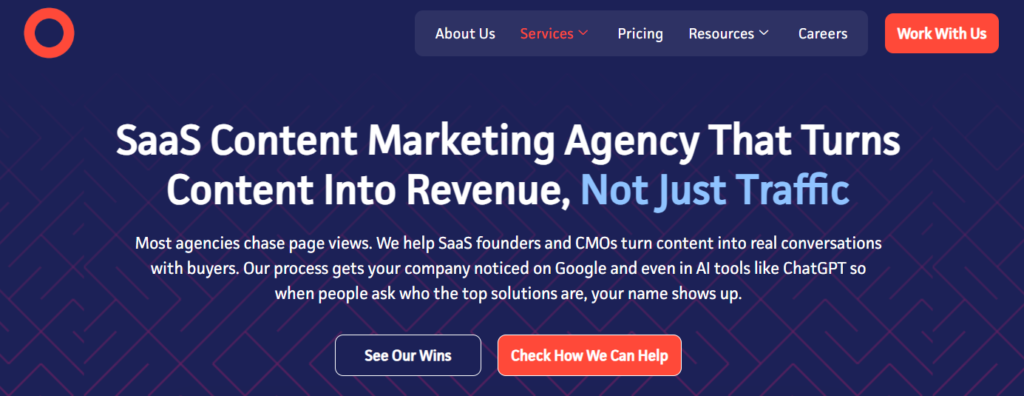
Concurate is a B2B SaaS content marketing and GEO agency for companies that have already achieved product-market fit and need content to contribute directly to revenue.
Source – Concurate
Our work is designed to generate demo requests, signups, and a qualified pipeline while improving visibility across traditional search engines and AI platforms. Rather than treating traffic as the outcome, we connect content strategy and production to the actions potential buyers take while researching and evaluating SaaS products.
Before we proceed further, let’s look at how Concurate performs against the factors mentioned above.
1. We Build Content Strategies Around Pipeline
Every engagement starts with identifying the keywords and topics your buyers search for when they are actively evaluating solutions. We prioritize comparison keywords, category keywords with buying intent, and use-case keywords that map to the specific problems your product solves.
That’s not it. For every client, we track leads generated from our content against the investment. This gives marketing leaders something concrete to show the executive team: not sessions and impressions, but actual pipeline contribution from content.
One client, Triangle IP, doubled its inbound leads within 16 months. Another newly launched patent tech saas company generated 13 leads in 2 months. We do not report on traffic as a primary metric. We report on what the traffic produced.
2. We Use An Interview-Based Writing Process
Before writing anything, we conduct detailed interviews with product managers, engineers, sales leaders, and customer success teams at each client company. These interviews provide us with specific insights, differentiators, and customer pain points that are not possible to find through Google research alone.
The result is content that contains what we call originality nuggets, unique perspectives, and product details that competitors cannot replicate because they combine storytelling with insights that require insider access. This is what sets our content apart and results in a piece that a VP of Engineering reads and trusts rather than content they skim and forget.
We have done this across complex product categories including patent management software, video conferencing platforms, physical security systems, and customer experience tools. Those interviews ensure every article reflects product knowledge that goes beyond publicly available information.
3. We Have A Structured AI Visibility Strategy
We built our GEO approach around what we call the Perfect Match Framework. It starts with defining the ideal buyer and the prompts they are likely to use when asking AI tools for recommendations. Then we benchmark where your brand currently shows up across ChatGPT, Perplexity, Claude, and Gemini, and where it does not.
From there, we audit your existing content and web presence to identify what an LLM can find and cite about your brand and what is missing. We then build a content strategy around the gaps.
We don’t stop there. We track AI visibility over time, re-running benchmarks quarterly and monitoring AI referral traffic monthly by source and by page.
You can find out all about the Perfect Match Framework in the deck below:
4. We Produce The Content End-To-End
We do not hand off keyword lists or content briefs and leave production to your team. We handle everything from keyword strategy and interviews through writing, review, and publishing. Our typical engagement includes blog posts optimized for SEO and GEO, case studies, and landing page content, all produced by our team after interviewing your internal experts.
In addition to YouTube channel management, we also handle LinkedIn content for both company brands and founders. This supports AI visibility by creating additional signals across platforms that LLMs reference when formulating recommendations.
Best For: B2B SaaS companies that have achieved product-market fit and want content to generate pipeline and improve visibility across AI tools and traditional search.
Pricing: Our monthly retainers typically range from $5,000 to $7,500, while one-time projects start at $3,500.
Clutch Rating: 5/5 (2 reviews)
2. Grow and Convert
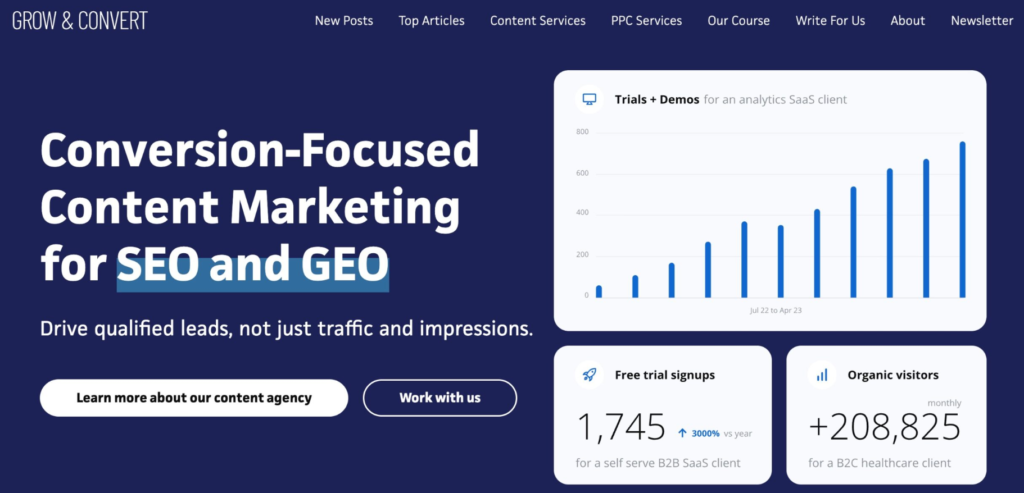
Grow and Convert is an SEO and GEO-focused content marketing agency that works with B2B SaaS companies. They are known for pain point SEO, an approach that prioritizes keywords buyers search when they are already looking for a solution over high-volume keywords that bring traffic without conversions.
Source – Grow and Convert
Instead of assigning topics to freelancers who research independently, they interview the client’s product team, subject-matter experts, and customers, and then build the article from that material.
They handle the full content operation from a single retainer, including strategy, production, SEO, link building, and paid promotion, and report on leads generated rather than traffic alone. They have also built out a GEO practice with their own tool to track brand visibility across ChatGPT, Perplexity, and AI Overviews.
Best For: B2B SaaS companies that want content tied to trials, demos, and pipeline, with lead attribution reporting rather than traffic reports.
Pricing: Starts at $10,000 per month.
Clutch Rating: 4.8/5
3. Skale
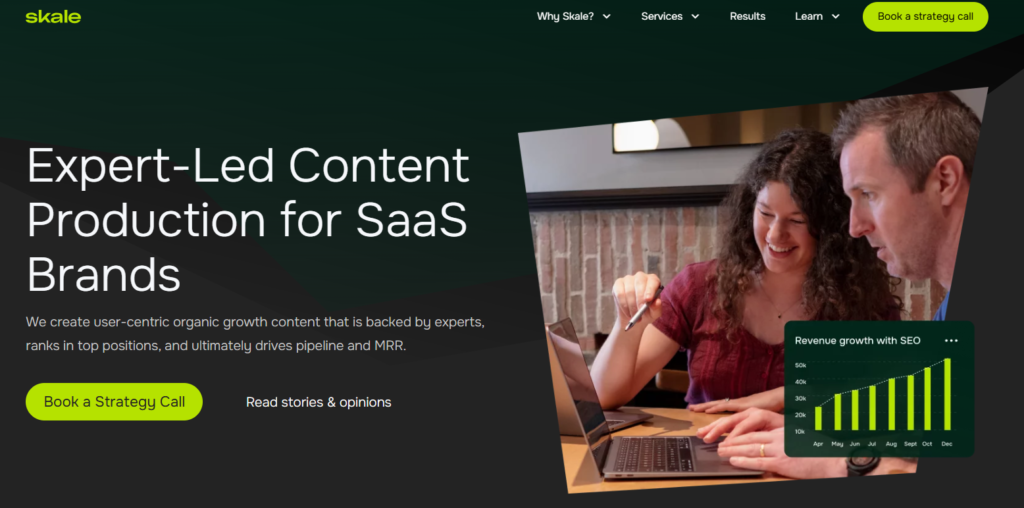
Skale is an AI search-first organic growth agency that caters to tech and SaaS brands and focuses on driving revenue. They measure success through pipeline and qualified signups rather than vanity metrics like sessions and domain authority.
Source – Skale
They work with SaaS companies and support marketing and growth leaders with revenue-focused organic growth strategies. Their services include SEO strategy and execution, content marketing, technical SEO, link building, and GEO.
Best For: Growth-stage SaaS companies seeking an SEO and GEO partner focused on pipeline, revenue, and scalable organic growth.
Pricing: Starts at around $4,000 per month.
Clutch Rating: 4.9/5 (16 reviews)
4. NoGood
NoGood is a growth marketing agency based in New York that works across SaaS, healthcare, fintech, and consumer brands. They operate as cross-functional growth squads that combine performance marketing, creative, and data expertise.
Source – NoGood
Their strength is in bringing content, paid advertising, conversion improvement, and customer communication together under one strategy. Their SEO and content services form part of a broader full-funnel growth offering.
Best For: Startups, scaleups, and established brands looking for one agency to handle content, advertising, search visibility, website performance, and customer communication.
Pricing: Their retainers start at $20,000+ per month.
Clutch Rating: 5/5 (1 review)
5. Kalungi
Kalungi is a full-service B2B SaaS marketing agency based in Washington. It provides senior marketing leadership, including an Associate Chief Marketing Officer, alongside execution. Their approach is built around the T2D3 playbook, a growth framework for scaling SaaS companies from early traction through rapid expansion.
Source – Kalungi
They provide strategic marketing leadership, in addition to just content production. A typical full-service setup includes an Associate CMO who owns the marketing priorities alongside specialists who handle content, SEO, branding, and demand generation.
Best For: B2B SaaS companies that need senior marketing leadership and a full team to handle strategy, content, SEO, branding, and demand generation.
Pricing: Starts at $50,000+ per month.
Clutch Rating: N/A
6. Refine Labs
Refine Labs is a demand generation agency that works with mid-market and enterprise B2B SaaS companies. They are known for advocating demand creation over traditional lead generation.
Source – Refine Labs
As an agency, their focus is on modernizing go-to-market strategies by helping companies move from traditional lead generation toward demand generation that reflects how buyers research and make decisions today. Their services combine demand strategy, paid media, measurement, content, and creative work.
Best For: Mid-market and enterprise B2B SaaS companies looking to modernize marketing, improve paid campaigns, and generate a more qualified pipeline.
Pricing: Starts at $20,000 per month for paid media and creative, and $31,000 per month for full-service support.
Clutch Rating: N/A
7. Omniscient Digital
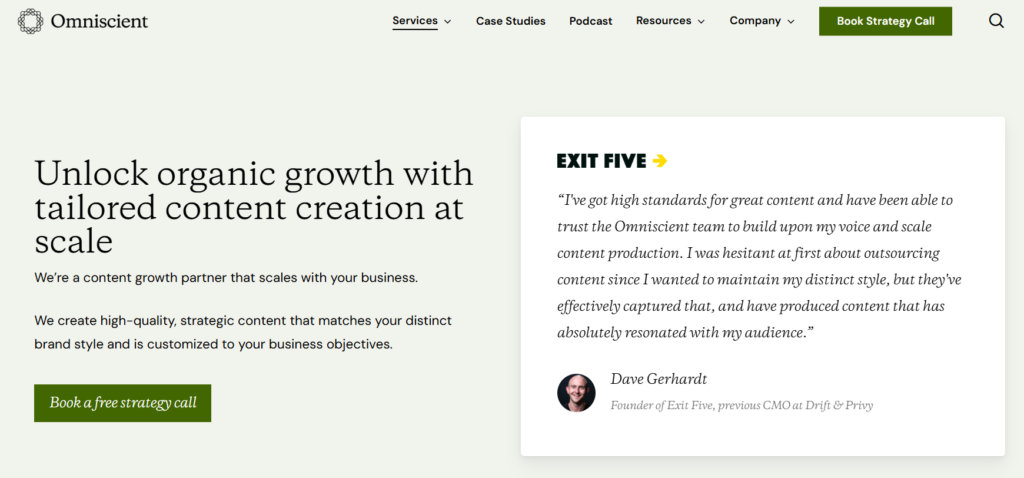
Omniscient Digital is an organic growth agency based in Texas that works primarily with B2B software companies.
Source – Omniscient Digital
Their services include SEO strategy, content production, link building, technical SEO, and GEO. As part of their content production process, they interview subject matter experts. Their approach combines content at scale with product research and expert interviews. Additionally, like any good agency, it includes brand voice alignment and custom briefs designed to make the content specific to each company.
Best For: B2B software companies that want to scale SEO, GEO, and expert-led content while keeping the work aligned with revenue goals.
Pricing: Starts at $10,000 per month.
Clutch Rating: 4.8/5 (6 reviews)
8. Single Grain
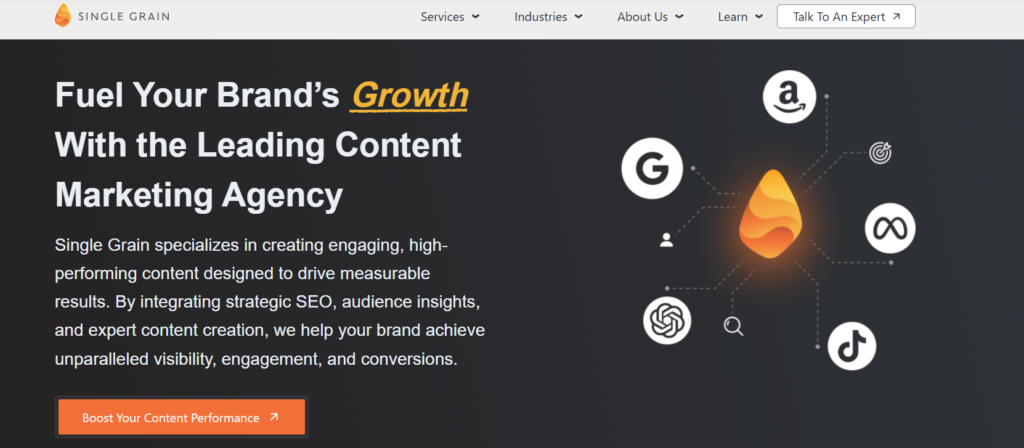
Single Grain is a full-service digital marketing agency that works across SEO, paid media, CRO, and content marketing. They are a generalist agency that serves SaaS businesses alongside other industries, such as education, ecommerce, and blockchain.
Source – Single Grain
Their approach includes AI-native marketing, AEO, SEO, paid media, content, and conversion optimization. Their content marketing services sit within a larger suite of performance marketing offerings.
Best For: Growth-stage companies and established brands looking for one agency to handle search, AI visibility, paid advertising, content, and website conversions.
Pricing: Available on request.
Clutch Rating: 4.8/5 (12 reviews)
9. Bay Leaf Digital
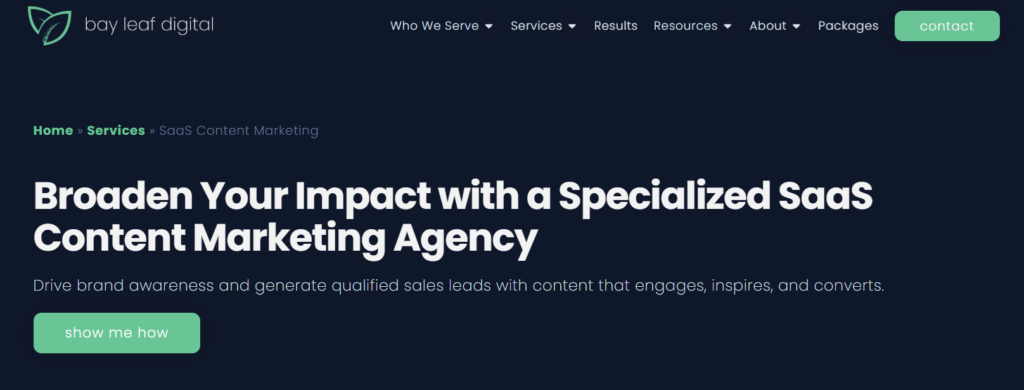
Bay Leaf Digital is a full-service B2B SaaS marketing agency based in Texas. They support SaaS businesses at various stages, from startups to enterprises, with services spanning SEO, paid media, content, analytics, and marketing automation.
Source – Bay Leaf Digital
Their content marketing process includes research, content creation, and distribution across multiple channels. It also involves performance tracking and repurposing content into formats such as videos, carousels, and infographics.
Best For: SaaS and Climate Tech companies looking for one agency to manage content, SEO, paid advertising, analytics, and marketing automation.
Pricing: Starts at $4,999 per month.
Clutch Rating: 5/5 (4 reviews)
10. SimpleTiger
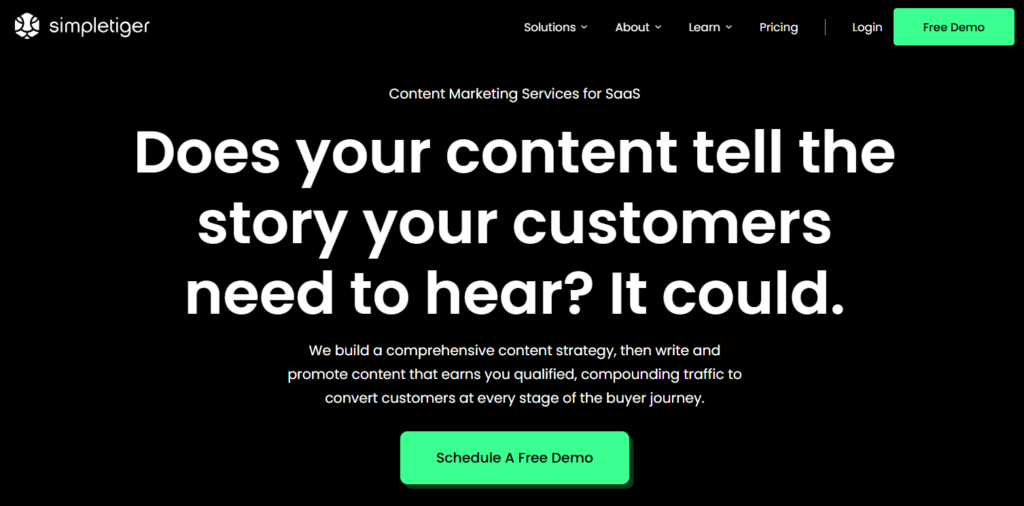
SimpleTiger is a marketing agency based in Florida that works with B2B SaaS and AI companies. They focus on speed and execution, with an emphasis on reducing the time needed to generate search visibility and pipeline.
Source – SimpleTiger
Their services include SEO, content marketing, link building, paid search, web design, and GEO. They use proprietary AI tools to accelerate their process.
Best For: SaaS and AI companies looking for one agency to manage SEO, AI search visibility, content, paid advertising, and website performance.
Pricing: Custom package pricing available on request.
Clutch Rating: 4.9/5 (31 reviews)
11. Ninja Promo
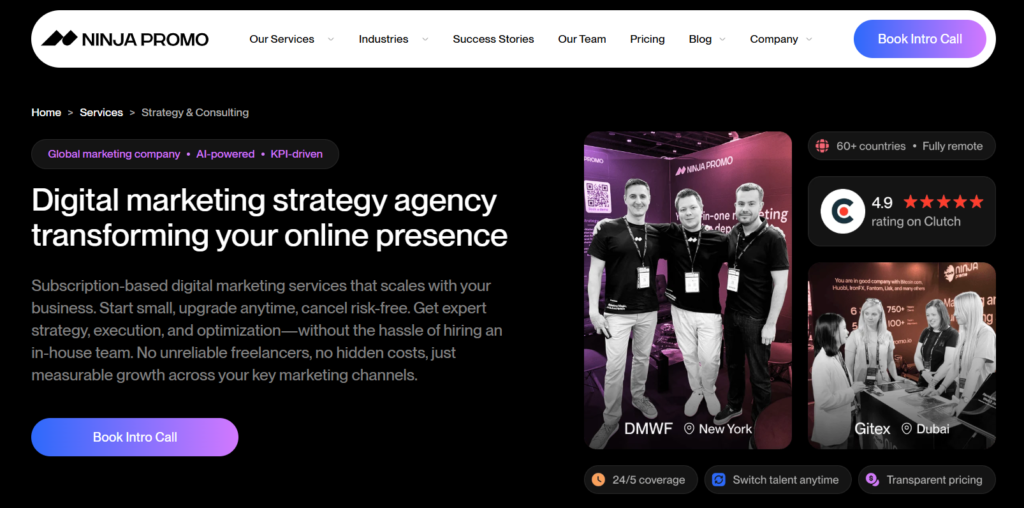
Ninja Promo is a subscription-based digital marketing agency that serves clients globally. They serve SaaS companies alongside crypto, fintech, and other industries.
Source – Ninja Promo
Their services include social media marketing, paid advertising, SEO, email marketing, web design, branding, community management, and strategy. Clients can access these services through a flexible monthly subscription that can be adjusted as their needs change.
Best For: Startups, small businesses, and established companies looking for one subscription to cover several marketing and creative services
Pricing: Starts at $3,200 per month
Clutch Rating: 4.9/5 (94 reviews)
12. Ironpaper
Ironpaper is a B2B growth agency based in New York that specializes in serving companies with complex sales cycles. Their services span demand generation, account-based marketing, content strategy, and sales support.
Source – Ironpaper
They create content for different stages of the buying process, including thought leadership, demand generation, account-based marketing, lead nurturing, and sales support.
Best For: B2B companies with long or complex sales cycles that need content to support lead generation, buyer education, and sales.
Pricing: Available on request.
Clutch Rating: N/A
13. Sōvyn
Sōvyn is a marketing and communications agency serving healthcare, health tech, biotech, life sciences, dental tech, and technology companies. It was formed after KNB Communications acquired Roketto. It brought together KNB’s experience in public relations, branding, research, and executive visibility with Roketto’s digital marketing capabilities.
Source – Sōvyn
Its services include content creation, public relations, lead generation, branding, web design and development, SEO, GEO, performance marketing, fractional Chief Marketing Officer support, and market research.
Best For: Healthcare, biotech, life sciences, and health technology companies that need both marketing and communications support.
Pricing: You can contact their team for more information.
Clutch Rating: 4.6/5 (16 reviews for Roketto)
14. Animalz
Animalz is a content marketing agency that works with software companies at different stages of growth, from companies starting to large established brands.
Source – Animalz
Their strength is in editorial quality and thought leadership content. Their process begins with understanding the client’s customers, product, industry, and go-to-market strategy.
Depending on the project, they may work with internal experts or conduct their own research. They also offer AI search optimization through SEO and AEO audits that assess visibility across Google Search, Google AI Overviews, and popular LLM-based tools.
Best For: Software companies that want research-led thought leadership, high-quality editorial content, and stronger visibility across search and AI tools
Pricing: Available on request
Clutch Rating: N/A
Now that we have had a look at the agencies that serve B2B SaaS companies like yours, it must be easier to make a choice. While you are making the decision, there are a few things you can get started on internally, too.
What B2B SaaS Companies Can Do Before Hiring A Content Marketing Agency
Before hiring a content marketing agency, get a few things in order internally. You do not need to prepare a complete content strategy or identify every content gap. That is part of the agency’s job.
However, the agency should not have to spend the first month figuring out who you sell to, why customers choose you, or who can answer product questions.
- A clear view of your ideal buyer: Define the roles, company types, problems, and situations that usually lead someone to consider your solution. Avoid broad descriptions such as “mid-market SaaS companies.” More specific buyer context helps the agency create content around real purchasing decisions.
- Common questions from sales conversations: Ask your sales and customer success teams to document the questions, objections, and comparisons they hear repeatedly. Keep them in one shared document that the agency can access. The language buyers use in these conversations often provides better content direction than keyword data alone.
- Access to product expertise: Identify the people who can explain the product, its use cases, customer challenges, and competitive differences. This may include someone from product, sales, customer success, engineering, or leadership. Make sure they can participate in interviews and review important product details.
- Relevant sales and product material: Gather customer call recordings, sales decks, product demos, case studies, competitor notes, and internal documentation. These materials give the agency useful context and reduce the need to repeatedly chase your team for information.
- A clear review process: Decide who will review the content, who has final approval, and how quickly feedback will be shared. Even a strong content program can slow down when several people provide conflicting feedback or when reviews take weeks.
These inputs help an agency understand your product and buyers faster. However, they do not replace the work required to identify the right opportunities, create the content, publish it, and measure whether it contributes to the pipeline.
A B2B SaaS company may have a strong product, but buyers may still overlook it if the brand does not appear while they are comparing vendors, researching alternatives, or asking AI tools for recommendations.
Concurate helps B2B SaaS companies close this gap. We create buyer-focused content that improves visibility across Google and AI platforms while supporting product evaluation, trust, and pipeline growth.
What’s the wait?
Ready to Strengthen Your Content Strategy? Get In Touch With Us Today
Content Marketing: Learn more about our content marketing services, including decision-stage content, programmatic SEO, and LinkedIn ghostwriting.
Generative Engine Optimization: If improving AI search visibility is a priority for your B2B SaaS company, explore our GEO services.
Get in touch directly: If you have questions or want to discuss whether Concurate is the right fit for your company, you can email nitesh.gupta@concurate.com or book a call through our calendar.
Stay ahead with smarter B2B marketing ideas. We share practical lessons, proven frameworks, and real campaign insights every week.
Frequently Asked Questions
1. How long should you work with a content marketing agency before evaluating results?
Six months is usually a reasonable initial window, but the exact timeline depends on your starting point. A company with an established website may see movement sooner than a newer brand with limited authority. During the first few months, look for early indicators such as stronger keyword coverage, improved rankings, qualified traffic, and better visibility across AI platforms. Pipeline may take longer, particularly when buyers need several months to evaluate a solution. You can judge the agency on both early progress and its contribution to business outcomes over time.
2. Should you hire a specialist content agency or a full-service marketing agency?
That depends on the problem you are trying to solve. A specialist agency may be a better fit when content, SEO, or AI visibility is your main priority. It can usually bring more depth to keyword strategy, subject matter interviews, content production, and performance measurement.
A full-service agency may make more sense when you also need paid media, branding, website development, marketing automation, or broader demand generation support. Before deciding, look at how much expertise the agency has in the specific service that matters most to you.
3. Can an agency manage content without an internal content marketing team?
Yes, an experienced agency can manage strategy, interviews, writing, editing, publishing, and performance tracking. You may not need an internal content team to oversee every step. However, the agency will still need access to people who understand the product, customers, and sales process. Someone inside the company should also coordinate interviews, review important claims, and approve the final content. This person does not need to be a content marketer. They simply need enough context and authority to keep the process moving.
Disclaimer: The information presented in this article is compiled from publicly available sources, including company websites, industry reports, and social media. All trademarks, brand names, and logos mentioned are the property of their respective owners. This article is intended for informational purposes only.