


| TL;DR: Many startups do not struggle because they are not doing marketing. They struggle because their marketing is not reaching buyers at the moment they are actually comparing solutions. Traffic may improve, content may get published, and reports may look clean, but the pipeline still depends on founder relationships or outbound. This guide covers sixteen digital marketing agencies for startups, including Concurate, Directive Consulting, and KEXINO. It also explains five reasons startup marketing often fails to create a pipeline, five questions to ask before hiring an agency, and how to choose a partner that can support long-term visibility across Google, AI search, and buyer-led discovery. |
Most B2B SaaS startups have already tried to solve marketing before they start looking for an agency.
Some hired a marketing manager or a content lead. The person was capable. They published regularly, built a content calendar, and kept the blog active. But eighteen months in, the pipeline was still running on founder relationships and outbound. The content existed; it just never reached a buyer who was actively evaluating a solution.
Others hired an agency. Traffic went up, keywords moved, and the monthly report looked clean. The sales team noticed nothing different.
The problem is not always effort. It is often the case that marketing is built for visibility, not for the moment a buyer is deciding who to shortlist. This guide looks at agencies through that lens. Before we get to the list, let’s look at why startup marketing often fails to create a pipeline.
5 Reasons Why Marketing Usually Fails B2B SaaS Startups
Most marketing failures at B2B SaaS startups are not execution failures. More often, it comes down to the decisions made before any of that work began.
Here is where it breaks down most consistently:
1. They Started With “We Need More Content” Instead Of “We Need A Pipeline From Content”
The brief that kicks off most B2B SaaS marketing programs is some version of “we need to be publishing more.” Volume becomes the measure for progress. Consistency becomes the metric.
By the time anyone asks whether the content is reaching buyers who are actively evaluating solutions, the content calendar is already full. The instinct becomes to keep publishing rather than stop and reassess.
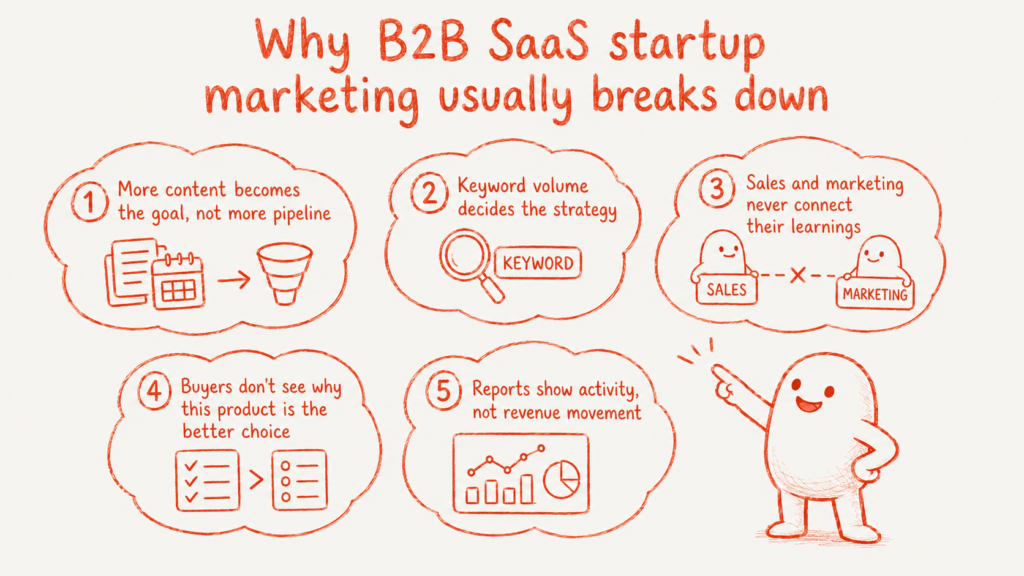
2. They Let Keyword Volume Decide the Content Strategy
Keyword research is useful. It shows how people talk about a category and where demand exists. But it cannot be the only guide.
A startup can rank for a broad term and still miss the searches that happen when buyers are actually comparing options. For example, a buyer may not search only for “incident management best practices.” They may look for “PagerDuty alternatives” or “incident management tools with Datadog integration.”
Content built only around broad, high-volume keywords often misses these decision-stage searches. That is where real pipeline opportunities are usually hiding.
3. They Kept Marketing And Sales Disconnected
The company treated content marketing and sales as separate functions. Sales ran outbound. Neither knew what the other was doing. The marketing team did not know which objections came up on sales calls every week. Sales did not know which content assets existed or how to use them.
Buyers who engaged with content got the same cold pitch as everyone else. The two motions were never compounded because they were never connected.
4. They Do Not Build Content Around Why Buyers Should Choose Them Over Alternatives
Content without a clear competitive position is just information. Many startups know their product well, but they have not clearly explained why it is the better choice for a specific buyer, use case, or situation.
That usually happens when marketing is not built from real buyer research, sales conversations, competitor insights, and customer objections. The team may know why customers choose them, but that knowledge never turns into comparison pages, alternative pages, use-case content, or decision-stage resources.
The result is generic content. It may explain what the product does, but it does not help a buyer understand why this product should move higher on the shortlist.
5. They Measured What Was Easy To Report Instead Of What Connected To Revenue
Traffic, keyword rankings, impressions, follower counts, these go up almost by default when you publish consistently. They are easy to put in a monthly report, and they look like progress.
But none of them answer the question a B2B SaaS founder actually cares about: Is our marketing reaching buyers who are evaluating our product and moving them closer to a conversation with sales?
When the reporting does not answer that question, nobody notices the disconnect until the quarterly or annual review conversations.
Understanding these gaps makes it easier to build a marketing strategy that supports revenue, not just activity. This is where the right B2B SaaS marketing agency can help.
But not every agency will be the right fit for a B2B SaaS company. So before you choose one, here are the key factors to evaluate.
5 Questions To Ask A Digital Marketing Agency Before You Sign Anything
Choosing a digital marketing agency for a B2B SaaS company involves more than reviewing case studies or clientele. The agencies that drive the pipeline understand how buyers research solutions, evaluate vendors, and move through the buying process.
Here are five questions that reveal whether an agency is built for a B2B SaaS pipeline or for something else entirely.
1. How Do They Define The ICP Before Touching Content?
One of the first things to evaluate is how the agency approaches buyer research. Not “do they have a process for understanding your audience,” as every agency will say yes. The real question is what they need to know about your buyer before they write a single piece of content.
For example, a buyer evaluating incident management software may start researching after a reliability issue, a tooling migration, or a period of rapid team growth. Those triggers matter far more than a job title alone.
The answer should include the situational triggers that cause your buyer to start looking for a solution, not just their job title and company size. If their onboarding process starts with keyword research rather than buyer research, their instinct is traffic-first.
| Question to ask: How do you define the ICP before creating content, and what buyer information do you prioritize? |
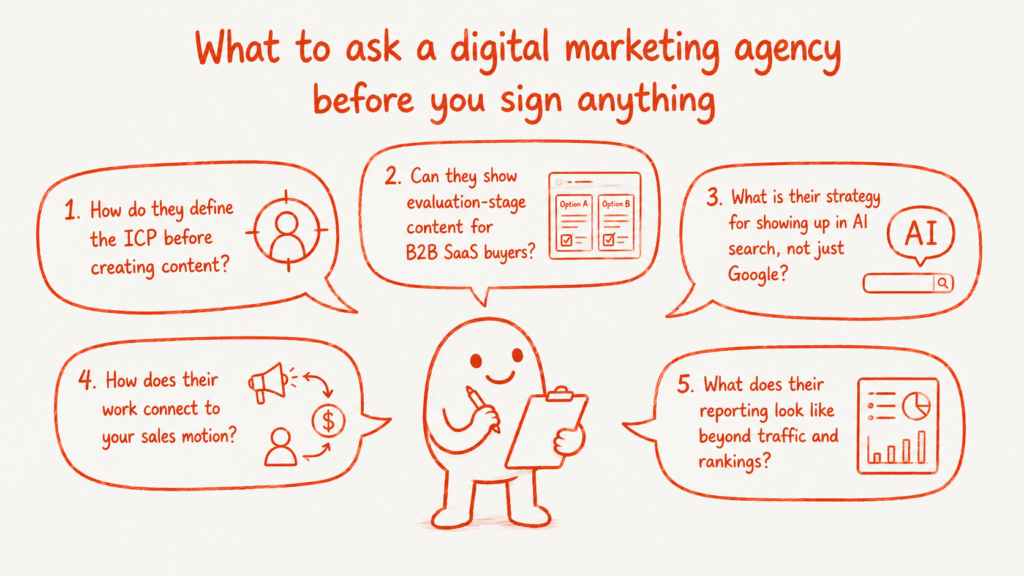
2. Can They Show You Evaluation-Stage Content They Have Built For A B2B SaaS Client?
The focus should be on content designed for buyers who are actively evaluating vendors, not blog posts or thought leadership content. That includes comparison pages, alternative pages, use-case-specific landing pages, and competitor positioning content.
For example, a buyer comparing CRM platforms is more likely to need competitor comparisons, migration guides, and implementation content than another introductory article about CRM software.
If the agency’s portfolio is dominated by educational content and awareness-stage articles, that is what they will produce for you.
| Question to ask: Can you show examples of evaluation-stage content you have created for B2B SaaS buyers? |
3. What Is Their Strategy For Showing Up In AI Search, Not Just Google?
B2B SaaS buyers increasingly use ChatGPT, Perplexity, and Google AI Overviews to research vendors before ever visiting a website. Many agencies still approach search as if Google is the only place buyers discover solutions.
If the answer focuses only on schema, structured data, and technical optimization, they are solving only part of the problem. The agencies that improve AI visibility build consideration and decision-stage content that aligns with how buyers describe their problems.
| Question to ask: How do you build AI search visibility for a B2B SaaS product? |
4. How Does Their Work Connect To Your Sales Motion Specifically?
Content and sales should not operate as separate functions. The agencies that move the pipeline for B2B SaaS startups treat sales conversations as a primary content research source.
Sales teams know what questions buyers ask before signing, what competitors come up most often, and what content would make those conversations shorter. If the agency does not consider those conversations, the content will lack nuance.
| Question to ask: How do you find out what objections come up on our sales calls, and how does that shape what you write? |
5. What Does A Three-Month Report Actually Look Like?
Ask to see one even if it’s anonymised. If it is a dashboard of organic sessions, keyword positions, and published post counts, they are reporting on production.
The stronger agencies go beyond activity metrics and show how content contributes to business outcomes. If it includes qualified lead attribution, AI citation share for target queries, and evaluation-stage content performance, they are reporting on the pipeline.
| Question to ask: What does your reporting look like, and how do you measure success beyond traffic and rankings? |
Understanding these factors makes it easier to separate agencies that drive the pipeline from those that simply produce marketing activity. With that in mind, here are some of the digital marketing agencies worth considering for startups.
Top 16 Digital Marketing Agencies For Startups To Consider In 2026
Not every agency offering digital marketing services is built for startups. In fact, very few understand how startup marketing evolves as you move from seed to Series C and beyond.
The list below brings together digital marketing agencies that consistently work with startups across different growth stages, industries, and levels of complexity. Each agency has a distinct operating model, strengths, and ideal-fit scenarios, which we break down in detail further below.
To compile this list, we prioritized agencies with clear startup expertise, well-defined operating models, and proven results through case studies, reviews, or client outcomes.
Here’s a quick look at the agencies covered in this guide:
- Concurate
- Directive Consulting
- KEXINO
- The Rubicon Agency
- Ladder
- NinjaPromo
- GrowthRocks
- Taktical Digital
- Demand Curve
- Tuff Growth
- O8
- Azarian Growth Agency
- Transcend Digital
- Growth Division
- LaunchSquad
- SmartSites
Let’s look at each of these digital marketing agencies for startups one by one, with clear guidance on who they are best for, what they actually do well, and when they make sense to hire.
1. Concurate
At Concurate, we believe in a simple but often ignored truth: visibility only matters if it reaches buyers at the moment they are evaluating solutions.
Source – Concurate
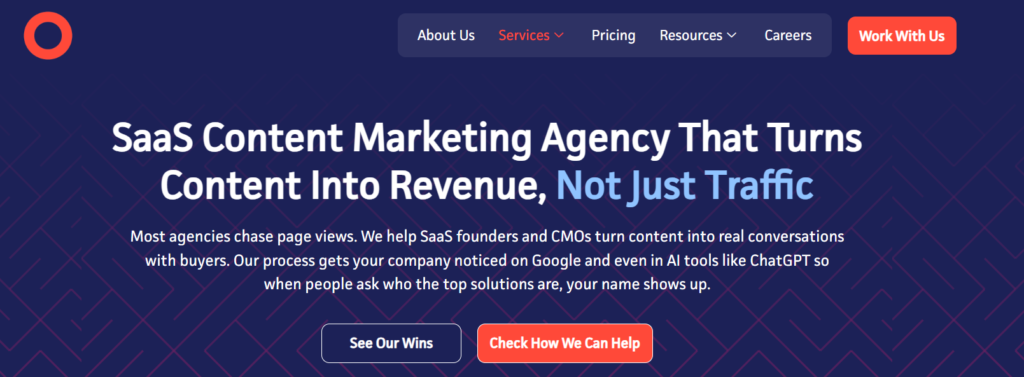
As a B2B digital marketing agency for startups, we focus on building long-term, compounding search visibility that works across modern discovery surfaces, not just traditional Google rankings. This includes Google Search, Google AI Overviews, and generative and answer engines such as ChatGPT, Perplexity, and Gemini.
The outcome is durable visibility across the entire buyer journey, especially in categories where buying decisions are complex, technical, and high-stakes.
We Are Built For How Startups Are Discovered Today
You see, search behavior has changed. Buyers no longer rely only on Google. They research across AI surfaces such as ChatGPT, Perplexity, Gemini, and more before ever speaking to a vendor.
The work we do sits at the intersection of search engine optimization and generative engine optimization, helping startups build visibility across multiple channels.
Whether your buyer searches for options across your category, domain, or geography, our content strategy ensures your brand shows up consistently, with authority, and in context.
Results-Driven Execution, Not Templated SEO
Concurate operates as a boutique agency. So there are no recycled templates or volume-first content plays. Every engagement starts with understanding the client’s:
- Growth stage
- Sales motion
- Buyer personas
- Competitive landscape
- Technical depth of the product
From there, we build full content ecosystems, including strategy for LinkedIn, YouTube, blogs, landing pages, and more.
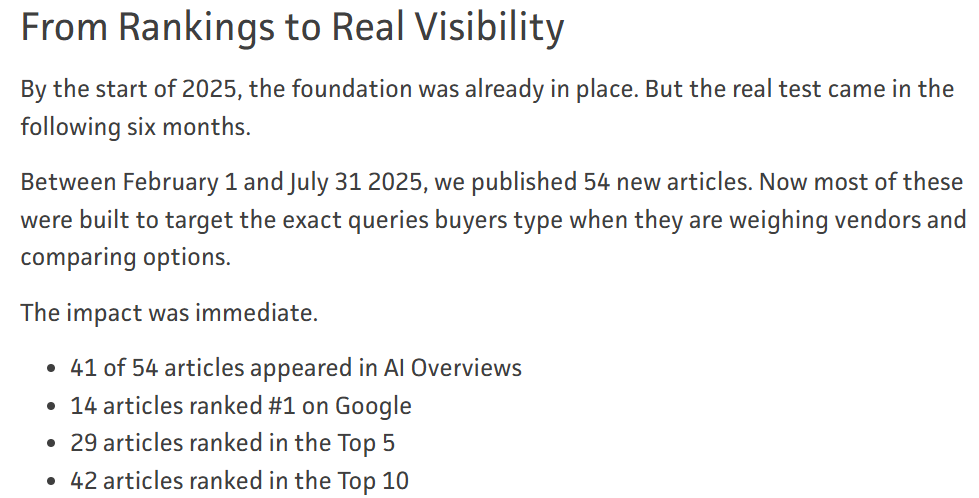
Capturing enterprise IT demand through buyer-stage content
For an enterprise IT services client, we focused on consideration- and decision-stage content mapped directly to service offerings. Over six months, impressions grew from 65K to 449K, with more than 100 qualified leads generated in the same period.
Source – Concurate
The content surfaced not only in Google Search but also across AI Overviews and generative engines, reaching buyers actively evaluating vendors rather than early-stage browsers.
Owning High-Intent, Complex Niches
For another patent-tech startup, we built a structured content cluster around patent drawing requirements across major patent offices worldwide. These queries have modest volume but extremely high intent.
Patent rules are fragmented across dense manuals, outdated PDFs, and jurisdiction-specific documents, often defaulting to local language rules in case of conflict.
We simplified this complexity into clear, jurisdiction-specific guides optimized for both SEO and generative discovery.
The result was visibility across Google Search and AI engines for 50–60% of targeted jurisdictions, helping the client dominate a niche that directly influences purchasing decisions.
Programmatic SEO Done With Intent, Not Shortcuts
We have multiple strategies in our arsenal, programmatic SEO being one of them.
For instance, for a network training provider targeting global visibility, we created over 70 GEO-specific landing pages from a single framework, carefully adapting language, examples, and positioning by region. That is, the landing page for one city did not read similarly to that of another.
This approach delivered:
- #1 rankings in 9 key markets
- First-page visibility in 33 locations
- A high-value enterprise lead from a UK-based company with over 60,000 employees
The same programmatic methodology has been applied to blog ecosystems for SaaS and compliance-driven startups, generating qualified leads within the first 60 days.
This was just a quick snapshot. Below is the complete list of services we offer.
Services Offered By Concurate For Startups Across All Stages
Concurate supports startups across the full spectrum of search-led growth, including:
- Generative Engine Optimization
- Answer Engine Optimization
- Programmatic SEO
- B2B demand generation
- Lead generation
- Enterprise SEO
- International SEO
- Ecommerce SEO
- Content-led authority building for complex domains
Our breadth of services allows us to support startups across even complex domains such as cybersecurity, enterprise IT, patent-tech, SaaS, and other technically dense categories.
Who Concurate Is best For
- Seed-stage startups building foundational visibility
- Series A and B companies looking to turn content into a reliable pipeline
- Series C and growth-stage teams scaling across markets and geographies
- Startups in complex or technical niches such as cybersecurity, enterprise software, or patent-tech
- Teams that want visibility not just in Google, but across AI and conversational search engines
- Companies focused on building long-term inbound assets rather than short-term campaigns
Pricing
Our monthly retainers typically range from $5,000 to $7,000, with project-based engagements starting at approximately $3,500.
2. Directive Consulting
Directive is built for startups that are past “trying things” and ready to run marketing like a revenue function. Their entire approach revolves around customer generation.

Source – Directive
Directive operates as a consolidated growth team covering research, paid media, SEO, CRO, and reporting under one operating model.
This offering works well for B2B startups that already understand who they sell to and need disciplined execution tied to the pipeline. Directive’s structure favors speed, accountability, and repeatable systems over experimentation for experimentation’s sake.
Notable clients: Gong, ZoomInfo, Varonis, Arctic Wolf, Kaseya, DataStax
Best for:
- Series A to early Series C B2B startups
- Companies with a defined ICP and sales-led motion
- Teams that need pipeline clarity more than brand storytelling
Pricing: Their Startup package starts at $6,500 per month
3. KEXINO
KEXINO works with startups and small businesses that need marketing to clarify who they are before trying to scale demand. Their work leans heavily into differentiation, messaging, and trust-building rather than aggressive growth loops.
Much of their approach starts with diagnosis. This includes understanding existing customers, sharpening positioning, and aligning marketing with how the business actually sells.

Source – Kexino
They combine branding, content, SEO, CRO, and lead generation, but their emphasis is on relevance and credibility over speed. KEXINO’s size and operating style suggest a hands-on partnership model, suited to teams that want close collaboration and marketing that supports long-term visibility, not short-term spikes.
Notable clients: DQ Technologies, Bambooloo, and other small and mid-sized businesses across the US and Europe
Best for
- Bootstrapped or early funded startups
- Small teams refining positioning and messaging
- Businesses prioritizing credibility and clarity over rapid scale
Pricing: Not publicly disclosed
4. The Rubicon Agency
The Rubicon Agency presents itself as a specialist technology marketing agency focused on supporting startups across different funding stages.
Their website consistently frames marketing as something that must change as a company moves from pre-seed through later rounds, rather than a fixed operating model.
Source – Rubicon
The agency emphasizes brand strategy, proposition development, thought leadership, sales enablement, and demand programs designed to support both customer acquisition and investor expectations.
Rubicon positions its work around adapting marketing frameworks to company maturity, particularly for B2B technology businesses with complex products and longer buying cycles.
Notable clients: Prevedere, SmartHarvest, WorkBuzz, Nextira
Pricing: Not publicly disclosed
5. Ladder
Ladder operates on the belief that static scopes break as markets shift. Their work centers on adaptive growth systems that evolve month to month based on performance, priorities, and channel behavior.

Source – Ladder
Instead of locking clients into fixed plans, Ladder flexes strategy, creative, and execution continuously across acquisition, conversion, and retention. A core part of this approach is heavy experimentation, rapid creative iteration, and the use of internal systems like LadderAI and Nucleus to guide decision-making.
This model suits teams that value structured testing and velocity over long planning cycles, and that are comfortable operating in constant optimization mode rather than linear campaigns.
Notable clients: Booking.com, Monzo, Nestlé, IDEO, Criteo, GoTenna
Best for
- Growth-stage startups with a budget for sustained experimentation
- Teams optimizing multiple paid channels simultaneously
- Companies prioritizing performance, creativity, and testing velocity
Pricing: Not publicly disclosed
6. NinjaPromo
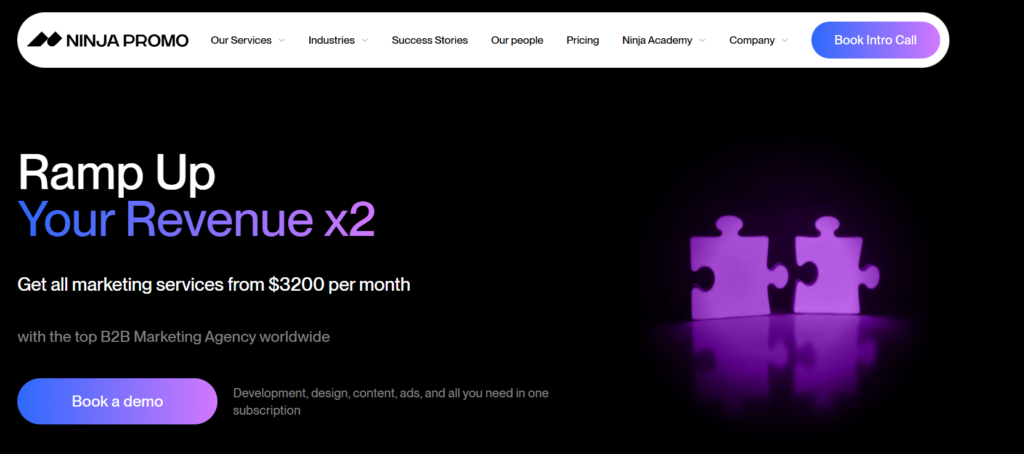
NinjaPromo presents itself as a subscription-based digital marketing agency offering a wide range of marketing and creative services under a single monthly plan.
Their model emphasizes speed, volume, and operational flexibility, with same-day task starts and access to a large internal team across design, content, paid media, SEO, development, and analytics.
Source – Ninja Promo
The agency positions its offering as an alternative to traditional retainers, highlighting predictable pricing and on-demand execution.
Notable clients: Zoomex, 8×8, Revolut, Babbel
Best for
- Startups looking for a subscription-based marketing model with predictable monthly pricing
- Teams that need fast execution across many marketing tasks, rather than deep specialization in one channel
Pricing: Their pricing plans start at $3,200 per month and extend based on the subscriptions you choose.
7. GrowthRocks
GrowthRocks presents itself as a growth hacking marketing agency centered on data-driven experimentation across the full customer lifecycle. Their website consistently frames growth as a process of rapid testing and optimization rather than channel-led execution.
Source – Growth Rocks
Much of their work is organized around acquisition, activation, retention, and revenue, with an emphasis on identifying leverage points through experimentation and measurement.
GrowthRocks positions paid advertising as a supporting tactic and highlights frameworks such as product-market fit validation, onboarding optimization, retention analysis, and conversion improvement.
Their services span consulting, training, and execution, reflecting a focus on both hands-on growth work and transferring growth methodology to internal teams.
Notable clients: FedEx, Volvo, Nokia, Blue Air, Talent Garden, Moveo.ai
Best for
- Startups focused on experimentation-led growth rather than fixed channel plans
- Teams working toward product-market fit or early traction
- Companies looking to improve activation, retention, and revenue mechanics
Pricing: Their pricing is not publicly disclosed.
8. Taktical Digital
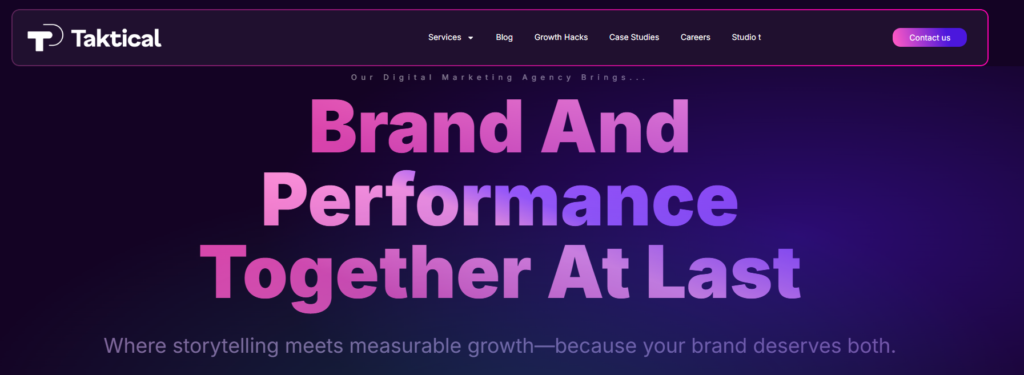
Taktical Digital presents itself as a performance-focused digital marketing agency with a strong emphasis on paid media, SEO, and conversion optimization.
Their website highlights channel execution across paid social, paid search, ecommerce advertising, Amazon ads, content, and landing page optimization, with services designed to support both direct-to-consumer and B2B brands.
Source – Taktical Digital
Taktical’s positioning centers on fast-moving execution, ongoing optimization, and hands-on account management rather than fixed campaign delivery. The agency also emphasizes creative production alongside media buying, framing its work around continuous testing and iteration across channels as markets and priorities shift.
Notable clients: WORX, TAOS Footwear, Do Amore, Fahlo, Aputure
Best for
- Startups and growing brands investing heavily in paid acquisition
- Teams looking for ongoing channel optimization rather than one-off campaigns
- Companies operating across ecommerce, B2B, or hybrid revenue models
Pricing: Not publicly disclosed
9. Demand Curve
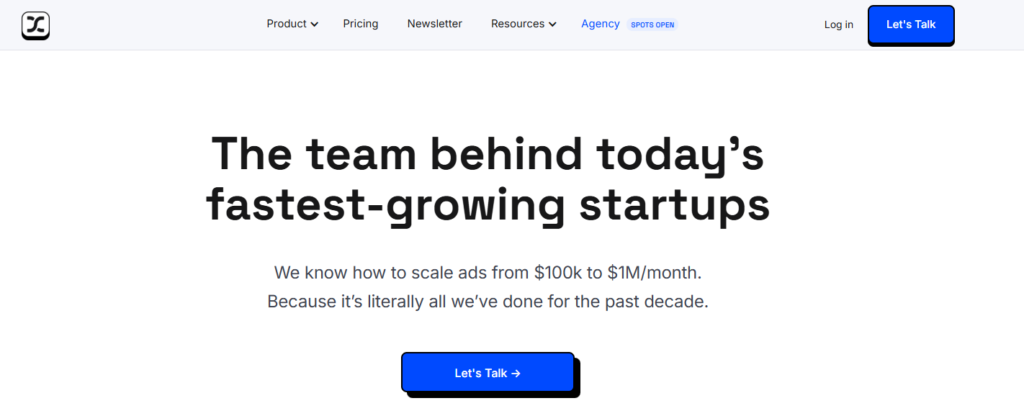
Demand Curve operates a growth-focused agency offering centered on paid acquisition and conversion performance for startups.
Source – Demand Curve
The agency positions itself around senior-led execution, with campaign strategy, media buying, creative testing, landing page optimization, and reporting managed end-to-end by experienced operators rather than layered account teams.
Its model emphasizes full-funnel paid growth systems, direct founder access, and asynchronous communication over traditional meeting-heavy agency workflows.
Notable clients: Envoy, Clearbit, Segment, Zendesk, Perfect Keto, Outschool
Best for
- Startups that want to build and run growth internally, rather than fully outsource
- Founders looking for structured, execution-oriented growth education
- Early to mid-stage teams combining learning with selective agency support
Pricing: Their pricing starts at $7,500 per month, positioned as a fixed monthly retainer for paid acquisition, creative production, CRO, and reporting.
10. Tuff Growth
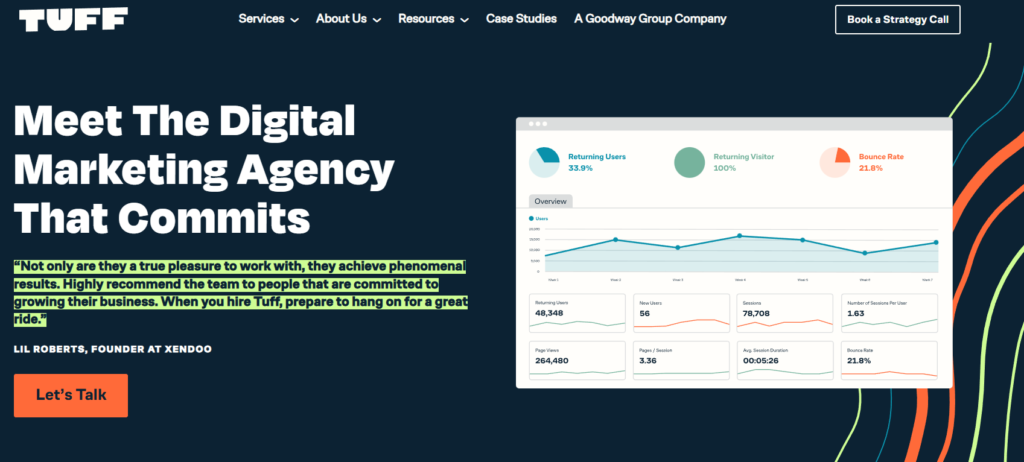
Tuff presents itself as a growth marketing agency built for early-stage startups and small businesses that need structure, focus, and experimentation to find traction.
Their positioning centers on helping teams move from scattered tactics to a clear growth roadmap supported by ongoing execution.
Source – Tuff
Tuff operates using a defined growth marketing framework that prioritizes learning, testing, measurement, and iteration across channels such as paid media, SEO, CRO, content, email, and analytics.
Their operating model highlights close collaboration, frequent communication, and functioning as an extension of the client’s internal team, particularly for companies that are not yet ready to hire full in-house growth roles.
Notable clients: Hippo, Thnks, Team Bootcamp, Xendoo
Best for
- Early-stage startups and small businesses building their first growth engine
- Teams running experiments to identify scalable acquisition and conversion channels
- Founders looking for a roadmap plus hands-on execution before hiring internally
Pricing: Not publicly disclosed
11. O8
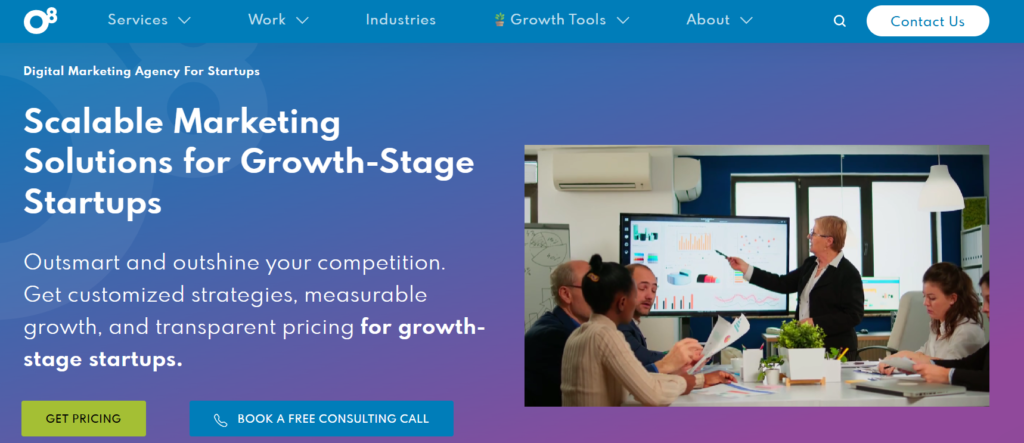
O8 positions itself as a digital marketing agency built specifically for growth-stage startups that need structured, scalable marketing without committing to large in-house teams.
Their messaging consistently frames marketing challenges as a mix of strategy gaps, execution constraints, and technical complexity rather than channel-specific problems.
Source – O8
A core part of their model is flexible, month-to-month engagement, allowing startups to assemble fractional teams across marketing, technology, and sales roles as they scale.
The agency emphasizes transparency in pricing and metrics, positioning itself as an extension of internal teams rather than a traditional outsourced vendor.
O8 also highlights technical depth, including web development, analytics infrastructure, and automation, alongside growth strategy and demand generation.
Notable clients: University of Minnesota, Cornell University, Estée Lauder, Medsource Labs, VITAL WorkLife, Mednition
Best for
- Growth-stage startups needing fractional marketing and technical support
- Teams balancing marketing execution with web, UX, and automation needs
- Founders looking for flexibility without long-term contracts or full-time hires
Pricing: Entry offerings range from free diagnostic roadmaps to project-based packages starting around $500–$2,500, with custom monthly retainers and on-demand expertise available. Their full-service pricing varies based on scope and team composition.
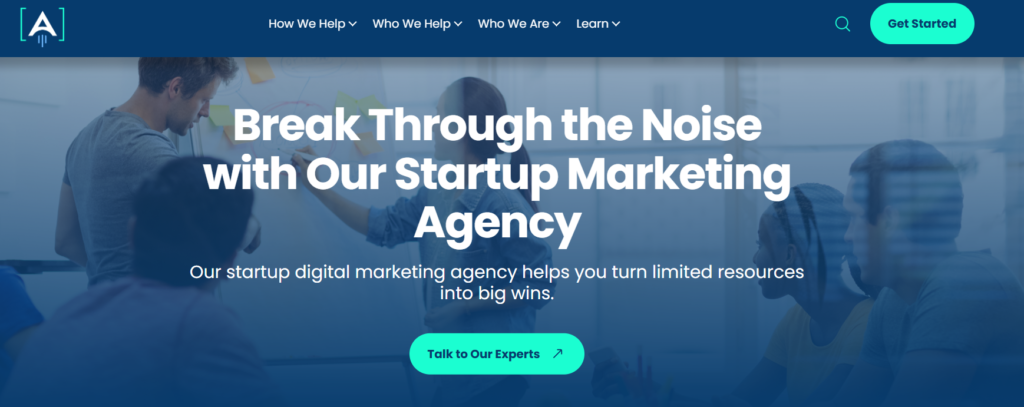
12. Azarian Growth Agency
Azarian Growth Agency presents itself as a startup-focused digital marketing agency designed to help early and growth-stage companies compete in crowded markets with limited resources.
Its positioning centers on helping startups stand out through structured, data-driven marketing rather than ad hoc experimentation or generic channel execution.
Source – Azarian
They operate as a full-service startup marketing partner, combining strategy, execution, and optimization across SEO, paid search, content marketing, social media, CRO, and email marketing. The agency emphasizes tailored growth strategies over one-size-fits-all frameworks, framing its work around customer understanding, channel selection, and continuous testing and optimization.
Notable clients: Camino Financial, Orders, Goodhood
Best for
- Early to growth-stage startups competing in crowded markets
- Teams looking for multi-channel execution under a single agency
- Founders prioritizing data-driven decision-making and measurable growth
Pricing: Their pricing is not publicly disclosed.
13. Transcend Digital
Transcend Digital positions itself as a digital marketing agency focused on startups and growth-stage businesses that need measurable business outcomes rather than surface-level marketing activity. Their messaging consistently emphasizes data, execution discipline, and close collaboration with client teams.

Source – Transcend Digital
The agency operates as an embedded marketing partner, integrating its specialists directly with internal teams to support strategy, execution, and delivery.
Their services span marketing for startups, email marketing, conversion optimization, and broader digital transformation initiatives, with outcomes positioned around MQL growth, call volume, adoption, and rollout execution.
Notable clients: Marlo, Fixodo, Neurun, Hed.
Best for
- Startups and growth-stage companies focused on measurable revenue and lead outcomes
- Teams that want an agency embedded closely with internal stakeholders
- Businesses prioritizing execution reliability, ROI, and retention over experimentation-heavy growth models
Pricing: Their pricing is not publicly disclosed.
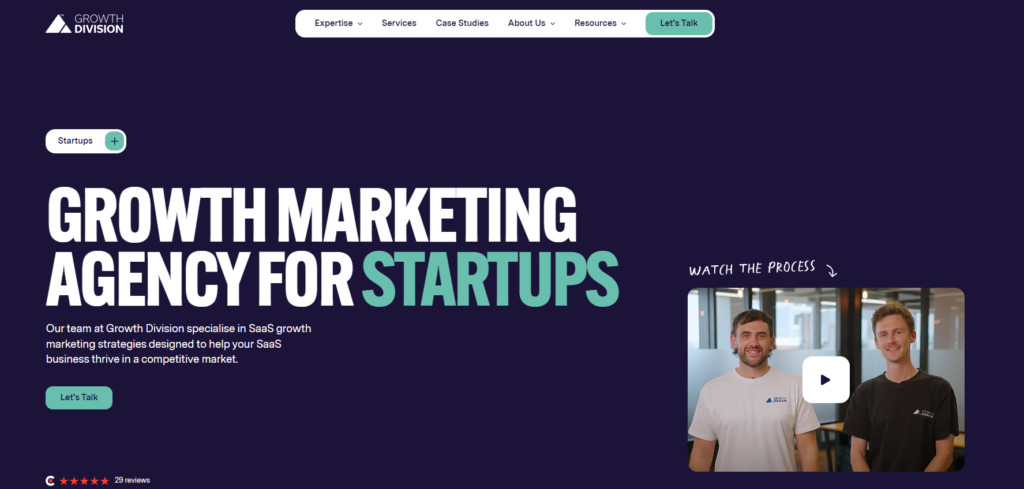
14. Growth Division
Growth Division positions itself as a growth marketing agency built specifically for startups, with a strong focus on SaaS and technology-led businesses.
Source – Growth Division
The agency emphasizes go-to-market strategy, martech stack setup, and multi-channel validation as core parts of its engagement model. Growth Division also highlights its role in helping startups move from early traction to more predictable demand by testing and validating multiple channels simultaneously.
A notable aspect of Growth Division’s positioning is its inclusion of Fractional CMO support alongside growth marketing execution. This indicates a focus on companies that need senior marketing leadership to define direction, align teams, and build internal capability, not just run campaigns.
Notable clients: Weavr, Retain International, Breezy.
Best for
- Early to mid-stage SaaS startups building or refining go-to-market strategy
- Teams validating multiple acquisition channels before scaling aggressively
- Startups seeking fractional CMO support, combined with hands-on growth marketing
Pricing: Their pricing is not publicly disclosed.
15. LaunchSquad
LaunchSquad positions itself as a technology-focused communications and storytelling agency rather than a traditional digital marketing or performance-led firm.
Its website consistently frames its work around narrative development, media engagement, and long-term brand building for companies creating new categories or shaping emerging industries.

Source – LaunchSquad
The agency emphasizes story development as the core of its offering, supported by strategy, content creation, media relations, and campaign ideation. LaunchSquad presents its role as helping companies uncover angles, define positioning, and communicate complex innovations in ways that resonate culturally and commercially.
Rather than focusing on channel execution or short-term acquisition, the site highlights relevance, earned media, thought leadership, and narrative clarity as primary growth levers.
The agency positions itself as a long-term strategic partner, particularly for teams building future-facing products that require careful messaging and credibility-building over time.
Notable clients: Ibotta, Precision Neuroscience, Anyscale, iHeartMedia, Zipline, Climeworks
Best for
- Startups and scaleups building new categories or complex technologies
- Companies prioritizing narrative, positioning, and earned media over paid acquisition
- Founders preparing for major moments such as launches, funding rounds, or IPOs
- Teams in AI, deep tech, healthcare, climate, or enterprise software requiring credibility-led storytelling
Pricing: Their pricing plans are not publicly disclosed.
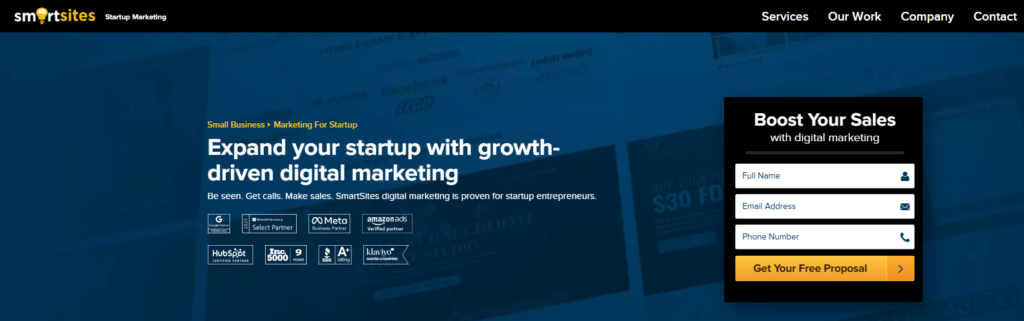
16. SmartSites
SmartSites positions itself as a full-service digital marketing agency focused on helping startups and small businesses generate visibility, leads, and sales through execution-led digital channels.
Its startup offering is framed around foundational marketing needs such as website development, SEO, and paid acquisition rather than experimental or systems-driven growth models.
Source – SmartSites
The agency emphasizes website-first digital presence, treating site design and development as the base layer for marketing performance.
Notable clients: Spurbe, Zane Productions, Chess Max Academy, Event Source Tickets.
Best for
- Early-stage startups and small businesses building their first digital presence
- Founders looking for bundled website, SEO, and PPC execution
- Teams prioritizing lead generation and traffic growth over experimentation-led growth
- Businesses seeking a widely reviewed, certification-heavy agency partner
Pricing: They do not disclose their pricing on the website.
That brings our list of agencies to an end. Each have their own edge. Some are stronger for paid acquisition, whereas others are better for PR, experimentation, growth strategy, or full-service execution.
But if your biggest challenge is that buyers do not find you when they are actively comparing solutions, you need more than scattered campaigns. You need content that explains your category, your use cases, and your differentiators clearly enough for buyers, search engines, and AI tools to trust.
That is where Concurate can help.
Want Your Startup to Show Up When Buyers Are Comparing Options?
At Concurate, we help startups build expert-led content that supports visibility, trust, and pipeline. This includes SEO content, evaluation-stage content, comparison pages, use-case pages, LinkedIn content, and content built for AI-driven discovery.
Our Content Marketing Services: If you need support creating content that helps buyers understand your product and move closer to a sales conversation, explore our content marketing services here.
Our GEO Services: If you also want your startup to appear more often across ChatGPT, Perplexity, Gemini, Google AI Overviews, and other AI search experiences, explore our GEO services here.
Want smarter marketing ideas in your inbox each week? We share practical lessons, useful frameworks, and real campaign insights you won’t find in generic marketing newsletters.
Frequently asked questions
1. How do I know if my startup is ready to hire a digital marketing agency?
You’re ready when growth feels urgent but unfocused. If you have a clear product, a defined buyer, and some proof of demand, but lack the time or experience to build repeatable growth systems, an agency makes sense.
2. Should startups hire an agency or build an in-house marketing team first?
Most startups should start with an agency. Hiring in-house too early locks you into one skill set. Agencies bring senior, cross-functional expertise immediately. Once channels are proven and repeatable, in-house hires make sense to scale what’s already working.
3. Which startup stage benefits most from working with a digital marketing agency?
Agencies are most effective from late seed through Series B. At this stage, startups need structure, speed, and experimentation without long hiring cycles. Agencies help validate channels early and scale them later without committing to full-time overhead.
4. Is a digital marketing agency worth it for seed-stage startups?
Yes, if expectations are right. Seed-stage startups should use agencies for clarity, positioning, and early demand signals, not massive lead volume. The goal is learning fast and building foundations, not overnight growth.
5. Are digital marketing agencies suitable for technical or niche startups?
The right ones are. Technical startups need agencies that understand complexity, not generic playbooks. Niche markets often have lower volume but higher intent. Agencies with domain expertise can turn that into an outsized impact.
6. Can a single agency handle SEO, content, and demand generation together?
Yes, and it’s often better when they do. When SEO, content, and demand generation are connected, messaging stays consistent, and attribution improves. The key is to evaluate whether the agency operates with a unified strategy.
7. How much should startups realistically budget for a digital marketing agency?
Most startups spend between $3,000 and $7,500 per month. Lower budgets work for focused projects. Higher budgets support ongoing growth systems.
8. Is it better to start with a project or a monthly retainer?
You can start with a project if you need clarity or proof. Move to a retainer once direction is clear and momentum matters. Retainers work best when you’re building compounding assets, not testing isolated ideas.
9. What are the common mistakes startups make when hiring agencies?
Hiring too early, chasing tactics instead of strategy, expecting instant results, or choosing based on brand name alone. The biggest mistake is not knowing what success looks like before signing the contract.
Disclaimer: The information presented in this article is compiled from publicly available sources, including company websites, industry reports, and social media. All trademarks, brand names, and logos mentioned are the property of their respective owners. This article is intended for informational purposes only.