

| TL;DR: Programmatic SEO helps SaaS and B2B brands capture long-tail demand at scale with structured, intent-driven pages. To help you find the right partner for this, the guide covers ten programmatic SEO agencies, including Concurate, Omniscient Digital, and Omnius. It also explains six principles for implementing programmatic SEO effectively, from using clean data and human input to connecting scaled content with leads and revenue. |
We have built programmatic SEO campaigns for B2B and SaaS companies across various domains at this point, ranging from Enterprise IT and IP Tech to education.
One thing we have learned is that programmatic SEO does not mean creating thousands of pages. Sometimes the right opportunity is 20 highly specific pages. Sometimes it is 200.
The number is not what makes the campaign work. Each page still needs the right context, research, and information to answer what someone is actually searching for. Otherwise, you are simply scaling thin, repetitive content.
That approach has become even riskier after Google’s May 2026 core update. A poorly planned campaign, especially one scaled carelessly with AI tools, can hurt your rankings instead of improving them.
Moreover, as AI visibility takes center stage, the bar is even higher. Your pages now need to help your brand appear not only on Google, but also when buyers search on ChatGPT, Perplexity, Gemini, Copilot, and other AI tools.
So, how do you choose an agency that can get this right?
Below, we have listed the programmatic SEO agencies worth considering in 2026 that can help you make it happen. But first, let’s look at the factors to consider when evaluating them.
4 Factors To Consider When Evaluating Programmatic SEO Agencies
Most programmatic SEO agencies will show you page counts, traffic graphs, and client logos. But those things do not tell you how well the agency will execute the program on your website.
The following four factors will give you a clearer picture of what the agency will own, how it will maintain page quality, and what happens after the pages are published.
Factor 1: Do They Build The Pages Or Just Hand You The Plan?
Some agencies stop after delivering the keyword map, dataset, and template brief. Your team is then expected to build the template, connect it to the CMS, implement internal linking, and manage indexation.
Before choosing an agency, clarify exactly what it will execute and what will still fall on your internal team. A lower agency fee may not mean lower overall costs if your engineers have to complete most of the implementation.
| Question to ask: What exactly is included in your programmatic SEO engagement? Is the implementation included in the quoted price? |
Factor 2: What Makes One Page Different From Another?
A shared template is expected in programmatic SEO. The real question is what changes from one page to the next.
Each page should include some information specific to the location, region, industry, product, or jurisdiction it targets. Otherwise, the agency is only swapping a few variables inside the same copy.
Ask the agency to show you two pages built from the same template and explain what unique information was added to each one.
| Question to ask: Can you show us two pages created from the same template and explain what location-specific, region-specific, or jurisdiction-specific information makes each page different? |
Factor 3: What Is Their Plan for Pages That Do Not Rank?
Not every page in a programmatic SEO campaign will perform equally well. Some may rank quickly, while others may struggle to get indexed or fail to gain visibility even after several months.
The agency should have a clear process for diagnosing why a page is underperforming. That may include checking indexation, strengthening internal links, improving page-specific information, revisiting search intent, consolidating overlapping pages, or pruning pages that have no realistic path to rank.
What matters is that the pages are reviewed and improved after launch rather than left untouched once they are published.
| Question to ask: How do you evaluate pages that do not rank, and what steps do you take next? |
Factor 4: Can They Build Pages That Help Your Brand Get Recommended In AI Search?
Buyers now search for companies and solutions through ChatGPT, Perplexity, Gemini, Google AI Mode, and other AI tools. Your programmatic pages therefore need to be useful enough to earn citations, not simply optimized for a keyword.
Ask the agency whether its programmatic SEO campaigns have helped clients appear in AI-generated answers for relevant searches. Look for evidence of the brand being recommended, not just the page being cited as a source.
| Question to ask: Can you show us a programmatic SEO campaign that helped a client’s brand appear or get recommended in AI-generated answers for relevant searches? |
Now that you know what to evaluate, let’s look at the agencies that are doing programmatic SEO well.
Top 10 Programmatic SEO Agencies For B2B SaaS In 2026
Each of the agencies listed below takes a different approach to programmatic SEO. Some focus more on strategy and content, while others are equipped to run larger-scale programmatic SEO campaigns.
On that note, here are 10 agencies worth considering in 2026.
- Concurate
- Omniscient Digital
- Omnius
- Conversion Factory
- Single Grain
- Prosperity Media
- Rock The Rankings
- BRIX Agency
- Stramasa
- Flying Cat
Let’s get started with the first company on the list.
1. Concurate
At Concurate, we see programmatic SEO as more than just a traffic play. It is one of the strongest tools to increase visibility, capture demand, and build a reliable pipeline.
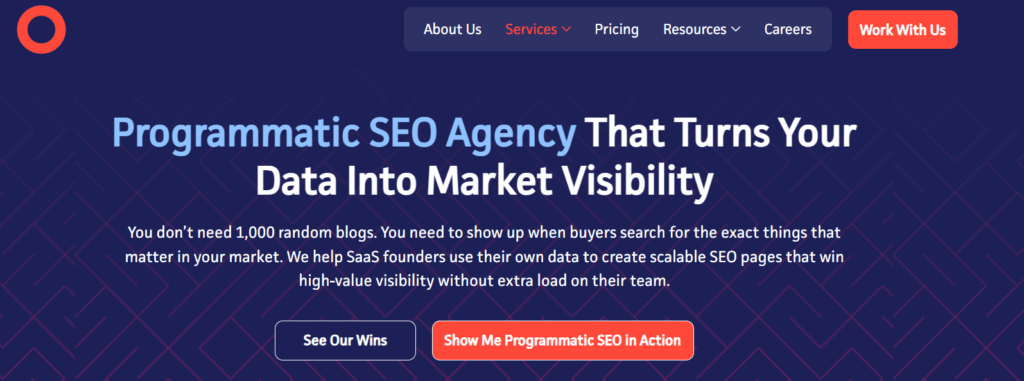
Source – Concurate
As a boutique content marketing agency, we do not rely on templates. Each content strategy is tailored to a client’s industry, funnel stage, and audience. With the right strategy, we get our clients top positions in Google Search and also on AI surfaces such as ChatGPT, Gemini, and Perplexity. Not to mention consistent leads.
Here are a couple of instances of how we leveraged programmatic SEO for our clients.
Going Global with Programmatic Landing Pages
For a leading network training provider, visibility across geographies was vital. They wanted to come across buyers when they searched for the specific OEM training in dozens of cities worldwide.
We went ahead with a programmatic SEO strategy. We created over 70 geo-targeted landing pages from a single structure, carefully adapting tone and examples for each location.
The page for Dubai spoke differently from the landing page for Kolkata, and that nuance made the difference.
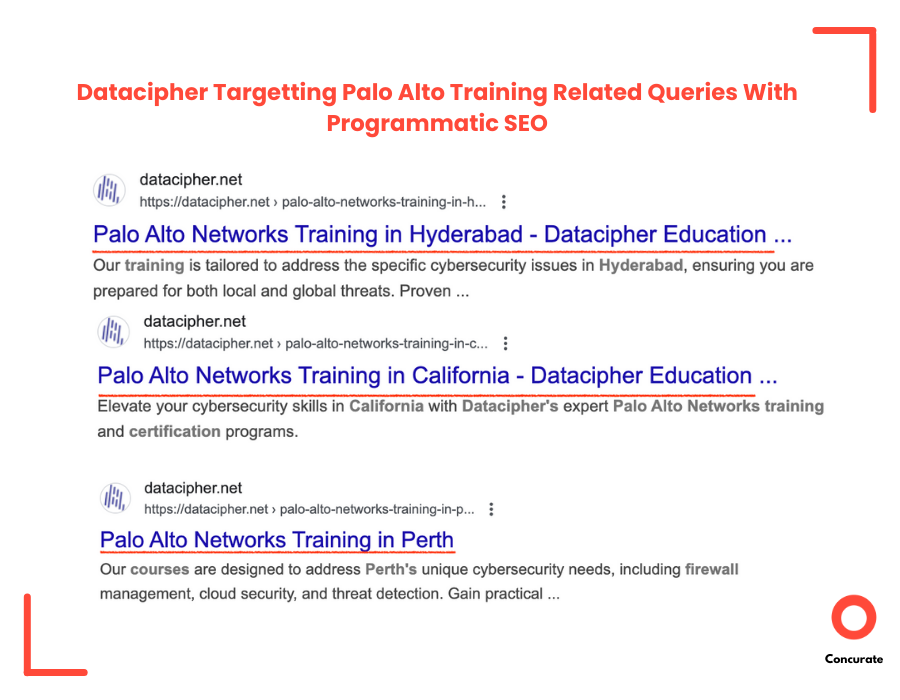
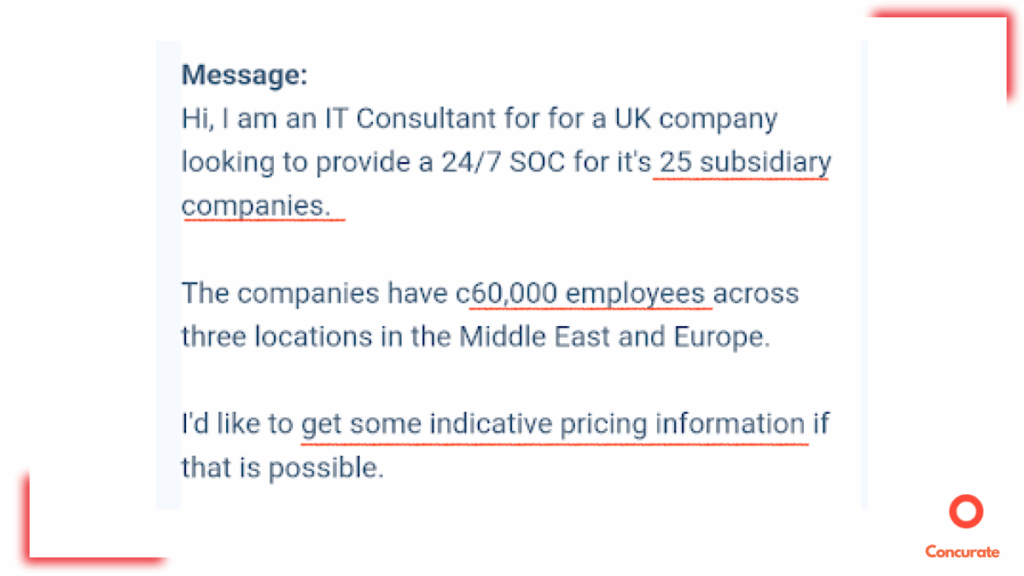
The outcome: #1 rankings in 9 key markets, first-page visibility across 33 locations, and a high-value enterprise lead from a UK-based company with 60,000 employees.
You can read the detailed case study here.
Building Authority with Programmatic Blogs
Programmatic SEO does not need to stop at landing pages. For a patent-tech SaaS building compliance software, we applied the same principles to blogs.
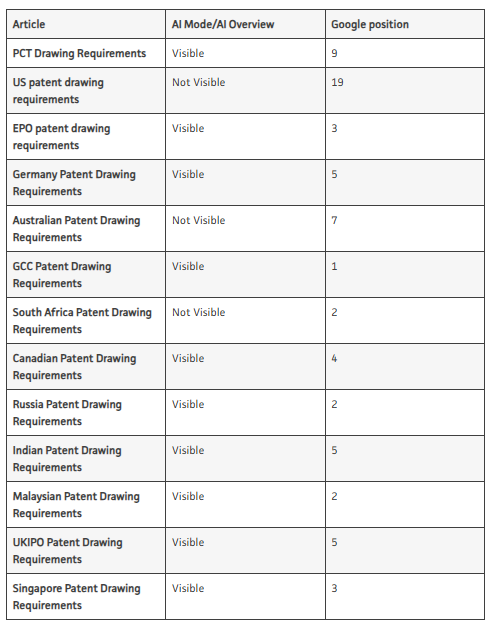
We created jurisdiction-specific FAQ style guides that covered patent drawing requirements across multiple offices. These resources simplified rules that were previously scattered across dense and outdated PDFs. Buyers could now find everything they needed in one place.
The impact of this strategy was clear. The articles ranked in both Google searches and AI overviews. Below is a snapshot of what the ranking looked like as of September 2025.
Not just that, within 60 days, we generated 13 qualified leads for the client with our content.
How are we able to bring such results, you ask?
Our difference comes from depth. Our writers have 3-7 years of domain expertise in areas such as patents, cybersecurity, and enterprise IT. Every piece is refined by senior editors with industry context.
This combination of expertise and editorial quality ensures that our clients do not just rank. They gain qualified leads, stronger pipelines, and visibility in generative search engines where decisions increasingly begin.
CMO’s Note: Not every client can be named, but every story can still be told. Here are 7 ways to turn anonymous case studies into lead-generating asset.
2. Omniscient Digital
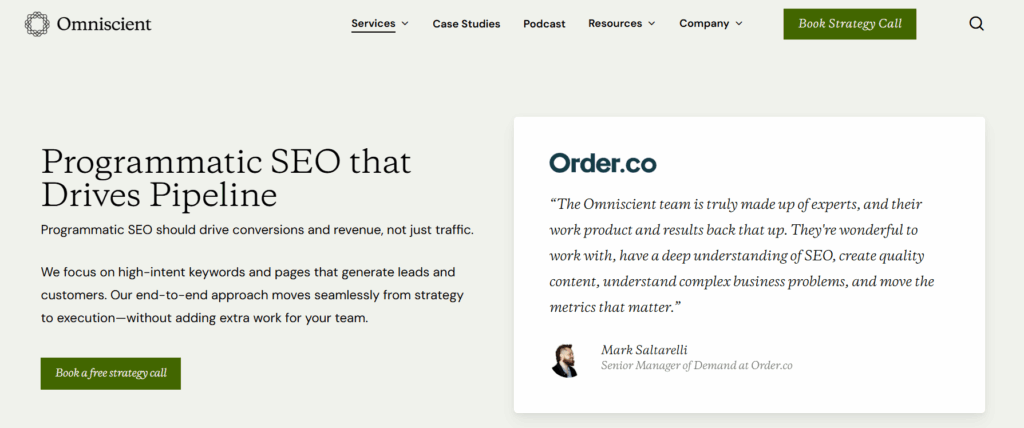
Omniscient Digital positions itself as a revenue-focused SEO partner for B2B software companies. Their programmatic SEO practice is designed to capture high-intent queries at scale and tie them directly to pipeline impact.
Source – Omniscient
The agency emphasizes strategy first: mapping keywords to jobs-to-be-done and pain points, then building page templates optimized for conversions.
They plug into existing production workflows and handle execution across CMS platforms such as Webflow, WordPress, and Contentful.
Beyond launch, they run SERP experiments, split tests, and ongoing optimizations to keep pages competitive and aligned with shifting search behaviors.
3. Omnius
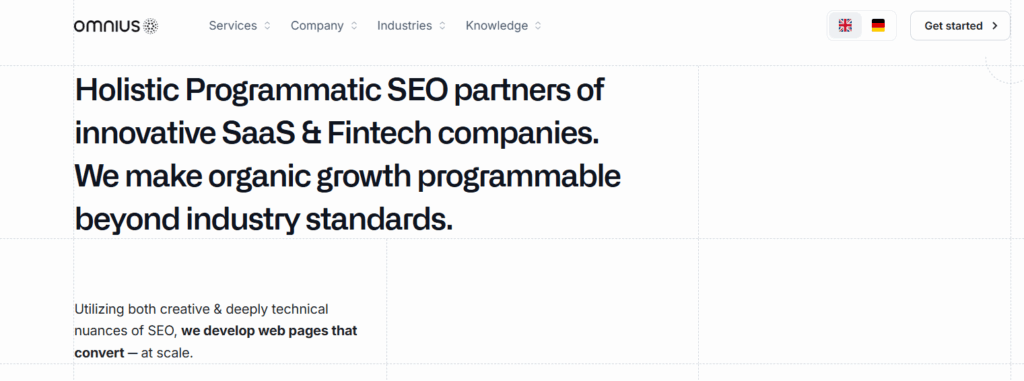
Omnius positions itself as a holistic programmatic SEO partner for SaaS and Fintech companies.
Their approach combines research, company data, and automated rules to create pages at scale that target bottom-of-funnel intent.
Source – Omnius
The process starts with extensive data sourcing, audits, and website mapping to build a structured content engine. The execution then includes content production, technical SEO, and template-based development, with results monitored and iterated weekly.
Omnius integrates programmatic SEO with emerging practices such as generative engine optimization to ensure visibility across both Google and AI-driven platforms.
Their positioning highlights the ability to combine creative content with technical automation, allowing clients to expand reach without increasing proportional costs.
4. Conversion Factory
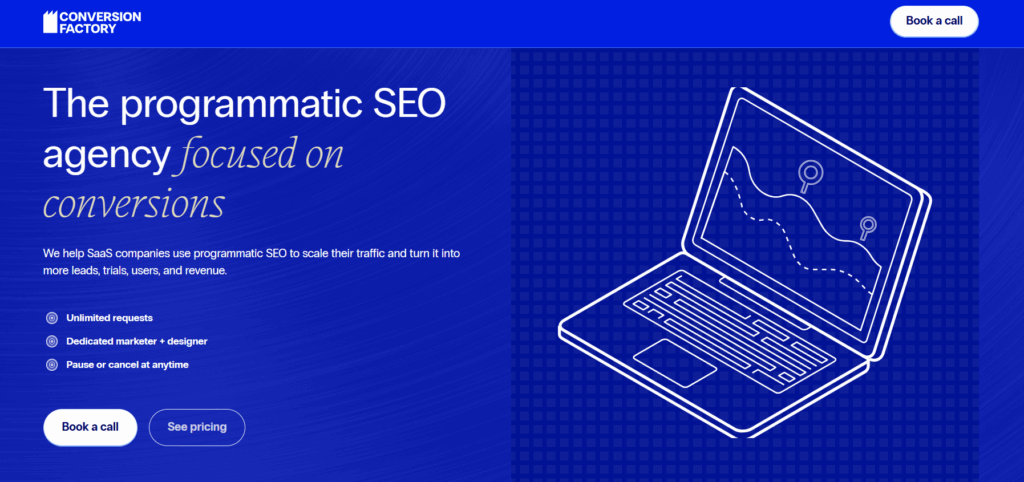
Conversion Factory is a programmatic SEO agency designed to help SaaS companies scale traffic and turn it into leads, trials, and revenue. Their model combines marketing and design expertise, with every client paired with a senior marketer and senior designer.
Source – Conversion Factory
Programmatic workflows follow a clear framework: generate data and insights, design SEO-friendly templates, connect technical setups, test with A/B experiments, and refine for performance.
They position themselves as a subscription-based service, emphasizing quick turnarounds, unlimited requests, and flexibility to pause or adjust at any time.
Beyond SEO execution, they support Webflow development, landing page design, and conversion-focused copywriting.
Related Read: Want to see programmatic SEO at scale in action? ElevenLabs built thousands of pages that turned into a growth moat. Read how they did it here.
5. Single Grain
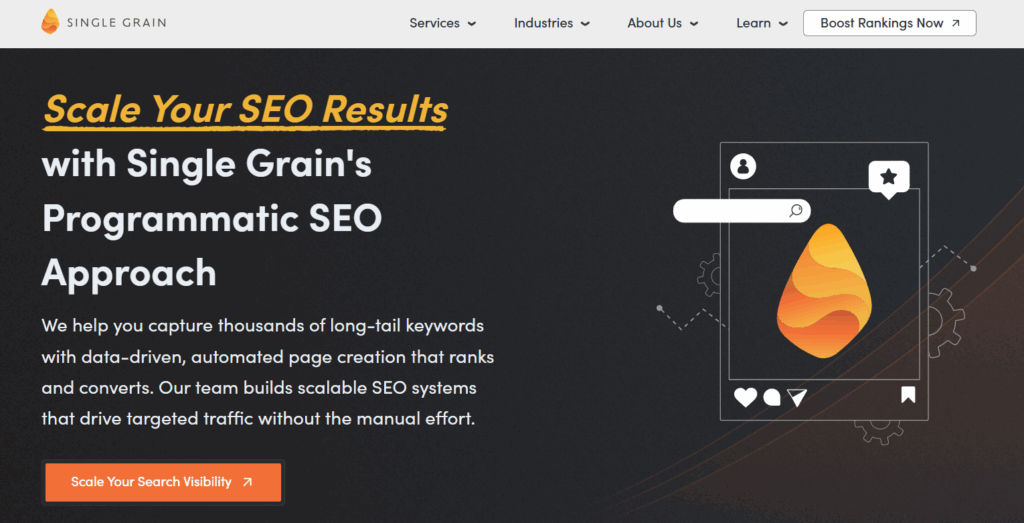
Single Grain offers programmatic SEO as part of its broader digital marketing services, with a focus on scaling search visibility for SaaS and B2B companies.
Source – Single Grain
Their approach is built around identifying long-tail keyword clusters, compiling structured datasets, and creating flexible page templates that insert dynamic content while maintaining brand consistency.
They emphasize safeguards against duplicate content, keyword cannibalization, and thin pages by applying quality controls before launch.
Beyond implementation, they track indexing, rankings, and traffic patterns to refine templates and amplify winning structures.
By tying programmatic SEO directly to commercial intent queries. Single Grain positions its strategy as a way to build sustainable, conversion-focused visibility at scale.
Related Read: 16 Top International SEO Companies For Global Growth (That Help You Rank On AI Search Results)
6. Prosperity Media
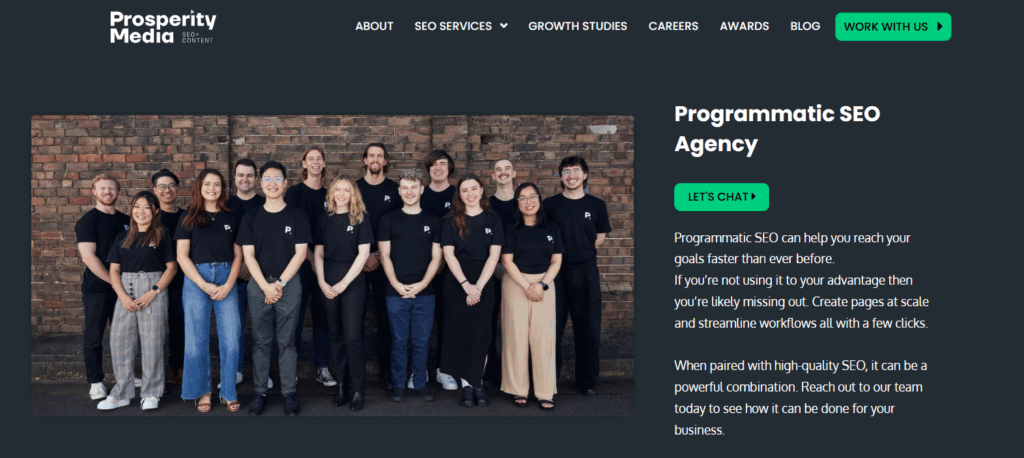
Prosperity Media frames its programmatic SEO services around quality control and tailored execution rather than sheer page volume. Their model combines keyword research, technical SEO, and automated workflows with manual oversight to prevent duplicate content and maintain site performance.
Source – Prosperity Media
The agency highlights use cases such as multi-location landing pages, e-commerce catalog scaling, and automated product comparison pages. All their work is handled in-house, supported by a modern tech stack for auditing, data clustering, and workflow automation.
They also emphasize conversion impact, ensuring generated pages load fast, match user intent, and fit into broader campaigns that include link building, local SEO, and content creation.
7. Rock the Rankings
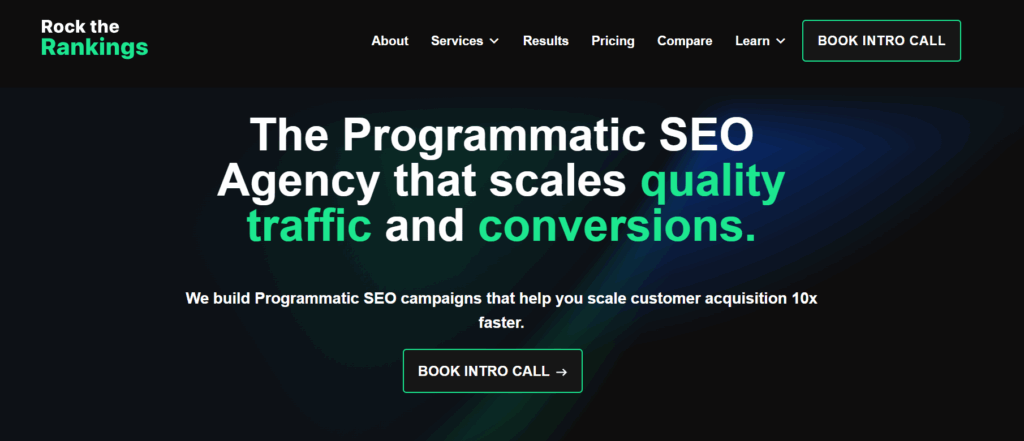
Rock the Rankings is a SaaS-focused SEO agency that incorporates programmatic SEO into broader acquisition strategies. Their framework blends automation, landing page templates, and conversion rate optimization to scale qualified traffic.
Source – Rock the Rankings
Their services cover strategy development, page design, and testing, with an emphasis on aligning bottom, middle, and top-funnel content to buyer intent.
The agency complements programmatic SEO with SaaS-specific content marketing, digital PR, and PPC services, positioning programmatic as part of their wider growth playbook.
Related Read: 15 Top PR And SEO Agencies In 2026 That Get Your Brand Visible On AI Search Results
8. BRIX Agency
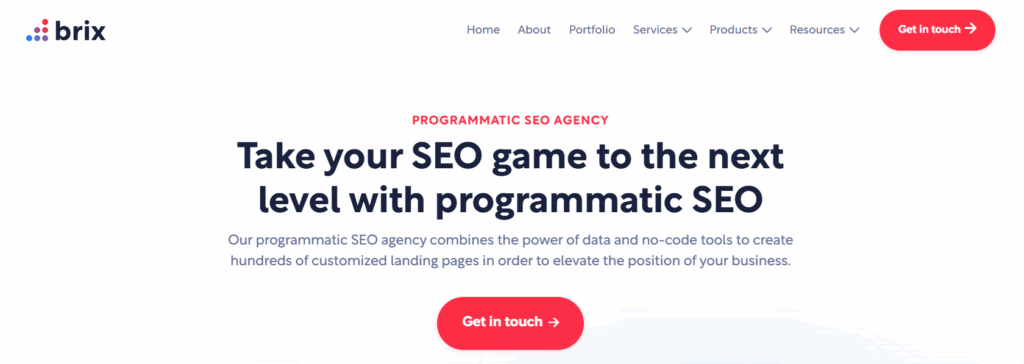
BRIX Agency brings a design-first approach to programmatic SEO, pairing automation with no-code tools like Airtable, Figma, and Webflow to create scalable landing pages.
Source – Brix Agency
Their process focuses on identifying low and medium-volume keywords and turning them into structured page sets that capture long-tail intent.
The agency emphasizes page quality, conversion-ready layouts, and SEO-optimized structures. By combining keyword research, structured data management, and in-house design and development, BRIX positions programmatic SEO as a way to expand visibility while maintaining brand consistency and user experience.
9. Stramasa
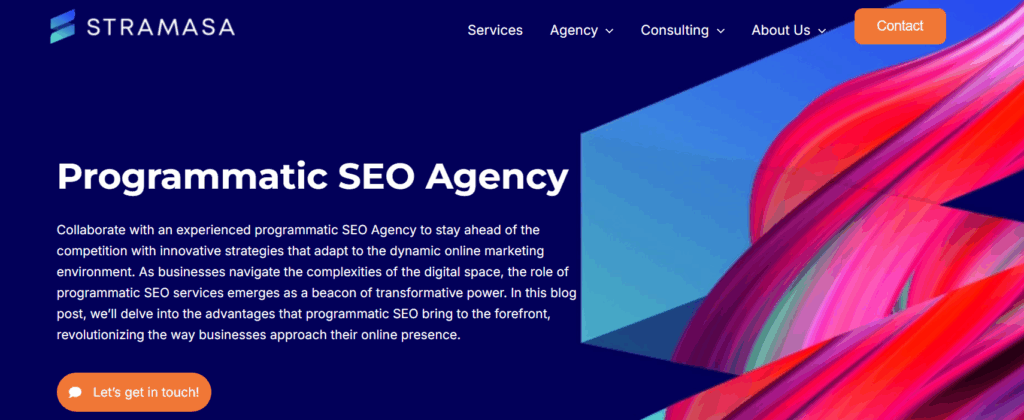
Stramasa positions itself as a full-service digital marketing agency with a dedicated focus on Programmatic SEO.
Source – Stramasa
The agency emphasizes precision targeting and real-time adaptability, ensuring that programmatically created pages not only rank but stay relevant as algorithms shift.
They highlight the use of AI SEO tools such as PrimeSEARCH to manage large datasets, streamline workflows, and automate keyword-driven content production.
Beyond programmatic SEO, Stramasa integrates broader digital marketing services, including programmatic advertising, CRO, content marketing, and demand generation.
10. Flying Cat Marketing
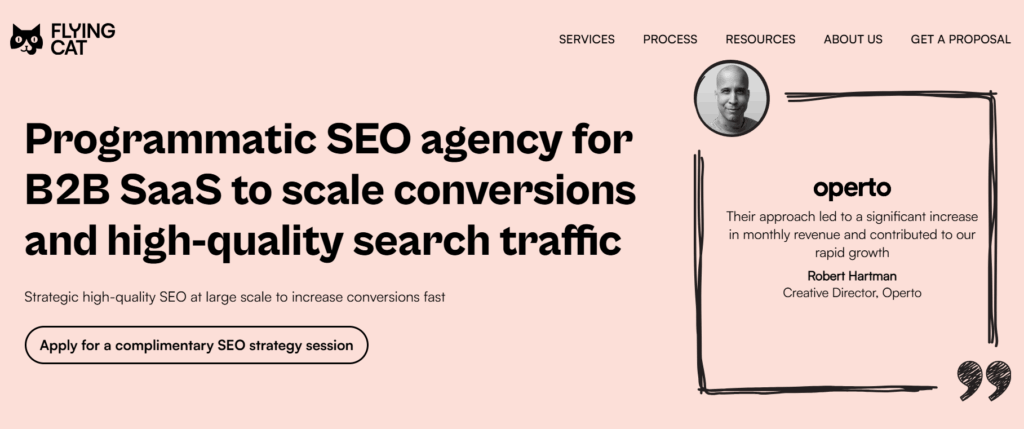
Flying Cat Marketing is an SEO consulting agency that helps B2B SaaS companies use programmatic SEO to scale traffic and conversions.
Source – Flying Cat Marketing
They specialize in building template-driven landing pages backed by keyword research, automation, and professional SaaS content writing. Their approach combines strategic SEO planning with human-led content to ensure quality and UX aren’t compromised.
The agencies above can help you plan and execute a programmatic SEO campaign. But hiring an agency is not the only option. If you have the right SEO, content, development, and CMS resources internally, you can also build the program in-house.
Here are the decisions you need to get right before you begin.
How to Run Programmatic SEO In-House
Building programmatic seo campaigns internally requires more than a keyword list and a page template. Your SEO, content, data, and development teams need to work together from the beginning. Here are six things to consider before you start.
1. Start With the Search Opportunity, Not the Page Count
Before creating a template, identify the search patterns you want to target and confirm that there is enough demand for those pages. You may find an opportunity for 20 pages or 200. The number matters less than whether every page answers a real search and has the potential to contribute to a business outcome.
2. Data Is the Fuel, Get It Clean and Structured
Programmatic SEO runs on data. Locations, product variations, service attributes, industry terms, jurisdictions. If that data is inconsistent, incomplete, or badly structured, every page you generate will carry the flaw. Clean it and organize it upfront, because it is the backbone of everything downstream.
CMO’s Note: Where that structured content is stored also matters. Platforms such as Sanity allow teams to define reusable content models, store content as structured data, and query the fields required for each page template. This can make it easier to update shared information, such as compliance requirements, product attributes, or regional details, across every page that references it. Moreover, editors can manage the content through Sanity Studio, while developers retain control over how it appears within each template. You can learn more about the Sanity tool here.
3. Test a Smaller Page Set Before You Scale
Do not create hundreds of pages before you know whether the structure works. Start with a smaller group and review how well the pages are indexed, ranked, and received by visitors.
This gives you a chance to fix problems with the template, data, or content before those problems are repeated across the entire page set.
4. Decide What Will Be Unique on Every Page
A programmatic template should define what remains consistent and what changes from one page to another.
Leave room for information specific to the location, jurisdiction, product, industry, or use case being covered. That may include a custom introduction, local requirements, examples, recommendations, or FAQs.
If every section is populated only by swapping variables, the pages will quickly start to feel repetitive.
5. Set Up Technical SEO and Internal Linking Before Launch
Decide the URL structure, canonical rules, indexation controls, and internal linking logic while the pages are being built.
Programmatic page sets can create duplicate content, crawl waste, and indexation problems when technical SEO is treated as something to fix later. It is much easier to address these issues before hundreds of pages are live.
6. Decide How You Will Review and Improve the Pages
Publishing is only the first stage. Track which pages are indexed, which ones rank, which ones appear in AI-generated answers, and which ones contribute to conversions.
Some pages may need stronger internal links or more page-specific information. Others may need to be consolidated, reworked, or removed. Build this review process into the campaign from the start.
Programmatic SEO can be run in-house, but it needs clear ownership across strategy, content, development, and ongoing optimization. If one of those pieces is missing, even a strong page opportunity can stall before it delivers results.
Related Read: Clean, structured data is just the foundation. The next step is picking the right automation stack to bring your strategy to life. Explore this curated list of top programmatic SEO tools to streamline dataset management, content generation, and template execution.
That’s why you need the right agency that can handle everything from planning to execution. That’s where Concurate shines too.
Why Concurate Is the Best Programmatic SEO Agency for B2B Growth
At Concurate, we understand programmatic SEO isn’t about flooding the web with landing pages. But it’s about building growth engines that result in conversion.
As a B2B SaaS content marketing agency, we understand that buyer journeys are complex, and every strategy must reflect this complexity. For one client, a global training provider, we built geo-targeted landing pages that secured top rankings across regions and delivered enterprise leads. For another patent-tech SaaS, we applied programmatic SEO to jurisdiction-specific blogs, turning compliance into a lead-generating asset.
Our difference is in execution. We work as an extension of your team, handling everything from data and implementation to optimization and reporting. Each strategy is designed to scale responsibly, integrate with your broader content plan, and drive outcomes that matter: demo requests, qualified leads, and revenue.
Ready to see programmatic SEO drive demos, deals, and revenue? Let’s build your growth engine together.
Frequently Asked Questions
Not at all. While large companies benefit from scale, SaaS startups and B2B companies can use programmatic SEO to capture niche, conversion-ready searches early and build authority fast.
The biggest risks are duplicate content, thin pages, and technical SEO issues if the strategy isn’t well-planned. Clean data, flexible templates, and ongoing monitoring are essential to avoid these pitfalls.
Programmatic SEO is not about impressions alone. It only works when tied to the funnel. At Concurate, we bake in clear CTAs into every scaled page. For instance, when creating geo-targeted landing pages for a global training provider, we designed conversion pathways that led directly to enterprise lead forms. The key is aligning every programmatic page with a measurable outcome, not just keyword coverage.
In-house teams often struggle with execution gaps, whether it’s cleaning datasets, setting up templates, or optimizing technical SEO at scale. Agencies bring proven playbooks, tooling, and cross-industry learnings to accelerate the process.
Absolutely. The fear is that scaled pages will feel robotic, but with the right process, programmatic SEO strengthens brand presence. For one of our SaaS clients, we applied programmatic SEO to jurisdiction-specific blogs rather than product pages. This not only kept the content aligned with their thought leadership tone but also expanded their organic footprint. Done right, programmatic pages complement cornerstone content, link back to resource hubs, and reinforce brand voice instead of diluting it.
Disclaimer: The information presented in this article is compiled from publicly available sources, including company websites, industry reports, and social media. All trademarks, brand names, and logos mentioned are the property of their respective owners. We do not claim any ownership of third-party marks, nor do we imply endorsement or affiliation. This article is intended for informational purposes only.