

Here’s a scenario that keeps SEO teams up at night. You’re still processing the fallout from March’s core update. Then Google drops another one. Just 43 days later, the May core update.
This time, it arrives one day after Google I/O 2026 wraps up. Google confirmed the May 2026 Core Update began rolling out at 08:40 PDT. It will take up to two weeks to complete. The target finish date is around June 4.
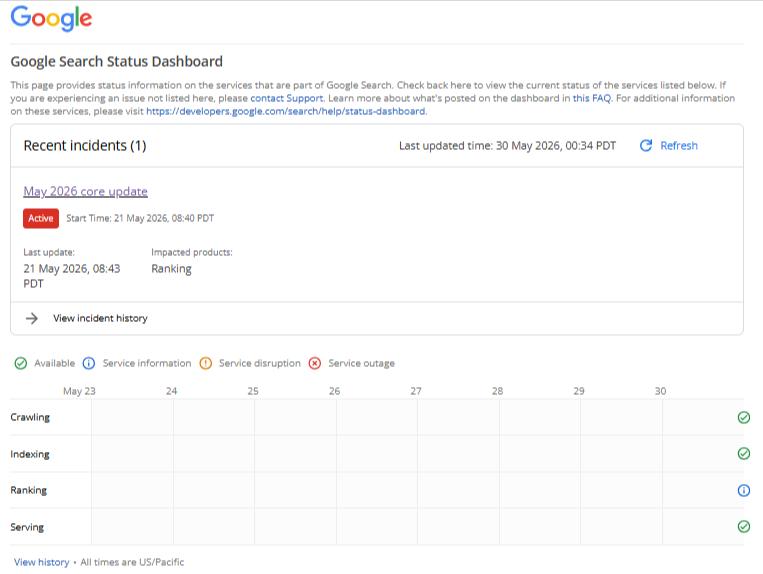
This is the tightest back-to-back cadence we’ve seen in years.
But here’s the critical context. Google I/O 2026 wasn’t just a developer conference. It was a declaration. AI-powered search is no longer the future. It’s the present.
When the ranking algorithm shifts within 48 hours of that declaration, it sends a clear signal. The rules of visibility are being rewritten in real time.
So what exactly is this update changing? Let’s break it down.
What the May 2026 Core Update Actually Targets
Google’s official statement is brief. It says this is a “regular update.” It is designed to surface better content for searchers.
But “regular” does not mean “minor.” The March 2026 update gave us a clear preview. The May update appears to be continuing that direction.
Here is what we know is being weighted more heavily.
1. First-Party, Expert-Led Content Is Winning
Google now rewards content that only you can create. Not copied content. Not summarized content. Content from your own experience, data, and expertise.
This includes:
- Original research you conducted
- Case studies from your clients
- First-hand testing with your tools
- Expert opinions from people in your field
Google can tell the difference. It knows when content repeats what 50 other sites already said. It knows when an article is written by someone who never did the work.
The March 2026 update proved this. Amsive tracked the impact using SISTRIX data. The data was clear. Sites that create their own content gained visibility. Sites that only aggregate or summarize lost it.
YouTube was one of the biggest losers. It dropped 567 points in the Visibility Index.
It dropped because it hosts a lot of non-original content. Re-uploads. Remixes. Repetition. Google is now favoring the source. Not the middleman.
The May update continues this direction. Early reports show two things losing visibility faster:
- Thin content articles that barely cover a topic
- AI-generated material without human editing or fact-checking
Both have the same problem. They are not first-party or expert-led. They are content for content’s sake.
| SISTRIX is a German SEO analytics platform. It has been the gold standard for measuring SEO success since 2008. It tracks 1 million keywords per country and monitors the top 100 organic results for each. When a core update hits, this index shows who won and who lost first. |
2. E-E-A-T Signals Are Now Primary
E-E-A-T stands for Experience, Expertise, Authoritativeness, and Trustworthiness. These are not new concepts. But in 2026, they are becoming primary ranking signals.
Sites with named expert authors are holding ground. Sites with verifiable credentials are gaining. Anonymous content is losing traction. Generic “Editorial Team” bylines are also struggling.
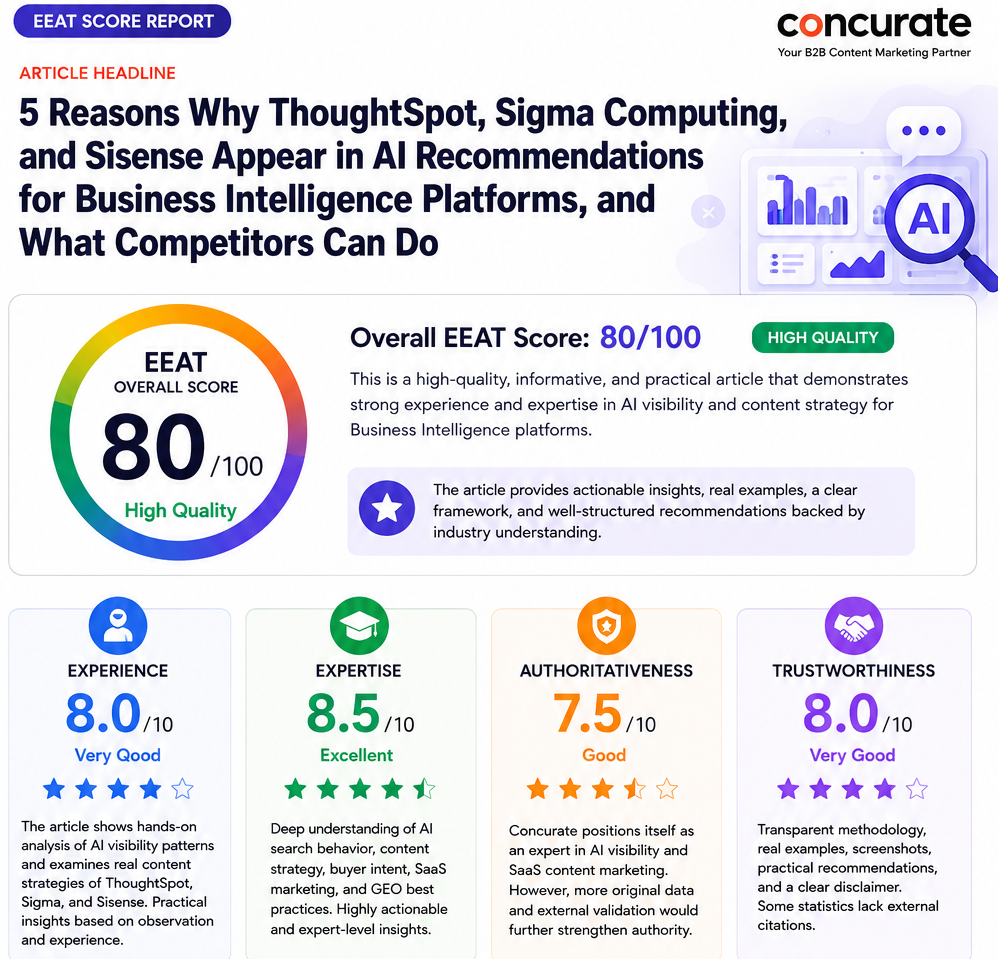
For instance, one of our recent articles received an EEAT assessment score of 80/100 from ChatGPT. While AI-generated evaluations are not official Google ranking metrics, they can provide a useful benchmark for assessing content quality.
The more important takeaway is what contributed to that score:
- Clear authorship
- Demonstrated expertise
- Practical insights
- Transparent methodology
- Real-world examples
- Actionable recommendations.
These are the same types of signals that search engines and AI platforms increasingly rely on when evaluating content quality and determining which sources to surface in search results and AI-generated answers.
3. Topical Authority Over Keyword Lists
Google is getting better at understanding your site. It wants to know what you actually specialize in.
A site that covers one subject thoroughly wins. It needs pillar pages and topic clusters. It needs interconnected sub-topic content. This type of site outperforms one that publishes surface-level articles. Especially if those articles cover many unrelated topics.
The algorithm is asking one question. Does this domain have the right to be authoritative on this subject?
4. The AI Content Quality Differentiation
Here is the nuance that matters. Google is not penalizing AI-assisted content. It is penalizing AI-generated content without human oversight.
The March 2026 Spam Update targeted “scaled AI content abuse.” The May Core Update appears to be reinforcing that same boundary. It is doing this through the main ranking system.
At Concurate, we recently published a short video on this exact topic. It breaks down the types of content that AI can’t generate and requires genuine human experience.
Now that we’ve mapped what the update targets, let’s look at what the community is seeing.
What the SEO Community Is Saying
The chatter across WebmasterWorld, X, and LinkedIn reveals a mixed picture. Here is what people are sharing:
- Some sites are seeing 50% traffic drops. These are sites relying on thin content or aggregation models.
- Others report 30% gains internationally. These are sites with strong E-E-A-T foundations and original research.
- Smaller sites in Brazil are being removed from Google Discover. Only large news portals or high-backlink domains remain visible. Even when those larger sites have clickbait content.
- One recurring frustration stands out. “Since 2022-2023, if you’re hit, you’re practically blacklisted. With each update, it will sink you lower and lower.”
Here is something notable. Google Search Liaison posted the May 2026 announcement on LinkedIn first. It was about 7 minutes before the Search Status Dashboard logged it.
This is a shift from the typical X-first pattern. It shows where Google sees its professional audience engaging most.
These community signals are valuable. But they only tell part of the story. So we did our own analysis.
Our Own Analysis: Organic Traffic Trends in B2B Sites
At Concurate, we ran our own analysis using Ahrefs data. We looked at how B2B SaaS sites performed during the May 2026 update window. Here is what we found.
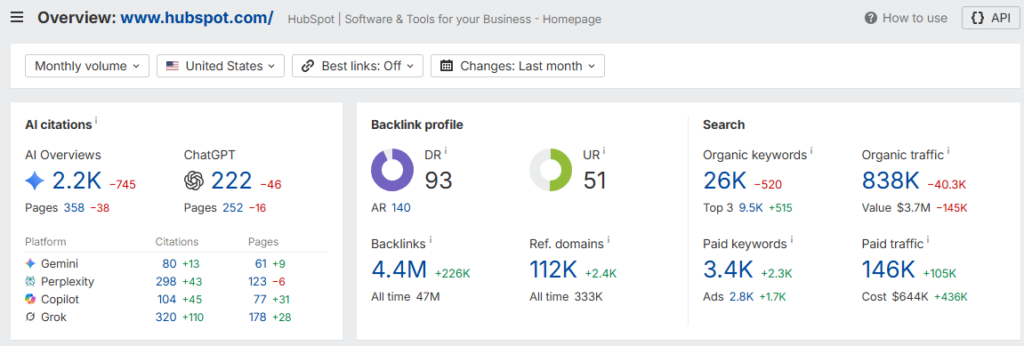
HubSpot, the CRM giant, saw a measurable dip. Their numbers tell the story:
| Metric | Before | After | Change |
| Organic Traffic | 878.3K | 838K | – 40.3K (-4.6%) |
| AI Overview Footprints | 2,945 | 2,200 | – 745 across 38 pages |
| /products/crm Page Traffic | 89.9K | 78.8K | – 11.1K |
This proves something important. Even massive authoritative domains are not immune. Google is chipping away at commercial search volume. It is adjusting topical boundaries. And it is reducing how often brands appear in AI surfaces.
But here is the nuance. HubSpot held their ground better than pure aggregators. Their branded terms stayed strong. Their non-branded commercial pages took the hit. This matches the pattern. Google is getting stricter about who owns which topic.
For instance, HubSpot has performed significantly better than aggregators like SoftwareAdvice.
| Metric | HubSpot (Builder) | Software Advice (Aggregator) |
| Organic Traffic | 838K (-40.3K) | 189K (-8.3K) |
| AI Overview Footprints | 2.2K (-745) | 1.3K (-237) |
| AI Overview Pages | 358 (-38) | 1.1K (-150) |
| ChatGPT Citations | 222 (-46) | 2.1K (-604) |
| Gemini Citations | 80 (+13) | 1.4K (-324) |
| Perplexity Citations | 298 (+43) | 4.6K (+718) |
| Organic Keywords | 26K (-531) | 44.7K (-3.2K) |
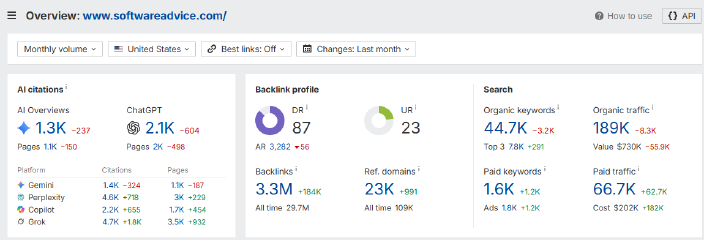
The gap is clear. HubSpot builds what people search for. Software Advice only lists what others build. When Google removes the middleman, the middleman loses.
What This Means for SEO: The Bigger Picture
Google is changing how search works. The May core update is part of that bigger shift. To understand it fully, we need to look at two connected forces.
1. The Compounding Effect of AI Search + Core Updates
Here is what most SEO coverage misses. When more queries go through AI surfaces, ranking signals matter more. Not less. They determine which content feeds those AI surfaces.
Data shows 30%+ of US queries now trigger AI Overviews. Position-one results see 18-34% CTR reduction. If your site was already losing traffic to AI Overviews, the core update may add to that pressure.
But there is a flip side. Content structured for citation wins. Clear sourcing helps. Expert authorship helps. Factual depth helps.
This content is more likely to be referenced by AI Overviews. Being cited as a source can drive significant referral traffic.
2. The Quarterly Core Update Reality
Google used to space core updates 4-6 months apart. That was from 2019 to 2023. In 2024, that compressed to four updates in one year.
In 2026, we’ve seen two core updates in 16 weeks. If this pace continues, SEO teams need a new mindset. Core updates are now a near-quarterly reality. They are not a semi-annual event to plan around.
Recovery from a core update takes 3-6 months. Reacting after a loss means half a year of reduced traffic. By the time you diagnose one update, the next may already be rolling out.
Understanding the landscape is important. But knowing what to do matters more. Here is the practical playbook.
What Marketers Should Do: A Practical Action Plan
Before we dive into specific actions, let’s establish the right mindset. The negative reaction can hurt more than the update itself.
First, the Golden Rule: Don’t Panic
Google itself says: “There’s nothing special for creators to do for core updates as a whole.” It also says: “Improvements made by site owners aren’t guaranteed to recover.” And: “Pages that drop aren’t in violation of our spam policies.”
The “Don’t panic” message is not about inaction. It is about strategic patience.
Your site is not being “penalized” for breaking rules. It is being re-ranked against competitors. Those competitors may have improved more.
Making hasty changes during a rollout confuses your data. It makes diagnosis harder.
Here is the right approach:
- Wait for the update to fully complete. Around June 4 for this one.
- Analyze your data. Compare pre-update and post-update performance.
- Identify patterns. Which pages dropped? Which held steady? Which improved?
- Then make targeted improvements. Base them on data, not anxiety.
Immediate Actions (After the Rollout Completes)
Here are the 7 immediate actions you can do right after the rollout is complete:
1. Audit Your Content for Originality
Ask this question for every important page. If this content disappeared tomorrow, would anyone lose information they couldn’t find elsewhere?
If the answer is no, rewriting for length won’t help. Restructuring headings won’t help either.
The fix is adding genuine original value. Use proprietary data. Do first-hand testing. Add case studies. Include expert analysis that requires access the reader doesn’t have.
2. Verify Your Author Authority
Audit your existing author profiles. Does your blog carry a generic “Editorial Team” byline? Do author pages link to nothing verifiable? If yes, update them.
Encourage your subject matter experts to contribute elsewhere. Have them write for third-party publications and speak at industry events. In addition to that, have them maintain an active professional presence.
The more places a person’s name appears in connection with a subject, the stronger the signal.
3. Check Your Core Web Vitals
The March 2026 update introduced holistic CWV scoring. Google now aggregates three metrics into one score. These are LCP, INP, and CLS.
Sites passing all three thresholds get stronger ranking boosts. Sites failing even one metric face compounded penalties.
4. Build Topical Coherence, Not Keyword Lists
Map your content against a defined topical domain. Identify the gaps. A pillar page on a core subject helps. Support it with deeply linked sub-topic pages. This signals topical completeness to Google.
Prioritize depth over breadth. One comprehensive, expert-authored piece wins. It outperforms three surface-level pieces on adjacent topics.
5. Use AI as a Drafting Tool, Not a Publishing Tool
AI-assisted content can perform well. It needs substantive expert editing, original perspective. It needs verifiable authorship.
AI-generated content without human oversight does not perform well. The distinction is becoming detectable by algorithms.
6. Diversify Beyond Traditional Organic Search
Relying only on Google organic traffic is risky. AI Overviews are capturing more queries. Your rankings can shift overnight.
Here is what diversification looks like:
- Build direct traffic. Email newsletters. Community forums. Slack groups. When people come directly, algorithm changes hurt less.
- Invest in brand search. When users search “your brand + keyword,” you own that result.
- Create referral assets. Tools, calculators, templates. When other sites link to your resources, you get traffic that does not depend on rankings.
- Use video and podcasts. YouTube, LinkedIn, Spotify. These platforms have their own algorithms. They hedge against Google volatility.
Long-tail queries with complex needs remain valuable. AI Overviews cannot fully address them.
7. Monitor More Frequently During Rollout Windows
Core updates may now be coming quarterly. Your monitoring cadence should change.
During the 14-day rollout window, check your top keyword clusters daily. This catches early signals. If you wait until the update finishes, you might be 2 weeks into a drop with no diagnosis.
Once the update completes, compare your site against industry patterns. This tells you if your drop is a broader trend or site-specific.
With the action plan in place, let’s step back. Let’s look at what this all means for the long game.
How Concurate Approaches Core Updates
At Concurate, we are implementing one thing irrespective of updates. Providing original content that is actually helpful to users. Our approach is simple. We do not write content for the sake of publishing it. We create content that brings business.
Every piece we publish answers three questions:
- Does this demonstrate first-hand experience? Not citations from external sources alone, but research from our own tools and resources. Recently, for one of our clients’ articles, we researched 100 examiners using the client’s tool. We used insights from that data. No other agency had access to that information. That is first-party content.
- Does this show genuine expertise? We interview subject matter experts. We quote real practitioners. We cite primary sources. When we write about SEO, we quote people who actually do SEO.
- Does this serve a business goal? Not vanity metrics. Not keyword stuffing. Content that moves a prospect from awareness to decision. Every article we publish has a clear next step. A clear conversion path and a reason to exist beyond traffic.
This is why our content holds steady during updates. Our E-E-A-T score is not an accident. It is the result of a system. A system we apply to every client project.
If your organization wants a content strategy that survives algorithm updates and drives real business results, let’s connect. We do not chase rankings. We build authority that rankings follow.
The Bottom Line
Google’s May 2026 Core Update is not introducing new rules. It is reinforcing a direction. Google has been moving this way for years.
Ranking is comparative. It is not formulaic. Pages are continuously stacked against competitors.
Sites that consistently gain share one trait. They invest in quality, performance, and authority as ongoing programs. They do not treat these as reactive projects.
Every update in the past three years reinforced the same signals. Deeper content expertise. Faster technical performance. More authentic authority. The specifics evolve. The direction stays clear.
Frequently Asked Questions
1. How Long Does Recovery From a Core Update Take?
Typically 3-6 months. Google has confirmed that improvements are not guaranteed to recover rankings. The next core update is the earliest opportunity for reassessment.
2. Is AI-Generated Content Completely Banned Now?
No. Google does not ban AI-assisted content. It penalizes AI-generated content without human edits, original reporting, or genuine expertise. The March 2026 Spam Update specifically targeted “scaled AI content abuse.” The key is editorial control and expert review.