

| TL;DR: Enterprise buyers expect to find clear answers when they research a company. Instead, they often come across disconnected messaging, outdated content, and conflicting information across different channels. That makes it harder for enterprise brands to stand out during evaluation. This guide covers 11 B2B marketing agencies for enterprise teams, including Concurate, Stein IAS, and Walker Sands. It also explains why enterprise marketing loses visibility and what to ask before hiring an agency. You’ll also learn how to choose a partner that helps buyers find and understand your company across Google and AI search. |
Enterprise companies face a different marketing challenge than most B2B businesses.
As they grow, they add new products, expand into new markets, and serve different customer segments. Different teams create content and campaigns for different goals. Over time, those efforts can make it harder to present a clear and consistent story to buyers.
Your strongest product may not be the one ranking. Your most profitable use case may be buried inside a PDF. Your regional pages may say something different from your global website. Your product content may explain features, but not help buyers compare options or justify the decision for a particular solution internally.
Your buyers are not searching for your entire company. They are searching for a specific solution to a specific problem. They want to know which vendor understands their industry, supports their region, integrates with their systems, and has proof for their use case. If your content does not make those answers easy to find, buyers may never realize your company is relevant.
This guide covers eleven B2B marketing agencies that help enterprise companies solve this challenge. But before we get to the list, let’s look at why enterprise marketing often struggles to build consistent visibility across Google and AI search.
4 Reasons Why Enterprise Companies Don’t Get Discovered
Enterprise companies often do more content marketing than smaller B2B businesses. The challenge is not volume. It is whether marketing gives buyers the answers they need to evaluate your business.
Here is where it usually goes wrong:
1. They Build Content In Silos
Enterprise companies publish a lot of content. Product teams create documentation. Marketing teams publish blogs. Regional teams create local content. Each piece serves a purpose. But they often stay disconnected.
Google rewards companies that build deep expertise around a specific topic. It is more likely to rank a connected library than scattered articles.
For example, someone searching “enterprise digital transformation strategy” is more likely to find Deloitte or Accenture. They have built extensive resources around that topic over many years. As a result, buyers find companies that have built depth around those subjects, even when other vendors offer similar solutions.
2. Their Core Positioning Changes Across Pages And Regions
Many enterprise companies often tailor their messaging for different industries, regions, and customer needs. The problem starts when the core positioning changes. Your examples, proof, and use cases can change. Your identity shouldn’t.
For example, your global website may describe you as a digital transformation partner. Your product pages may call you an enterprise software platform. Your regional websites may position you as a local specialist.
AI uses these signals to understand what your company does and who it serves. It needs enough clarity to recommend your business for a specific use case. When your core message changes from one page to another, AI may not connect the dots clearly enough to recommend your company for the right searches or prompts.
3. They Do Not Help Buyers Compare Them With Other Vendors
Enterprise buyers compare vendors in many different ways before they make a shortlist. They compare competitors based on industry expertise, implementation approaches, integrations, total cost, and other buying criteria.
Leading enterprise vendors make those comparisons easy. They create comparison pages and decision-stage content that answer these questions before buyers have to ask sales.
However, many enterprise companies still stop at product pages. When buyers still have questions, they look elsewhere for the answers.
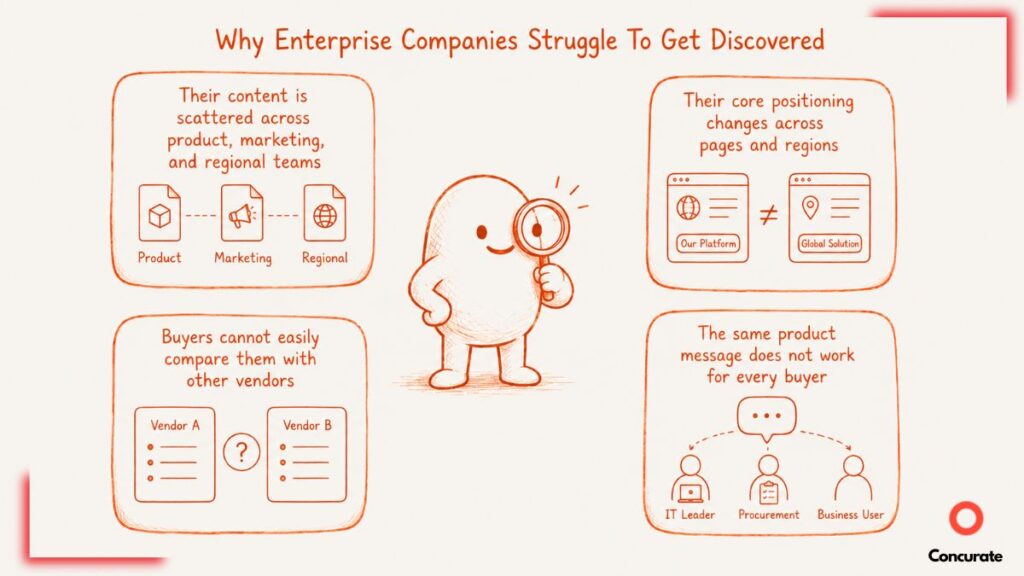
4. They Give The Same Message To Every Decision Maker
Enterprise buying involves many decision-makers. Executives, IT teams, operations leaders, and procurement teams all evaluate the same solution from different perspectives.
For example, a CFO may want to understand business outcomes and ROI. An IT engineer may look for integrations and security. A project manager would want to know about implementation and timelines.
However, most companies rely on the same product pages and messaging for everyone. As a result, buyers struggle to find answers they need for their role. They continue evaluating vendors that speak more directly to their concerns.
The good news is that these problems can be fixed with the right strategy. An agency with enterprise marketing experience can help you build stronger visibility across Google and AI search.
But enterprise marketing is more complex than traditional B2B marketing, so not every agency is equipped for it. Before you make a decision, here are the questions worth asking.
5 Questions To Ask Before Choosing A B2B Marketing Agency For Your Enterprise Team
Choosing an enterprise marketing agency is not about finding the one with the biggest client list. The agency you choose should understand your biggest visibility challenge before recommending a solution.
Here are five questions to help you choose the right partner for your enterprise.
1. How Will You Help Us Show Up On Google And AI Tools?
Enterprise buyers now research software in more than one place. Some start with Google. Others ask AI tools like Claude or ChatGPT for recommendations. A good agency should know how to help your business get discovered in both.
Google ranks higher content that covers a topic in depth. AI looks for clear and consistent information that helps it recommend the right solution for a specific situation. A strong agency should be able to explain how it will improve your visibility in both places.
| Question to ask: How will you help us show up when buyers search on Google and ask AI tools for vendor recommendations? |
2. How Will You Keep Our Message Consistent Across Regions And Business Units?
Enterprise companies often have different regional teams, product teams, and business units creating their own content. That can make the company sound different depending on which page, region, or team a buyer finds first.
For example, a global manufacturer may explore your manufacturing solutions and visit your pages for Europe and North America. They may also review your product information before building a shortlist. Every piece of content should reinforce the same understanding of what your company does, even when the examples, regulations, and case studies differ.
The right agency should not recommend centralizing every message or letting every team work independently. Instead, they should explain how they would create one clear positioning for the business. Regional teams can then adapt it for local markets.
| Question to ask: How would you keep our core message consistent across regions and business units? |
3. Can You Create Content For Different Decision Makers?
Enterprise software is rarely purchased by one person. Multiple stakeholders evaluate the same solution before a final decision is made.
The problem starts when an agency treats all of these decision-makers as one audience. The content may explain what your company does, but it fails to answer the questions each buyer needs answered before making a decision.
The right agency should be able to show how they adapt content for different decision-makers while keeping your core positioning consistent.
| Question to ask: How would you create content for different decision makers, such as executives, IT teams, operations, and procurement? |
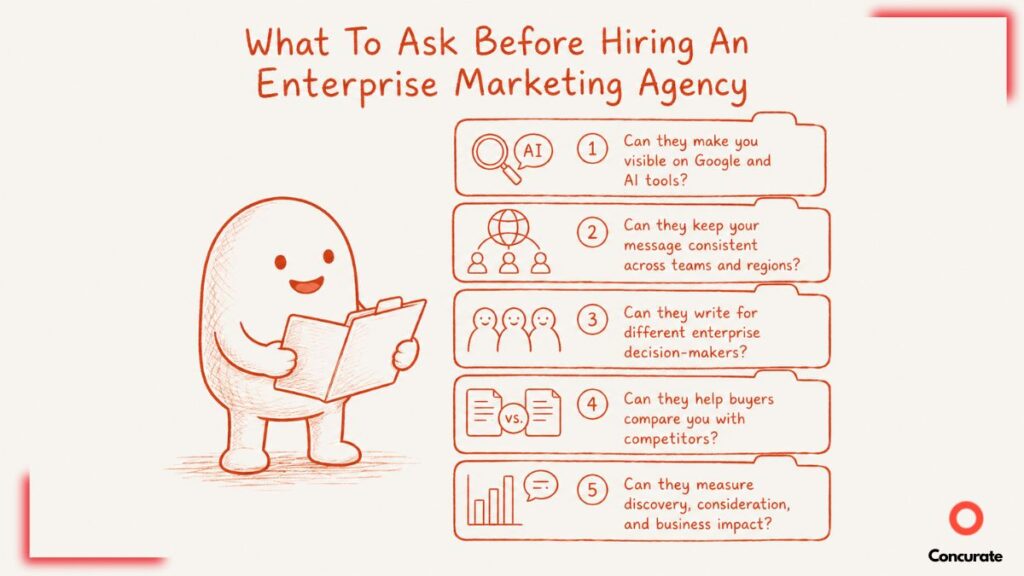
4. How Will You Help Buyers Compare Us With Other Vendors?
Enterprise buyers check multiple sources before choosing a vendor. They read review sites, analyst reports, and peer recommendations to compare their options.
Comparison content helps you become part of that evaluation. It explains how your solution differs before buyers verify that information through other sources. Without it, competitors and third-party sources are more likely to shape the comparison.
| Question to ask: How will you help buyers compare us with competitors across different enterprise buying criteria? |
5. How Will You Measure Whether More Buyers Are Finding And Considering Us?
Traffic and rankings only tell part of the story. Enterprise companies need to know whether they are becoming easier to discover when buyers research, compare, and shortlist vendors.
A good agency should look beyond website metrics. They should explain how they measure visibility across Google and AI search. They should also explain whether your company appears for important buyer searches and how they measure the impact on business results.
| Question to ask: How will you measure whether more buyers are finding and considering us? |
Once you know what questions to ask, it becomes much easier to identify agencies that understand enterprise visibility instead of relying on generic B2B marketing playbooks. Now, let’s look at eleven B2B marketing agencies that work with enterprise companies.
Top 11 B2B Marketing Agencies For Enterprise Teams
Not every B2B marketing agency is equipped to support enterprise companies.
However, the agencies below have experience working with enterprise teams across different industries. Each has a different approach, strengths, and ideal use cases. To create this list, we prioritized agencies with proven enterprise experience, relevant client work, and capabilities that align with the challenges covered in this guide.
To make your evaluation easier, we’ve summarized the key differences between the agencies below.
| Agency | Best Fit | Services Offered | Search + AI Visibility Strength | When to Choose Them |
| Concurate | Enterprise teams that need stronger visibility for priority products, use cases, and visibility in buyer-stage queries across Google and AI search | Content marketing, SEO, Generative Engine Optimization, Answer Engine Optimization, thought leadership content, LinkedIn management, YouTube channel management, programmatic SEO | Strong | Choose Concurate when your strongest products, use cases, or proof points are not showing up when buyers search, compare vendors, or ask AI tools for recommendations. |
| Stein IAS | Global B2B brands that need integrated brand, demand, creative, and campaign programs across markets. | Brand strategy, demand generation, creative, content, media, marketing technology | Good | Choose Stein IAS when you need large-scale brand and demand programs that stay consistent across regions, business units, and campaign teams. |
| Walker Sands | Enterprise and mid-market companies that need PR, credibility, and demand generation working together. | Public relations, strategic communications, demand generation, content, creative, digital marketing, sales enablement | Good | Choose Walker Sands when reputation, media visibility, category credibility, and pipeline support all need to move together. |
| Holini | B2B tech teams that need paid acquisition, analytics, and tighter control over CAC and pipeline measurement. | PPC, paid social, analytics, landing pages, reporting, dashboard setup | Limited | Choose Holini when your immediate priority is paid pipeline performance, cleaner attribution, and senior-level execution across paid channels. |
| The Mx Group | Enterprise B2B teams that need coordinated support across brand, demand, sales enablement, and digital experience. | Brand strategy, demand generation, ABM, sales enablement, content, digital experience, SEO, CRO, data-driven measurement | Good | Choose The Mx Group when your buyer journey feels fragmented and you need brand, demand, and sales programs to work as one system. |
| Omnius | SaaS, fintech, and AI companies that need organic growth across Google search and AI-driven discovery. | SEO, GEO, content clusters, programmatic SEO, website development, CRO, analytics | Strong | Choose Omnius when SEO, AI search visibility, and scalable organic acquisition are the main growth priorities. |
| Twogether | Enterprise technology companies that need global B2B campaigns across multiple regions, partners, and buyer groups. | Brand, demand generation, digital, media, martech, partner marketing, ABM, events, sales enablement | Good | Choose Twogether when you need integrated campaigns for complex enterprise technology audiences and multi-market execution. |
| Torpedo | B2B technology companies going through product launches, market expansion, repositioning, or GTM change. | Brand strategy, go-to-market strategy, positioning, ICP and persona development, SEO, paid media, demand generation, sales enablement | Good | Choose Torpedo when you need sharper positioning and GTM execution around a launch, expansion, or repositioning effort. |
| Godfrey | Industrial, manufacturing, and technical B2B companies with complex products and long buying cycles. | Strategy, creative, content, digital marketing, lead generation, sales enablement, industry-specific campaigns | Good | Choose Godfrey when your marketing needs to translate technical products, industrial expertise, and complex buyer requirements into clear messaging. |
| DeSantis Breindel | Enterprise teams that need brand clarity, positioning, messaging, or identity work before scaling campaigns. | Brand strategy, messaging, communications, verbal identity, visual identity, employee branding, experience design | Limited | Choose DeSantis Breindel when the core challenge is brand clarity, rebranding, M&A communication, category positioning, or internal alignment. |
| Red Lorry Yellow Lorry | B2B tech companies that need PR, analyst relations, reputation building, and thought leadership across markets. | PR, media relations, analyst relations, content, brand positioning, campaign development, social, influencer engagement, crisis communications | Limited | Choose Red Lorry Yellow Lorry when credibility, media visibility, analyst influence, and communications support matter more than SEO-led growth. |
Here’s the lineup:
- Concurate
- Stein IAS
- Walker Sands
- Holini
- The Mx Group
- Twogether
- Ironpaper
- Torpedo
- Godfrey
- DeSantis Breindel
- Red Lorry Yellow Lorry
Let’s explore each agency one by one.
1. Concurate
At Concurate, we don’t get pulled in when teams want more marketing. We show up when enterprise teams realize that more isn’t helping anymore.
You know that content is shipping, agencies are busy, and dashboards look active. But when buyers start comparing tools, asking peers, or checking AI answers, the brand doesn’t hold the room the way it should.
That’s the problem we solve.
Source – Concurate
Enterprise marketing breaks down quietly. Not because teams lack skill, but because scale dilutes intent. Content gets spread across regions, products, funnels, and owners. Over time, it stops guiding decisions and starts just filling space.
So we don’t start with channels or calendars; we start with pressure points.
- Where buyers hesitate
- Where conversations stall
- Where search and AI answers quietly shape opinion before your team ever gets a meeting
From there, we build content systems designed to influence those moments.
That means:
- High-intent content built for evaluation, comparison, and shortlisting stages
- Enterprise and international SEO that stays coherent across markets, not fragmented
- Programmatic SEO used carefully, only where scale actually makes sense
- Generative Engine Optimization and Answer Engine Optimization so your brand shows up inside AI-driven discovery
- Sales-aligned content that helps handle objections, not just explain features
- Distribution support across LinkedIn, YouTube, and search so strong work doesn’t sit idle.
What enterprise teams usually appreciate most is how we work.
We don’t treat complexity as a blocker because we expect it. Multiple stakeholders, layered approvals, or conflicting priorities. We design for those realities instead of pretending they don’t exist.
We act as an extension of your team and bring clarity so your marketing efforts can consistently bring revenue.
If your team feels like it’s doing a lot, but the impact isn’t compounding the way it should, that’s usually the signal.
And that’s exactly the moment we are built for. Book our calendar today so we can build the right playbook for you.
Notable clients: Inspire IP, Triangle IP, Datacipher, Athena Security, and others
Pricing: Our partnerships typically range from USD 5,000 to USD 7,500 per month, with project-based work starting at USD 3,500.
2. Stein IAS
Stein IAS works with enterprise B2B teams that need to manage both brand and demand across complex, multi-market environments. Their approach focuses on bringing strategy, messaging, creative, content, and media together into a single operating model.
Source – Stein
Their services span strategy, creative and content development, paid and earned media, audience insight, and technology-enabled activation. Stein also supports enterprises running account-based and data-driven programs through integrations with major B2B platforms, helping teams plan, execute, and measure campaigns across regions and business units.
Notable clients: Merck, Trelleborg, Ingredion, Atos, Lectra, HCLTech, Juniper Networks
Pricing: Enterprise engagements are typically structured as long-term retainers or large-scope projects, with pricing varying based on the scope.
3. Walker Sands
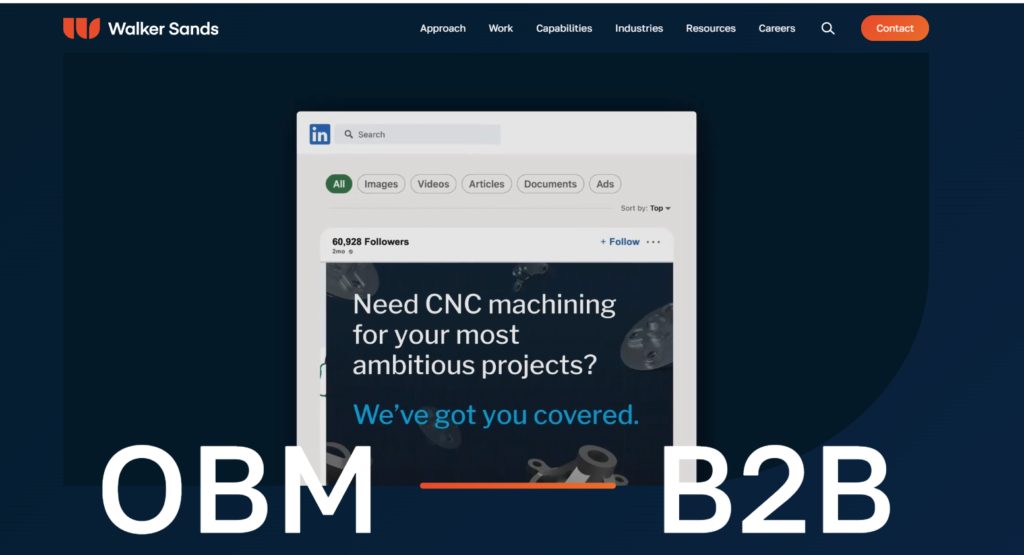
Walker Sands is a B2B marketing and public relations agency that works with enterprise and mid-market teams across technology, healthcare, manufacturing, professional services, and supply chain sectors. Their approach is centered on Outcome-Based Marketing, where programs are designed around business outcomes rather than individual channels.
Source – Walker Sands
Their services cover strategy and research, public relations and strategic communications, creative and content development, digital marketing, and sales enablement.
Walker Sands supports organizations looking to manage multiple objectives at once, such as category positioning, pipeline growth, and brand credibility, while operating across complex industries and buyer groups.
Notable clients: Sophos, Paylocity, Semrush, SoftwareONE, Ensono
Pricing: Engagements are typically structured as ongoing retainers or large-scope integrated programs, with pricing varying based on industry focus, service mix, and campaign scale.
4. Holini
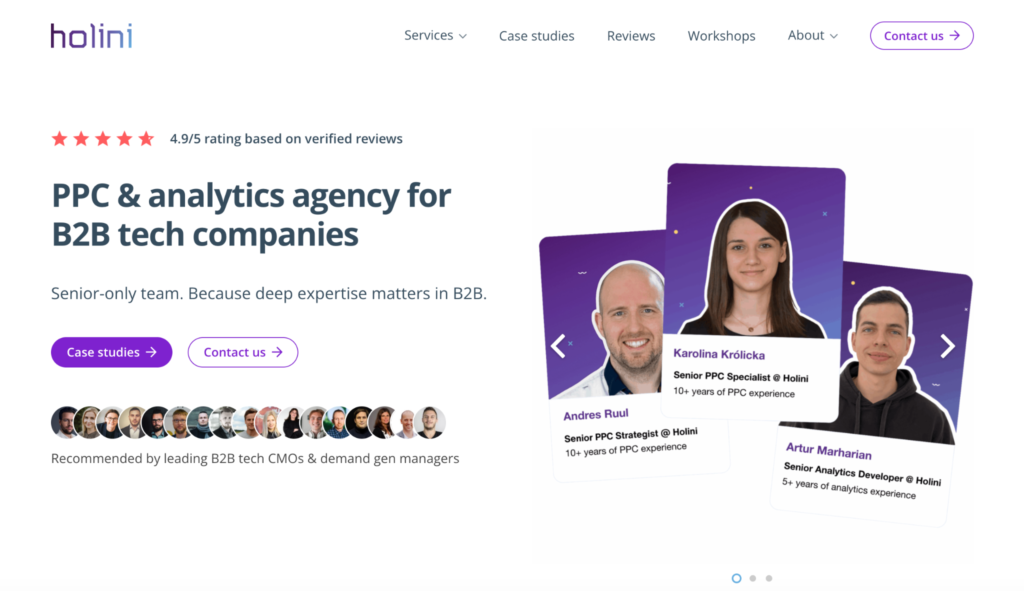
Holini is a B2B PPC and analytics agency that works with technology companies, especially SaaS and other complex B2B categories. Their positioning is narrower than that of a general marketing agency, with a focus on paid acquisition, analytics, and performance support for teams that want tighter pipeline control and cleaner attribution.
Source – Holini
Their services cover paid search, paid social, and analytics, including Google Ads, Microsoft Ads, LinkedIn Ads, YouTube Ads, full-funnel measurement, reporting, and dashboard setup. They also offer landing page and creative design support as add-on services.
Holini is best suited for B2B tech companies that need senior-level execution instead of a broad full-service agency model. The agency emphasizes a senior-only team and supports growth programs where CAC control, measurement accuracy, and qualified pipeline growth matter most.
Notable clients: Veriff, Cherry Servers, DeskTime, Livespace, and Passwork.
Pricing: Engagements are custom-scoped. Third-party review data suggests Holini commonly works on projects starting from $10,000+, with pricing varying by scope and service mix.
5. The MX Group
The Mx Group works with enterprise B2B organizations that need to manage brand, demand, and engagement across complex buyer journeys. Their approach brings together brand strategy, go-to-market planning, demand generation, ABM, content marketing, digital experience, media, and data to create coordinated programs that work across the full funnel.

Source – The MX Group
Their services span buyer persona development, sales and marketing alignment, content strategy and performance, ABM programs, website and digital experience design, SEO and CRO, and data-driven measurement. The Mx Group typically partners with organizations looking to strengthen credibility, support pipeline growth, and improve how buyers experience the brand across touchpoints.
Notable clients: Siemens, Honeywell, Cummins, Panduit, Chamberlain
Pricing: Enterprise retainers and project-based engagements, scoped based on program size and service mix.
6. Omnius
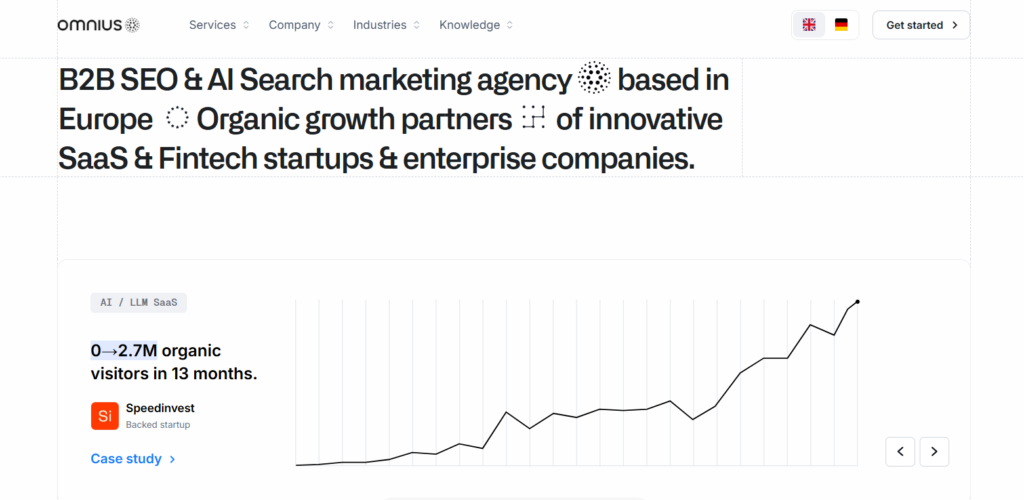
Omnius is a B2B SEO and AI search marketing agency working primarily with SaaS, Fintech, and AI companies, including both high-growth startups and enterprise teams.
Their work focuses on organic growth across traditional search engines and emerging AI-driven discovery platforms.
Source – Omnius
Their services cover B2B SEO strategy, content clusters, generative engine optimization, programmatic SEO, website development, CRO, and analytics. Omnius typically partners with teams looking to scale organic acquisition, improve search-driven conversions, and adapt their content strategy.
Notable clients: WorldFirst, TextCortex, Meniga, Native Teams
Pricing: Custom monthly retainers and project-based engagements, scoped based on growth goals and technical complexity.
Recommended Read: This guide on marketing agencies for medical device companies adds practical context here.
7. Twogether
Twogether is a B2B marketing agency focused primarily on technology and enterprise software companies. Their work spans brand, demand, engagement, ABM, digital experience, sales enablement, and performance marketing, supporting organizations with complex buying journeys and multiple stakeholder groups.
They typically partner with teams looking to run integrated programs that balance long-term brand building with pipeline and revenue goals.
Source – Twogether
Their services include strategy and planning, creative and copy, digital and media, ABM, martech and operations, data and performance, ecosystem and partner marketing, as well as experience and event-led programs.
Twogether often works with global enterprise teams that need consistency across regions while adapting campaigns to different markets and channels.
Notable clients: Adobe, Dell, Hitachi, Lenovo, Salesforce, Sage
Pricing: Enterprise retainers and program-based engagements, scoped based on regions, services, and campaign complexity.
8. Torpedo
Torpedo is a B2B marketing agency that supports enterprise and mid-market organizations with go-to-market strategy, brand positioning, and demand activation.
Their work focuses on helping companies enter new markets, launch products, reach new audiences, and strengthen brand relevance through structured GTM planning, differentiation, and sales enablement.
Source – torpedo
Their services span go-to-market strategy, ICP and persona development, sales enablement, ABM, brand and positioning, digital experience design, campaign activation, and AI-led initiatives.
Torpedo typically works with organizations that need marketing to support commercial outcomes such as market expansion, product adoption, and revenue growth.
Notable clients: Adobe, Autodesk, Epson, Phison, Nominet
Pricing: Project-based and retainer engagements, scoped based on strategy depth and activation requirements.
9. Godfrey
Godfrey is a B2B marketing agency focused on industries where complexity, long sales cycles, and technical buying processes are the norm.
Their work centers on helping enterprise teams translate complex products, systems, and supply chains into clear, relevant messaging that resonates with multiple buyer groups.
Source – Godfrey
Their services span strategy, creative, content, digital marketing, lead generation, and industry-specific campaign execution. Godfrey typically works with organizations in manufacturing, chemicals, life sciences, logistics, and related sectors where marketing must align closely with operational realities and industry regulations.
Notable clients: Assa Abloy, Avantor, Brooks Instrument, Danfoss, Emerson
Pricing: Retainer and project-based engagements, scoped based on industry focus and program requirements.
10. DeSantis Breindel
DeSantis Breindel is a B2B branding agency that works with enterprise organizations on brand strategy, positioning, and communications.
Their focus is on helping companies clarify who they are, what they stand for, and how they communicate with customers, employees, and investors across touchpoints.
Source – DeSantis Breindel
Their services include research and insight development, brand strategy, messaging and communications, visual and verbal identity design, culture and employee branding, and experience design.
DeSantis Breindel typically partners with organizations where brand clarity and consistency are critical to long-term growth rather than short-term campaign performance.
Notable clients: Barclays, LexisNexis, TIAA, BNY Mellon, Korn Ferry
Pricing: Project-based engagements, with pricing scoped based on research depth, brand scope, and implementation needs.
11. Red Lorry Yellow Lorry
Red Lorry Yellow Lorry is a B2B tech PR and marketing agency that works with enterprise and high-growth technology companies across sectors such as AI, cybersecurity, fintech, enterprise software, and emerging technologies. Their work focuses on helping brands build credibility, manage reputation, and communicate clearly with complex technical and business audiences across global markets.
Source – Red Lorry Yellow Lorry
Their services include brand strategy, PR and media relations, analyst relations, content creation, campaign development, social and influencer engagement, crisis communications, and paid media support.
Red Lorry Yellow Lorry typically partners with organizations that need integrated communications programs spanning brand positioning, thought leadership, and demand support across multiple regions.
Notable clients: Extreme Networks, OneSpan, Dynata, Avid
Pricing: Retainer-based and campaign-led engagements, scoped based on geography, service mix, and program duration.
Now that we have looked at the agencies, the next question is how to work with one effectively.
Enterprise teams do not always struggle because they chose the wrong agency. More often, they expect the agency to solve problems that need input from the business itself. The best results come when both sides are clear about what the agency owns and what the internal team should continue to lead.
How Enterprise Teams Should Actually Use A B2B Marketing Agency
This is where things usually go sideways.
- Don’t hire an agency just to move faster: Speed without direction usually creates more noise, not better outcomes.
- Stay involved in decisions, even if execution sits outside: The teams that get value keep ownership of priorities and judgment.
- Use the agency to bring structure and an outside view: They’re most useful when they help you see what’s unclear or misaligned from the inside.
- Bring them in early to pressure-test messaging: Fixing positioning before approvals saves far more time than reworking it later.
- Treat the agency like a thinking partner, not a task queue: The more clearly you share the real problem, the more value you get back.
5 Things Enterprise Teams Can Start Doing In-House, Even Before Bringing an Agency In
Before looping in an agency, there’s a lot that enterprise teams can already tighten up on their own. Sometimes small shifts make a big difference.
- It helps to step back and look at your content as a system, not as individual assets. See what actually connects and what’s just sitting there.
- Revisiting your messaging through a buyer’s lens often reveals gaps you stop noticing when you’re too close to the product.
- Aligning internally on what success really means, beyond leads or impressions, usually clears a lot of confusion.
- Mapping where buyers drop off or go quiet can surface more insight than any other campaign ever will.
- Giving sales a clearer role in feedback loops often improves relevance faster than new tools.
These are all things teams can start doing themselves. But turning them into something consistent, scalable, and compounding is where having Concurate in the mix makes the real difference.
Why Enterprise Teams Partner With Concurate
At Concurate, we usually step in when enterprise marketing looks busy but stops influencing decisions.
Content is being published, traffic exists, and agencies are active. Yet when buyers start comparing options, validating internally, or asking AI tools for recommendations, the brand doesn’t consistently show up where it matters.
That’s the gap we work on.
Instead of chasing volume, we align content, SEO, and distribution around how enterprise buyers evaluate and choose.
A good example of this approach is how we’ve helped teams build scalable, high-intent visibility through structured content systems and programmatic execution. You can see one such breakdown here: Programmatic SEO case study.
If your team feels like effort isn’t compounding anymore, it’s usually an intent problem, not a talent one. Book our calendar today and let’s fix this.
Every SaaS company is looking for growth. SaaS Growth Hacks brings together practical ideas, proven tactics, and lessons you can put into action.
Frequently Asked Questions
1. How do enterprise B2B marketing agencies differ from regular agencies?
Enterprise B2B marketing agencies are built to handle scale, complexity, and long sales cycles. They work across multiple regions, products, and stakeholder groups and focus on consistency, governance, and alignment rather than short-term campaigns or isolated channels.
2. When should an enterprise team hire a B2B marketing agency?
Enterprise teams usually bring in agencies when internal execution is there, but the impact feels fragmented. Common triggers include global expansion, complex product portfolios, misalignment between brand and demand, or the need for an external perspective to drive consistency across teams and markets.
3. How should enterprise teams measure success with a B2B marketing agency?
Success is usually measured through alignment and outcomes rather than volume. This includes clearer messaging, stronger buyer relevance, improved visibility during evaluation stages, better sales enablement usage, and a steady pipeline influence over time instead of quick spikes in leads.
4. How long does it take to see results from enterprise marketing?
Enterprise marketing takes time. Search visibility may improve within a few months. But consistent visibility across Google, AI, and buyer research takes longer. Be cautious of agencies that promise immediate results.
5. How can you tell if a marketing agency understands enterprise marketing?
Look at how they think, not just what they promise. A strong agency should understand enterprise buying, explain how they approach both Google and AI search, and show relevant enterprise examples. If they rely on generic B2B strategies or promise quick results, they are unlikely to be the right fit.
Recommended Read: Top 12 Content Marketing Agencies for Fortune 500 Companies
Disclaimer: The information presented in this article is compiled from publicly available sources, including company websites, industry reports, and social media. All trademarks, brand names, and logos mentioned are the property of their respective owners. This article is intended for informational purposes only.