

| TL;DR: Many companies do not struggle with answer engine optimization because they lack content. They struggle because their content is visible in AI responses, but it isn’t the answer buyers see when they compare solutions. This guide covers 13 answer engine optimization agencies, including Concurate, Victorious, and Ignite Visibility. It also explains five reasons AEO efforts fall short and five factors to consider before hiring an agency. You’ll also learn how to identify a partner that can improve your visibility across AI-powered search. |
There’s a specific moment in the buyer journey that most content marketing agencies overlook.
A head of sales asks ChatGPT, “Which CRM is best for a growing B2B sales team?” Or a procurement leader asks Gemini, “Which contract management platforms do healthcare companies use?”
Each question produces a short list of recommendations. Think 3-5 names that AI engines deem fit for the situation described.
The companies that show up in those answers get considered. Those left out may never enter the buyer’s shortlist. This is what answer engine optimization is about. It helps your company become a direct recommendation when a buyer asks which solution to choose.
However, AEO requires more than appearing somewhere in an AI-generated response. Your content must answer specific questions, show expertise, and be supported by third-party signals so that AI platforms can trust your brand enough to recommend it.
That’s where you need the expertise of an AEO agency. This article explains how to evaluate answer engine optimization agencies and profiles 13 agencies leading the shift beyond traditional SEO.
5 Reasons Companies Struggle To Get Answer Engine Optimization Right
Many companies appear in AI responses and still miss the questions that determine which products buyers consider. They have restructured content, added schema, published more content, and checked whether their brand shows up across AI platforms.
What they usually have not done is separate general visibility from answer placement. That is why the work improves visibility without influencing which companies get recommended.
Here is where it typically breaks down.
1. They Confuse General AI Visibility With AEO
Two different questions produce two very different kinds of answers.
Ask ChatGPT “what is a CRM,” and you get an explainer. A few product names appear along the way as examples. Ask it “which CRM works best for a 15-person sales team that runs everything through Gmail,” and you get five recommended names and why they are the right fit.
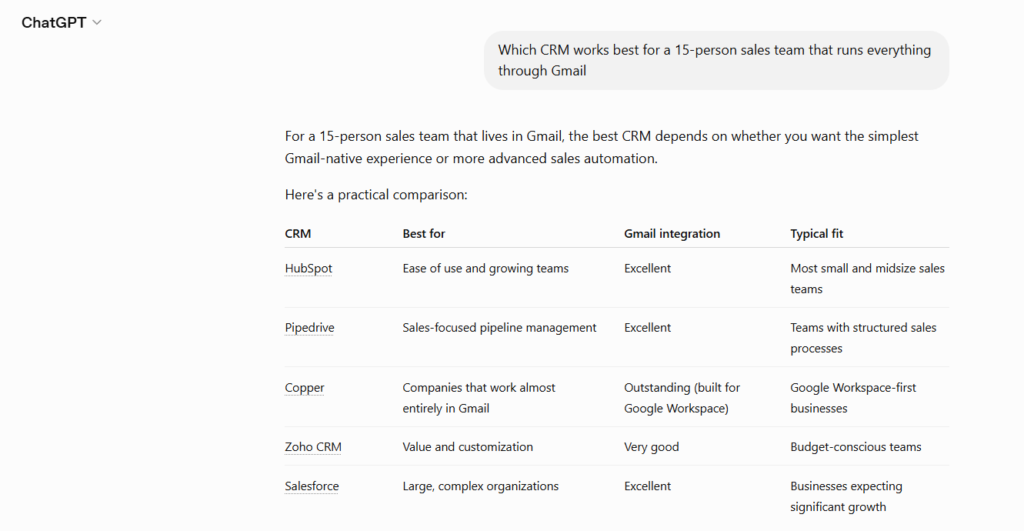
Source – ChatGPT
Showing up in the first answer gives you visibility. Appearing in the second can influence the buyer’s decision.
Most teams never separate the two. They check whether their brand appears in AI answers, find it somewhere, and conclude the strategy is working. Meanwhile, your competitors are winning the shortlist questions that buyers ask before booking a demo.
The two also require different kinds of work. A familiar category brand may appear in a general explainer without having content tailored to the buyer’s specific situation. Getting into a shortlist requires content that matches a buyer’s exact situation, including their team size, existing tools, industry, and non-negotiable requirements.
2. They Build Content Around Keywords Instead of Buyer Questions
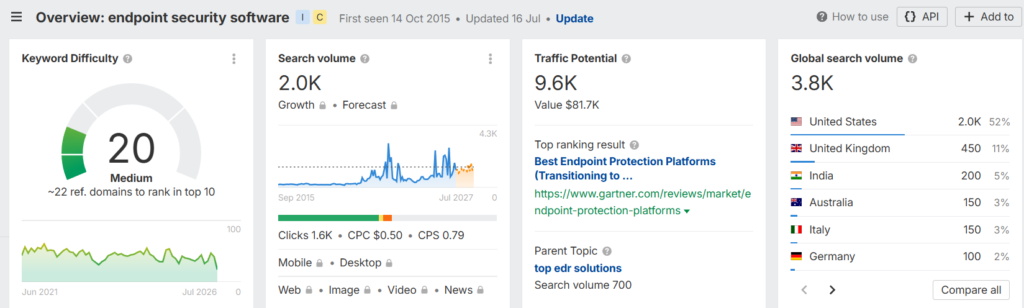
Keyword research will tell you that “endpoint security software” has a monthly search volume of 3.8K.
Source – Ahrefs
It will not tell you that buyers are asking which endpoint security platform works best for a remote workforce of 3,000 Windows users.
That is the problem. People talk to AI platforms in long, specific, conversational questions. Those exact phrases often have little or no search volume, so they never make it onto the content calendar. Instead, the calendar fills up with category-level topics. AI platforms can now answer much of that content directly, without sending users to another piece of content.
The questions that matter are sitting in places most content teams do not look: sales call recordings, objections raised before a demo, and discussions on Reddit and G2.
3. They Publish Generic Content
“Our platform is built for enterprise security teams” does not give an AI platform enough information to work with.
When an AI platform names a company, it is relying on information sufficient to support that recommendation for a specific buyer’s need. Supporting a recommendation requires specific information: which compliance requirements the product handles, what it integrates with, how it performs at a particular deployment size, and which industries use it.
A useful test is to swap a competitor’s name into your product page. If it still reads as true, the content is not specific enough to support a recommendation.
4. They Overlook the External Signals AI Platforms Trust
AI platforms do not rely only on your website. They also look at where else your company is discussed. That includes reviews on your G2 and Gartner Peer Insights profiles, mentions on third-party listicles, community threads, and analyst references. Those signals can influence which companies get recommended.
Two companies may have equally strong product pages, but one appears consistently across trusted external sources. That company gives the platform more independent information to support a recommendation.
We have seen this play out directly. One of our patent technology clients was recommended by Perplexity, but their website was not the cited source. A third-party listicle had included them, and Perplexity used that article to support its answer.
Most companies treat their own website as the entire strategy. Meanwhile, their review profiles remain incomplete, and they are missing from the comparison articles buyers and AI platforms use to compare the category.
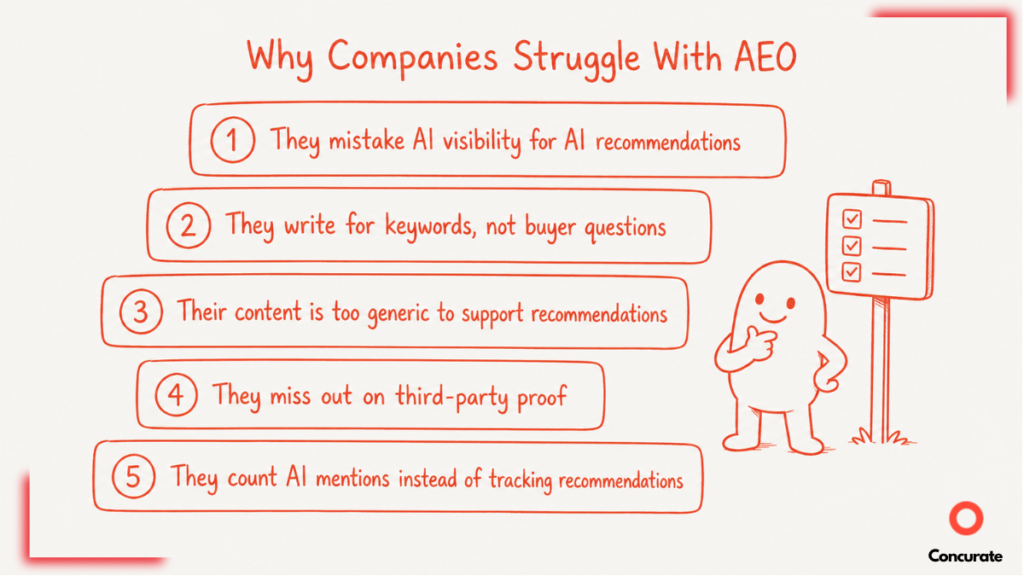
5. They Track How Often They Are Mentioned, Not Whether AI Recommends Them
Brand mentions are easy to track. But they do not answer the question that matters most: when a buyer asks what to buy, are you on the shortlist?
Direct recommendations must be tracked question by question. That means maintaining a fixed set of real buyer questions and running them across AI platforms regularly. For each question, you need to record whether your company was named and which competitors appeared instead.
Without that, you cannot tell whether the last six months of content changed anything. A dashboard showing an increase in mentions can still hide the fact that competitors are winning every buying question in your category.
An agency that understands these challenges can actually improve your answer visibility instead of simply increasing AI mentions.
Before you make a decision, here are the five factors you can evaluate.
5 Factors To Consider When Evaluating Answer Engine Optimization Agencies
Nearly every content marketing agency now offers some version of AI search optimization. But what agencies include in their AEO services can vary widely. The difference shows up in what they actually do once the engagement starts.
Below are the five factors we would focus on. They come from our own client work and from what we have seen go wrong for companies that hired an agency for AI visibility and got page optimization instead.
1. Do They Optimize for Direct AI Recommendations, Not Just Brand Mentions?
This is the first thing you should check because many agencies treat AI mentions and direct recommendations as the same thing.
The agencies that understand this build content around specific buyer questions. That means content with clear positioning about who the product is for and, just as importantly, who it is not for. Not “everything you need to know about CRM software,” but “for a 10-person sales team that works mainly through Gmail, here are the CRMs to consider.”
The clearest sign is how they describe the goal. If the pitch is about being present across AI platforms, you are getting general AI visibility. If the pitch is about which specific buyer questions you should be winning and which competitors appear instead, you are getting answer engine optimization.
| Question to ask: Can you show us a buyer question where a client became a recommended option and explain what changed? |
2. Do They Start With Buyer Questions Or Keyword Volume?
Most agencies begin with keyword research because that is the process they know. Agencies specializing in AEO start with the questions your buyers ask when they are actively comparing options.
A good agency builds that list from real inputs. They sit in on your sales calls or listen to recordings. They read how your buyers describe the problem on Reddit, G2, and industry forums. They also run prompts across ChatGPT, Perplexity, Gemini, and Claude to see which companies are being recommended and where your brand is missing.
| Question to ask: Which buyer questions would you target first, and why? |
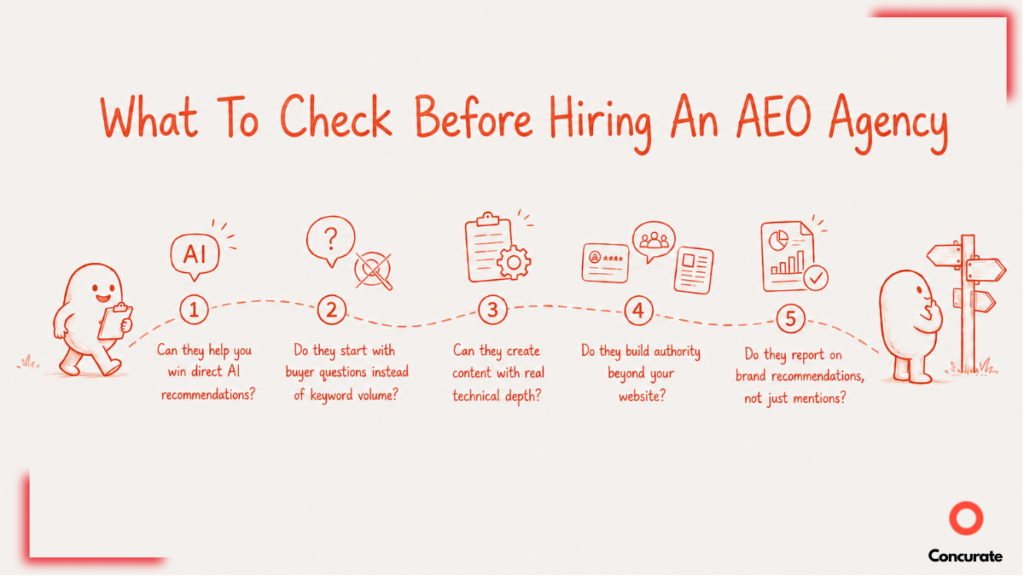
3. Can They Create Content With Enough Technical Depth to Be Trusted?
Technical depth depends more on the agency’s process than its writing, so ask how they gather expertise.
Agencies that produce content worth citing usually have an interview-based system. They speak with your product engineers, solutions architects, and sales engineers. The agency should be able to tell you how many interviews they require in a month, how long they take for each piece, and who reviews the draft for technical accuracy.
The other thing worth checking is whether they can learn an unfamiliar category. That is where you can see whether they know how to extract expertise or simply polish the information a client gives them.
| Question to ask: How do you build technical depth in unfamiliar topics? |
4. Do They Work Beyond Your Website?
Most AEO engagements focus almost entirely on your website: optimizing content, adding schema, restructuring content, and reporting on it monthly. But optimizing your website alone is rarely enough to earn a recommendation.
A complete strategy also includes sources outside your domain. That means keeping review profiles complete, collecting customer feedback, and appearing in third-party lists buyers use to compare options. It also includes building a presence in relevant communities where buyers discuss products. Some of this requires outreach, while some involves creating content for platforms beyond your own website.
Work outside your website often takes longer to produce results, so some agencies leave it out and focus only on website changes.
| Question to ask: How would you build our authority beyond our website? |
5. Do They Measure Direct Recommendations or Just Brand Mentions?
Reporting is where the difference between general AI visibility and AEO becomes clear.
A general visibility report shows how often your brand is mentioned, whether those mentions are positive, and how that compares with competitors. It may look encouraging, but it reveals little about whether AI platforms actually recommend your company.
An AEO report goes question by question. It shows which buyer questions are being tracked and whether your company appears for each one. It also shows which platforms recommend your company and which competitors appear instead.
You should also check how often the agency reruns these questions and which AI platforms it covers. A report built only around ChatGPT may miss other platforms your buyers use during their research. Because AI responses can vary between runs, users, and platforms, these results should be tracked as trends rather than treated like fixed Google rankings.
| Question to ask: Can you show us an anonymized AEO report? |
These factors provide a practical way to separate agencies that understand answer engine optimization from those applying traditional SEO tactics to AI search. Now, let’s look at the agencies leading that shift.
Meet The Top 13 Agencies Making Brands The Answer in 2026
To formulate this list, we only included agencies that clearly offer answer engine optimization services and help companies improve their visibility in AI answers.
We looked at their services, areas of expertise, case studies, client results, and how they approach AEO, so you get a shortlist of the right options to consider.
Here’s the lineup:
- Concurate
- Victorious
- Ignite Visibility
- First Page Sage
- WebFX
- Amsive
- Spicy Margarita
- Flow Agency
- Omniscient Digital
- Animalz
- Brainlabs
- NoGood
- Marcel Digital
Let’s look at each agency.
1. Concurate – Where GEO Meets AEO for Real Buyer Visibility
At Concurate, we’re not just chasing rankings on traditional search engines. Of course, we love getting your content ranked, but our goal is to make sure your brand becomes the answer.
Source – Concurate
Generative Engine Optimization and Answer Engine Optimization are often treated as separate lanes. We’ve built our practice at the intersection.
That is why we follow our proprietary Perfect Match Framework for AEO.
The idea is simple: the buyers who discover your brand should already see why your solution fits their situation. By the time they reach your sales team, the conversation should feel more like confirmation than persuasion.
This is what our playbook looks like in action:
- Define the Ideal Buyer: We identify who your platform serves, the problems buyers are trying to solve, and what makes your product the right fit.
- Benchmark AI Visibility: We test how your brand currently appears across AI platforms for the questions real buyers ask.
- Audit Existing Content: We review your key website content to see whether it clearly explains who your product is for, what it does, and why buyers should choose it.
- Build the Strategy: Based on the gaps we find, we prioritize the categories, buyer questions, and content most likely to improve AI visibility and recommendations.
- Create Expert-Led Content: We work with your sales, product, and technical teams to capture insights that generic research cannot provide.
- Monitor Performance: We track where your brand appears in AI answers, which platforms send visitors, and where new content opportunities are emerging.
We applied this approach for a newly launched staffing firm with almost no digital presence.
We created content around the searches buyers use to find staffing providers. Within six months, 11 of 15 articles reached Google’s first page, while eight appeared in AI Overviews.
More importantly for AEO, we tested five detailed buyer questions against established staffing firms. In every case, at least one AI platform leaned toward or recommended our client. The brand had started earning a place on buyer shortlists.
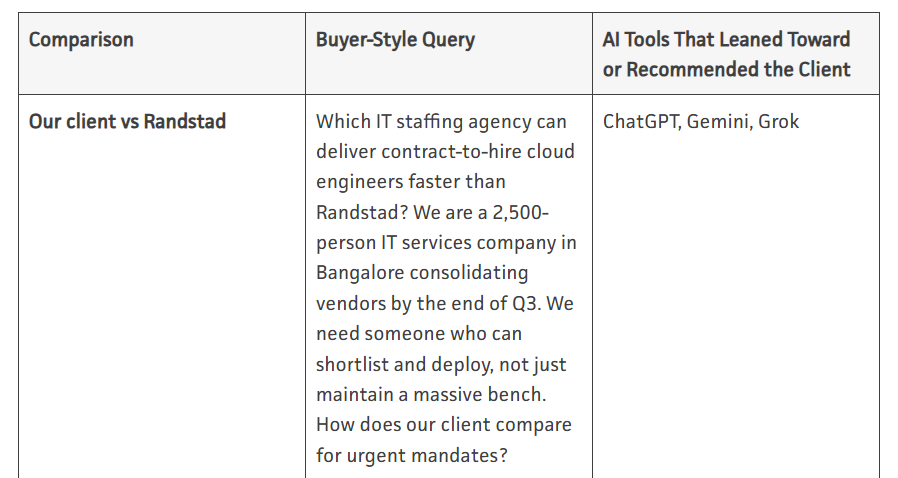
This is one of the queries. You can read the case study to find out the other queries for which our client brand got recommended by AI Platforms.
For another cybersecurity client, we created content clusters around their key service offerings and the questions buyers ask while comparing providers. In six months, the strategy generated 100+ qualified inbound leads, while 41 of 54 new articles appeared in AI Overviews.
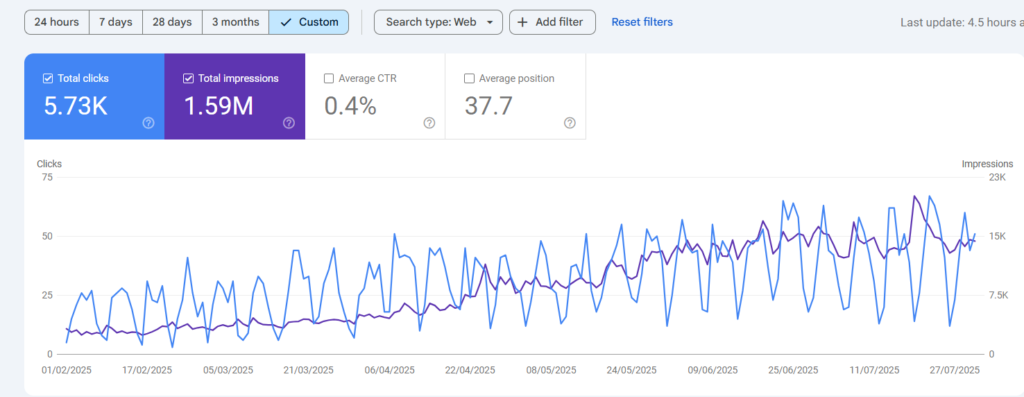
The client also surfaced in ChatGPT, Perplexity, and Gemini when buyers asked for service-provider recommendations. The brand was appearing at the exact point where buyers were building their shortlists.
We can achieve similar results for your brand too. Get your brand GEO- and AEO-ready with us. Book a strategy call and claim your spot in AI answers.
2. Victorious
Victorious has built its AEO practice around a simple idea: ranking alone isn’t enough when AI overviews own the first screen.
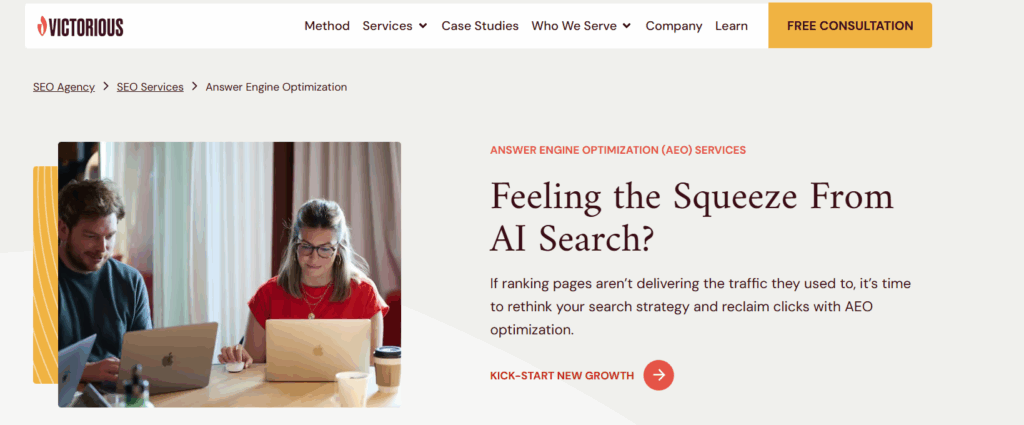
Source – Victorious
The agency focuses on reshaping content into direct, high-confidence answers, supported by structured data and technical cleanup so engines can actually parse it.
Their process leans on question mapping, content rewrites, and schema markup to make brands more “answer-ready” across Google, ChatGPT, and Perplexity.
The agency stresses that AEO requires both content and technical alignment, positioning itself as a partner that integrates answer-focused tactics into broader SEO programs.
Notable Clients: GE Digital, SoFi, Delta Dental, Bitly
3. Ignite Visibility
Ignite Visibility positions itself as a full-service digital marketing agency, but its answer engine work comes through GEO and voice optimization.
The firm emphasizes tailoring content for Google AI Overviews, voice assistants, and other AI-driven search features by layering structured data, schema markup, and FAQ-style content into client sites.
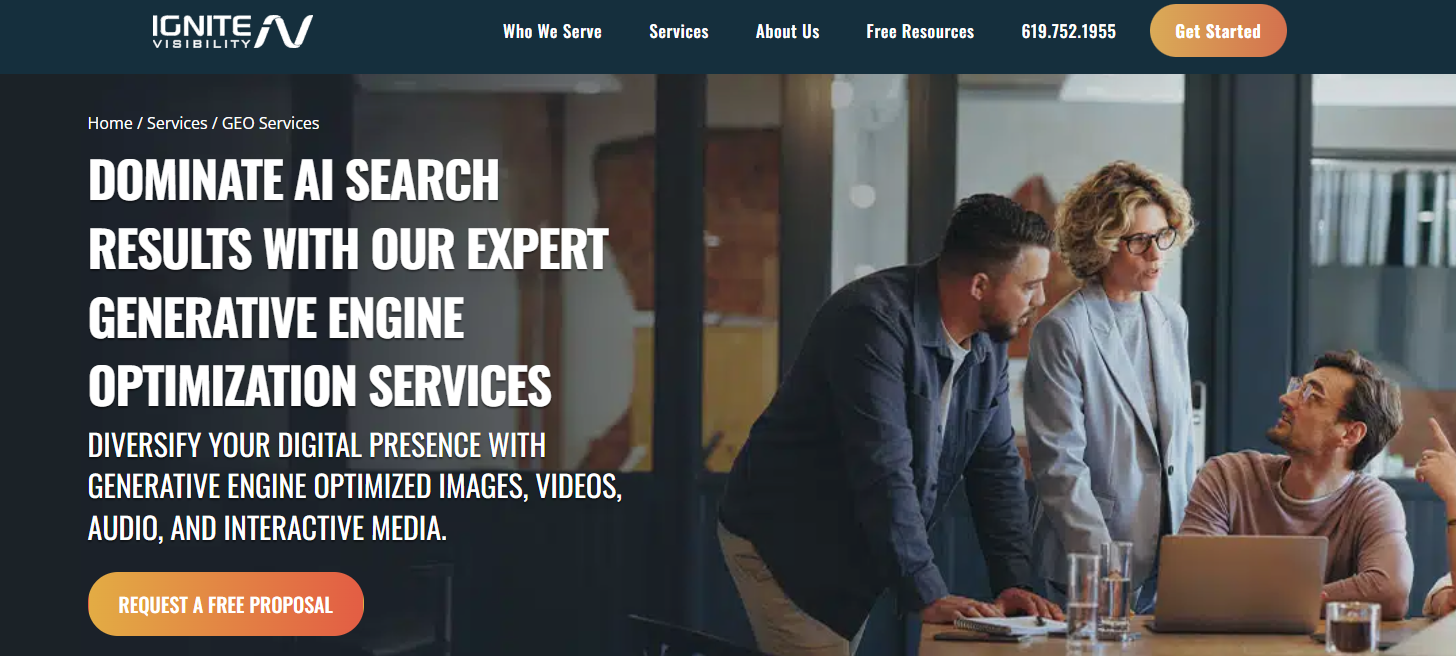
Source – Ignite Visibility
Its GEO program covers question-first content creation, snippet optimization, and E-E-A-T enhancements designed to improve retrievability in AI summaries. Ignite also integrates voice search optimization, preparing content to surface on devices like smartphones and smart speakers.
The agency presents AEO not as a standalone product but as part of a broader mix that combines technical SEO, paid media, and digital PR to help brands stay visible as AI reshapes search.
Notable Clients: Experian, Tony Robbins, The Knot
4. First Page Sage
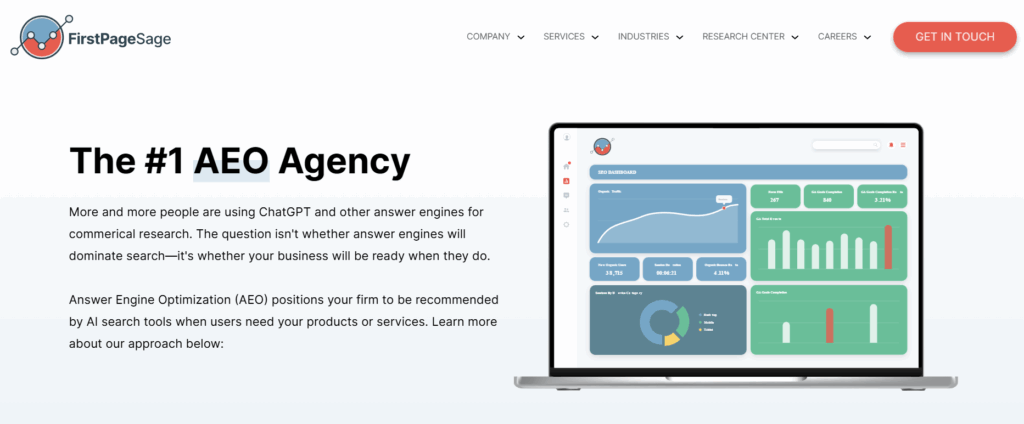
First Page Sage positions itself as the #1 AEO agency, and treats AEO as a discipline of its own rather than an add-on. Their practice is built around six pillars: full audits, authoritative content creation, structured data implementation, ongoing optimization, reputation amplification, and alignment with broader SEO and marketing goals.
Source – First Page Sage
What sets them apart is how they approach answer engines as distinct ecosystems. From ChatGPT and Perplexity to SearchGPT, their team researches the ranking factors inside each recommendation algorithm and tailors campaigns accordingly.
For brands aiming to be seen as industry authorities, First Page Sage positions AEO as both a search strategy and a thought leadership play.
Notable Clients: Salesforce, Logitech, Verizon, U.S. Bank
5. WebFX
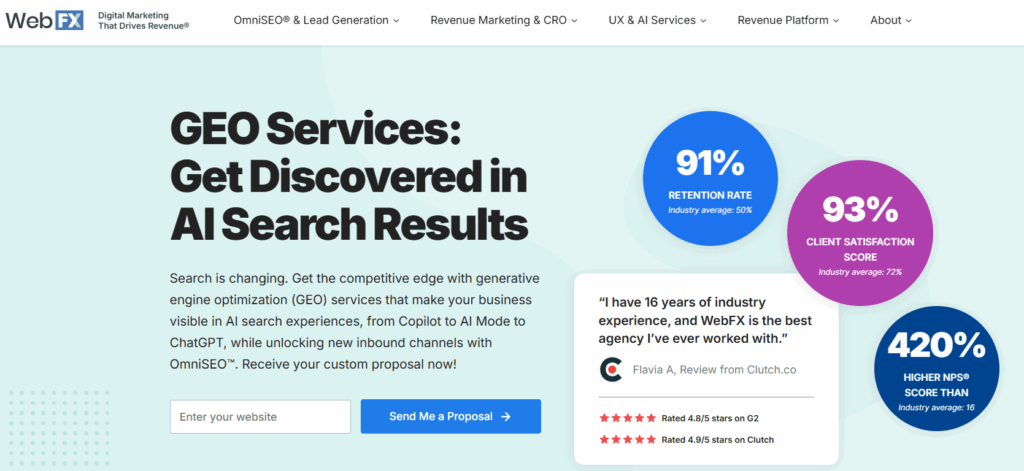
WebFX approaches AEO through the lens of what it calls OmniSEO™ – a framework designed to make brands visible across both traditional search and AI-powered engines.
Their emphasis is on building answer visibility everywhere users turn: be it Google AI Overviews, Bing Copilot, Perplexity, ChatGPT, and even Meta AI.
Source – WebFX
The agency’s differentiator lies in its scale and data. With in-house platforms like RevenueCloudFX, they mine billions of data points to refine how content is read, parsed, and surfaced by AI models. This can make WebFX particularly relevant for Fortune 500 companies that need to manage AI visibility across large websites, multiple business units, and high volumes of content.
For clients, that translates to structured strategies covering schema, content enrichment, and answer engine reporting at volume.
Notable Clients: Verizon, Sysco, Subway, Wrangler
6. Amsive
Amsive approaches AEO through what it calls “Audience Science®”, a data-driven way of shaping search visibility around the questions real customers ask.
Their service covers the core areas of answer engine optimization, including topic ideation around clustered queries, structured content aligned with LLM retrievers, and technical cleanup for AI crawlability.
Source – Amsive
They also emphasize consistency in brand citations and extend optimization to multimedia formats like video and podcasts, anticipating how multimodal AI search will surface answers.
Where Amsive differentiates is in measurement. They track how often a client is cited across generative engines with “share of voice” analysis, while monitoring sentiment and competitor visibility. That feedback loop informs both content and PR, tying AEO to broader brand performance.
Notable Clients: Emergient, Vermont Blue Advantage, Commerce Bank, University of Tennessee
7. Spicy Margarita
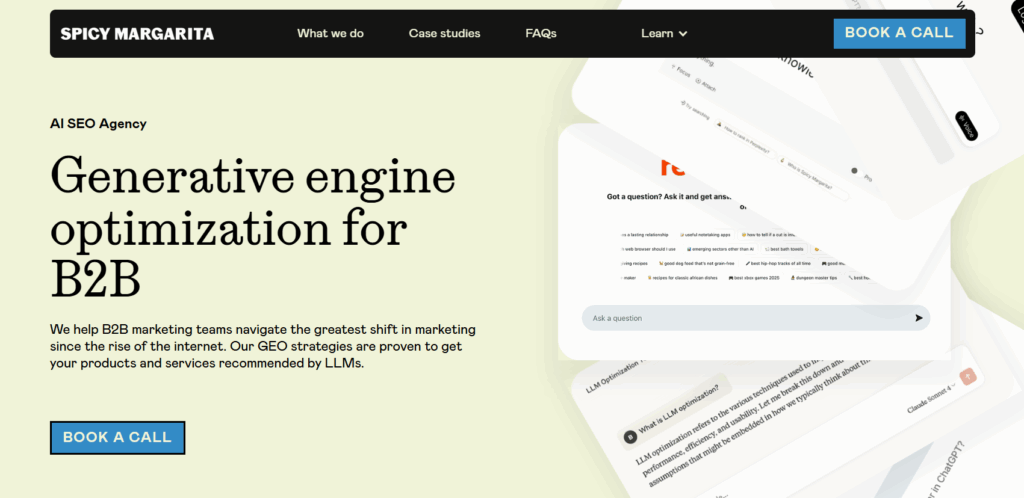
Spicy Margarita positions itself as a GEO and AI SEO partner for B2B companies, but much of what it delivers fits squarely under AEO. The agency focuses on revenue-first search strategies that place brands inside AI-driven answers.
Source – Spicy Margarita
Their services blend traditional SEO with answer engine tactics: on-site content structured for LLM retrieval, schema and entity optimization, reputation management to control how brands are described, and visibility audits that show where competitors are winning citations. Spicy Margarita also runs a dedicated LLM Visibility program, designed to secure mentions in trusted sources and ensure companies are consistently surfaced in AI-generated responses.
Notable Clients: Eton Venture Services, Piktochart, EssayGrader
8. Flow Agency
Flow Agency is a boutique B2B marketing firm that focuses on SaaS and professional services. Instead of using the label Answer Engine Optimization, they position their offering as LLM Optimization, but their work closely parallels AEO.
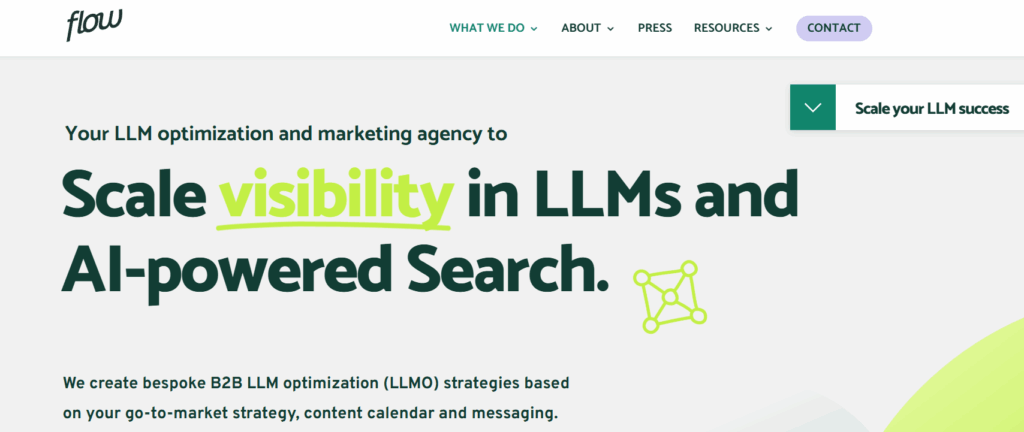
Source – Flow Agency
Their programs are designed to help brands gain early-mover visibility in AI-powered search platforms. Their services include technical SEO for AI discoverability, structured content built around real buyer questions, and auditing which sources LLMs cite so clients can appear in trusted references.
By integrating LLMO with broader B2B SEO and paid strategies, Flow Agency aims to make clients answer-ready for both organic and AI-driven discovery.
Notable Clients: Betterworks
9. Omniscient Digital
Omniscient Digital positions itself at the intersection of SEO, content, and AI. While they brand their service as Generative Engine Optimization, the practice closely mirrors AEO.
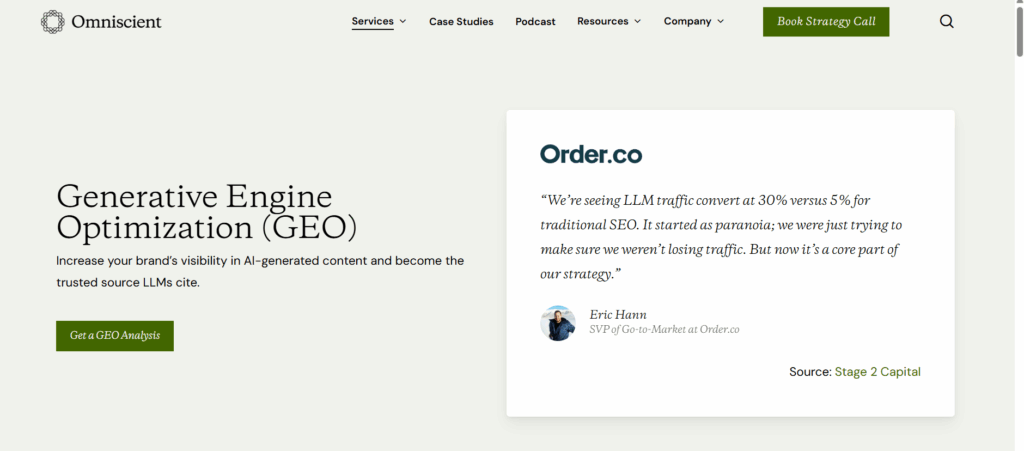
Source – Omniscient
Their focus is on making B2B software companies the sources large language models pull from. That includes producing content designed to be “source-worthy,” optimizing brand and author entities, engineering citations through PR and backlinks, and ensuring technical readability for AI crawlers.
Notable Clients: Smartling, Lokalise, GatherContent, AppSumo
10. Animalz
Animalz leans into AEO by combining editorial depth with technical alignment.
Source – AnimalZ
Their programs blend micro-refreshes, original research, and citation outreach to get brands surfaced in ChatGPT, Perplexity, and Google AI Overviews. Animalz also tracks AI mentions directly, giving teams visibility into where they’re showing up and where they’re being overlooked.
Instead of chasing vanity traffic, Animalz frames AEO as trust-building at scale: get mentioned in the answers that matter, and the pipeline follows.
Notable Clients: Airtable, Atlassian, UiPath, Wistia, Intercom, Amazon
11. Brainlabs
Brainlabs treats AEO as part of a wider media strategy. Their pitch is simple: AI engines are rewriting discovery, and visibility now depends on being understood by machines as well as people.
Source – Brainlabs
They fold AI SEO into cross-channel programs, combining technical SEO with creative, retail media, and programmatic. Their goal is to be surfaced in the right context across Google AI Overviews, ChatGPT, and retail search engines.
Brainlabs’ strength lies in scale: they use their proprietary Cortex AI platform to test, measure, and optimize at speed, making AEO a lever inside a much larger growth engine.
Notable Clients: Microsoft, PepsiCo, Estée Lauder, eBay, American Express, Formula 1, Lego
Related Read: 15 SaaS Leaders Reveal How to Get Recommended by ChatGPT & Perplexity
12. NoGood
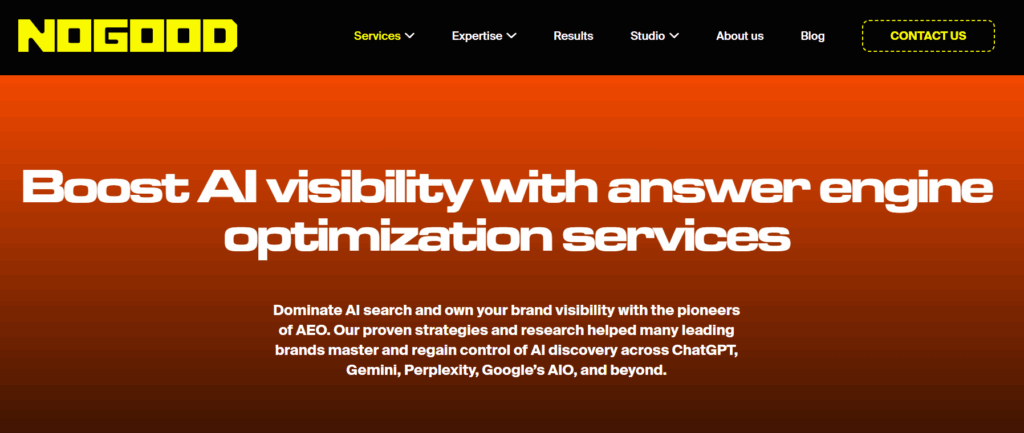
NoGood positions AEO as the next evolution of organic growth. They’ve built a dedicated practice around it, from AI visibility audits and technical fixes to content refreshes designed specifically for AI readability.
What makes them stand out is Goodie, their proprietary AEO platform that tracks citations, visibility, and conversion impact across LLMs in real time.
Source – NoGood
Their approach is holistic: owned content, earned citations, Reddit and community engagement, technical architecture, and digital PR all stitched together into one AEO strategy.
Notable Clients: JVN Hair, Spring Health, Amyris
13. Marcel Digital
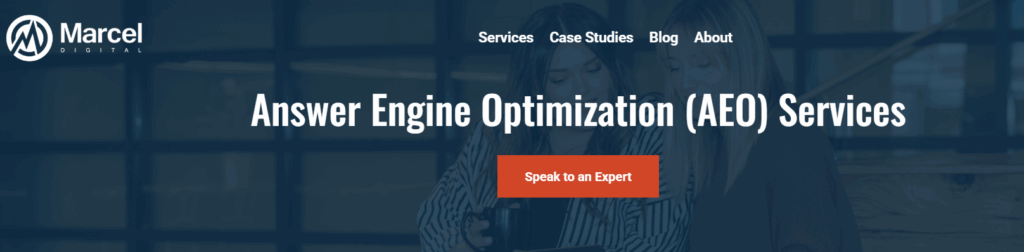
Marcel Digital treats AEO as more than an add-on to SEO. Their offering is built around making brands discoverable in AI-driven environments like Google’s AI Overviews, Microsoft Copilot, ChatGPT, and Perplexity. They run AI visibility audits, tighten technical performance, and implement structured data so content can be parsed and cited by answer engines.
Source – Marcel
What differentiates Marcel is the way they blend traditional SEO infrastructure with AEO tactics, balancing schema, FAQs, and AI-readable content with digital PR and authority building.
For companies already investing in organic growth, they’re positioned as a partner that can extend those gains into AI search without reinventing the wheel.
Notable Clients: Komori, Johns Hopkins University, Ziegler, Kellogg’s
If your company is already past the early growth stage, this list of generative engine optimization agencies for unicorns is a useful next step for finding partners built for scale.
An AEO agency will be more effective when your company’s information and internal expertise are easy to access. Before you hire one, there are several things you can start doing internally.
What Brands Can Do Internally Before Hiring an AEO Agency
You do not need to rewrite your website or resolve every technical issue before approaching an AEO agency. A capable agency should identify those gaps and recommend what needs to change.
What you can do internally is organize the information the agency will need to understand your business and build an informed strategy.
- Document where your product fits: Clearly outline the problems your product solves, its primary use cases, the situations where it is the strongest fit, and when another solution may be more suitable.
- Define your ideal customer profile: Note the roles involved in buying your product, the company sizes you serve, the industries you cater to, the regions you operate in, and any technical or operational requirements your customers commonly have.
- Capture the questions buyers ask: Review sales calls, demo notes, support conversations, and customer emails. Document the questions, objections, comparison points, and concerns that repeatedly come up during the buying process.
- Organize your product and customer evidence: Bring together customer stories, measurable outcomes, integrations, security credentials, industry experience, and other details that support why a buyer should consider your company.
- Identify internal subject matter experts: Make a list of the people an agency can speak with across product, sales, customer success, and technical teams. These conversations often provide the specific insights that cannot be found through external research.
You do not need to turn all this information into polished content. The goal is to make your company’s knowledge easier to access.
A specialized AEO agency can then use it to assess your current visibility, identify the real gaps, and determine what needs to be created, improved, or distributed.
Concurate is equipped to support you with exactly that. We have extensive experience helping B2B and SaaS companies appear in AI answers when their products are the right fit for the buyer’s needs.
Want to Work With Us?
If you want your company to appear when buyers ask AI platforms which solutions they should consider, we can help. You can learn more about our GEO and AEO services here or book a call with us.
Preparing your content for AI search starts with the right fundamentals. This checklist covers the key optimizations that help SaaS blogs become easier for AI platforms to understand, cite, and recommend.
Frequently Answered Questions
1. What is Answer Engine Optimization?
Answer Engine Optimization is the process of structuring and presenting content so AI engines, search platforms, and voice assistants can pull it as the definitive answer.
Think featured snippets on Google, “People Also Ask” boxes, Siri/Alexa reading your response, or ChatGPT citing your page as the source of a fact.
AEO is the play for authority. It’s about being the name users remember when they ask a question.
2. What is Generative Engine Optimization, and how is it different from AEO?
Generative Engine Optimization operates one level above AEO. Instead of winning the single answer slot, it focuses on making sure your content is included, synthesized, and blended into multi-source AI-generated responses.
Think Google’s AI Overviews, Perplexity summaries, or ChatGPT’s multi-paragraph answers that mix several sources. Sometimes you get cited. Sometimes you don’t. But your influence shapes what the user reads.
Here’s how AEO and GEO compare:
| Dimension | AEO – Answer Engine Optimization | GEO – Generative Engine Optimization | SEO – Search Engine Optimization |
| Primary goal | Be the named answer for a specific question | Be included in a multi-source AI summary | Rank higher in search engine results pages |
| Typical surfaces | Featured snippets, PAA boxes, voice assistants, AI facts | AI Overviews, ChatGPT, Perplexity, Gemini long-form answers | Google/Bing SERPs |
| Attribution | High – usually cited or read aloud | Variable – sometimes cited, often blended | Always visible through ranking/link |
| Content that wins | Concise Q&A, fact boxes, schema, tight claims | Depth, semantic breadth, corroborated sources | Keyword-optimized, link-backed pages |
| Business value | Authority + recall: users remember who answered | Presence + influence: shape the synthesis users read | Visibility + clicks: users land on your website |
3. Why is Answer Engine Optimization important in the era of generative search?
Because generative AI is shrinking the space for visibility. Instead of ten blue links, users see one snippet or a handful of citations. If your brand isn’t the answer, it’s invisible.
AEO makes sure you don’t just show up on Google but also inside AI Overviews, voice assistants, and LLM-powered shortlists where buying decisions are happening.
4. Can you do Answer Engine Optimization yourself?
Yes, but it’s tricky. If you want to experiment, start with:
- Adding FAQ sections and How-To guides to your content.
- Using schema markup (FAQ, HowTo, Organization).
- Aligning copy with the way buyers phrase questions in forums, reviews, and Reddit threads.
- Monitor if your brand appears in ChatGPT, Perplexity, or Google AI Overviews.
But scaling this consistently requires a system. You need continuous monitoring, third-party authority building, and tailored content clusters, which is why agencies like Concurate exist. You can book a consultation today to get started.
Disclaimer: The information presented in this article is compiled from publicly available sources, including company websites, industry reports, and social media. All trademarks, brand names, and logos mentioned are the property of their respective owners. We do not claim any ownership of third-party marks, nor do we imply endorsement or affiliation. This article is intended for informational purposes only.