


| TL;DR: Traffic from AI tools converts much better than Google. Hence, Concurate’s GEO framework is built on the core idea of attracting the kind of prospects where conversion feels like a mere formality. That is why we call it The Perfect Match. It has six stages: 1. Define, 2. Benchmark, 3. Audit, 4. Strategise, 5. Create, and 6. Monitor. This article tells readers about what happens at every stage. |
A prospect once stopped us mid-call and asked: what is your framework for getting a brand to show up in AI answers?
Eleven people on the other side. A company with over 200,000 employees and operations in 60 countries. The kind of room where words without a visual anchor do not clear the bar.
We did not have a good enough answer.
Not because we did not know what we were doing. But because we had never written it down.
That call changed something. We went back, mapped every step we take before writing a single word of content for a client, and built a framework around it.
We call it The Perfect Match Framework. This is how it works.
The Perfect Match – GEO Framework at Concurate
An inbound lead comes in and gets handed to the sales team. The first demo goes well. The second call looks promising. Then the deal falls apart. Not because your sales team failed. Because the relationship was never meant to work. The prospect was never the right fit.
Divorce was never the goal. A marriage that feels like it was made in heaven was.
That’s what The Perfect Match Framework is built for.
It helps ensure that the buyers who discover you, engage with you, and eventually reach out have already decided you’re the right solution for their problem. The sales conversation becomes confirmation, not persuasion.
Six stages get you there:
- Define: Know exactly who your ideal buyer is
- Benchmark: See where you actually stand in AI answers today
- Audit: Find out what is holding you back: content, technical, and AI visibility
- Strategise: Build the plan to close the gaps
- Create: Publish content built on real expertise, not generic advice
- Monitor: Track whether the match is actually working, and keep improving it

01 – Define
Did you know that most people on dating apps have a rough idea of who they are looking for, but almost none of them are specific enough?
Tall. Funny. Loves dogs. Wants kids. Good family. It feels specific enough. But that description fits roughly four million people. And most of them would be completely wrong for you.
The moment you start swiping right on Tinder without clarity, you are swiping on potential, not fit.
Here is what Twinkle Khanna did before marrying Akshay Kumar. She did not just look at him. She ran a full background check on his entire family. Their health histories. What illnesses ran in the family line. What his uncles died of. She did this quietly, without telling him. Akshay found out only after the wedding.
Twinkle’s logic was airtight. Vague parameters do not decide compatibility.
The same applies to AI search. When a buyer types a query into ChatGPT, they are not typing “best CRM tool.” They are typing something like: “I run a dental clinic in Austin, we just crossed five locations, I need practice management software that works without a full-time IT person, my front desk team is not very tech savvy, and I cannot afford three months of onboarding.”
AI reads that brief and matches it against everything it knows. The brands that show up are not the biggest. They are the ones whose content speaks directly to that exact situation, that exact frustration, that exact constraint.
So we start here. Request a detailed ICP from clients covering pain points, situational triggers, decision-making units, and disqualifiers. If they do not have one, we build it together. Set up a call with their sales team. Ask them about their champion customers, what frustrated them before they found your client, and what finally made them decide. Dig into discovery call transcripts and CRM records.

02 – Benchmark
Before asking someone out, it’s worth knowing whether they’re even aware you exist. That is exactly what Benchmark measures: whether the buyers you want to reach can actually find you when they ask AI tools for recommendations.
In an internal study at Concurate, we found a couple of fintech companies with $10M to $50M ARR were nearly invisible in AI search. Smaller competitors with a fraction of their revenue were being recommended instead. Not because they were better. Because their content matched specific prospect queries.
This is what we do in Benchmark.
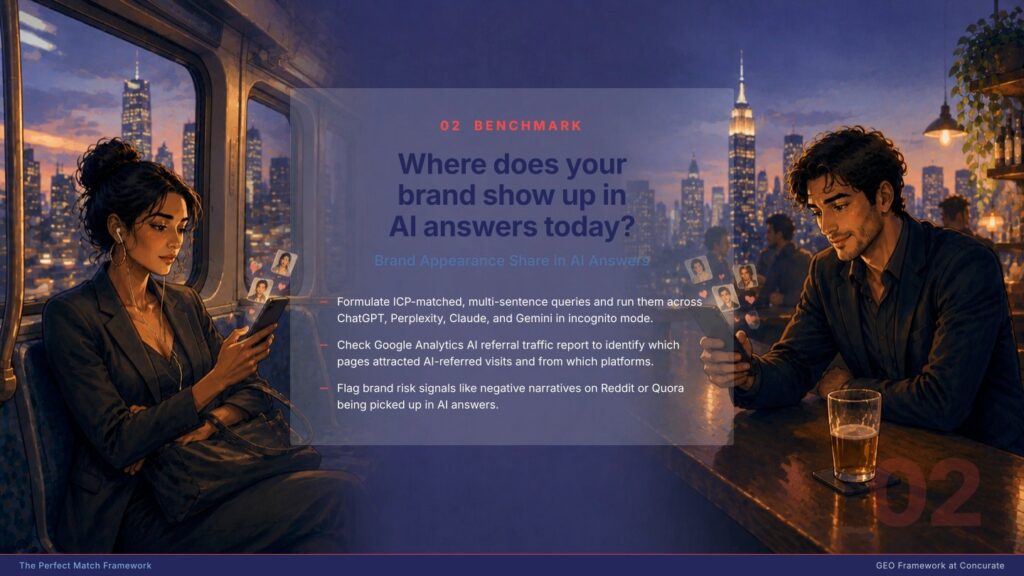
We formulate 20 to 25 ICP(Ideal Customer Profile)-matched, multi-sentence queries and run them across ChatGPT, Perplexity, Claude, and Gemini in incognito mode. We track where your brand shows up and where it should but does not. We used a similar process in our study of AI visibility tool recommendations, running buyer-style queries across three AI platforms to identify which tools appeared most often and what could be supporting their visibility.
Then we do citation (sources that AI tools referred to for composing their answers) analysis. We identify which sources AI is pulling from to make recommendations. Listicles? Case studies? Third-party content? This tells us what kind of content is influencing AI answers about your category.
We check your Google Analytics AI referral traffic report. We identify which pages attracted AI-referred visits and from which platforms. This shows us what content AI actually considers valuable enough to reference.
We flag brand risk signals. We worked with a repair and care plan provider company in the UK. During benchmarking, we found negative Reddit narratives about care plans being picked up in AI answers. That was the perception that needed to be changed with the right customer education.
This baseline is the foundation. Everything that follows depends on what we find here.
| 📌A Note on Measuring AI Visibility AI answers are moody. You ask ChatGPT at 9 AM, you show up. Your manager asks at 2 PM, you’re gone. That is not a bug. Prompts shift. Personalization kicks in. The whole thing is probabilistic. So we do not treat AI visibility the way we treat Google ranks. We treat it as a way to find content gaps. Also, getting linked is not the same as getting recommended. You want to be the answer. Not the footnote nobody scrolls to. And every LLM plays by its own rules. ChatGPT absorbs. Gemini cites. Perplexity does its own thing. If you are curious about how they differ, 13 research papers say a lot about this. |
03 – Audit
Once you know who you want as your potential match, you would want to figure out if they would also be interested in you. Hence, after benchmarking, we know where you stand. Now we dig into why.
The idea at this stage is to figure out if AI can read our content and if we are feeding it the right content. That’s why we run two parallel audits.
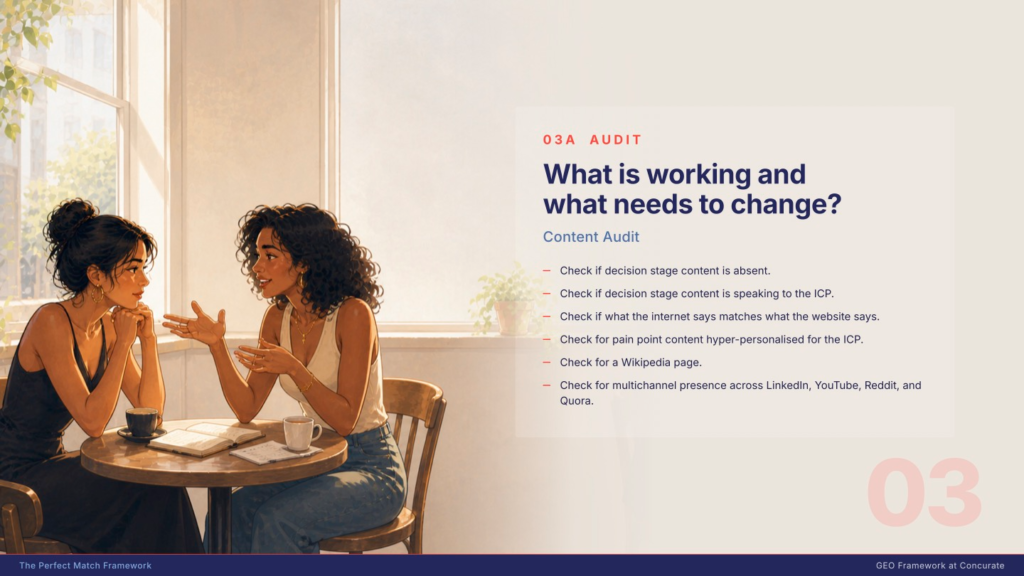
The first is a Content Audit. We check if decision stage content exists. We check if that content is speaking to the ICP. Moreover, we check for a Wikipedia page and identify whether what the internet says matches what your website says.
We look for pain-point content hyper-personalised for the ICP. We map your multichannel presence across LinkedIn, YouTube, Reddit, etc.
| 📌Why do Most B2B SaaS Listicles Fail to Generate Leads Lack of specificity around ICPLack of pain point resonance with ICPMore focus on features than benefitsLack of social proof like video testimonials and comprehensive case studiesLack of differentiation in positioningLack of a proprietary layer |
The second is a Technical and AI Visibility Audit. We check core web vitals and run site health scans. In addition to that, we check if content is structured for AI to parse cleanly. We check for blocked pages. We check if llms.txt exists and correctly lists priority pages.
This is where the gaps become visible. Everything we build next closes them.

04 – Strategize
Now you would make a plan to come in front of your potential match. Hence, once the audit shows us the gaps, we build the plan. Most of this work happens on your website, because that is where we have the most control.
We identify keywords for evaluation and comparison stage content, the searches a buyer runs when they are actively shortlisting and deciding, not just learning.
Beyond that, the plan shifts based on what the audit actually found.
Sometimes we run a content campaign to build topical authority in a category where a client has no footprint. Sometimes the gap is proof, and we help build out case studies because that is what is missing entirely. If it is a new category with no search demand, we focus more on how-to content for product discovery instead of evaluation stage content.
Original data plays a bigger role in getting cited by AI tools than most of us expect. Just as Google rewards information gain, AI rewards original data that it cannot find elsewhere.
When we broke down Ramp’s SEO and GEO playbook, their proprietary data studies stood out as one of the strongest levers in their entire strategy. Ramp turns anonymized spend data from its own platform into two recurring reports, the AI Index and the SaaS Leaderboard, refreshed every month. That data has been cited by The Atlantic and The New York Times. From an SEO perspective, these are high-authority backlinks, and from a GEO perspective, these help in establishing brand trust.
Hence, in this stage we also look at whether a client has data worth turning into an asset like this.
This is the plan. Stage 5 is where it comes to life.

05 – Create
Time for the first date. This is where the plan turns into published work.
We start by getting close to the client’s business. We use an ICP questionnaire built from publicly available information, then fill in the gaps by interviewing someone from the client’s sales team, someone who has sat through real objections and knows why deals close or fall through.
In addition to that, we watch product demos ourselves. Wherever possible, we also talk to someone from the product team to understand specific features so that we can better explain the benefits.
We set a Mutual Action Plan with timelines for draft delivery, review cycles, and publishing dates, so nothing sits waiting on either side.
Thought leadership content comes from direct interviews with senior leaders. With Triangle IP, we send the founder specific how-to questions, ones built directly from the pain points his target users face. He records his answers on video, and in every video, he demonstrates how the tool solves that exact problem. We publish it on their YouTube channel, then repurpose it into blogs, guest posts, and LinkedIn posts.
Every client works differently. Some review every single piece we send. Others have no bandwidth for review at all. For clients where deep review is not possible, we lean on templated articles built from tool data, where the structure does most of the work. Either way, for GEO, articles need a credible, named author. That is what earns AI’s trust.
We request access to tools like Google Search Console and Google Analytics. Where possible, we request the client to build a dynamic list inside the client’s CRM to track leads that come specifically from the content we write.
This is where the framework stops being a plan and starts becoming visible in the world.

06 – Monitor
The framework does not end at publishing, just like how you would work towards earning more dates and eventually enter a relationship.
Every quarter, we re-run manual benchmarking to see where the brand is appearing in AI answers. But we treat this more as a proxy than as proof. Running queries through ChatGPT, Perplexity, Claude, and Gemini tells us how visible the brand looks. It does not tell us whether that visibility is actually pulling in business.
The real proof is AI referral data.
We track AI referral traffic in Google Analytics 4, broken down by source and page. Which AI tools are sending traffic? Which specific pages are they landing on? This tells us which pieces of content are doing the heavy lifting.
But at Concurate, we care more about leads than traffic. Most of our clients use HubSpot, which shows which leads came via AI referral. Some clients use other tools. Either way, the goal is the same. We want to know which real leads walked in through AI, so we can double down on what is working and rework what is not.
Models will keep changing. Mediums will keep shifting. But what a buyer needs to make a decision does not. Keep the foundation strong, and adapt everything else around it.

Concurate – Your Partner for AI Visibility in GEO Era
Search behaviour will keep evolving. From Google to AI tools. From AI tools to whatever comes next. But one thing does not change. Humans make buying decisions in a specific way, just like how compatibility makes marriages work. And every decision comes down to the same foundation: does this brand understand my problem, do I trust the proof, and can I see myself in the story they are telling?
That is exactly what we help B2B SaaS companies do. Attract the right buyer with content that speaks to their exact situation. Build proof they can trust. Make it easy for them to say yes.

We recently helped a B2B financing platform get a 100% lift in AI referrals, a 315% surge in Google AI Overviews, and a 300% increase in qualified leads.
If you want the same for your brand, book a call with us. We will show you exactly where you stand and what it will take to become the recommended one in AI answers.
Frequently Asked Questions (FAQs)
1. How does Concurate Do Benchmarking for AI Appearances?
Concurate primarily focuses on evaluation-stage queries when the prospects are creating shortlists in a specific B2B SaaS category. We keep the queries nuanced with information like team size, specific integration requirements, learning curve, support, etc. to attract the prospects who are most likely to convert.
2. Does Concurate Include AI Answers for Evaluation-Stage Queries?
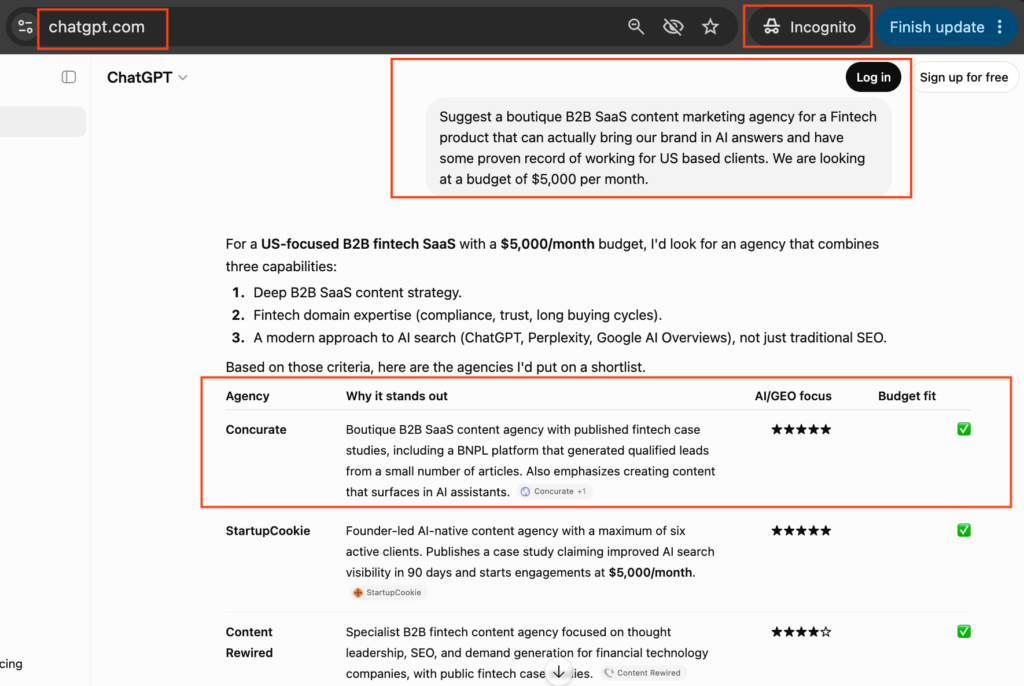
Yes, when there is a perfect match :), check this screenshot below where we ran a nuanced query to find an agency like ours, and Concurate was the first answer:
3. How to Know if We are Receiving Traffic from AI Tools like ChatGPT, Perplexity, Claude, etc.?
The quickest way to check is inside your Google Analytics 4 account. You do not need any additional tool for this.
Head to the Explore section in GA4 and build a custom report. Add Page referrer and Page title as dimensions, and Sessions, First visit, and Key events as metrics. Then apply a regex filter on Page referrer that matches AI tool URLs, ChatGPT, Perplexity, Claude, Gemini, CoPilot, and others. Save the report.
That is it. You now have a live view of which AI tools are sending traffic to your website and exactly which pages they are landing on.
For the full step-by-step walkthrough with screenshots, read our complete guide here.