

| TL;DR: Low-code and no-code platforms are built for speed and simplicity. But that same simplicity makes them nearly impossible for AI systems to tell apart. Every platform uses the same language, targets the same keywords, and ends up sounding identical online. So even well-built, actively marketed platforms keep getting skipped in AI-generated recommendations. Generative engine optimization agencies for low-code platforms like Concurate, Quoleady, and Omniscient Digital fix this. By restructuring how your content is positioned and creating clear contextual signals around your specific use cases, workflows, and buyer profiles, they help AI systems actually understand and recommend your platform. This blog covers 10 such agencies you can consider. |
You’ve probably noticed this already.
Every time someone asks ChatGPT, Gemini, or Perplexity for the “best low-code platforms” or “top no-code tools,” the same few brands show up. Meanwhile, platforms like yours barely get a mention.
At some point, it starts feeling like AI systems have some personal vendetta against you. After all, your tool is easier to use, you run laser-focused SEO and paid campaigns, and you even push more content just to get cited.
But that’s not the case. The truth is, they just can’t tell where your tool fits.
You see, most low-code and no-code websites basically use the same marketing terms in big, bold fonts: “drag-and-drop builder,” “no coding required,” “launch in minutes,” and so on. When AI tries to figure out which platform does what best, it just can’t tell them apart. So, it does what anyone would do. It picks the legacy names it’s most confident about, even if your platform would’ve been a better choice.
It’s a problem. But that’s exactly the gap that generative engine optimization agencies for low-code platforms are built to fill.
Top 10 Generative Engine Optimization Agencies for Low-Code Platforms
Simply publishing more blogs or running stronger SEO campaigns doesn’t automatically improve AI visibility for low-code or no-code tools. Yes, they might bring traffic. But AI discovery works differently from traditional search.
You may have already noticed this if you hired a generalist marketing agency. They promise to get you discovered by AI systems, yet proceed to go aggressive with keyword ranking. The result? You end up right where you started.
AI tools care about something different. They value content structure, clarity, and relevance. That’s exactly where the below companies offering generative search optimization services for B2B low-code companies stand out.
- Concurate
- Quoleady
- Virayo
- Linkflow
- First Page Sage
- Growth Plays
- Slam Media Lab
- Animalz
- Omniscient Digital
- Perceptric
Now, let’s discuss every low-code GEO agency in detail, starting with Concurate:
Concurate – Best for Building AI Visibility Around Real Low-Code Buyer Journeys
As a low-code founder, your biggest marketing roadblock today is AI visibility. Your marketing team is trying to publish more articles, update landing pages, and even run paid campaigns, but with no visible results on AI.
When buyers are asking AI tools, “What’s the best no-code app builder?” and “What are the best low-code platforms for internal tools?”, your platform is nowhere to be found.
That’s exactly where we at Concurate can help.
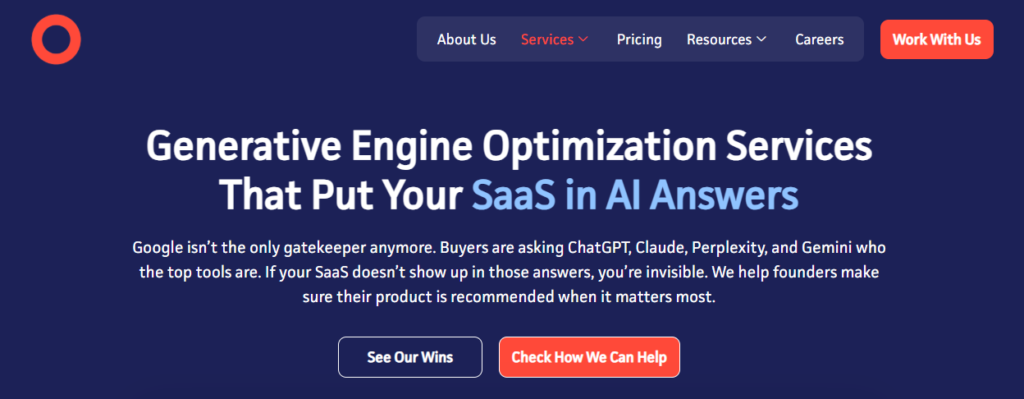
Source – Concurate
At Concurate, we don’t treat GEO like another SEO service. We treat it as a positioning and discoverability problem first. Our goal is simple: help AI systems understand who your platform is for, what workflows it supports, and when it should be recommended over other low-code and no-code tools.
In fact, after running multiple GEO campaigns across industries, we identified clear patterns behind why some brands appear more often in AI-generated recommendations. Those learnings shaped our proprietary Perfect Match Framework, a GEO playbook designed to help AI systems match your brand with the right buyer questions, workflows, and use cases.
Here’s what it entails:
How We Approach GEO for Low-Code Platforms: Decoding Our Perfect Match Framework
We start by understanding your ideal buyer in detail. Not just basic personas, but the actual problems buyers are trying to solve, the workflows they struggle with, the tools they currently use, and the triggers that push them to start evaluating low-code platforms in the first place. If you already have this documented, we work from it. If you don’t, we build it using your customer data, sales call transcripts, and discovery notes.
That matters because AI tools do not recommend products randomly. They try to match platforms to very specific situations. For example, a healthcare operations team searching for internal workflow automation should ideally see very different recommendations from a startup looking for a lightweight internal dashboard builder.
Once that buyer context becomes clear, we study how your brand currently appears across AI tools. We also check your Google Analytics AI referral traffic to see which pages are already pulling AI-referred visits.
We also flag brand risk signals: negative narratives on Reddit or Quora that might be getting quietly picked up in AI answers before a buyer ever reaches your site. Community discussions across LinkedIn and YouTube are reviewed, too, because these platforms increasingly influence how AI systems interpret software categories and buyer sentiment.
Then comes the content and visibility audit.
Most agencies simply ask whether your content is ranking. We go deeper. We look at whether your content actually answers decision-stage questions, whether your positioning sounds too generic, whether your use cases are clear enough, and whether AI crawlers can properly access and interpret your important pages. We also check core web vitals, run a site health scan, and verify your llms.txt is present and listing the right pages so AI crawlers know what actually matters.
This becomes especially important in low-code because category saturation is a real problem. After a point, most platforms start sounding identical online.
That’s why we focus heavily on contextual and workflow-based content instead of generic SEO blogs. Rather than publishing another “What is low-code?” article, the strategy focuses on high-intent searches tied to real buying situations.
For example:
- low-code tools for insurance workflows
- Retool alternatives for operations teams
- internal tools for healthcare admins
- no-code workflow software for logistics companies
- low-code CRM builders for sales teams
This is also where our AI SEO services for low-code companies become much more effective. The strategy is designed around helping AI systems confidently connect your platform to specific workflows, industries, and use cases instead of treating your product like another generic SaaS tool.
Once the strategy is in place, we move to execution. We interview your in-house experts and sales team to capture firsthand perspectives that exist nowhere else on the internet. That’s what separates our content from generic agency output: it’s built on original insight, real product nuance, and actual customer language. We set a publishing cadence with you and create content according to the strategy.
And importantly, the process does not stop after publishing content. We continuously track how your visibility changes across AI platforms over time, which prompts start surfacing your platform more often, and where competitors are still outperforming you.
So if your low-code platform isn’t getting recommended by AI tools despite all the effort, book a call with us. Let’s build the right GEO strategy for your brand!
Pricing
Our monthly retainers usually fall between $5,000 and $7,500, and specific one-off projects begin at about $3,500.
Notable clients
PQAI, Datacipher, Triangle IP, Pinch Patent Drawings, Athena Security, InspireIP
Rating: 5/5 (2 reviews)
2. Quoleady – Best for Building Third-Party Authority That Improves AI Trust Signals
Quoleady is a content marketing and digital PR agency known for helping SaaS brands grow through thought leadership and editorial visibility.
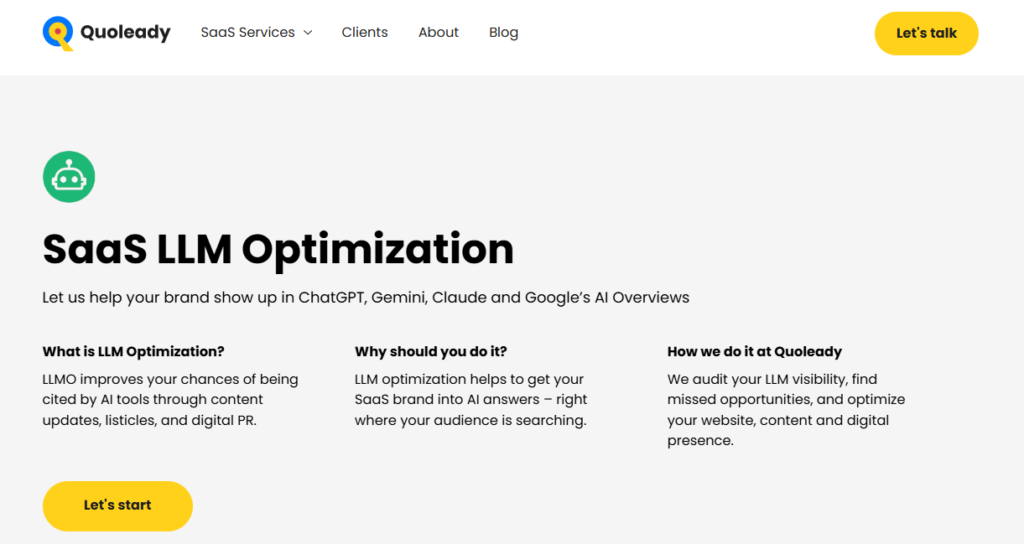
Source – Quoleady
The agency focuses heavily on getting brands featured across trusted publications instead of relying only on on-site SEO content. That approach matters because AI systems often pull recommendations from brands that appear repeatedly across credible sources.
The team also puts strong emphasis on expert-led articles and contributor-driven content. This helps create the kind of authority and familiarity that can improve how often a company gets surfaced in AI-generated recommendations and category comparisons. Quoleady is particularly effective for brands trying to strengthen visibility outside their own website and build a broader digital footprint across the SaaS ecosystem.
Pricing: Available upon request
Notable Clients: monday.com, Hyperise, Wooclap
Rating: 4.9/5 (5 reviews)
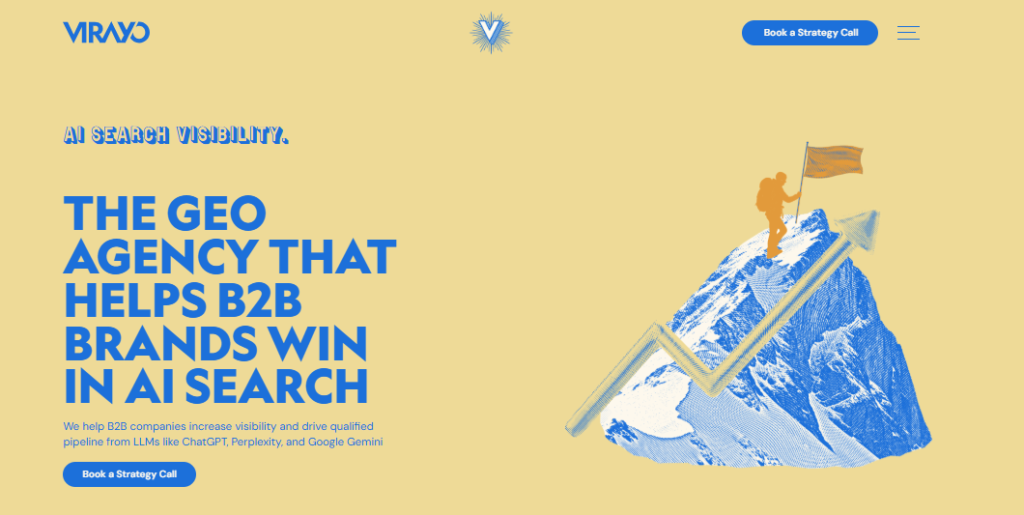
3. Virayo – Best for Simplifying Complex Product Positioning for AI Search
Virayo is a GEO-focused agency that works closely with B2B SaaS and technical software companies.
Source – Virayo
Its approach is much more structured and semantic compared to traditional content agencies, especially when it comes to helping AI systems interpret product messaging correctly.
The agency focuses on improving topical clarity, entity recognition, and contextual relevance across websites and content assets. They can be particularly useful for products with multiple workflows or overlapping use cases where AI tools may struggle to categorize the platform accurately. Virayo also highlights they pay close attention to how information is structured across pages so AI systems can connect product features, user intent, and industry relevance more effectively.
Pricing: Available upon request
Notable Clients: Sprout Social, SPOTIO, Brandfolder
Rating: 4.8/5 (11 reviews)
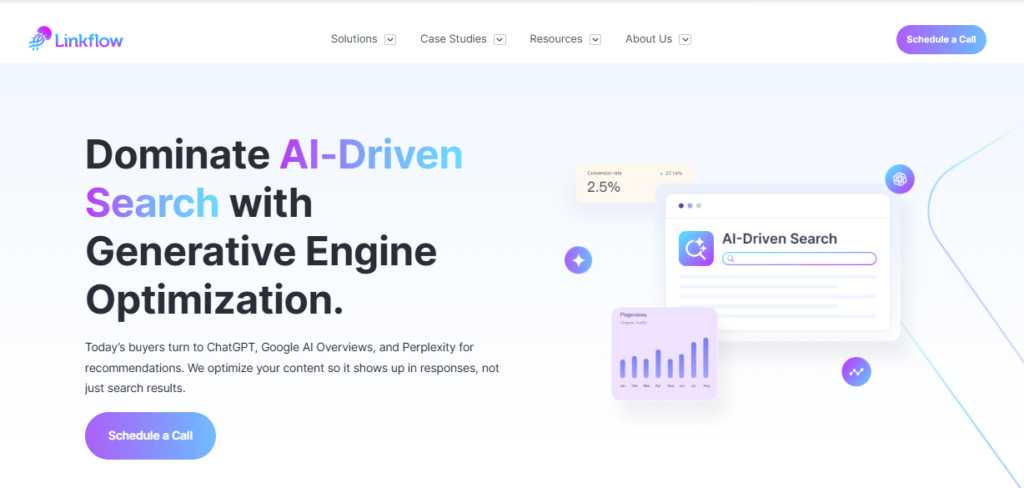
4. Linkflow – Best for Improving AI Visibility Through Authority-Driven Link Strategies
Linkflow is a link-building and authority growth agency that helps brands strengthen their off-site presence.
Source – Linkflow
Rather than producing large amounts of content, the agency concentrates more on earning high-quality backlinks, media mentions, and trust signals across relevant websites.
This approach works well for companies that already have decent content foundations but lack broader digital authority. Since AI systems often rely on external credibility signals while generating recommendations, Linkflow’s strategies can help improve overall brand trust within AI search environments. The agency is also known for building highly relevant links instead of chasing volume, which helps create stronger contextual authority over time.
Pricing: Available upon request
Notable Clients: Semrush, HelpSystems, Insightly
Rating: 5/5 (5 reviews)
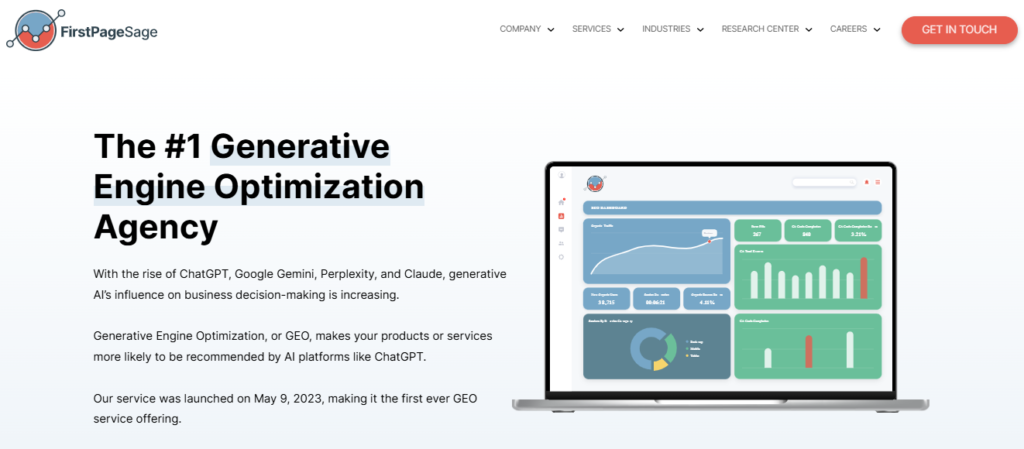
5. First Page Sage – Best for Creating Expert-Led Content That Builds Long-Term GEO Momentum
First Page Sage is a B2B SEO and thought leadership agency with deep experience in technical industries and SaaS marketing.
Source – First Page Sage
The agency is known for producing educational content that feels more like industry expertise than traditional SEO writing.
Instead of chasing short-term traffic gains, the team focuses on building long-term topical authority through in-depth editorial content and strategic content planning. This makes the agency particularly strong for companies that need to educate buyers before conversion and strengthen their authority across AI-powered search experiences.
Their content strategies also tend to map closely to high-intent business queries, which can improve visibility during software evaluation and comparison searches.
Pricing: Available upon request
Notable Clients: Salesforce
Rating: NA
| Take Your SaaS Business to the Next Level—Download Our “30 SaaS Growth Hacks in 30 Days” eBook Today! |
6. Growth Plays – Best for Turning Product Workflows Into High-Intent AI-Search Content
Growth Plays is a product-led marketing agency that focuses heavily on buyer journeys and bottom-funnel discovery.
Source – Growth Plays
Its content strategies are designed around how software buyers actually evaluate tools, compare workflows, and search for operational solutions.
The agency stands out for its ability to turn product capabilities into highly targeted use-case content. Instead of broad awareness blogs, the focus stays on workflow-driven pages, integration-focused content, and decision-stage comparisons that align closely with modern AI search behavior. This makes Growth Plays particularly useful for products with complex onboarding paths or highly specific operational use cases.
Pricing: Available upon request
Notable Clients: Lattice, Cortex.io, Calendly
Rating: NA
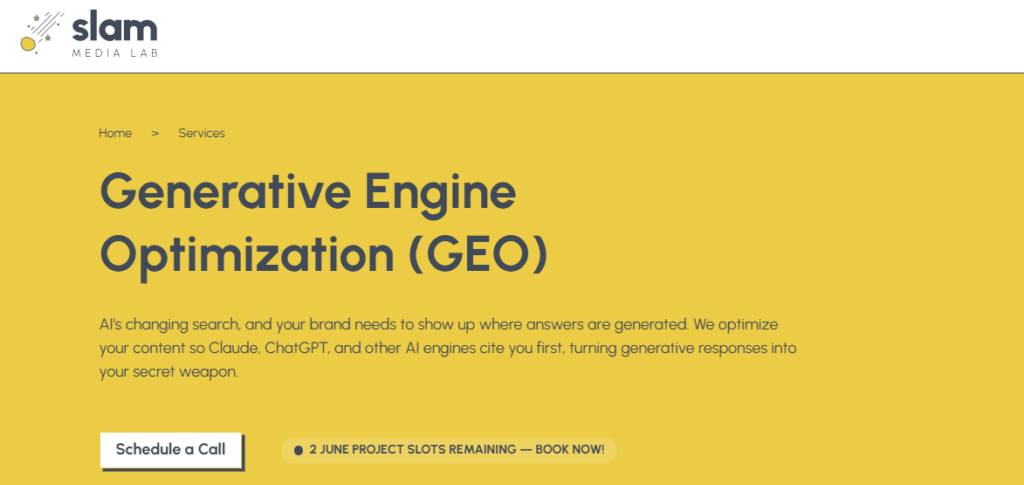
7. Slam Media Lab – Best for Refining Brand Messaging for Better AI Categorization
Slam Media Lab is a branding and digital marketing agency that works with modern SaaS and technology companies.
Source – Slam Media Lab
Compared to most GEO agencies, its approach leans more heavily into messaging clarity, storytelling, and brand communication.
This becomes especially valuable for companies whose positioning sounds too broad or too similar to competitors. By improving how the brand explains its product, audience, and value proposition, the agency helps create clearer signals that AI systems can understand and categorize more confidently. The team also focuses strongly on user-facing communication, which helps make technical products feel easier to understand without oversimplifying them.
Pricing: Available upon request
Notable Clients: Kai XR
Rating: 5/5 (32 reviews)
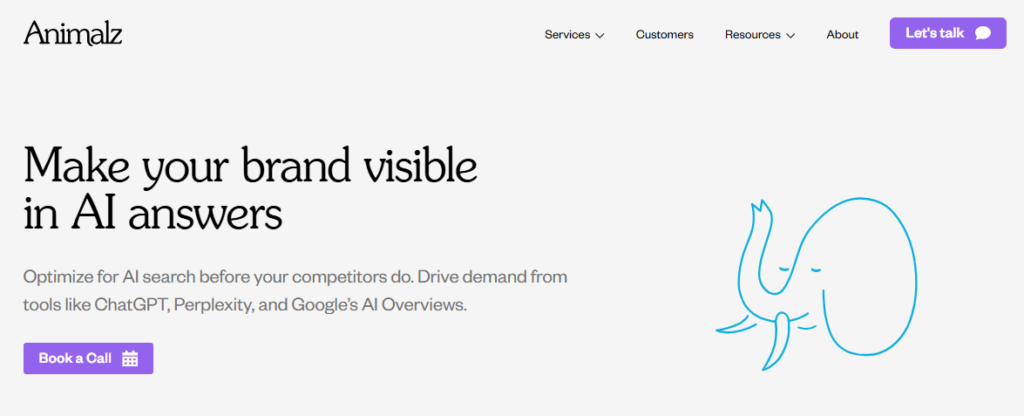
8. Animalz – Best for Publishing Educational SaaS Content That AI Tools Trust
Animalz is a well-known SaaS content marketing agency recognized for its editorial quality and educational writing style.
Source – Animalz
The agency has built a strong reputation by creating content that feels genuinely useful rather than aggressively optimized for search engines. That distinction matters more than ever in AI search environments.
Animalz performs particularly well in categories where products involve technical workflows or complex operational concepts. Its content also tends to age well, which helps brands maintain consistent visibility across search and AI-driven discovery channels over time.
Pricing: Available upon request
Notable Clients: Airtable, Frontify, Appcues, GoDaddy, Intercom
Rating: NA
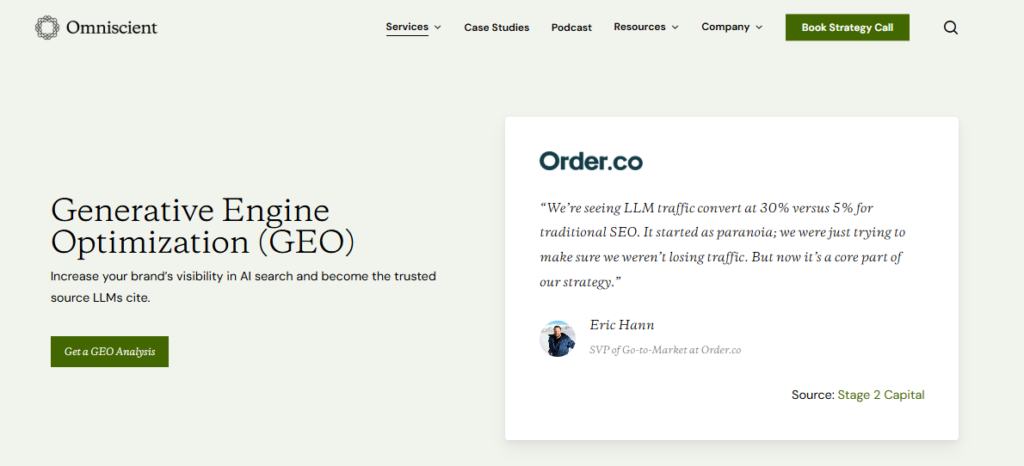
9. Omniscient Digital – Best for Building Strong Topic Clusters Around SaaS Use Cases
Omniscient Digital is a B2B SaaS content and SEO agency focused on long-term organic growth.
Source – Omniscient Digital
One of the agency’s biggest strengths is how it structures content ecosystems around workflows, integrations, operational pain points, and industry-specific themes instead of treating each blog as an isolated asset.
The team also takes a heavily research-driven approach to content planning. This helps create stronger topical relationships across the website, which can improve how AI systems understand category relevance and overall authority over time. Omniscient is particularly strong at helping SaaS brands scale content across multiple product areas without making the strategy feel fragmented or repetitive.
Pricing: Available upon request
Notable Clients: Asana, SAP, Hotjar, Retool
Rating: 4.8/5 (5 reviews)
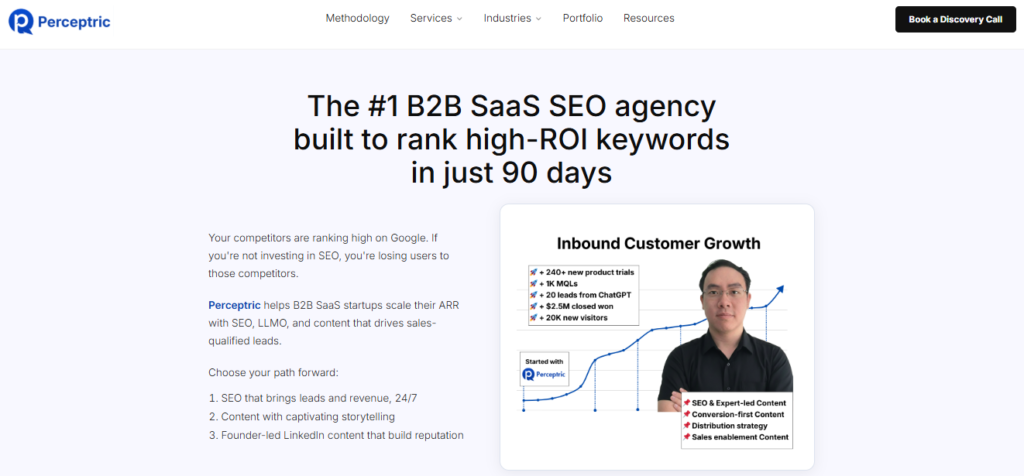
10. Perceptric – Best for Tracking and Optimizing Prompt-Level AI Search Visibility
Perceptric is an AI-native GEO agency built specifically around generative search visibility.
Source – Perceptric
Unlike traditional SEO agencies, which are adapting to AI search later, Perceptric’s services are designed directly around conversational discovery and AI recommendation systems.
The agency focuses strongly on prompt visibility, AI citation tracking, and recommendation monitoring across platforms like ChatGPT and Perplexity. This gives companies a clearer understanding of how often they appear inside AI-generated answers and where their discoverability gaps exist. Perceptric also places strong emphasis on content structuring and entity optimization so AI systems can interpret brand positioning more accurately across different types of prompts.
Pricing: Starts at $2,000 per month
Notable Clients: Scout, Anduin, deepidv
Rating: NA
Now that the list of the best generative engine optimization agencies for low-code SaaS startups has come to an end, we’ll break down how we created it in the first place.
How We Picked the Best GEO Agencies for Low-Code Platforms
Most “top GEO agency” lists online are either generic SEO roundups or random compilations with little to no relevance to low-code platforms. But not this one. Since low-code companies face very specific AI discovery and positioning challenges, we followed a more targeted approach to shortlist agencies that are actually visible, credible, and experienced in this space.
Here’s the exact methodology we followed:
- We first asked AI platforms like ChatGPT, Gemini, and Claude to recommend a list of top GEO agencies around the world. Our logic was simple: if an agency claims to specialize in GEO, it should already have visibility in AI-generated results.
- Then, we shortlisted agencies based on their experience working with low-code, no-code, or SaaS industries. This helped us ensure they understand the marketing challenges common in this space.
- Finally, we checked reviews, case studies, client portfolios, and overall industry credibility across platforms like Clutch and agency websites. This helped us filter out agencies with weak proof of work or overly generic service claims.
And that’s how this list came to life. Now, let’s get to the point you must be the most curious about: is GEO something you can’t do without a no-code SaaS marketing agency by your side? The answer is: yes and no. The next section explains how.
3 Things Low-Code Platforms Can Internally Do to Improve GEO
Hiring a GEO agency is usually the fastest way to improve AI discovery. But that doesn’t mean you need to wait until you find the right partner to get started.
Here are a few simple low-code platform marketing strategies you can implement to improve how AI tools understand and recommend your product:
1. Create clearer product positioning: Many low-code platforms describe themselves using broad terms like “workflow automation” or “digital transformation.” That makes it harder for AI systems to understand what the platform actually does. Instead, clearly explain your main use cases, ideal customers, and core strengths across your homepage and product pages.
2. Publish comparison and use-case content: AI tools heavily rely on comparison pages and practical examples when generating recommendations. Simple list style content like “Best low-code platform for internal tools” or “Retool alternatives for enterprise teams” can help improve discoverability.
3. Keep your documentation simple and updated” AI systems frequently pull information from product documentation. So, if your docs clearly explain integrations, workflows, pricing, and setup processes, AI tools can better understand and describe your platform. Pro tip? Avoid overly technical explanations where simpler language works better.
These steps can help build a solid foundation for GEO. But for long-term results, working with a specialized GEO agency is the only solution. And that’s where Concurate comes in as the best choice.
What Makes Concurate the Best Generative Engine Optimization Agency for Low-Code Platforms
Most low-code platforms aren’t losing to competitors because of a product gap. They’re losing because of a visibility gap.
There’s no shortage of generative engine optimization agencies for low-code platforms claiming to solve this. But most treat it like a content volume problem. More blogs, more keywords, more pages. That’s not what moves the needle in AI search.
Concurate is built differently. As an AI SEO agency for no-code and low-code tools, we don’t come in with a generic playbook. We come in knowing the saturation problem, the identical messaging trap, and the positioning gaps that keep well-built platforms invisible in AI recommendations. We understand how buyers in this space think, what they ask AI, which workflows they’re searching for, and what kind of content makes AI systems trust and cite a brand over a competitor.
So if your platform is strong but AI keeps leaving you out of the conversation, that’s not a content problem. It’s a strategy problem. And it’s one we know how to fix. Book a call with us right now to get started!
Frequently Asked Questions:
1. Why is it more difficult to optimize low-code platforms for AI visibility than standard SaaS products?
Optimizing low-code platforms for AI visibility is more difficult because these products are harder for AI systems to categorize clearly. Most low-code platforms support many workflows, industries, and user types, from developers to business teams. As a result, AI tools struggle to understand their exact use case fit and can’t confidently cite them.
2. How important are comparison pages for AI visibility in the low-code industry?
Comparison pages are highly important for AI visibility in the low-code space because AI tools use them to understand how your platform differs from popular options in the market. Moreover, buyers searching for low-code software also compare features, integrations, scalability, and ease of use before making a decision. A well-written comparison page often clearly explains where your platform performs better than others and which use cases it fits best.
3. Can AI discovery help our low-code platform compete against larger competitors?
Yes, strong AI discovery can help smaller low-code platforms compete against larger competitors. AI tools often recommend products based on how clearly they understand the platform and its use cases, not just brand size. So, if your content clearly explains what your platform does and who it’s for, it has a better chance of appearing in AI-generated comparisons and recommendations.
Disclaimer: The information presented in this article is compiled from publicly available sources, including company websites, industry reports, and social media. All trademarks, brand names, and logos mentioned are the property of their respective owners. We do not claim any ownership of third-party marks, nor do we imply endorsement or affiliation. This article is intended for informational purposes only.