

| TL;DR: VR companies face a visibility problem that is different from most B2B categories. Their strongest proof often lives in demos, videos, simulations, and immersive experiences. But AI recommendations still depend heavily on clear written context. If your content does not explain what your product does, who it helps, and where it should be recommended, AI tools may keep defaulting to more familiar names. This guide covers seven GEO agencies for VR companies, including Concurate, Single Grain, and iPullRank. It also explains why VR companies struggle to show up in AI answers, what to look for before hiring a GEO agency, and how to start improving AI visibility internally. |
VR companies have a content problem that is different from almost every other B2B category.
Your best proof is a demo. Your product’s value is experiential; it has to be seen, tested, or felt. So most VR companies invest heavily in videos, interactive experiences, polished product pages, and sales-led demonstrations that show what the platform can do.
But AI platforms do not experience a demo the way a buyer does.
When an L&D leader at a manufacturing company asks ChatGPT for “best VR safety training software for industrial workers,” or a hospital team asks Perplexity for “VR surgical simulation platforms for medical training,” AI tools look for accessible content that explains the product clearly.
Most VR companies have not built enough content for that moment. The demo may be excellent. But the written explanation that helps AI tools understand and recommend the product is often thin, scattered, or missing.
The agencies in this guide help solve that problem. But before we get to them, let’s look at why most VR companies struggle to show up in AI recommendations.
4 Reasons Why VR Companies Struggle To Show Up In AI Search
VR companies can invest heavily in demos, videos, events, and product marketing. However, the real problem is a lack of enough written context for AI tools to understand when to recommend them.
The gap usually shows up in four places:
1. They Built Content For Trade Show Audiences, Not AI Platforms
VR companies spend heavily on conference presence, demo booths, and video production. Their marketing instinct is to show the product. That works when a human experiences it in person.
However, it produces almost nothing that AI platforms can extract and cite when a buyer is researching options remotely. The entire marketing investment is optimized for a moment when AI platforms are not part of.
2. They Use VR Keywords, but Not Enough Buyer-Specific Context
Many VR companies use terms like “immersive learning,” “spatial computing,” “XR platform,” and “virtual training.” These keywords help describe the category, but they do not always explain who the product is for, what problem it solves, or when it should be recommended.
That becomes a problem in AI search because buyers do not always ask broad category questions. They describe their situation. For example, a buyer may ask:
“Which VR training software can help a manufacturing company train 500 frontline workers on safety procedures across multiple sites?”
If your content only says “immersive training platform,” AI tools may not connect your product to that prompt. They need a clearer context around the user, industry, team size, workflow, training goal, and expected outcome.
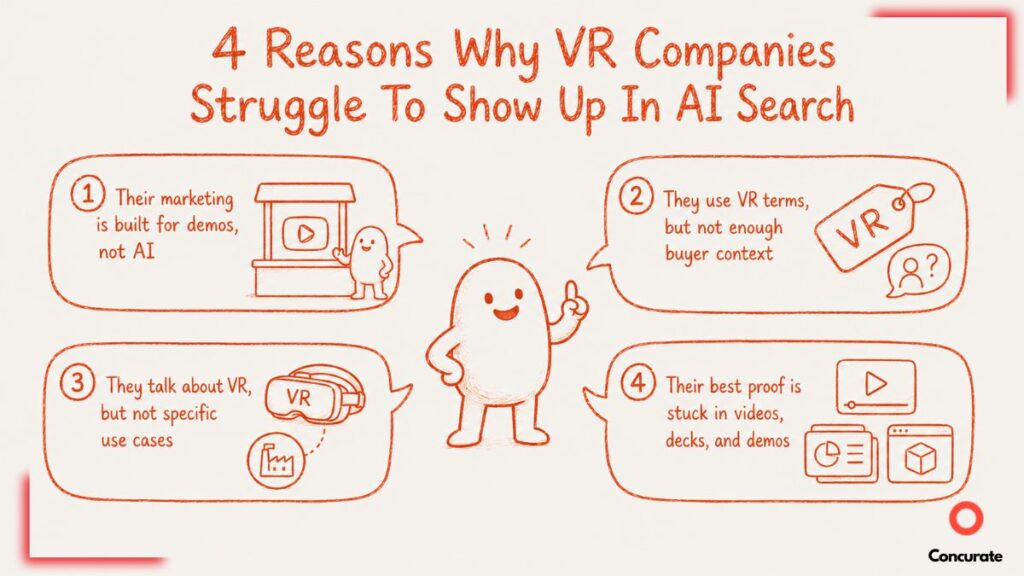
3. They Build Authority Around VR, but Not Around Specific Use Cases
A VR company that publishes extensively about spatial computing trends, XR hardware developments, and metaverse applications has built authority in VR as a topic.
That does not help them appear when an L&D director searches for training software, a hospital searches for surgical simulation tools, or a construction firm searches for safety training platforms. The buyer searches by industry and problem. If you are not creating content for that layer, AI tools may understand that the company works in VR, but not when to recommend it.
4. Their Proof Of Outcomes Exists In Formats AI Cannot Read
The case studies exist. They are often buried in demo videos, sales decks, conference presentations, and customer testimonial clips. Nobody converted them into structured written content that AI platforms can extract and cite when a buyer asks which VR safety training platform has delivered measurable results in manufacturing environments.
The proof is real. It is just invisible to the systems that increasingly influence which vendors get onto enterprise shortlists.
Understanding these gaps makes it easier to build a stronger AI visibility strategy. But not every GEO agency will be the right fit for a VR company. So before you choose one, here are the key factors to evaluate.
5 Factors To Look For When Evaluating A GEO Agency For Your VR Company
Not every generative engine optimization agency that works well for SaaS companies will work for a VR company. The category has specific dynamics.
Here are five questions that separate agencies equipped for this from agencies that will produce generic content and call it GEO.
1. Do They Have A Structured Process For Working With Your Internal Experts?
VR products are technically complex and highly specific to the industries they serve. A writer who researches VR for two weeks will produce content that sounds plausible to a general audience but lacks the depth and specificity that makes AI platforms confident enough to cite it when an enterprise buyer asks a pointed question.
The strongest agencies have a structured process for extracting what your engineers, sales team, and customer success people actually know. That insider knowledge is what makes content genuinely differentiated from everything else AI platforms have already indexed.
| Question to ask: How do you develop content for a technical product, and what process do you use to capture expertise from internal subject-matter experts? |
2. Do They Combine Keyword Research With AI Benchmarking?
Keyword research is useful. It can show how the market talks about the category and which topics have search demand. But for VR companies, it cannot be the only starting point.
A buyer may not use a clean keyword like “VR training software.” They may ask an AI tool a more specific question, such as: “Which VR training platforms can help hospitals train medical staff through realistic emergency scenarios?”
The right agency should test these kinds of questions across AI platforms. They should check which companies appear, why those companies are recommended, what sources are being cited, and what context is missing from your own content.
| Question to ask: How do you combine keyword research with AI benchmarking to find content opportunities for our VR company? |
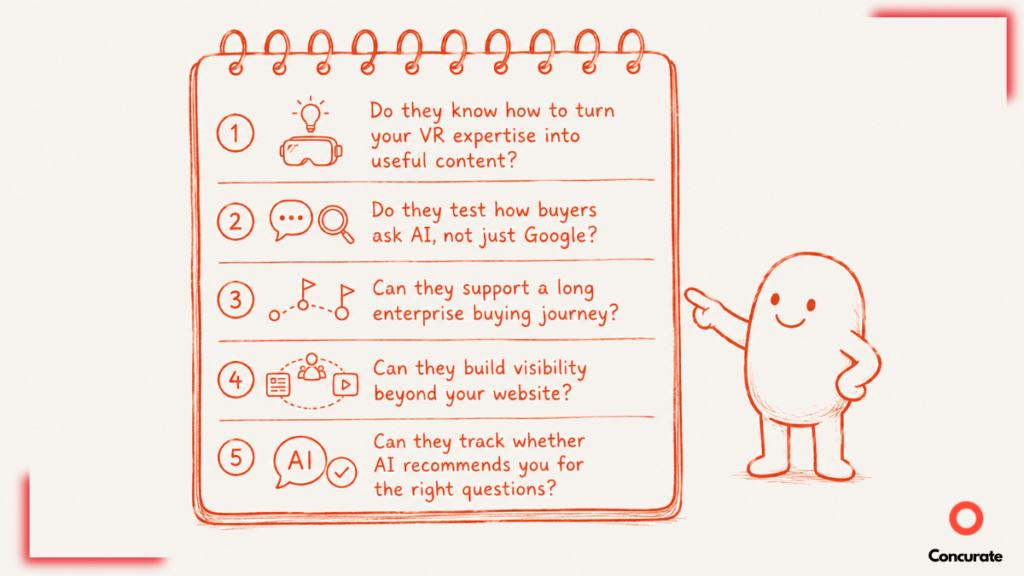
3. Have They Built AI Visibility For A Product With A Long Enterprise Sales Cycle And Multiple Stakeholders?
VR enterprise software rarely closes from a single piece of content. Content may help get the product onto the shortlist. But the buying process usually continues through a proof of concept, IT security reviews, procurement discussions, and legal approvals.
Content needs to support that entire journey across multiple stakeholders who each search differently and need different information to move forward. If most of their case studies come from self-serve SaaS products with short buying cycles, their approach may not align with how enterprise VR deals actually close.
A good GEO agency understands how to build content ecosystems that support the full buying journey rather than a single search or page visit.
| Question to ask: Do you have experience building content ecosystems for products with six-to-twelve-month sales cycles and multiple stakeholder groups? |
4. Do They Know How to Build Visibility Beyond Your Website?
G2 and Gartner matter for general enterprise software evaluation. But they are not the only sources that shape trust for VR companies. A manufacturing safety director or a hospital procurement team may also look at industry publications, event pages, partner content, customer stories, and professional communities when validating vendor decisions for VR training platforms.
The right agency should identify the outside sources your target buyers and AI tools are likely to trust. They should have a plan for building a solid presence there, instead of treating third-party visibility as generic backlink building.
| Question to ask: Which third-party sources do enterprise buyers in our target industries trust when evaluating VR software, and how do you build presence across those specifically? |
5. Can They Track Whether AI Tools Recommend You for the Right Buyer Questions?
There is a meaningful difference between your brand being mentioned somewhere in an AI response about VR and your brand being recommended as a named option.
For instance, when a hospital asks for surgical simulation software or a manufacturing company asks for safety training platforms. Appearing in those recommendations is far more valuable than being mentioned in a general AI response about VR. That is what can influence the shortlist.
If the reporting only shows how often your brand is mentioned, it is not enough. A strong agency should show how your visibility changes across the buyer questions that matter to your business.
| Question to ask: What does your reporting look like, and how do you track AI visibility? |
Understanding these factors makes it easier to identify agencies that can improve AI visibility for VR companies rather than simply increase content output. With that foundation in place, let’s move on to the agencies themselves.
Top 7 Generative Engine Optimization Agencies For VR Companies
To compile this list, we focused on agencies with experience in technical B2B industries, a clear GEO or AI search methodology, and evidence of work beyond traffic-focused SEO. We also prioritized agencies that understand content strategy, technical clarity, authority-building, and AI visibility measurement.
Here are the seven agencies worth considering:
- Concurate
- Single Grain
- Xponent21
- Onely
- Directive Consulting
- Reboot Online
- iPullRank
Now, let’s take a closer look at the best GEO agencies for immersive tech companies in detail.
1. Concurate
For many VR companies, the problem is not that marketing has never been tried. The problem is that their content still does not give AI engines enough clear context to understand, reference, and cite them.
At Concurate, that’s the gap we fix. We help companies show up in AI-generated answers when buyers are searching for solutions.
We understand the unique challenge of the augmented reality and virtual reality industry: your best content is visual and experiential, while AI search engines need clear, structured text. We bridge that gap without oversimplifying your product or changing what makes it stand out.
Source – Concurate
We’ve built our entire process around how AI search engines discover, evaluate, and cite brands, and this process is especially useful for technical, demo-driven categories like AR/VR.
How We Build AI Visibility for VR Companies: Decoding Our Perfect Match Framework
We follow a systematic approach built specifically for brands competing in AI search. Here’s how it works:
- Define your ideal buyer: First, we try to understand who the ideal customer is for your virtual reality solutions. We map their pain points, the situations that trigger them to search, who makes the decision, and what disqualifies options. This becomes the foundation for everything we create.
- Benchmark your current AI visibility: Next, we run dozens of buyer-matched queries across ChatGPT, Perplexity, Claude, and Gemini to see where your brand appears today. We also check your Google Analytics for AI referral traffic and flag any negative narratives about your company showing up in AI answers.
- Audit what’s working and what’s not: Then, we review your existing content to see if it speaks to your ideal buyer, matches what the internet says about you, and addresses decision-stage questions. We check if you have multichannel presence and pain point content that’s specific enough for AI to extract and cite.
- Build your content strategy: From there, we identify which channels influence AI answers most for your category. We create a keyword strategy for your blog, plan content updates if needed, and prioritize the pages and topics most likely to improve your AI visibility.
For virtual reality companies, we target evaluation and decision-stage queries based on your ideal buyer and industry fit. For instance, depending on the industry your VR product serves, we can target queries like: VR medical training platform for hospitals, VR safety training software for manufacturing workers, VR simulation software for industrial training, VR therapy platform for rehabilitation clinics and more.
- Create content: After that, we interview your in-house experts and sales team to capture insights AI can’t find anywhere else. We then convert those insights into content pieces that clearly explain your product’s strongest features, use cases, and differentiators in a way AI systems can understand and surface in relevant answers.
- Monitor performance: Finally, we re-run benchmarking every quarter to track citation share growth and monitor AI referral traffic monthly to see which pages attract AI-referred buyers.
To read more about our Perfect Match Framework, view the deck below.
Are you ready to show up where your buyers are searching? Book a call with us to discuss your AI visibility strategy.
Pricing
Our monthly retainers usually fall between $5,000 and $7,500, and specific one-off projects begin at about $3,500.
Notable clients
PQAI, Datacipher, Triangle IP, Pinch Patent Drawings, Athena Security, InspireIP
Rating: 5/5 (2 reviews)
2. Single Grain
Single Grain is a revenue marketing agency that builds content systems for steady visibility.
Source – Single Grain
Beyond traditional content execution, Single Grain also discusses using AI within marketing workflows, making it relevant for companies considering search and AI visibility together. The agency treats search engines and AI platforms as connected channels rather than separate strategies.
They also focus heavily on content distribution and audience reach beyond just on-site publishing. This combination of search strategy and audience-focused storytelling can help strengthen visibility across search and AI-driven discovery environments.
Pricing: Available upon request
Notable Tech Clients: Logitech, SentinelOne, Salesforce, Amazon
Rating: 4.8/5 (12 reviews)
3. Xponent21
Xponent21 has built its reputation through extensive publishing on generative engine optimization.
Source – Xponent21
The agency runs a global education platform teaching GEO methods and employs a neuroscientist who structures content for both human readers and language models. This scientific foundation helps translate complex XR concepts into language that AI systems can parse accurately.
Their 14-step content framework includes prompt testing across multiple AI platforms to verify what actually earns citations. Instead of following generic optimization checklists, they test and validate what works. For VR companies where technical terminology can confuse automated systems, this experimental approach reveals which explanations surface when prospects research immersive experiences or compare spatial computing platforms.
Pricing: Available upon request
Notable Tech Clients: Hume Health, Sendwave
Rating: 4.5/5 (1 review)
4. Onely
Onely is a technical SEO and generative engine optimization agency that helps brands improve how they appear in AI search results.
Source – Onely
Their GEO work focuses on making a company’s website easier for AI systems to understand, categorize, and recommend. This includes content and product page optimization, structured data, technical fixes, content consolidation, AI search monitoring, and testing different optimization approaches.
For VR companies, this matters because many websites rely heavily on visual demos, interactive pages, and technical product language. If the written content, page structure, and technical signals are not clear enough, AI systems may struggle to understand what the product does and when it should be recommended.
Onely’s strength lies in fixing that foundation. They help improve existing pages, organize overlapping content, add clearer technical signals, and monitor how often the brand appears across AI search platforms. This makes them a useful fit for VR companies that already have content and product pages but need those assets to work harder in AI-driven discovery.
Pricing: Available upon request
Notable Tech Clients: Live Chat, Brainly, Yotpo
Rating: 5/5 (19 reviews)
5. Directive Consulting
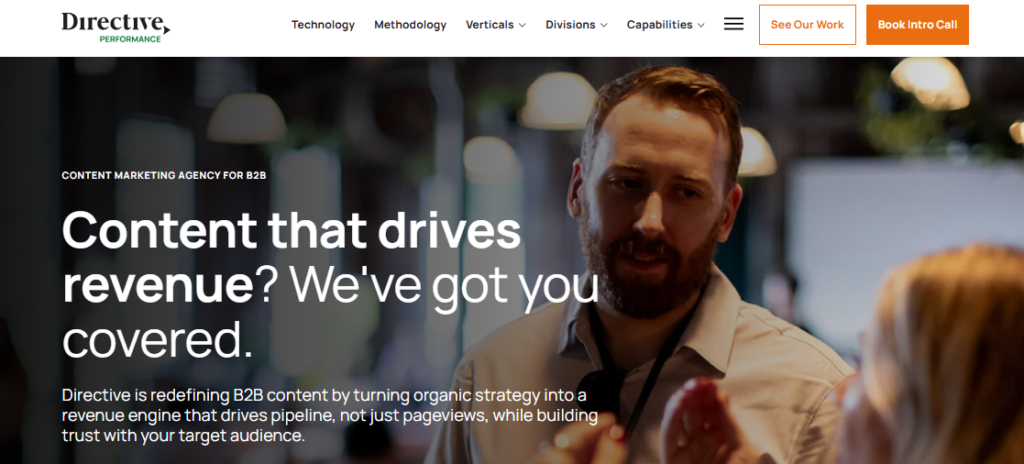
Directive Consulting works exclusively with B2B technology companies.
Source – Directive Consulting
They’ve developed a Customer Generation methodology that connects organic search to a qualified pipeline rather than just traffic volume. Their AI-powered Stratos platform unifies CRM, paid media, SEO, and operations data in real time, revealing which content drives assisted conversions.
This integration proves useful for VR companies selling enterprise solutions. Instead of measuring rankings, they track how search influences actual buying decisions. Their content targets high-intent queries around comparison searches and implementation concerns rather than broad awareness topics.
Pricing: Available upon request
Notable Tech Clients: Samsung, Adobe, Calendly, Cisco, Amazon
Rating: NA
6. Reboot Online
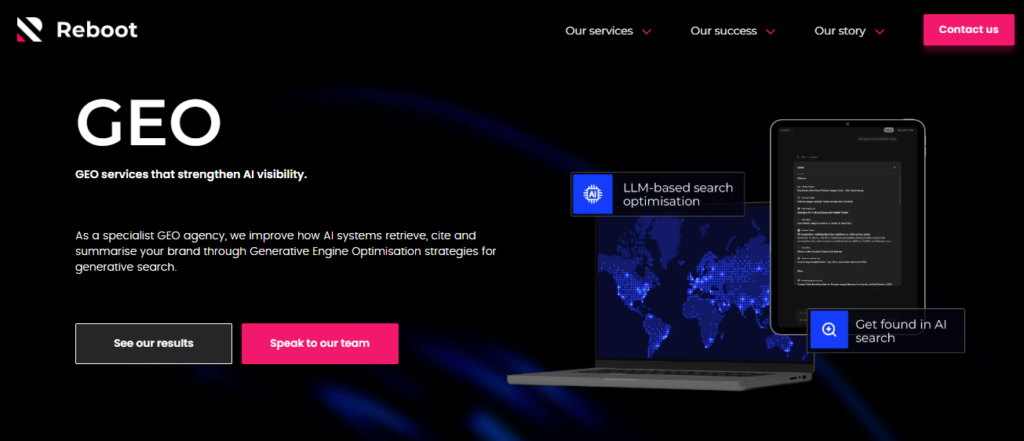
Reboot Online highlights that they run controlled SEO experiments across multiple websites over extended periods.
Source – Reboot Online
They test how search systems respond to different authority signals and content structures. These studies produce practical insights about what influences AI-generated answers in technology categories.
The agency also operates a large digital PR team that creates data-driven research for media coverage. Their scientists analyze trends and publish findings that journalists cite, building authoritative backlink profiles.
They focus on strengthening topical relationships and entity associations. This contextual approach improves how AI systems categorize expertise and surface VR brands when users ask about immersive technology trends or spatial computing applications.
Pricing: Starts at £2,500 per month
Notable Tech Clients: Uswitch, eToro, Resume.io, Tripadvisor
Rating: NA
7. iPullRank
iPullRank specializes in catering to organizations with complex site architectures and multiple stakeholder teams.
Source – iPullRank
They’ve developed Relevance Engineering, a methodology focused on reducing ambiguity across content and structure so AI systems clearly understand what a brand represents.
They build content ecosystems around topical understanding. For VR companies competing in crowded markets or introducing new spatial computing categories, their semantic approach strengthens how brands appear in conversational search experiences.
Their research-backed strategies address how buyers move through digital evaluation journeys, which helps establish clear category authority when prospects compare immersive platforms.
Pricing: Available upon request
Notable Tech Clients: Etsy
Rating: NA
Now that we have covered the agencies, let’s look at a few things your team can do internally to make your VR company easier for AI tools to understand.
What VR Companies Can Internally Do to Improve AI Search Visibility
While long-term GEO success always requires specialized expertise, your team can still make a few small internal changes to improve how AI systems understand and surface your VR business. Here’s how:
1. Explain Your Product in Plain Language
VR companies generally use overly sophisticated language. For example, phrases like “immersive digital transformation ecosystem” or “next-gen spatial engagement platform.” While they sound impressive, these terms don’t clearly explain what the product actually does. As a result, AI systems may struggle to understand when they should cite them in recommendations.
So, always use clear, natural language to explain what your platform does, who it’s for, and where it’s used. For example, “VR onboarding software for warehouse teams” gives AI systems much stronger context than broad innovation-heavy copy.
2. Create Content Around The Exact Problems Your Buyers Search For
AI systems prefer content that directly answers user questions because that’s how most people interact with these search platforms. So, instead of only posting company news or feature updates, create content around real buyer concerns and industry problems. Topics like “How to train remote employees with VR” or “Best AR use cases for ecommerce brands” can help AI systems understand where your company fits.
3. Get More Specific With Your Use Cases
Unclear positioning makes AI visibility harder. That’s because AI systems rely on specificity to understand relevance. So, instead, create dedicated pages or sections for industries and workflows you actively target, like healthcare training, retail visualization, manufacturing simulations, or virtual collaboration. The more specific your positioning becomes, the easier it becomes for AI systems to recommend your company confidently.
Always remember: these strategies are just starting points. If you want long-term GEO success, you’ll need more than just a 90-day roadmap. You need a partner that can support you through execution. That’s where specialized agencies like Concurate can help.
The steps above can clean up the basics. But AI visibility usually does not change because one page becomes clearer.
It changes when your product starts showing up for the exact moments buyers ask AI for help.
For a VR company, that could mean safety training for frontline teams, surgical simulation for hospitals, onboarding for distributed employees, rehabilitation programs, or product visualization for sales teams.
That is where Concurate comes in. We help you find the AI prompts where your company should appear, understand why other names are showing up instead, and build the content and outside proof that helps AI tools understand why your product belongs in the answer.
Ready to Get Recommended When Buyers Ask AI?
Our GEO Services: If your VR company wants to appear more often in ChatGPT, Perplexity, Gemini, and other AI-generated recommendations, learn more about our GEO services here.
Our Content Marketing Services: If you also need support with technical content, evaluation-stage content, industry-specific content, or LinkedIn content, learn more about our content marketing services here.
Every campaign teaches us something. Our weekly newsletter brings together those lessons into practical marketing ideas you can use to make better decisions and avoid common mistakes.
Frequently Asked Questions:
1. My VR company has good SEO rankings, so why are we still missing from AI search results?
Your VR company may still be missing from AI search results because AI systems don’t look at rankings alone. They care more about contextual clarity, topical authority, trusted mentions, and whether they can confidently understand your product and use cases. So, if your VR website ranks on Google but fails to appear in ChatGPT or Perplexity, it’s probably because your messaging is too broad or unclear for AI systems to process properly.
2. What kind of content helps VR companies improve AI visibility fastest?
The content that usually improves AI visibility is the kind that directly answers buyer questions. In the VR industry. This can include comparison pages, implementation guides, industry explainers, workflow breakdowns, and educational thought leadership tied to specific use cases.
3. Should my VR company focus on AI visibility or traditional SEO first?
Your VR company should ideally treat AI visibility and SEO as connected strategies rather than separate priorities. That’s because AI systems still somewhat rely on high-authority web content to pull information from. However, ranking well on Google is no longer enough on its own. So, modern content should be optimized for both search engines and AI systems.
Disclaimer: The information presented in this article is compiled from publicly available sources, including company websites, industry reports, and social media. All trademarks, brand names, and logos mentioned are the property of their respective owners. We do not claim any ownership of third-party marks, nor do we imply endorsement or affiliation. This article is intended for informational purposes only.