

| TL;DR: Fashion tech companies often run marketing without seeing momentum compound. Content exists, channels are active, but buyers still hesitate. This guide breaks down the top marketing agencies for fashion tech companies, how they approach growth, and how to choose a partner that aligns with real buyer journeys. |
In the past few years, fashion tech has really gained momentum.
Brands are rolling out virtual try-on features, experimenting with 3D sampling, and investing in AI for sizing, demand forecasting, and inventory planning. Still, many teams hesitate before making calls on the tech. Returns remain high, sampling cycles feel long, and decisions take longer than they should.
From the outside, the gap is clear. Technology is moving faster than internal alignment. Tools exist, but they don’t always speak to each other. Data is available, but trust in that data is uneven across teams.
Fashion tech was meant to reduce guesswork for users. Instead, for many brands, it has added another layer they’re still learning how to rely on.
That tension is where most fashion teams are operating today.
Top 10 Marketing Agencies for Fashion Tech Companies
Fashion tech stalls when the message sounds like software and the buyer thinks in garments, margins, and returns.
At this stage, marketing is not about reach. It’s about helping brands understand why 3D design, AI sizing, or virtual try-on matters to their day-to-day decisions.
The agencies below are brought in when fashion tech companies need their story to finally click, not just circulate.
Here’s the lineup:
- Concurate
- Spring Studios
- DIVISA
- VELOX Media
- Stylophane
- Netgains
- AMP Agency
- VMGROUPE
- DTE Studio
- Stryde
Let’s see what each one does.
1. Concurate
Most fashion tech teams never sit down and say, “We have a visibility problem.” What they say instead is:
- Sales calls are taking longer than they should
- Prospects keep asking basic questions late in the process
- Competitors show up in conversations before we do
- AI tools mention other brands more often than ours
None of this looks like a marketing issue at first glance. But it all traces back to the same thing.
Your brand isn’t showing up where buyers form confidence.
At Concurate, this is the pattern we see most often when we audit fashion tech marketing:
- Buyers discover you too late: They first hear about you after they’ve already framed the category in their head, usually influenced by competitors, marketplaces, or AI-generated answers.
- Your content explains, but doesn’t reassure: Product pages describe features. Blogs talk trends. But nothing actively reduces risk or answers the quiet “is this right for us?” question.
- Visibility is accidental, not designed: You appear in some searches, disappear in others, and have no real presence in comparison or evaluation moments.
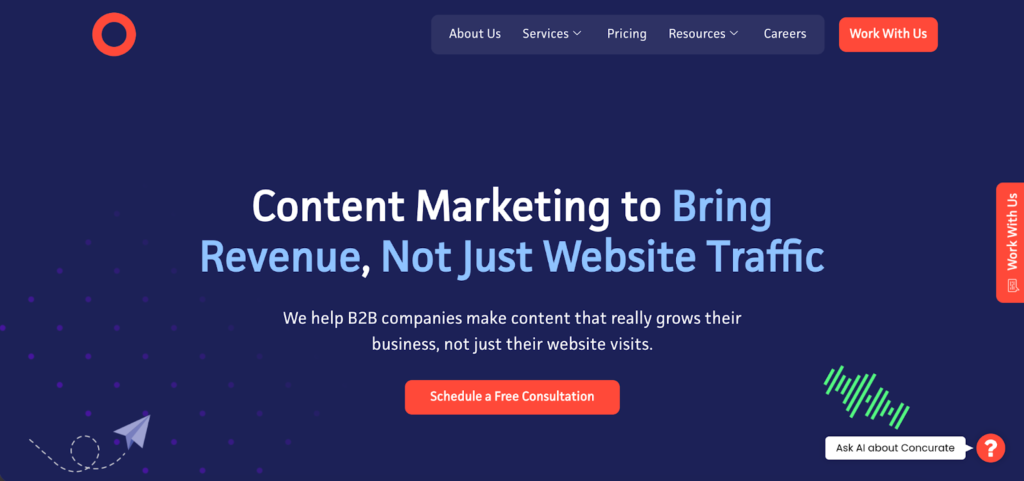
Source – Concurate
This is why adding more content rarely fixes the issue. It just adds noise around the same gaps.
The shift happens when teams stop asking “what should we publish next?” and start asking “where does the buyer hesitate, and why?”
That’s when visibility starts stacking. Content begins to support decisions. Search and AI answers reinforce your position instead of diluting it. Sales conversations change because buyers arrive oriented, not skeptical.
What We Do
- We do SEO the right way, focused on intent-led pages, long-form articles, and content that actually answers buyer questions.
- We work on generative engine optimization, helping brands show up in AI-led search and discovery environments, not just traditional Google results.
- We handle LinkedIn thought leadership content for founders and leadership teams. That includes writing, positioning, and managing their LinkedIn presence so it stays consistent and credible over time.
- We manage company LinkedIn pages alongside founder profiles, making sure both tell a coherent story instead of operating in silos.
- We create and manage YouTube channels, from scripting and positioning to publishing and consistency, so video doesn’t stay stuck as an idea.
- We write articles, blogs, and industry pieces that go deeper than surface-level commentary and are built to compound over time.
- We combine copywriting, content marketing, and distribution so ideas don’t just get written, they get seen and reused across channels.
That’s the work we do at Concurate. Not louder marketing, but marketing that shows up before doubt sets in.
If that’s the problem you’re actually dealing with, then yes, it’s worth a conversation.
Notable Clients: Athena Security, Datacipher, Scanwriter, Ratio Tech, Inspire IP, and Triangle IP.
Pricing: Partnerships typically range from USD 5,000 to USD 7,500 per month, with project engagements starting at USD 3,500.
2. Spring Studios
Spring Studio is a full-stack marketing agency that brings creative, media, strategy, and retention together in one operating model. Their work spans campaign development, paid media, branding, websites, lifecycle programs, and conversion optimization.

Source – Spring Studios
The agency works across technology, retail, and ecommerce-led businesses, supporting teams that need consistent creative output, performance execution, and reporting across multiple channels. Their approach is designed to reduce dependency on multiple vendors and provide structured support from early campaigns through ongoing optimization.
Notable clients: GoGov, Copysmith, Pack Animals, HoverAir, Taponit, NjiaPay
Pricing: Engagements start at $1,500 per month, with flexible, no-long-term-contract pricing across strategy, creative, media, and retention services.
3. DIVISA
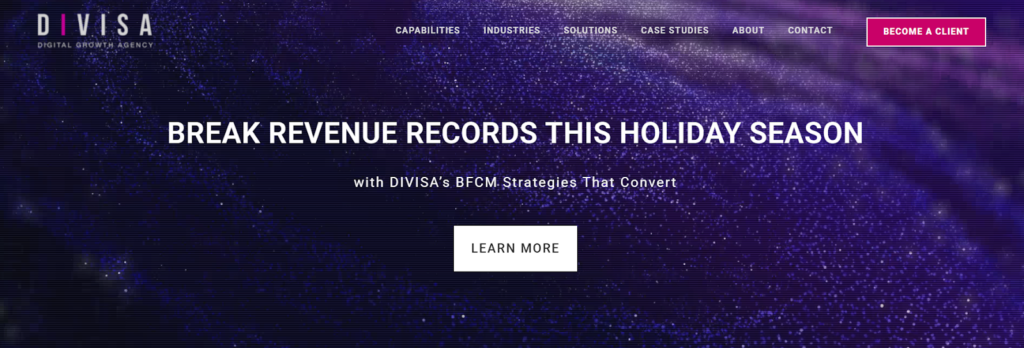
DIVISA positions itself as a digital growth agency focused primarily on DTC e-commerce brands across fashion, beauty, and consumer products. Their work spans media buying, ecommerce SEO, demand generation, and AI-led research initiatives, with programs tailored to different revenue stages, from early-stage stores to large-scale operations.
Source – DIVISA
The agency emphasizes vertical-specific execution, particularly in fashion and apparel, consumer electronics, and lifestyle categories. Their offering is structured around performance marketing, Shopify and ecommerce optimization, and market entry support. They also have partnerships across platforms like Google, Meta, Shopify, and Klaviyo, forming part of their operating model.
Notable clients: Midnight Bakery, Mercedes-Benz, Studio Cult, CurvySense
Pricing: Pricing is not publicly listed; interested companies need to contact the DIVISA team directly.
4. VELOX Media
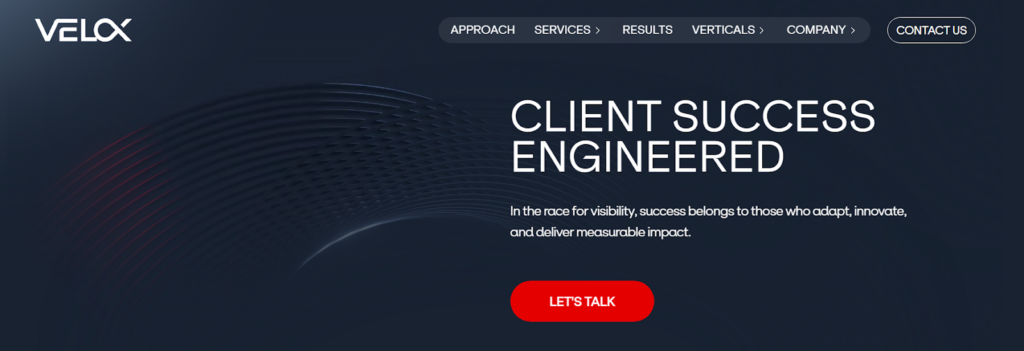
VELOX Media is a performance-focused digital marketing agency with a strong emphasis on organic search, paid media, and marketing intelligence. Their service mix includes SEO, content strategy, conversion optimization, paid search and social, retail, and Amazon media, along with analytics, attribution, and revenue modeling.
Source – Velox Media
The agency positions itself around data-led execution and long-term revenue impact, working across strategy, technical implementation, and reporting. Their approach centers on connecting visibility, performance, and business outcomes through integrated organic and paid programs supported by analytics and planning.
Notable clients: Rent the Runway, Primally Pure, Democracy Clothing, doTERRA
Pricing: Pricing details are not disclosed on the website and are shared through direct consultation with the VELOX Media team.
5. Stylophane
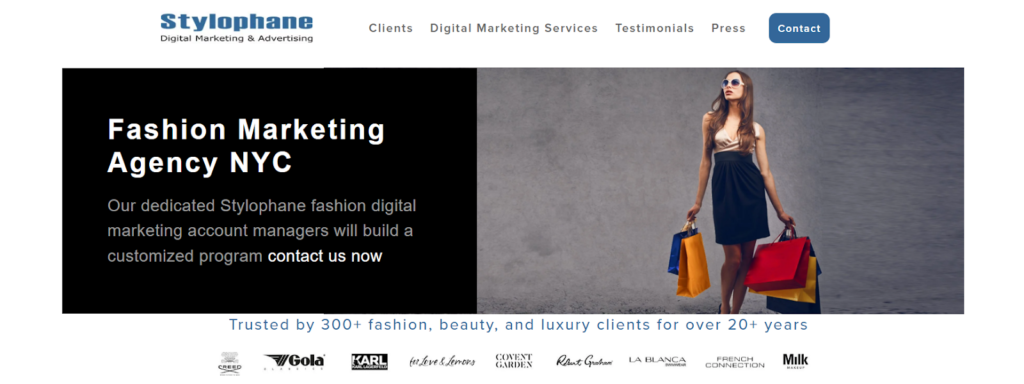
Stylophane is a New York-based digital marketing agency focused on fashion, beauty, and luxury brands. Their services focus on paid advertising, social media, influencer programs, search advertising, and affiliate and retargeting management, with an emphasis on performance-driven digital campaigns.
Source – Stylophane
The agency also highlights capabilities in merchandising technology, advanced attribution, and customer journey analysis, supporting brands that require tighter visibility into audience behavior and revenue impact. Their work focuses on scaling online revenue and improving traffic quality through customized digital programs.
Notable clients: Alternative, Gola, French Connection, Pacifica
Pricing: Pricing information is not published on the website and is discussed directly during engagement conversations.
6. Netgains
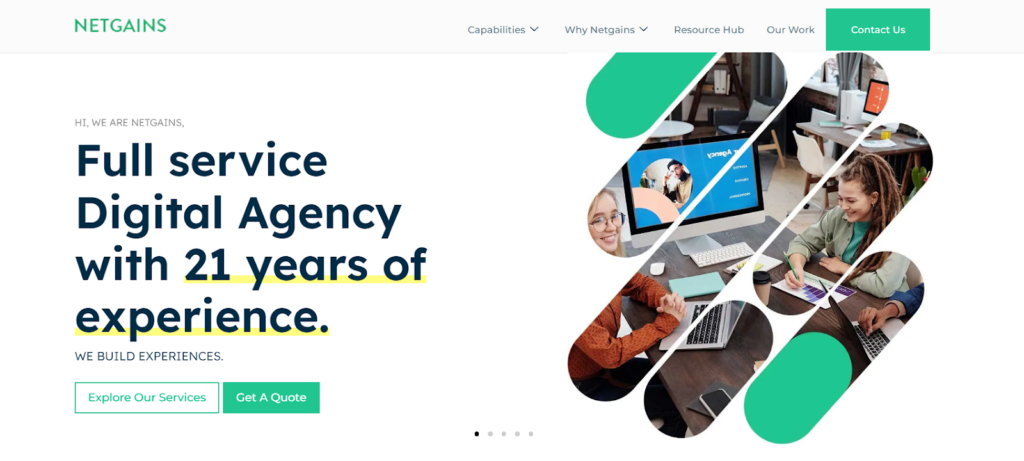
Netgains is a full-service digital agency with a broad footprint across ecommerce, digital marketing, data, and enterprise technology. Their capabilities span ecommerce platforms such as Shopify, Magento, WooCommerce, and BigCommerce, as well as digital marketing, conversion optimization, omnichannel strategy, and paid media execution.
Source – Netgains
Beyond marketing, Netgains also operates deeply in web and mobile development, data and AI, ERP and CRM systems, and retail automation. This makes them relevant for businesses that require both customer-facing growth support and underlying technical infrastructure.
Notable clients: StarTalkRadio, SHANY Cosmetics, Jootti, Karini, TotleKid.
Pricing: Pricing varies by service scope and engagement type and is shared directly by the Netgains team during consultations.
7. AMP Agency
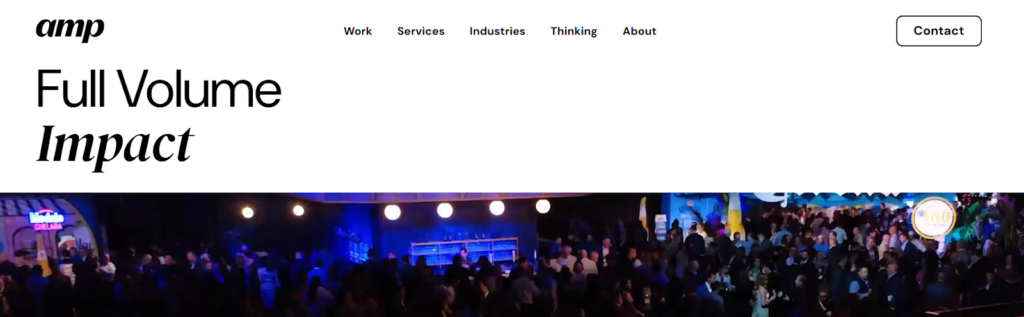
AMP Agency is an integrated marketing agency that works across brand, product, commerce, and experience-led marketing. Their services cover creative and content development, social strategy, integrated campaigns, media planning and buying, ecommerce optimization, and digital and mobile shopping experiences.
Source – AMP Agency
Within fashion and footwear, AMP focuses on how brands show up across touchpoints, from awareness and engagement through purchase and loyalty. Their work spans retail environments, experiential marketing, and performance-driven commerce programs, combining creative execution with media and measurement.
Notable clients: Caleres, Popilush, Merrel
Pricing: Engagement pricing is not publicly outlined and is based on campaign scope and service mix, determined through direct discussions with AMP Agency.
8. VMGROUPE
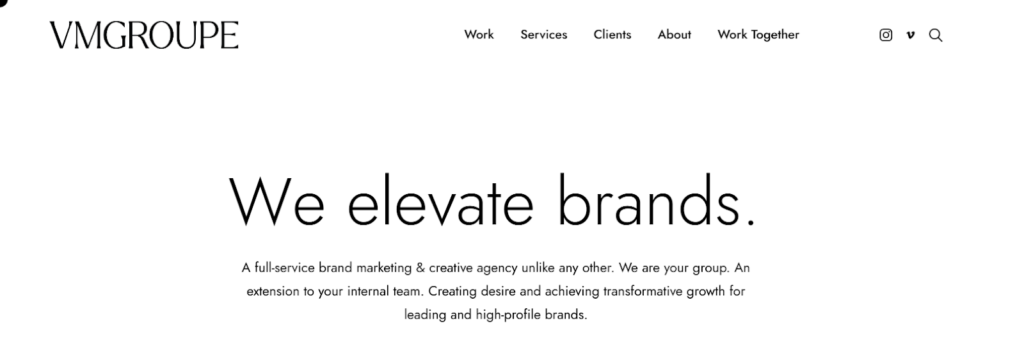
VMGROUPE is a New York-based creative and marketing agency operating across brand strategy, content creation, digital environments, growth marketing, PR, events, and spatial design.
Their work spans positioning, storytelling, branding systems, campaign strategy, performance marketing, and retail and experiential design, with a strong emphasis on visually driven execution.
Source – VMGROUPE
The agency works primarily with luxury, fashion, beauty, and lifestyle brands, supporting both brand-building and growth-focused initiatives. Their services combine creative production, digital platforms, media, and experiential touchpoints, enabling brands to manage how they are presented across online, physical, and cultural environments.
Notable clients: Alexander McQueen, Johnson & Johnson, Kérastase Paris, Kiehl’s, L’Oréal, Yves Saint Laurent, Vogue
Pricing: Pricing is not published publicly and is defined based on scope and engagement requirements.
9. DTE Studio
DTE Studio is a New York-based creative agency working across branding, digital, campaigns, and content production. Their core work includes brand strategy, visual identity, campaign development, website and digital product design, packaging, and creative storytelling. Their experience spans fashion, beauty, lifestyle, hospitality, and technology brands.

Source – DTE
The agency operates as a full-service creative partner, combining strategic consulting with hands-on execution across digital platforms, ecommerce, and content. DTE also highlights work around sustainable design and responsible product launches, supporting brands from early positioning through launch and ongoing creative evolution.
Notable clients: Macrene Actives, The Getty Residences, Vogue, i-D, Elle, Refinery29
Pricing: Pricing is engagement-based and discussed directly with DTE Studio depending on project scope and requirements.
10. Stryde
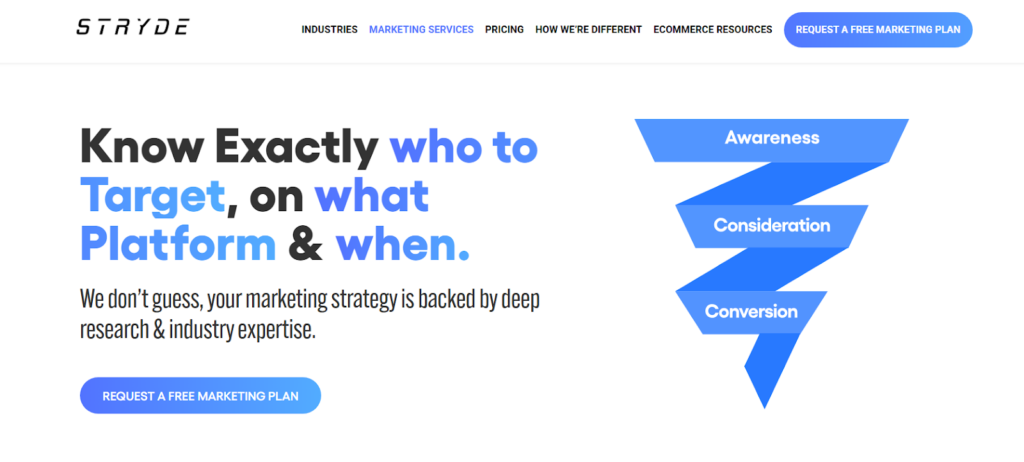
Stryde is an ecommerce-focused marketing agency built around a structured growth framework rather than channel-by-channel execution. Their approach starts with research-led audits covering brand, customer, product, competitors, funnel performance, and unit economics, which then feed into a phased roadmap for scaling acquisition and retention.
Source – Stryde
The agency’s services span SEO and content, paid search and social, and email and SMS, with a strong emphasis on aligning messaging, funnel mechanics, and financial targets. Stryde works primarily with ecommerce brands across categories like fashion, apparel, home goods, and consumer products.
Notable clients: Tilebar, ScentSationals, Ergobaby
Pricing: Pricing is tied to a custom growth plan and is shared after an initial strategy assessment rather than published upfront.
How We Picked These Agencies
This list wasn’t built by scanning awards pages or pulling names from generic directories.
- We started with relevance, not reputation. Each agency had to show clear work in fashion, ecommerce, or adjacent consumer categories where design, digital, and performance intersect.
- We looked closely at what they actually do, not how they describe themselves. Services, case studies, client types, and delivery models mattered more than positioning language.
- We filtered for execution depth. Agencies needed to demonstrate hands-on capability across creative, digital, growth, or technology, not just one narrow channel.
- We avoided firms that rely purely on PR or influencer-led visibility and focused on teams that support real buying journeys, from discovery to conversion.
The result is a practical list built around fit and substance, not noise.
How to Choose the Right Agency for a Fashion Tech Company
The agencies in this list are strong at what they do. The real question is which one matches your priorities right now.
- Get clear on the problem you’re trying to solve. Some brands need sharper positioning and creative clarity. Others need help turning demand into consistent conversions. The choice changes based on that gap.
- Match the agency to your stage. Early teams benefit from speed and hands-on execution. More mature teams need process, reporting, and fewer moving parts.
- Pay attention to how they describe their work. Agencies that are clear about delivery, timelines, and ownership tend to be easier to work with over time.
- Look for comfort across product, design, and commerce. Fashion tech sits at the intersection of all three. The right agency won’t treat them as separate conversations.
A good fit doesn’t feel like a big reveal. It feels like things are finally starting to move in the same direction.
What You Can Do In-House Before Bringing an Agency Onboard
Not every fashion tech team needs an agency on day one. There are a few fundamentals you can and should get right internally first.
- Clarify your story in plain language: If someone outside your team can’t explain what you do after reading your homepage, that’s the first fix.
- Map your real buyer journey: Write down how people actually discover you, compare options, and decide. Not how you wish it worked.
- Audit what’s already live: Look at your website, landing pages, and content and ask one question: Does this help someone make a decision?
- Pick one channel and do it well: Instead of spreading thin, focus on one place where your buyers already spend time and show up consistently.
- Track a few meaningful signals: Engagement, demos, trials, conversions. Skip vanity metrics until the basics are solid.
You can make solid progress with these steps on your own. But when growth depends on sharper positioning, higher-intent visibility, and content that actually drives decisions, that’s where a focused partner like Concurate helps you move faster and go further.
Why Fashion Tech Teams Work With Concurate
At Concurate, we usually step in when marketing activity exists, but outcomes don’t compound.
Our work starts with intent mapping. We study how buyers discover solutions, what questions surface late in the funnel, and where confidence drops. From there, we build content systems that support those moments across search, AI-led discovery, and decision-focused pages.
You can see this approach in our Triangle IP case study, where tightening buyer-focused content and distribution helped double inbound leads, without increasing output or chasing vanity metrics.
That same discipline is what we apply when working with fashion tech teams navigating complex buying journeys.
If you want marketing for your company that compounds instead of resetting every quarter, book our calendar and let’s map this properly.
Frequently Asked Questions
1. What does a marketing agency for fashion tech companies actually do?
A fashion tech marketing agency helps brands translate complex products into clear buyer-facing narratives. This includes positioning, content, search visibility, comparison pages, and demand-focused distribution. The goal is to guide buyers through evaluation, trust-building, and decision-making across digital channels.
2. How is fashion tech marketing different from traditional fashion marketing?
Traditional fashion marketing focuses heavily on aesthetics and awareness. Fashion tech marketing adds layers like product education, feature comparison, platform credibility, and long buying cycles. Buyers need clarity on how the technology fits into workflows, operations, or commerce systems, not just how it looks or feels.
3. When should a fashion tech company hire a marketing agency?
An agency makes sense when internal efforts create activity but results don’t compound. If traffic exists but conversions stall, content doesn’t support sales conversations, or visibility drops across search and AI platforms, an external team can bring structure, prioritization, and buyer-centric execution.
4. What should fashion tech founders look for in a marketing agency?
Founders should look for agencies that understand buyer journeys, not just channels. Strong signals include experience with intent-led content, distribution beyond social media, clarity on measurement, and the ability to align marketing with sales and product narratives instead of chasing vanity metrics.
5. Can early-stage fashion tech companies do marketing without an agency?
Yes, early-stage teams can handle foundational work like basic content, positioning drafts, and customer interviews. However, as buyer journeys become more complex and competition increases, execution gaps appear. Agencies help reduce trial-and-error by applying tested frameworks and avoiding misaligned content investments.
6. How do marketing agencies help fashion tech brands stand out in crowded markets?
Agencies help brands stand out by sharpening positioning and focusing on buyer intent. Instead of creating more content, they prioritize fewer, higher-impact assets that answer comparison questions, remove friction, and show up consistently across search, AI answers, and decision-stage touchpoints.
Disclaimer: The information presented in this article is compiled from publicly available sources, including company websites, industry reports, and social media. All trademarks, brand names, and logos mentioned are the property of their respective owners. We do not claim any ownership of third-party marks, nor do we imply endorsement or affiliation. This article is intended for informational purposes only.