


| TL; DR: Most content marketing agencies say they understand travel tech. Very few understand the difference between marketing for travel consumers and marketing for the hotel groups, tour operators, and airlines that buy travel software. This guide covers nine agencies that do, and five questions to ask before hiring any of them. |
Travel tech companies have a very specific content challenge.
They are not selling trips to travelers. They are selling software to hotel groups, tour operators, airlines, online travel agencies, and other travel businesses.
That means generic travel content does not work. A buyer evaluating a booking engine, revenue management platform, or travel operations tool needs content that explains the product clearly. They want to understand the use case, integrations, workflows, pricing logic, implementation effort, and proof.
But most content does not go that deep. It explains the category in broad terms and leaves the buyer with more questions than answers. The result is content that exists but does not always help the right buyer understand, compare, or shortlist the product.
This guide covers nine content marketing agencies that understand the difference between marketing for travel and marketing for travel tech software. But before we get to that, let’s understand the reasons why content efforts fail for most travel tech SaaS companies.
4 Reasons Why Travel Tech SaaS Companies Struggle To Get Content Marketing Right
Travel tech companies can invest heavily in content and still struggle to influence buying decisions. The problem is rarely content production alone. More often, it comes down to whether the content reflects how travel buyers actually research, evaluate, and shortlist solutions.
Here is where it usually goes wrong:
1. They Write For A General SaaS Audience Instead Of Travel Industry Insiders
A hotel revenue manager, a tour operator, or an airline distribution lead reads content differently than a generic B2B buyer. They know the vocabulary. They know the workflows. They know when a piece of content was written by someone who researched the industry for two hours.
They also know when it comes from someone who actually understands how a global distribution system works or why channel management matters. Generalist content fails this test instantly and loses credibility before it can build any.
2. They Focus On Awareness Content When Travel Tech Buyers Need Evaluation Content
Travel tech buying cycles are long. By the time a buyer is seriously evaluating a platform, they have already done significant research. They are not looking for “what is a property management system.” They are looking for comparisons, alternatives, integration guides, and use-case-specific content that helps them decide.
Most companies default to awareness-stage blog content because it is easier to produce. Unfortunately, it is also the type of content that contributes the least when buyers are making a final decision.
3. They Ignore AI Search, Where More Travel Tech Buyers Are Now Starting Their Research
When a hotel group’s IT director asks ChatGPT for “best channel management software for a chain of 50 hotels” or a tour operator queries Perplexity for “booking platforms for multi-day tours,” the answer is a short list.
The companies on that list get considered first. The companies missing from it may not enter the buyer’s initial research at all. Most travel tech SaaS companies are still optimizing for Google rankings alone and have no strategy for AI search visibility.
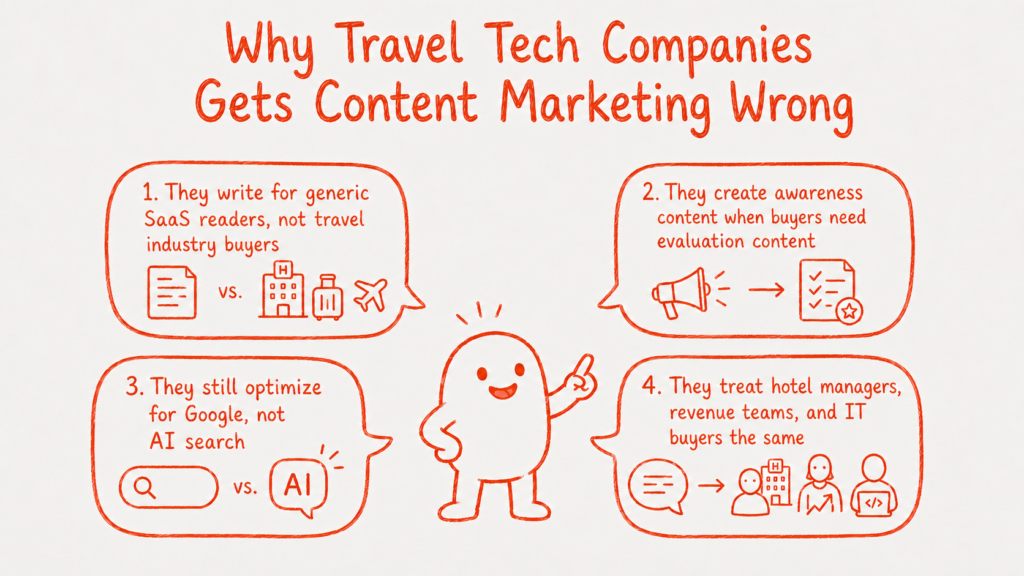
4. They Write One Generic Message for Different Buyers
A travel tech platform is usually evaluated by more than one team. A hotel GM may care about guest experience and operational efficiency. A revenue manager may care about pricing, inventory, and distribution. An IT team may care about integrations, data flow, security, and implementation effort.
If the content speaks to all of them in the same way, it does not answer anyone’s questions properly.
Most travel tech SaaS companies write for one generic persona, which will reach one stakeholder and miss the rest of the buying committee. Understanding these gaps makes it easier to build a stronger content strategy. This is where the right travel tech content marketing agency can help.
But not every agency will be the right fit for a travel tech company. So before you choose one, here are the key factors to evaluate.
5 Questions To Ask A Content Marketing Agency Before You Sign Anything
Choosing a content marketing agency for a travel tech company involves more than reviewing case studies or content samples.
The agencies that create meaningful business results understand how travel buyers research solutions, compare vendors, and make purchasing decisions. They also know how to create content that supports those decisions instead of simply generating traffic.
Here are five that will separate the ones who get it from the ones who do not:
1. Can They Show You Content They Have Built Specifically For Travel Tech Buyers, Not Travel Consumers?
This is the first question to ask and the one most agencies fumble. Marketing for Expedia or Airbnb is consumer marketing. Marketing for a booking engine provider or a revenue management platform is B2B SaaS marketing for a highly specialized audience.
For example, a hotel group evaluating a revenue management platform is looking for very different information than a traveller choosing where to spend a weekend. If the agency’s portfolio is full of destination guides and hotel brand content, they are not the right ones for you.
| Question to ask: Can you show examples of content you have created for travel tech buyers rather than travel consumers? |
2. Do They Build Evaluation-Stage Content, Or Do They Default To Awareness Content?
Ask any agency you are considering: what percentage of the content they produce is designed for buyers who are actively comparing solutions versus buyers who are just learning about a category?
The agencies that move pipeline build comparison pages, alternative pages, use-case specific landing pages, and integration guides. This matters because a buyer evaluating channel management software is unlikely to need another introductory article explaining what channel management is. They are far more likely to be looking for competitor comparisons, integration information, and implementation guidance.
For travel tech, that is the type of content that helps buyers move closer to a decision.
| Question to ask: How much of your content is designed for buyers actively evaluating vendors rather than people who are just learning about a category? |
3. Do They Have A Strategy For AI Search Visibility, Not Just Google Rankings?
Travel tech buyers are increasingly using ChatGPT, Perplexity, and Google AI Overviews to build vendor shortlists. Most agencies still talk about search as if Google is the only place buyers look for information.
Is the strategy limited to page structure and schema markup? Then they are focusing on technical optimization without addressing how buyers actually discover vendors through AI platforms.
The agencies that actually move AI citation share build decision-stage content that matches how buyers describe their problem to an AI platform.
| Question to ask: How do you build visibility in AI search for a travel tech platform? |
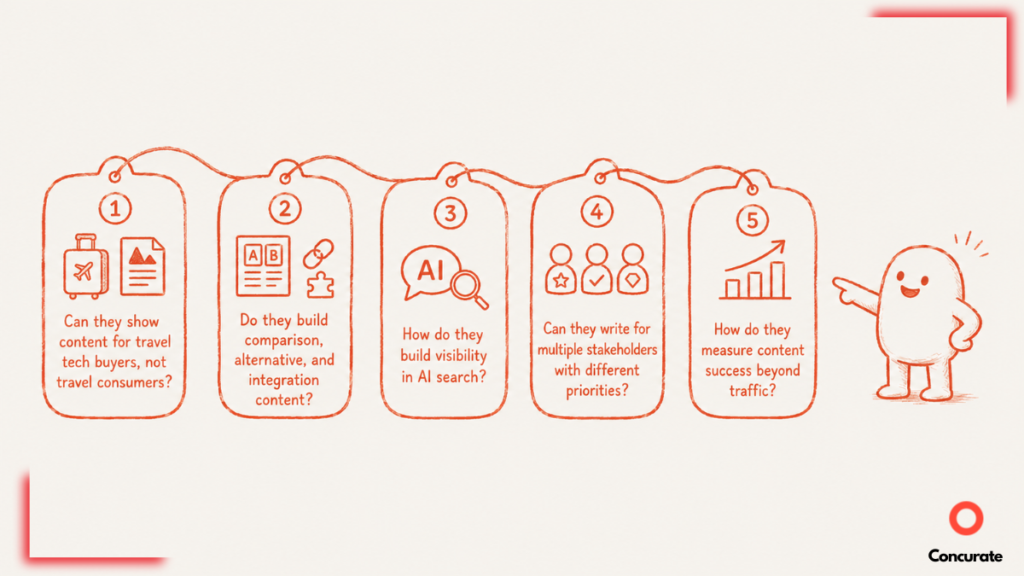
4. Can They Write For Multiple Buyer Personas Without Everything Sounding The Same?
A travel tech platform is rarely evaluated by just one person. For example, a hotel GM and an IT director may both be involved in evaluating the same platform, but they care about very different things.
If an agency describes a single content strategy that addresses both audiences in the same way, they have not thought about the buying process deeply enough. The right agency maps each persona’s specific concerns and builds content that speaks to each one at the right stage of the buying process.
| Question to ask: How would you approach content for a platform evaluated by multiple stakeholders with different priorities? |
5. How Do They Measure Success Beyond Traffic And Rankings?
Traffic is not the goal. Pipeline is. Many agencies report on organic sessions, keyword rankings, and publishing output because those metrics are easy to track. The problem is that none of those metrics directly tells you whether content is influencing buying decisions.
For example, a travel tech company may see traffic increase while generating little additional pipeline. Another company may attract fewer visitors but consistently influence vendor evaluations and qualified opportunities.
The strongest agencies connect content performance to qualified leads, evaluation-stage engagement, and increasingly, AI visibility.
| Question to ask: What metrics do you use to measure content success beyond traffic and rankings? What would reporting look like after three months into an engagement? |
Now that we have covered how to evaluate the right content marketing agency, let’s look at the companies helping travel tech brands turn content into a competitive advantage.
Top 9 Content Marketing Agencies For Travel Tech Companies In 2026
Most marketing agencies look good on paper. Very few actually work once travel tech complexity enters the picture.
The agencies listed below have proven they can handle multiple buyer personas and products that cannot be explained with surface-level messaging.
This list focuses on teams that know how to turn complex travel technology into content that supports real buying decisions, not just page views.
Here’s the lineup:
- Concurate
- VERB Interactive
- Wanderlust Social
- Mediabloom
- MMGY Global
- SeoProfy
- Madden Media
- AAMP Agency
- Propellic
Let’s explore each one by one.
1. Concurate
Most travel tech teams don’t have a content problem. They have a visibility problem.
You’re publishing blogs and running SEO. You might even be ranking for a few keywords. But when buyers actually start researching or asking AI tools for recommendations, your brand may still not show up.
That’s the gap Concurate is built to fix.
At Concurate, we don’t start by asking how much content you want to produce. We start by asking a harder question: where are buyers dropping you from consideration, and why?
For travel tech companies, that usually shows up in a few familiar ways:
- You rank for broad travel keywords, but not for platform comparisons, alternatives, or integration-led searches.
- Your product pages don’t surface when buyers search for the best tools, software lists, or category breakdowns.
- AI tools summarize your category, but cite your competitors instead.

Source – Concurate
Our work sits where travel tech marketing usually breaks down: between visibility, positioning, and buyer education.
We focus on content that shows up where buyers look, whether that is Google, AI search, LinkedIn, or the pages your sales team shares during evaluation.
That means:
- Structuring pages so they rank on Google and get picked up by AI answers
- Building comparison, category, and use-case content that mirrors how travel tech buyers actually evaluate tools
- Creating BOFU content that answers late-stage questions before sales ever get involved
Our services for travel tech teams typically include:
- High-intent SEO and category content
- Comparison and alternatives pages built for real buyer behavior
- Integration and use-case content for specific travel tech workflows
- Programmatic SEO where scale actually makes sense
- AI search visibility optimization so your brand shows up beyond blue links
- Content frameworks that support sales, not fight it
- Short video content across YouTube
- LinkedIn and short-form content that supports founder and sales-led visibility
And importantly, we don’t operate like a volume factory. We work closely with teams who want clarity on what not to write as much as what to publish next.
If your travel tech product is solid but still feels invisible during real buying moments, that’s usually not a traffic issue. It’s a positioning and discoverability issue.
That’s the problem Concurate exists to solve.
If you want to understand where your content is losing buyers, book a call and let’s map the gaps together.
Notable Clients: Datacipher, Scanwriter, Ratio Tech, Inspire IP, and Triangle IP.
Pricing: Partnerships typically range from USD 5,000 to USD 7,500 per month, with project engagements starting at USD 3,500.
2. VERB Interactive
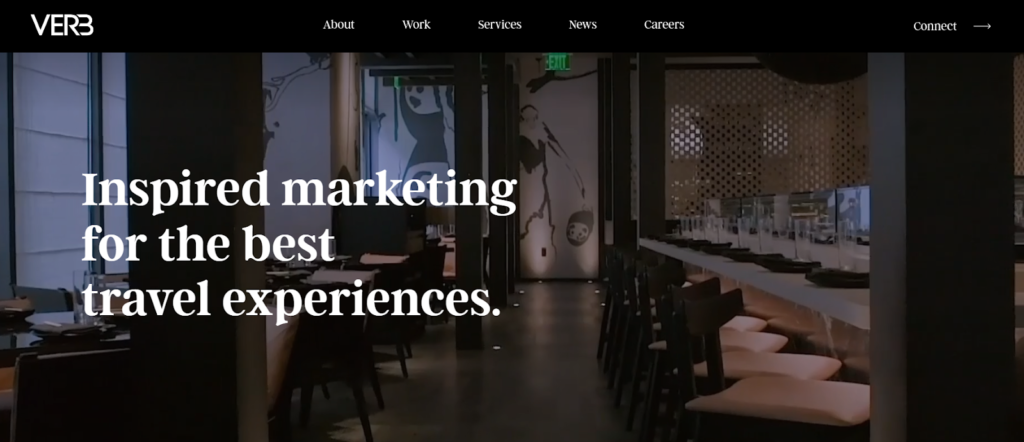
VERB takes a blended approach that sits at the intersection of technology, creative, and marketing, which makes it particularly relevant for complex digital-first brands. Their work spans strategy, content, SEO, social, creative, and performance media, but what stands out is how tightly these pieces are connected rather than operating in silos.
Source – VERB Interactive
Beyond marketing execution, VERB brings strong technical depth. From CMS-agnostic website builds to booking integrations and platform-level solutions for hotels, resorts, ferries, and cruise lines, they operate comfortably in environments where marketing and product infrastructure overlap.
Notable clients: The Venetian Las Vegas, Hotel Bardo Savannah, Bermuda
Pricing: Pricing is not publicly listed; teams typically need to contact VERB directly for engagement details.
3. Wanderlust Social
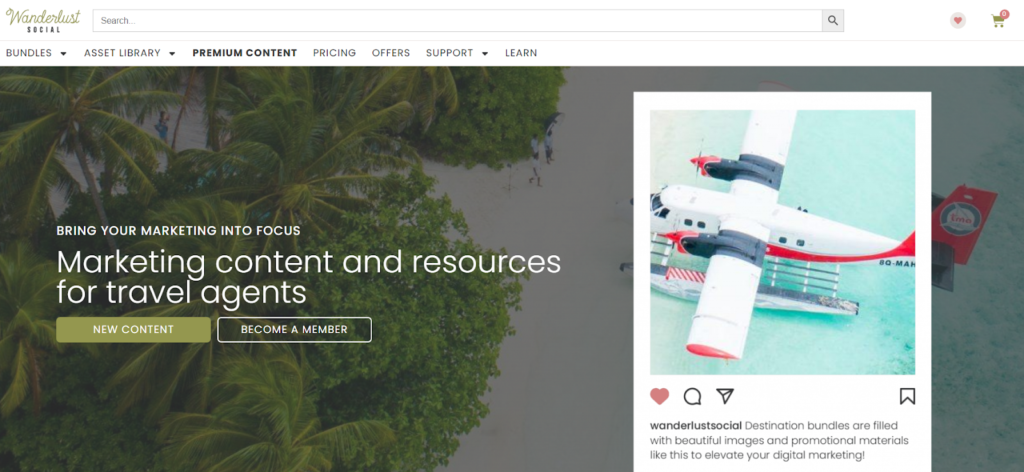
Wanderlust Social operates as a subscription-based marketing content platform focused on travel agents and travel agencies. The company provides pre-created marketing assets that can be used across social media, email, blogs, and promotional materials, with content organized by destination, travel theme, or niche.
Source – Wanderlust Social
The offering is structured around content bundles that include images, captions, videos, itineraries, maps, packing lists, and email templates. These assets are designed to be reused and customized through tools like Canva, allowing travel professionals to plan and publish marketing content without producing it internally.
Notable clients: Travelwhirled, Experience the Dream Travel, Dream Travel By Design, Erotas Travel, Turquoise Temptations Travel
Pricing: Pricing is publicly listed. Individual content bundles are priced at $99, and annual subscription plans start at approximately $570 per year.
4. Mediaboom
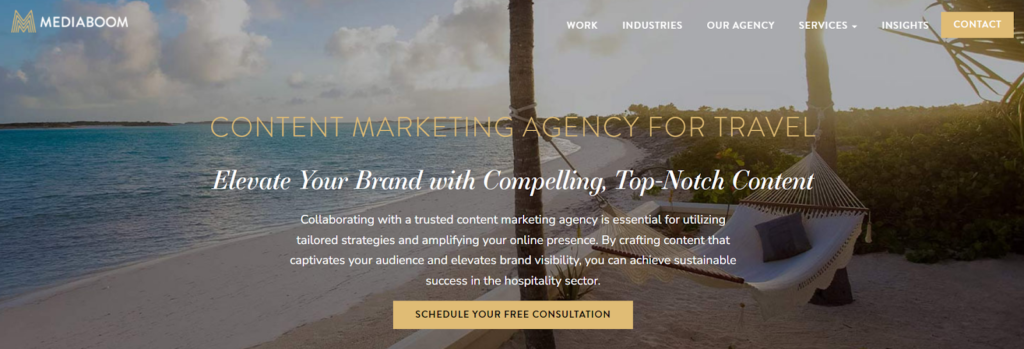
Mediaboom is a digital marketing agency with a focus on travel and hospitality brands, offering services across content marketing, SEO, website design and development, paid advertising, and email marketing. The agency positions its work around building and maintaining online visibility for hospitality businesses through structured content strategies and search optimization.
Source – Mediabloom
Their content marketing offering is closely tied to SEO, with defined service tiers that include keyword research, on-site and off-site optimization, link building, and ongoing reporting. Mediaboom also supports broader digital needs such as website builds and performance media, making it a full-service option for travel and hospitality brands.
Notable clients: JW Marriott, Crowne Plaza, Hampton Inn & Suites, Musha Cay, Marina Inn at Grande Dunes
Pricing: Pricing is partially listed, with content and SEO packages starting at $1,950 per month; higher tiers and enterprise engagements require a custom quote.
5. MMGY Global
MMGY Global is an integrated marketing company focused exclusively on the travel, tourism, and hospitality industry. The company operates through a group of specialized agency brands, covering areas such as advertising, branding, content creation, research, media, public relations, social media, and marketing technology.
Source – MMGY Global
Its model brings together strategy, creative, data, and execution under one umbrella, allowing travel and tourism organizations to work across multiple disciplines through a single partner network. MMGY Global’s services span the full marketing lifecycle, from research and strategic planning to campaign execution, measurement, and analytics, with a strong emphasis on destination and hospitality marketing.
Notable clients: Client names are not individually listed on the landing page; MMGY Global works with travel, tourism, and hospitality brands worldwide.
Pricing: Pricing is not publicly listed and typically requires contacting the MMGY Global team for engagement details.
6. SeoProfy
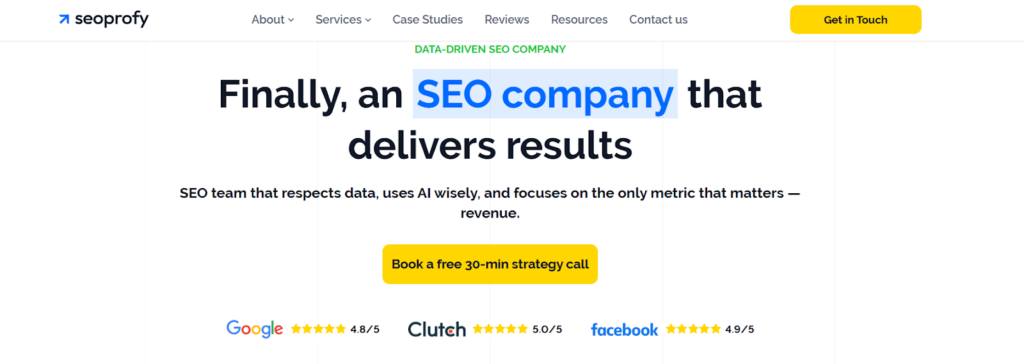
SeoProfy is an SEO-focused digital marketing agency that works across multiple industries, including SaaS, ecommerce, B2B, healthcare, and travel-related businesses. Its services cover technical SEO, content writing, link building, audits, site recovery, international SEO, and AI-focused search optimization.
Source – SeoProfy
The agency positions its work around structured audits, competitor analysis, and ongoing optimization, supported by in-house tools and a large specialist team. SeoProfy also offers consulting and strategy services alongside execution, with content creation typically integrated into broader SEO and search visibility.
Notable clients: Jooble, FXTM, Preply, VistaCreate, TemplateMonster
Pricing: Pricing is not publicly listed and varies by scope; prospective clients need to contact the team for a custom quote.
7. Madden Media
Madden Media is a destination-focused marketing agency that works primarily with travel, tourism, and community-based organizations. Its services span strategic planning, data analytics, creative, web, media, public relations, email marketing, and SEO, with an emphasis on destination branding and integrated campaigns.
Source – Madden Media
The agency’s work centers on helping destinations and communities articulate their identity through storytelling, research, and multi-channel execution.
Madden Media combines creative development with media strategy and destination intelligence to support tourism growth initiatives. This includes brand campaigns, visitor engagement, and market activation programs.
Notable clients: Visit Idaho, Visit Port Aransas, Visit Jacksonville, Puerto Rico, Brevard
Pricing: Engagement pricing is not disclosed publicly and is shared upon direct consultation.
| We recently studied why some data analytics platforms appear more in AI search recommendations than others. Read our insightful findings here. |
8. AAMP Agency
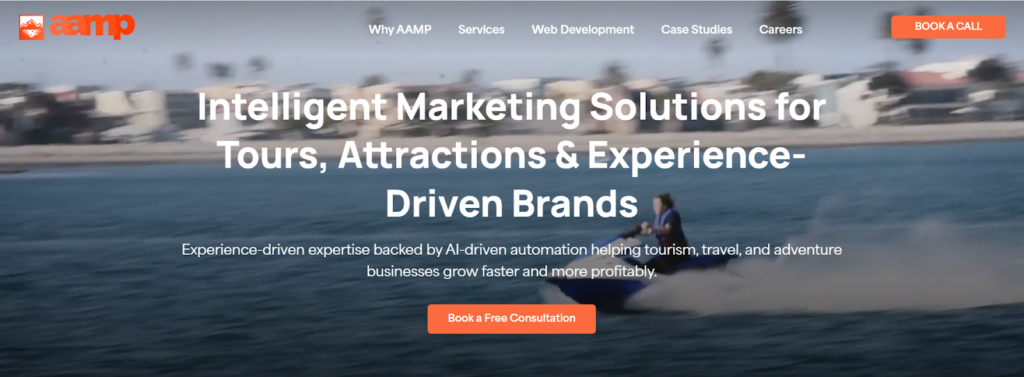
AAMP Agency is a tourism-focused digital agency that works primarily with tour operators, attractions, and experience-based travel businesses. Its services combine website design and development with marketing execution, covering areas such as SEO, content creation, social media, paid advertising, email marketing, and influencer management.
Source – AAMP Agency
A key part of AAMP’s offering is booking-oriented web development. The agency builds mobile-first websites with integrated booking engines, conversion-focused layouts, and performance optimization. It also focuses on the broader growth initiatives such as search visibility, multi-channel campaigns, and content production designed for travel discovery and booking behavior.
Notable clients: Go Car Tours, Nation Park Express, Nightly Spirits
Pricing: Pricing information is not publicly available and is shared through direct consultation based on project scope and service requirements.
9. Propellic
Propellic is a travel and tourism-focused digital marketing agency that works with tour operators, attractions, and travel brands to improve discoverability across search and paid media channels. Its services center on SEO, content strategy, link building, technical SEO, and paid advertising, with increasing emphasis on AI-driven search behavior and optimization.

Source – Propellic
The agency positions its work around data analysis and ongoing experimentation, using proprietary research and performance tracking to adapt strategies as traveler search patterns evolve. Propellic manages both organic and paid programs, supporting clients across the full journey from search discovery to booking conversion.
Notable clients: Captain Experiences, Unexpected Tours & Training
Pricing: Pricing is not publicly listed; packages and retainers are discussed directly based on goals and scope.
Now that we have covered the agencies, the next question is not just which one looks good on paper. It is the one that can actually understand how travel tech buyers evaluate platforms.
That distinction matters because travel tech teams often do not make the wrong choice. After all, an agency is bad. They make the wrong choice because the agency is built for a different kind of marketing problem.
5 Common Mistakes Travel Tech Teams Make When Choosing A Marketing Agency
Most hiring mistakes don’t come from picking a bad agency. They come from picking the wrong type of agency for travel tech.
Here are some common mistakes:
- Assuming travel experience automatically means travel tech experience. Selling destinations and selling platforms are very different problems.
- Hiring based on how polished the agency’s website or decks look, then struggling to explain the product better after the content goes live.
- Handing everything over and hoping the agency will figure out positioning, even when sales and product teams aren’t aligned internally.
- Expecting quick pipeline impact from blog content, while ignoring comparison pages, integrations content, and evaluation-stage assets.
- Optimizing for more traffic when the real issue is that the right buyers don’t understand the product well enough to move forward.
The goal is not to find the most visible agency. It is to find one that understands how travel tech is actually evaluated, compared, and bought.
Before you bring in an agency, there are also a few things your internal team can fix first.
What Travel Tech Teams Can Fix Themselves Before Hiring An Agency
Before bringing in an external agency, there are a few things travel tech teams can realistically tighten up on their own. Doing this first often makes any future agency partnership far more effective.
- Get your core story straight: Make sure sales, product, and marketing all explain the product the same way. If internal explanations vary, external content will too.
- Map how buyers actually evaluate you: List the questions prospects ask before demos. Integration concerns, comparisons, pricing logic, and implementation fears usually come up early.
- Audit what buyers see first: Look at your homepage, product pages, and top-ranking blogs. Ask whether a first-time visitor truly understands what problem you solve.
- Identify where deals slow down: If prospects stall after the first call, the gap is usually education, not awareness.
- Clean up obvious gaps: Missing comparison pages, unclear use cases, or outdated messaging are things teams can address without outside help.
These steps can help your team clean up the basics. But basic fixes will not be enough if buyers still cannot find you when they compare platforms, check integrations, look for alternatives, or ask AI tools for recommendations.
That is the real gap: your product may be relevant, but your content is not showing up at the moments buyers are making a shortlist.
Concurate helps travel tech companies close that gap with content built around how buyers actually research, compare, and decide.
Turn Your Travel Tech Content Into A Buyer Shortlist Asset
At Concurate, we help travel tech companies create content that does more than fill a blog calendar. We build comparison pages, use-case content, integration-led content, buyer-focused SEO, thought leadership, and LinkedIn content that supports search visibility, AI discovery, and sales conversations.
Our Content Marketing Services: Build content that helps buyers understand your product, compare alternatives, and move closer to a sales conversation.
Our GEO Services: Strengthen your visibility across ChatGPT, Perplexity, Google AI Overviews, Gemini, and other AI search experiences where buyers are starting to build shortlists.
Is your content ready for AI search? Our checklist walks you through the key optimizations that help SaaS blogs become easier for AI tools to understand, cite, and recommend.
Frequently Asked Questions
1. Why do travel tech companies need specialized content marketing?
Travel tech buyers research differently. They compare tools, read reviews, look for integrations, and evaluate real-world use cases. Generic SaaS content rarely works here. Specialized content marketing helps translate complex features into clear outcomes for travel operators, improving visibility, trust, and conversion across long buying cycles.
2. What type of content works best for travel tech companies?
High-performing travel tech content usually includes comparison pages, alternatives, integration explainers, pricing breakdowns, and industry-specific landing pages. Buyers want clarity, not fluff. Content that answers “Is this right for my property or operation?” tends to outperform broad thought leadership or generic blog posts.
3. How long does it take to see results from content marketing in travel tech?
Most travel tech companies start seeing meaningful visibility improvements within three to six months. Results depend on competition, existing content quality, and how well pages are aligned with buyer intent. Content built around high-intent searches tends to compound faster than awareness-focused publishing alone.
Disclaimer: The information presented in this article is compiled from publicly available sources, including company websites, industry reports, and social media. All trademarks, brand names, and logos mentioned are the property of their respective owners. We do not claim any ownership of third-party marks, nor do we imply endorsement or affiliation. This article is intended for informational purposes only.