

| TL;DR: We searched for data analytics platforms across ChatGPT, Perplexity, and Gemini to understand which names show up in recommendations. While legacy players appeared often, we also noticed tools like Snowflake, Domo, Mode, and Anomaly AI showing up repeatedly across different searches. That led us to study their content strategies. We found five consistent patterns around how they build content, present customer outcomes, and educate their buyers. If your platform isn’t showing up in AI recommendations today, this article breaks down what these companies are doing,and what you can do too, to close the gap. |
At Concurate, one of the more consistent patterns we’ve noticed while studying AI visibility in B2B software is that the top companies recommended for any category are rarely a surprise.
Take data analytics, for instance. The names that dominate AI recommendations in this space are usually Microsoft Power BI, Tableau, and Qlik Sense. These are all companies with decades of market presence and category-defining products behind them. So, it makes sense that they appear so consistently. But the real insight often comes from looking beyond the legacy names and seeing which other platforms keep appearing in recommendations.
That is where the analysis became more interesting. A few companies kept showing up repeatedly after the established players.
So, we studied their content more closely to understand why they were showing up. What we found was not one big trick, but a set of content patterns other data analytics platforms can learn from and apply.
In this article, we break down those patterns and show what you can do if your platform is not appearing in AI recommendations yet.
How We Picked the Data Analytics Platforms Performing Well in AI Search
To identify the platforms that repeatedly appeared, we did not rely on one broad query. We wanted to make sure we were looking across different types of buyer intent. So, we ran the following searches across ChatGPT, Perplexity, Gemini, and Claude:
- Top data analytics platforms for businesses
- Best data analytics platform for enterprise teams
- Best data analytics software for dashboards and business reporting
- Best data analytics tools for SaaS companies
The mix was deliberate.
A buyer searching “top data analytics platforms for businesses” may be looking for a broad shortlist, while someone searching “best data analytics tools for enterprise teams” has a more specific use case in mind. We wanted to see which platforms appeared across both broad and specific recommendation-style queries.
When the results surfaced, tools like Microsoft Power BI, Tableau, Google Looker, and Qlik Sense led almost every response.
However, for this analysis, we wanted to focus on companies that seemed to be earning their AI visibility intentionally. Platforms that had done something deliberate with their content strategy to show up where they do. So we checked the next set of names that kept showing up after the established players. They were Snowflake, Domo, Mode, and Anomaly AI.
Next, we analyzed their website and content more closely to understand what signals can be helping AI tools connect them with data analytics recommendation queries.
5 Reasons why AI Tools Cite Snowflake, Domo, Mode, and Anomaly AI More Frequently Than Other Platforms
Data analytics buyers do not always search in neat categories. Some search for “best analytics tool.” Others search for “best reporting tool or “best AI analytics software.” Even though the wording changes, the underlying need is often similar: they want a platform that can help them understand, analyze, and act on business data.
That is why it was worth looking at the platforms that appeared across these recommendation-style searches. So, we went and looked at their content to understand what they’re doing differently. Here are the five patterns we found:
1. They Create Content Around the Exact Questions Buyers Ask AI Before Making a Decision
Buyers don’t search on AI the way they do on Google.
For instance, a small business owner looking for a data analytics tool might search for something like “top data analytics tools for small businesses” or “simple dashboard tools for small teams” on Google.
But on ChatGPT, the same person is more likely to get extra specific, asking questions like:
- “I run a 40-person SaaS company and need a data analytics tool that can pull data from HubSpot, Stripe, and Google Analytics. Which tools should I compare?”
- “We’re a small finance team using spreadsheets for reporting. What data analytics platform can help us build dashboards without hiring a full data team?”
- “We’re moving from spreadsheets to a BI tool and need to compare between Looker, Mode, and Domo for finance reporting. Which one fits a small team better?”
These aren’t just keywords. They’re real buying situations. And when AI tools answer these questions, they look for content that matches the situation closely. They could pick information from:
- a top tools list covering data analytics platforms for SaaS companies at different growth stages
- a practical guide for small teams moving from spreadsheets to dashboards, explaining when the switch makes sense and what tools to consider
- a comparison page for buyers evaluating tools. Say Looker vs Mode, for a specific workflow, such as finance reporting or product analytics
All these are decision-stage content formats. They tell AI systems where a tool fits, what its use cases are, who it’s best for, etc. From what we’ve found, companies that create this kind of content show up more often in AI recommendations because their content answers the questions buyers search on AI tools when choosing a platform.
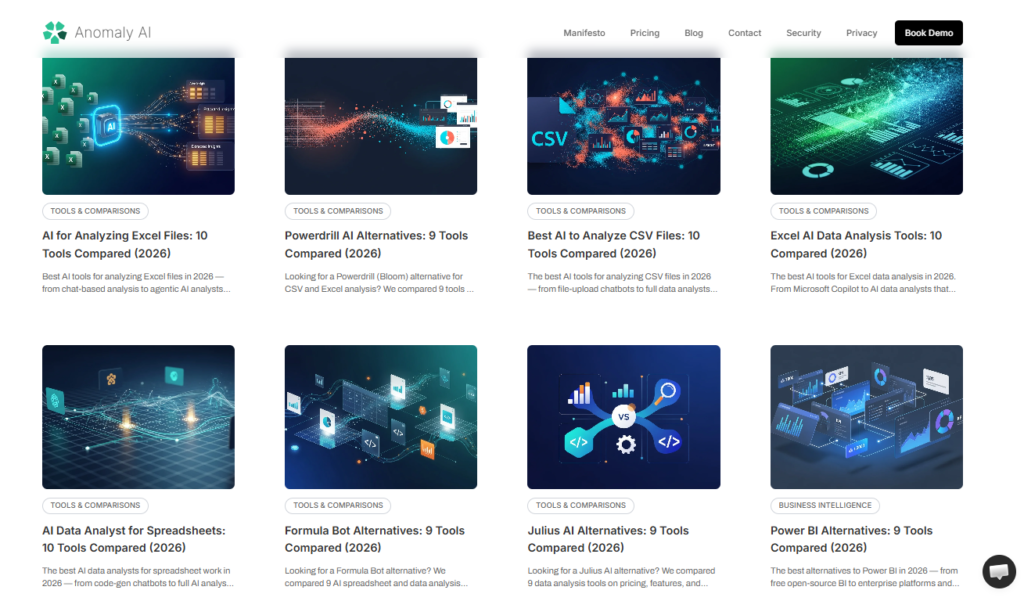
Anomaly AI is a testament to this fact.
Source – Anomaly AI
If you head to its Blog, you’ll find pieces like Best AI to Analyze CSV Files, 10 Best Excel AI Data Analysis Tools in 2026, and Top 9 Formula Bot Alternatives in 2026. Each one is written for a buyer with a specific situation, a specific tool they’re already using or considering, and a specific decision they’re trying to make.
That is also why Anomaly can show up for adjacent comparison queries. For example, when we searched for “Best ThoughtSpot alternatives for teams on a small budget,” ChatGPT referenced Anomaly’s Power BI alternatives article as one of the sources.
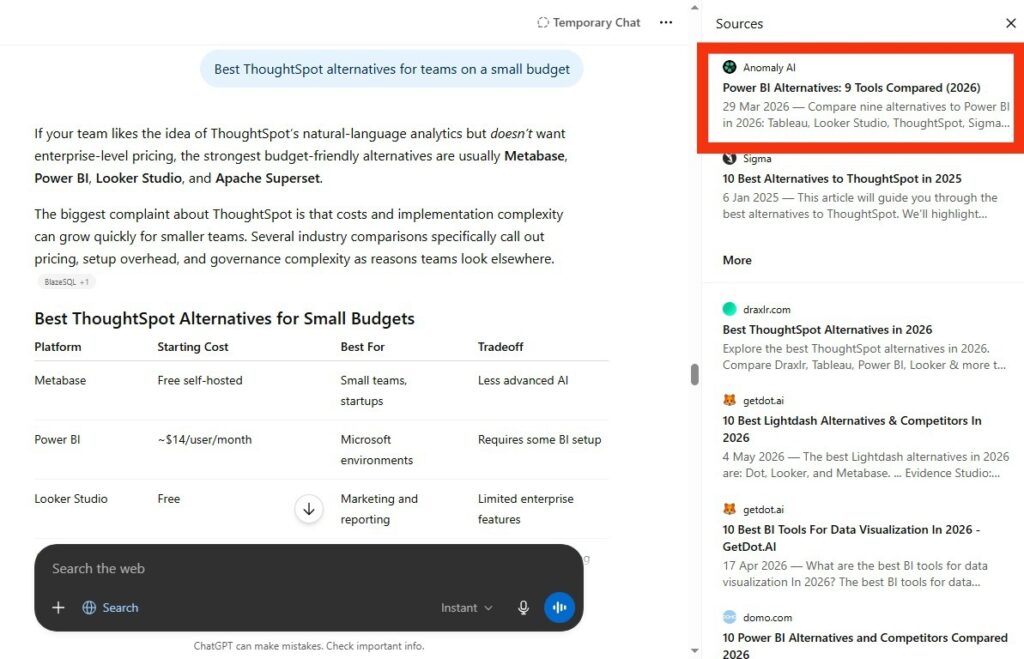
The article was not written specifically around ThoughtSpot alternatives. But because it compares BI and analytics tools in a similar decision-making context, AI tools could still reference it while answering a related alternatives query.
That is the larger point: when your content covers real comparison moments in the category, it can surface beyond the exact keyword you originally targeted.
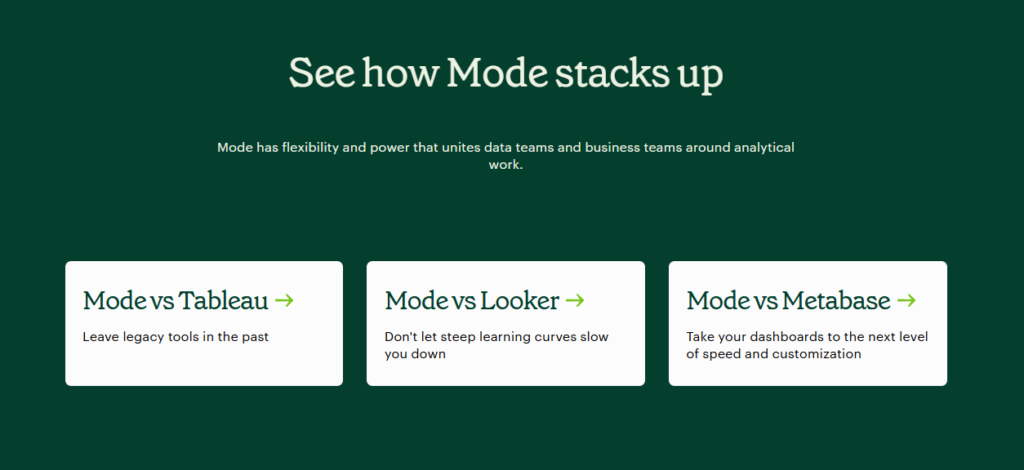
Mode takes a different approach to the same idea.
Source – Mode
It has a dedicated section called How Mode Compares that puts it directly against tools buyers are already evaluating. For instance, its Mode vs Tableau page is built for a buyer who has Tableau on their shortlist and wants to understand whether switching makes sense. Similarly, its Mode vs Looker page speaks to buyers drawn to Looker’s approach but worried about the learning curve.
Both approaches are different, but they’re working toward the same outcome: being present at the exact moment a buyer is making up their mind. And that’s precisely what earns you a spot in AI recommendations.
2. They Have Dedicated Landing Pages for Specific Roles, Industries, and Use Cases
Suppose a buyer is looking for a data analytics tool for their fintech company. They’ll probably ask AI engines something like, “What’s the best data analytics tool for fintech companies?” before narrowing the list by budget, team size, or use case.
Now, suppose another buyer runs an ecommerce startup. They may ask, “What’s the best data analytics platform for ecommerce startups?”
In both cases, AI tools will return a list of platforms. But the names may not be exactly the same because the industries are different. The same thing happens when buyers search by role, team, or use case.
This is where dedicated landing pages help. If your platform has separate pages or dedicated content for specific industries, roles, use cases, or workflows, AI tools have a better chance of citing it when a buyer asks a similar question. That’s because the page already explains how your product fits that need.
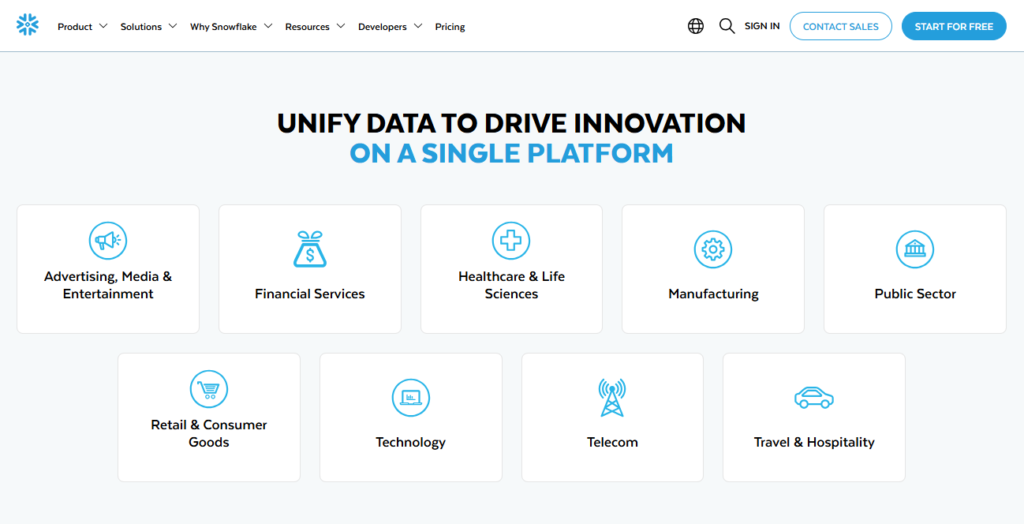
Snowflake does this well.
Source – Snowflake
The company has dedicated pages for major industries it serves, like Advertising and Media, Financial Services, Manufacturing, and more. It also has department-level pages for teams in Marketing, Finance, and IT.
Each page explains how Snowflake fits that specific workflow, using language and use cases that someone in that role would actually recognize. For example, its Telecom page doesn’t describe Snowflake as a general data platform. Instead, it connects Snowflake to telecom-specific needs like customer experience, network performance, churn, fraud, and operational analytics.
This clearly makes a difference because when we searched for the “best AI analytics platforms for telecom companies” on Perplexity and Google, the page appeared in both AI recommendations.
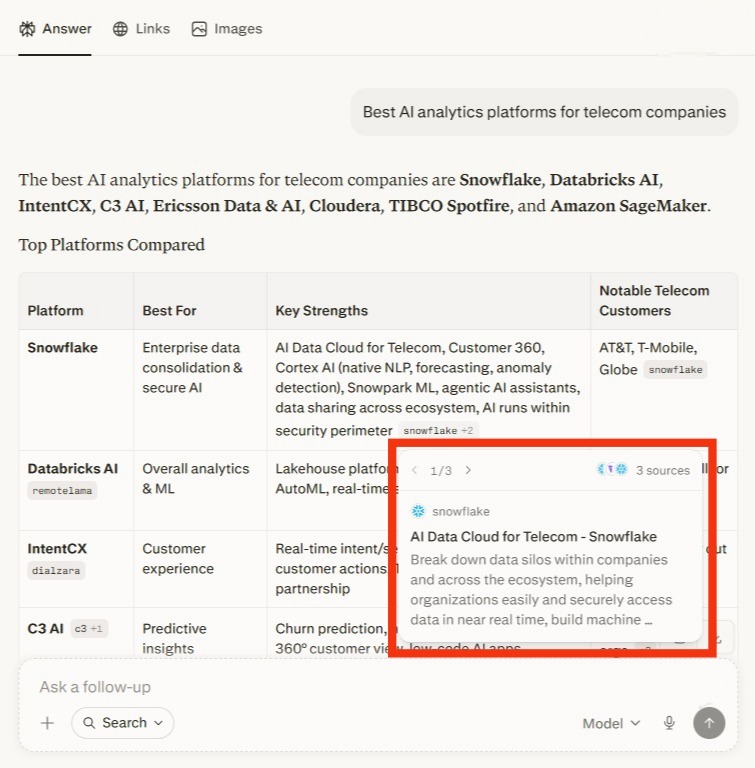
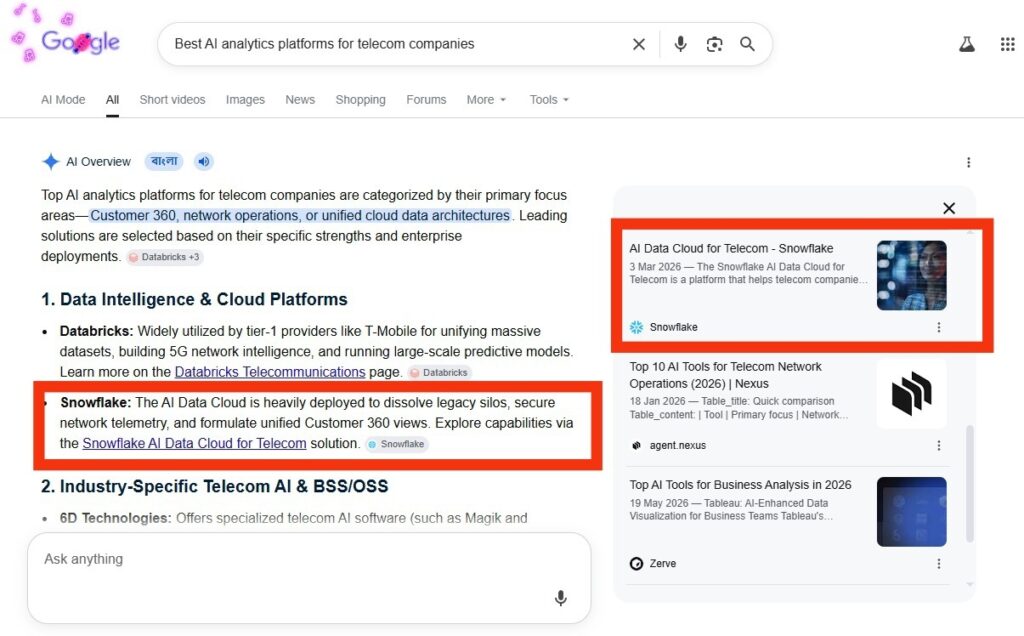
The takeaway is simple: AI tools need dedicated content to make specific recommendations. An industry page, a department page, or a use case page gives AI tools a clear reason to connect your platform with that search. Without those pages, AI tools may still understand your product at a broad level, but they have fewer reasons to cite it for niche buyer needs.
3. Their Case Studies Show Business Outcomes in Numbers
Almost every data analytics company publishes customer stories. But most of them follow the same pattern: a paragraph about the challenge, a paragraph about the solution, and a closing line about how the client “saw significant improvements in efficiency.”
For a buyer trying to evaluate a platform, that kind of content isn’t very helpful. And for an AI tool trying to build a useful recommendation, it isn’t very citable either.
The difference between a case study that gets cited and one that doesn’t often comes down to specificity.
When a buyer asks Perplexity, “Which data analytics platforms actually deliver measurable results for enterprise teams?”, Perplexity needs something concrete to point to.
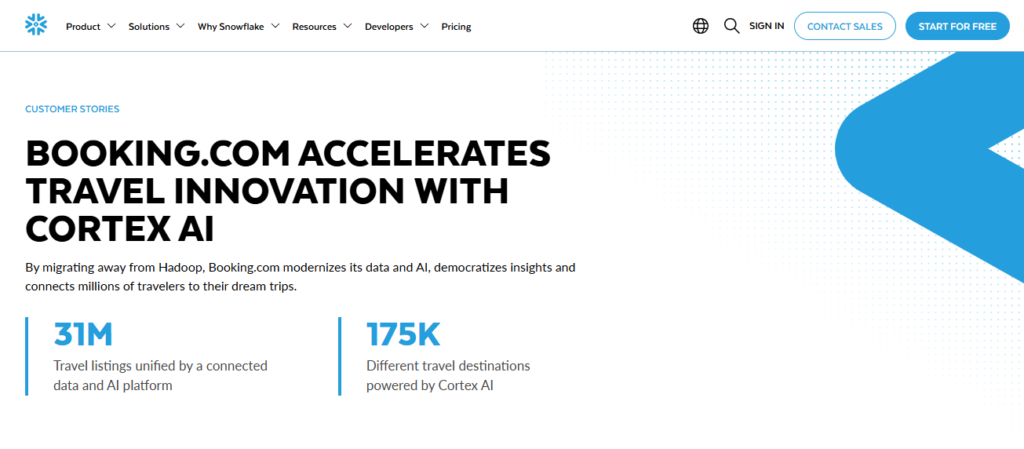
Snowflake’s Customer Stories page is a good example. Its case studies almost always lead with a quantified outcome.
Source – Snowflake
For example, take the Booking.com case study. The page opens with two numbers front and center:
- 31 million travel listings unified on a single platform
- 175,000 destinations powered by Cortex AI
These numbers can easily be cited by AI tools when a buyer in the travel space asks what results companies typically see with Snowflake.
This is a small but important shift. Most case studies in the data analytics space tell a nice story. Snowflake’s case studies prove the story with numbers. That precisely what makes them more useful for buyers and easier for AI tools to reference in recommendation-style answers.
Recommended Read: Inside Snowflake’s SEO Engine for AI and Data Platforms
4. They Have Rich Resource Hubs AI Tools Can Cite
There’s a pattern we’ve noticed across companies with strong AI visibility. They tend to cover their category very thoroughly by building additional resources like glossaries, knowledge bases, and training materials. And it explains why.
You see, AI tools don’t just recommend products. They answer questions, too. And to answer questions well, they need credible sources to pull information from.
The more a company has written about its category, the more often AI tools will pull from its content. For instance, a buyer might ask, “What is a data pipeline?” or “How does SQL work?” If a company has a page that answers that, AI will cite it.
Once AI starts treating a company as a reliable source, that association carries over to product recommendation queries, too. That’s the compounding effect of building rich, public content.
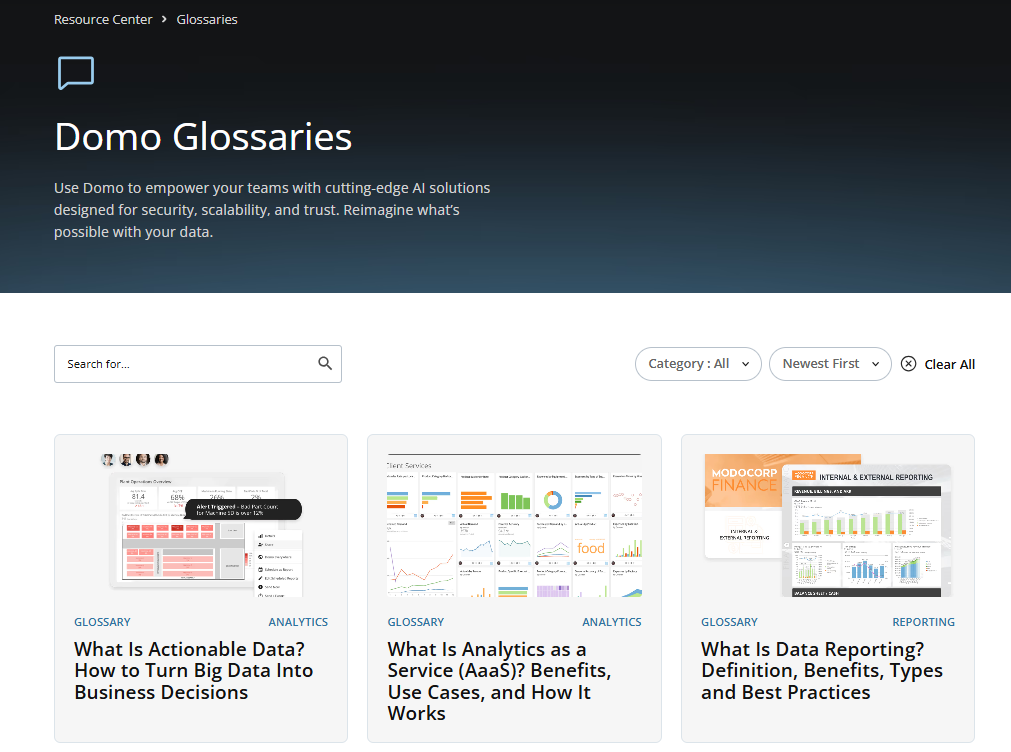
Domo is a strong example of this.
Source – Domo
The company has a comprehensive resource library, consisting of a curated Glossary that covers hundreds of terms across Data Integration, Data Quality, Data Architecture, and AI.
Alongside that, it maintains a Knowledge Base with detailed documentation covering nearly every aspect of its product, a Domo Central hub that brings together community forums, and a Resource Library with blogs, customer stories, and chart references.
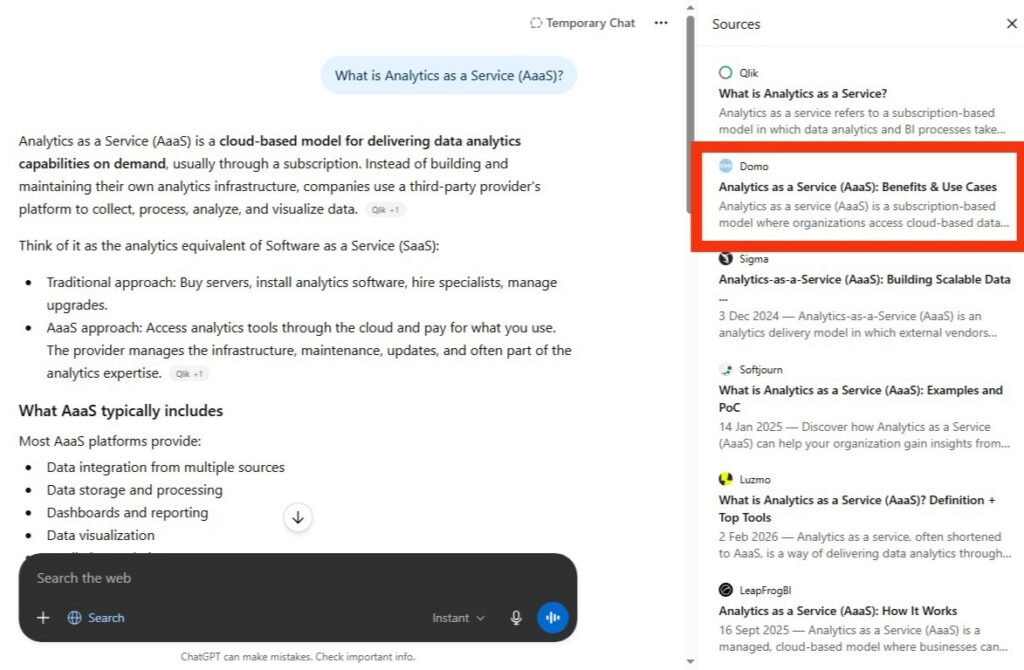
When AI tools are trying to answer a question that touches on any part of the data analytics space, Domo has likely covered it somewhere. That kind of breadth gives them many reasons to keep returning to Domo as a source, across many different types of queries. And we’re backed by proof here:
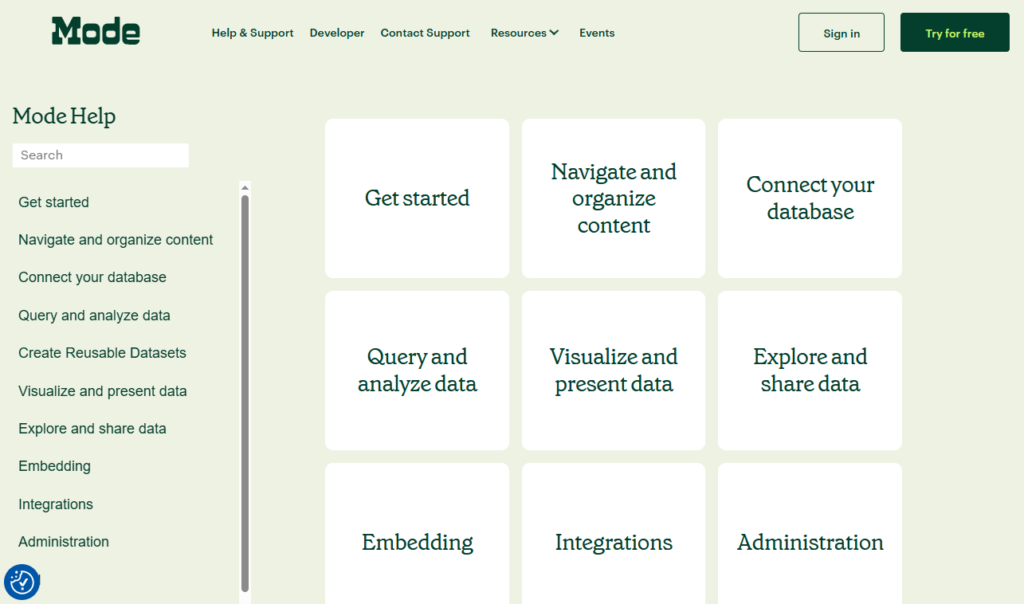
Mode takes a different approach to the same idea.
Source – Mode
Rather than building a glossary or a broad resource library, Mode has invested in content that helps analysts actually do their work. It has a Help Center with detailed product documentation, a Developer Hub for teams building on top of the platform, and dedicated learning resources for SQL and Python that go well beyond anything product-specific.
Basically, both Domo and Mode are doing the same thing at the core: publishing content that earns them a presence in conversations their buyers are already having. Each one is a reason for AI to bring up your name in a query you might never have thought to target. And as that library of content grows, so does the number of queries you show up in.
However, building resources at this scale isn’t something you can do quickly. It requires consistent effort over a long period of time. But for companies willing to invest in it steadily, it compounds and gives AI tools more and more to cite as it grows.
Ever wondered how to get your SaaS brand recommended by ChatGPT? Our senior content strategist sits down with B2B SaaS marketing expert Aditi Syal to break down exactly what it takes.
5. Their How-To Blogs and Explainer Content Aren’t Generic
Most how-to blogs in the data analytics space sound the same. They explain broad topics like “what is a dashboard” or “how to choose a BI tool,” without adding any unique value to the piece. But that makes the content easy to replace because if ten other companies have written the same basic explanation, AI tools don’t have a strong reason to cite your platform over another.
The stronger approach is to write content that helps buyers understand a specific problem they’re trying to solve.
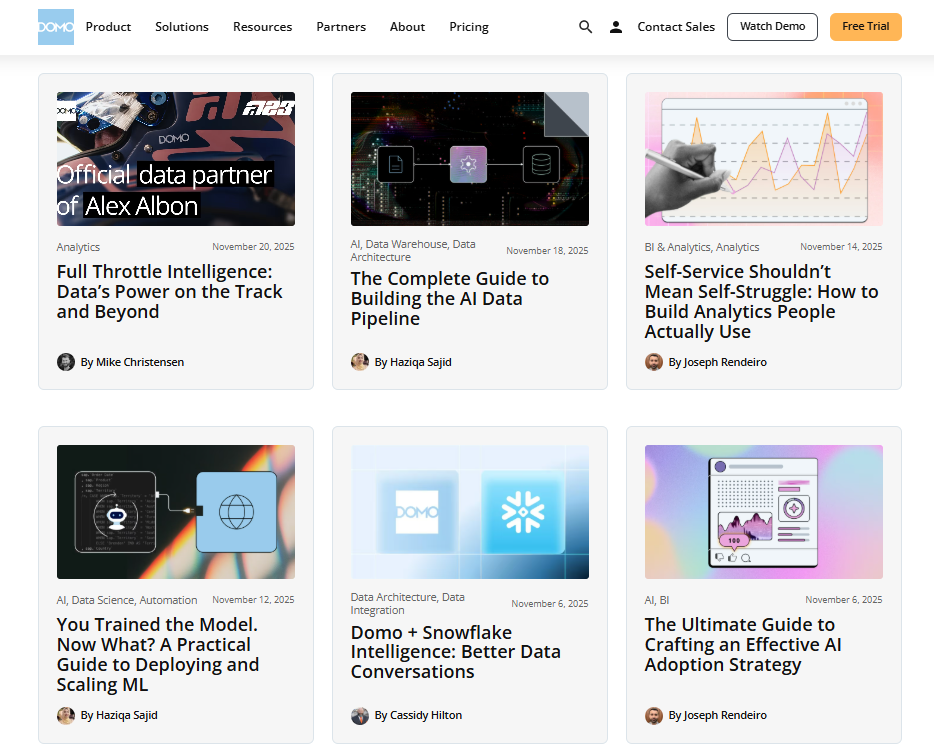
Domo does this well. Its blogs go beyond basic definitions and connect analytics topics to real business problems.
Source – Domo
For instance, instead of just explaining what self-service reporting is, it has a full piece on How to Build Analytics That People Actually Use, covering adoption challenges and practical design decisions. Similarly, it has a detailed guide on Marketing Mix Modeling that walks marketing teams through how to allocate budget across channels using their own data.
These aren’t overview articles. They’re written for someone who already has a problem and needs to solve it. That makes the content more useful than a basic definition because it gives AI tools something practical to pull from when users ask detailed questions.
Over time, this helps the brand show up in more conversations around analytics problems, even when the user isn’t directly asking for a product recommendation.
Now that we’ve covered what these players are doing well, let’s look at how you can apply the same strategies to improve your data analytics platform’s AI visibility.
3 Foolproof Ways You Can Improve AI Visibility for Your Data Analytics Platform
The five strategies above are only the starting point. Snowflake, Domo, Mode, and Anomaly AI are doing a lot more to earn the visibility they get across AI search results. But the good news is, you don’t have to do everything at once.
If you want to improve AI visibility for your data analytics platform, start with the areas that can influence how buyers discover, compare, and shortlist tools. Here are three practical strategies that can help you move in the right direction.
1. Move Beyond Broad Topics and Answer Specific Buyer Questions
Most data analytics companies publish content that explains broad concepts, like what a data warehouse is, how real-time analytics works, and what self-service reporting means. That kind of content builds authority and awareness. But it doesn’t help a buyer choose a platform.
At the point where a buyer is actively evaluating tools, they’re searching for something much more specific, like:
- Best data analytics platforms for SaaS companies
- Best reporting tools for finance teams without a dedicated data engineer
- Best analytics software for ecommerce companies under 100 employees
- Best data tools for marketing teams using HubSpot and Google Analytics
So, create more content around comparisons, use cases, alternatives, and specific buyer questions. They show where your platform fits, which buyers it is relevant for, and what kind of problems it can help solve. That makes it easier for AI tools to include your platform when someone asks for a recommendation.
Pro tip: Before deciding what to write, spend time searching for what people ask on Reddit, Quora, and LinkedIn. These are the places where buyers talk openly about what they’re looking for. The closer your content matches that language, the more likely AI is to surface it.
2. Write Comparison Content for Buyers Evaluating Different Platforms
Most buyers usually already know the popular names in your category. They may have heard of Snowflake, Databricks, Domo, Tableau, or Looker. So, when they get closer to making a decision, they start comparing these tools directly to understand what’s better for their needs.
Their searches start sounding like:
- Snowflake vs Databricks
- Domo vs Tableau
- Power BI alternatives
- Best Looker alternatives
- Which is better for governance, Snowflake or Databricks?
That’s why comparison content matters. If your website doesn’t answer these questions, AI tools turn to review sites, forums, or competitor pages for context. Moreover, creating your own comparison content gives your brand a chance to shape how buyers understand the difference between your platform and a known competitor.
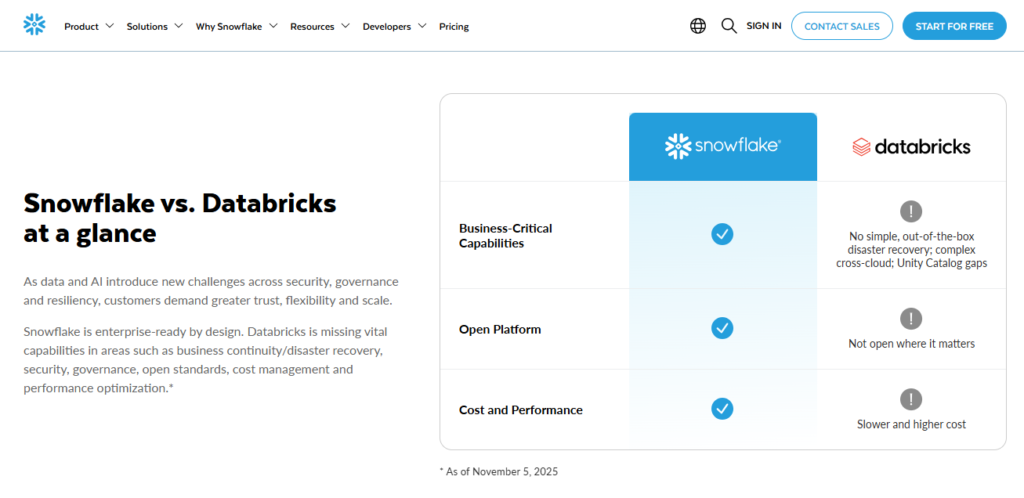
Snowflake’s Snowflake vs Databricks page is one of the strongest examples of comparison content done well.
Source – Snowflake
It doesn’t just compare features. It positions Snowflake as the stronger choice in three areas buyers care about: enterprise readiness, platform openness, and cost-performance at scale.
This matters for AI visibility because AI tools need something concrete to reference when a buyer asks, “Which is better for enterprise data teams, Snowflake or Databricks?” A page that takes a clear position and backs it up with specific claims gives AI far more to work with than a neutral feature comparison table.
This means, Snowflake isn’t just improving its chances of being recommended. It’s also making sure buyers see it as the stronger option when they compare it with Databricks.
So, don’t create comparison pages that only list features side-by-side. Go deeper into the questions buyers actually have:
- Which platform is easier to adopt?
- Which one is better for enterprise teams?
- Which one gives teams more control over their data?
- Which one is better for governance?
- Which one may cost more as usage grows?
- Which one fits a specific use case better?
This kind of content helps AI tools understand how your platform compares with others. It also gives you a chance to show where your product is stronger, who it is best suited for, and when it should be recommended.
3. Create Decision-Stage Content Tailored to Specific Industries, Roles, Use Cases, and Competitors
A SaaS founder, an IT head, a healthcare team, and a growing startup may all look for data analytics tools. But they won’t search for them in the same way. So, instead of writing one broad page like “best data analytics tools,” create more specific versions of that page for the different buyers you want to reach.
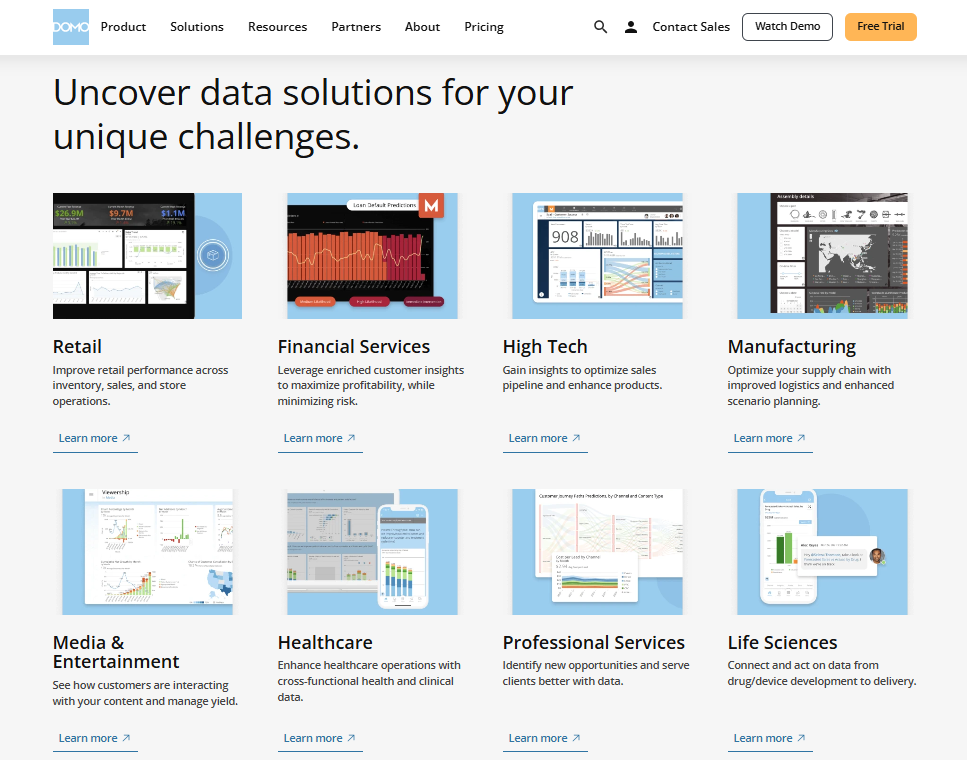
Domo’s Solutions section shows what this looks like in practice.
Source – Domo
It has industry pages for Financial Services, Healthcare, Retail, Education, and more. Alongside that, it has role-based pages for Finance, Marketing, Sales, and IT teams. Each page speaks directly to that buyer’s specific situation, not to a general audience.
You can follow the same approach by building content in clusters. For example, start with industry-led searches:
- Best data analytics platforms for financial services teams
- Best BI tools for healthcare analytics
- Best data analytics software for retail companies
Then move to role-led content:
- Best analytics tools for finance teams
- Best BI platforms for marketing teams
- Best data analytics software for operations leaders
Then competitor-led content:
- Snowflake alternatives for mid-market companies
- Domo vs Power BI for enterprise teams
- Mode alternatives for data analysts
Each cluster makes it easier for AI to understand who your platform is for and when to recommend it. And the more clusters you build, the harder it becomes for AI to leave you out.
Want to Improve Your AI Visibility in the Data Analytics Space? We’re Here for You
Snowflake has industry pages for every vertical it serves. Domo has a glossary, a knowledge base, and a resource library. Mode has learning resources that data analysts bookmark regardless of whether they use Mode. Anomaly AI has blog content built around the exact questions buyers ask before shortlisting a tool.
None of this is accidental. These companies have spent time making it easy for AI tools to understand what they do, who they serve, and when to recommend them. And the results show. So, if your platform isn’t showing up the same way, the gap is most likely in your content, not your product.
At Concurate, we help data analytics companies close that gap through our Perfect Match Framework. Here’s our deck showcasing how our framework works.
Our idea is simple: find out what your buyers are asking, where your brand is missing from those conversations, and what content you need to show up at the right decision moments.
Then we help you build a content strategy around those buying questions so your platform becomes easier for AI tools and buyers to understand, compare, and recommend.
If you’re ready to show up where your buyers are making decisions, let’s talk.
Frequently Asked Questions:
1. Why do some analytics platforms appear across multiple query types, like “BI tools,” “data analysis tools,” and “AI analytics platforms”?
That happens because their product covers more than one use case. For instance, they may support dashboards, reporting, AI insights, data exploration, and business intelligence workflows. AI tools pick up these signals from product pages, use-case pages, reviews, listicles, and third-party mentions. The stronger and clearer these signals are, the more likely the platform is to show up across related queries.
2. Can AI tools recommend my platform even if I don’t rank on page one of Google?
Yes, your platform can still show up in AI recommendations even if your website doesn’t rank on page one of Google. That’s because AI tools don’t only rely on Google rankings. They also learn from review sites, comparison articles, case studies, partner pages, help docs, and other trusted pages that mention your product. So, if enough sources clearly explain who your product is for, what it does, and what problems it solves, AI tools may recommend it.
3. What role do comparison pages play in helping AI tools understand a platform’s fit?
Comparison pages help AI tools understand your platform in relation to other tools. This is useful because buyers often search through alternatives, “vs” queries, and specific use cases before choosing an analytics product. A good comparison page shows who your tool is best for, how it differs from competitors, and where it performs better. For example, one platform may be stronger for dashboards, while another may be better for SQL analysis or AI-powered reporting. These details help AI tools match your platform to the right buyer queries instead of treating it like a generic analytics tool.
Disclaimer: The information presented in this article is compiled from publicly available sources, including company websites, industry reports, and social media. All trademarks, brand names, and logos mentioned are the property of their respective owners. We do not claim any ownership of third-party marks, nor do we imply endorsement or affiliation. This article is intended for informational purposes only.