

| TL;DR: We tested fraud management software queries across ChatGPT, Perplexity, and Gemini. Feedzai, SEON, and Sift appeared more often across these AI recommendations than many other fraud prevention tools. But they are not showing up by accident. Their content makes it easier for AI tools to understand what they do, who they serve, which problems they solve, and how they compare with other platforms. In this article, we will dig into the content patterns helping these companies improve AI visibility and share practical examples that challenger fraud management brands can learn from. |
The fraud management space is crowded. G2 currently lists more than 250 fraud detection and fraud management software products, many of which target similar industries and use cases.
Yet when we searched for fraud management software queries on ChatGPT, Gemini, and Perplexity, the same companies kept appearing.
That caught our attention because buyers using AI tools to build an initial shortlist may keep seeing the same vendors again and again. This raises an important question: what makes certain companies more visible than others?
To find out, we analyzed the fraud management vendors that consistently appeared in AI recommendations. In this article, we break down the patterns driving AI visibility in fraud management software and what other companies can learn from them.
How We Tested AI Visibility For Fraud Management Software
To understand which fraud management tools AI platforms recommend, we tested a set of evaluation-stage queries across ChatGPT, Perplexity, and Gemini.
We did not limit the test to a broad query like “best fraud management tools.” We included searches based on how different buyers may look for solutions depending on their company size, use case, or stage of evaluation.
Some of the queries included:
- Best fraud management software for startups
- Top fraud management platforms for businesses
- Top online fraud management and prevention solutions
- Best online fraud management solution for mid-sized businesses
- Top enterprise fraud management software
The results changed slightly depending on the query. That was expected. Some vendors showed up only for specific use cases. For example, Eftsure appeared in one search for “top fraud management platforms for businesses,” but did not show up consistently across the broader set of queries.
But across these searches, three names appeared more consistently than most others: Feedzai, SEON, and Sift.
So we reviewed their website and blog to understand what was helping them. We also looked at the broader signals they were giving AI tools through their public-facing content.
The more we reviewed their content, the more patterns we started to notice. Let’s take a closer look at the factors behind those recommendations.
5 Reasons Feedzai, SEON, And Sift Show Up So Often In Fraud Management AI Searches
Before we proceed further, here’s a fun stat. The global fraud detection and prevention market is projected to be worth USD 129.4 billion by 2033. As the market grows, competition for buyer attention will only increase.
In that environment, a strong product is not always enough. Buyers need clear information that helps them understand where a platform fits, which problems it solves, and how it compares with other options in the market.
That is something these three companies do particularly well. While each takes a slightly different approach, we noticed five patterns appearing repeatedly across all three companies.
Here is a closer look at what they are doing.
1. They Own “Best” And “Top” Searches That Buyers Use To Build Shortlists
Before buyers compare vendors, they usually start by figuring out which tools are worth evaluating in the first place. That often leads to broad category searches like “best fraud detection software” and “top fraud management platforms”.
But buyers do not always search only at the category level. Depending on their problem, they may also search for specific fraud workflows or adjacent risk areas, such as:
- Best chargeback management software
- Best identity verification software tools
- Top AML transaction monitoring vendors
These queries matter just as much. You see, a fintech company may care about identity verification and AML monitoring, whereas an e-commerce company may focus more on chargeback prevention.
That’s why fraud management companies should not only create content for the broad category. They also need to build content around the specific problems, workflows, and risk areas their buyers are already researching.
Feedzai appears to have invested in this type of content. One example is its detailed guide on AML transaction monitoring vendors. When we searched for this query in ChatGPT, Feedzai appeared in the recommendations.
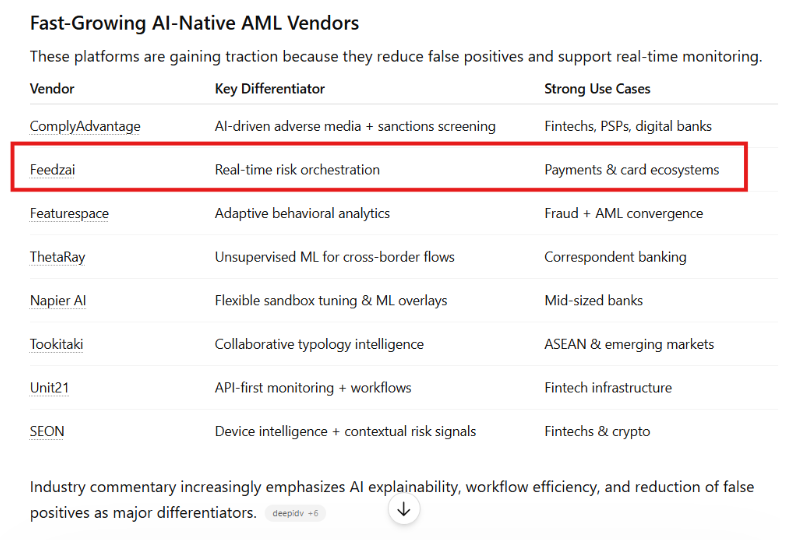
Source – ChatGPT
SEON follows a similar approach. Its website includes content covering queries like:
- Best Chargeback Management Software
- Best Identity Verification Software Tools
- Top AML Software Tools
These topics closely match the way fintech and e-commerce buyers research solutions before speaking with vendors.
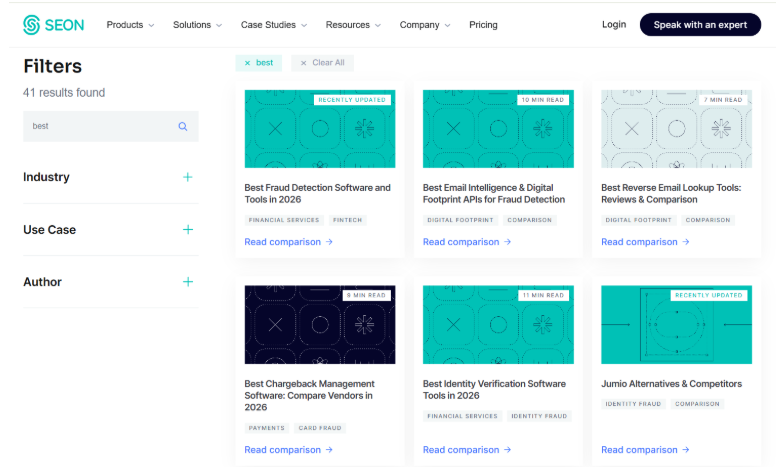
Source – SEON
That could be one reason why SEON appeared in Gemini for our search on the best fraud management tools.
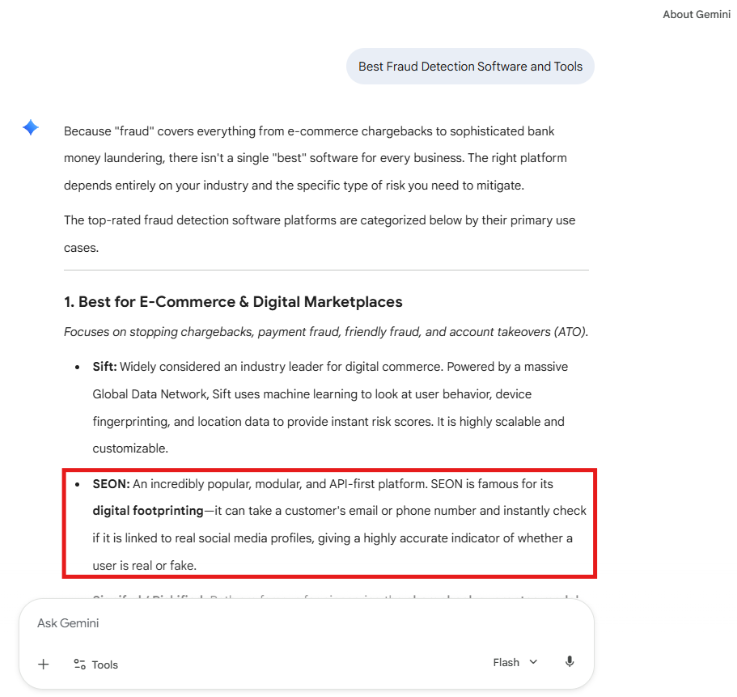
Source – Gemini
What stands out is that both companies have built content ecosystems around the searches buyers make while building their initial shortlist. Instead of just creating a resource on the best fraud management software, they are also covering more specific buyer searches.
That gives AI platforms useful context about the company’s strengths, use cases, and category relevance. More importantly, it increases their chances of being discovered before buyers start comparing specific vendors.
Recommended Read: Where Should Fraud Checks Happen? SEON is Building Them into the Systems Businesses Already Use.
2. They Show Up For The Comparison Searches Buyers Use Before Choosing A Tool
As buyers move closer to a decision, their searches become more focused on specific tools and alternatives. They are no longer asking broad topics like “which are the best fraud management software for mid-sized businesses?”
Instead, they start asking sharper questions like:
- Accertify alternatives
- Incode alternatives
- Sift vs Kount
These searches are often a sign that a buyer is actively narrowing down their options.
This is something SEON appears to understand well. They have created a large set of comparison and alternative pages around different fraud prevention and identity verification tools. As a result, when buyers search for competing tools, SEON often has content that directly matches that intent.
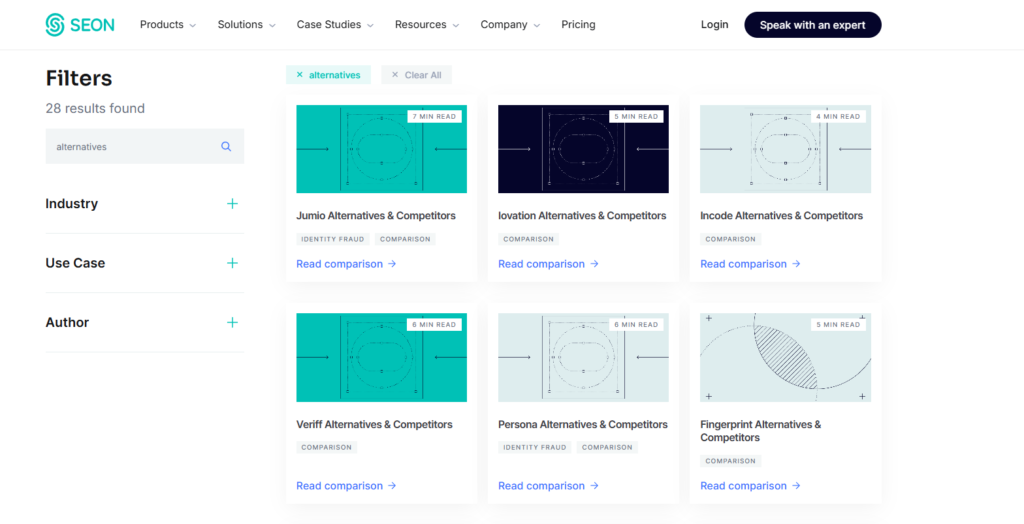
Source – SEON
For example, when we searched for “Jumio alternatives” in Gemini, SEON appeared in the results. What is interesting here is that the cited source was not a dedicated Jumio alternatives page. Gemini referenced SEON’s Sumsub alternatives page.
That still matters. Sumsub and Jumio both sit close to identity verification and fraud prevention use cases. So even though the page did not target the exact search, it still helped Gemini understand SEON as a relevant alternative in that buying context.
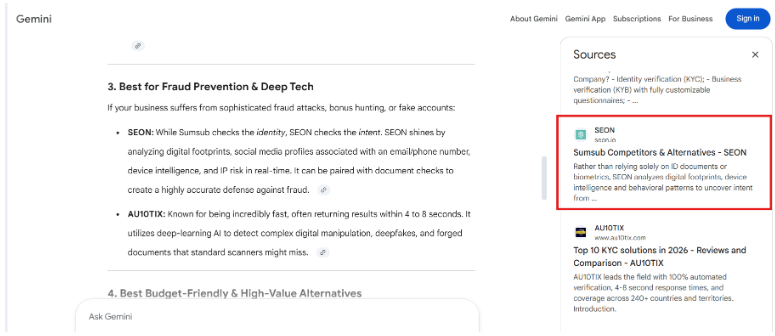
Source – Gemini
What stands out here is the strategy. Rather than waiting for review sites, forums, or third-party publishers to frame the conversation, SEON has created content around the comparison questions buyers are already asking.
This gives AI platforms more context to work with when comparison-related searches come up. Sometimes that may be an exact-match page. Other times, it may be a related alternatives page that still helps the AI tool understand where the company fits.
For fraud management companies looking to improve AI visibility, this is one of the clearest opportunities. Buyers are already searching for comparisons. Creating content around them makes it easier for both buyers and AI tools to understand where your platform fits.
3. They Publish Customer Proof That AI Tools Can Actually Use
Many fraud management vendors talk about similar outcomes. They often talk about reducing fraud, lowering false positives, improving decision-making, and protecting revenue. The difference is that the companies that get recommended by AI often support those outcomes with customer stories that show what changed after implementation.
SEON’s Xcoins case study is one example. Rather than simply stating that the platform helped reduce fraud, the company shares specific outcomes, such as 95% reduction in fraud and a 99% drop in multi-accounting attempts.
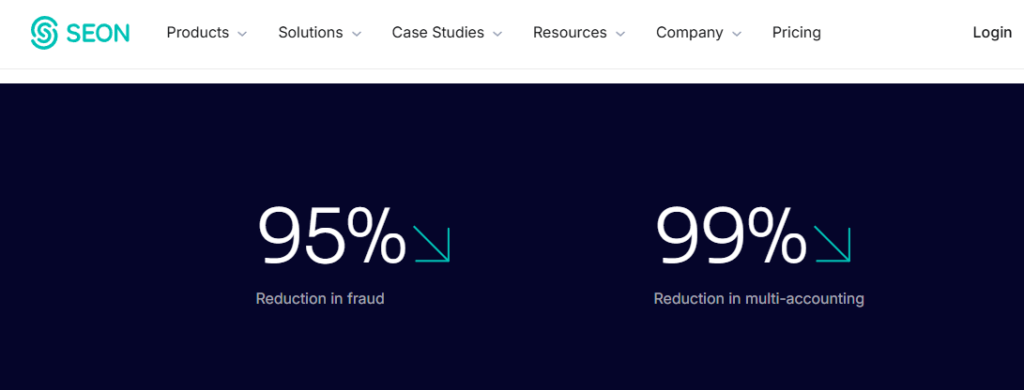
Source – SEON
That level of detail gives buyers a clearer picture of the results. It also makes it easier to understand where the platform has delivered results in the real world.
Feedzai takes a similar approach. Its CoreCard case study highlights a 64% fraud detection rate and includes a customer video alongside the results.
The video adds another layer of credibility. Buyers are not just seeing a performance metric on a page. They are also hearing directly from a customer about their experience with the platform. That makes the proof easier to trust and reference.

Source – Feedzai
Many fraud management companies have similar success stories. The difference is that those outcomes are often difficult to find outside sales conversations or internal materials.
The above companies make that proof visible. As a result, buyers can better understand the problems they solve, the customers they serve, and the outcomes they help deliver.
Recommended Read: How to Craft Compelling SaaS Case Studies and Testimonials using ChatGPT?
4. They Create Content For Buyers Who Are Considering A Switch
Not every fraud management buyer is evaluating vendors for the first time. Many are already using a fraud detection platform and are thinking about switching from one platform to another.
At that stage, the question is not only, “Is there a better alternative?”
It is also:
- How difficult will the migration be?
- Will existing rules and workflows carry over?
- Will fraud operations get disrupted during the switch?
- How much support will the team get during the transition?
This is where Sift’s migration content stands out.
Its Accertify migration guide speaks directly to buyers who may already be considering a move from Accertify to Sift. Instead of only positioning Sift as an alternative, the guide helps buyers understand what the migration could involve.
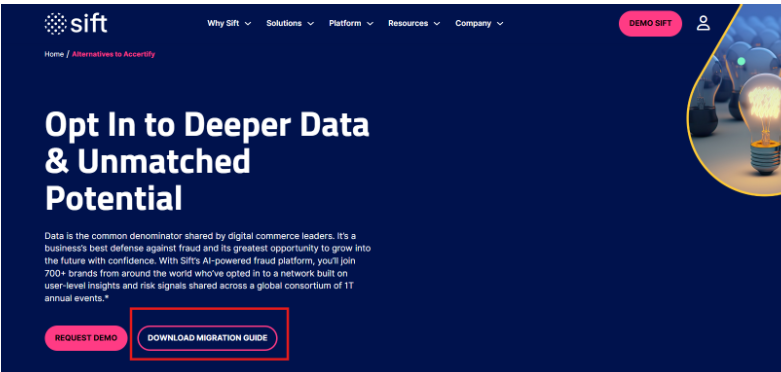
Source – Sift
This kind of content matters because switching fraud platforms is not a small decision. Buyers need confidence that transactions, users, and workflows will not be affected during the transition. By creating migration-focused content, Sift reduces one of the biggest hesitations buyers may have at this stage.
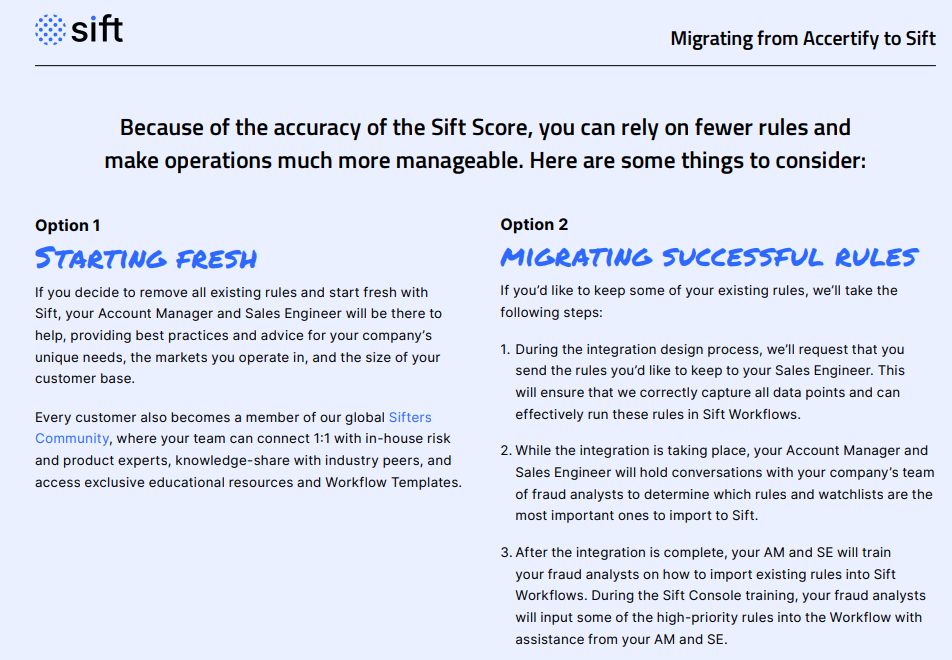
Source – Sift
It positions the company not just as another fraud management platform, but as a serious replacement for an existing solution.
Sift also places the guide behind a lead-generation form. That makes sense because someone downloading a migration guide is likely showing stronger buying intent than someone reading a general fraud prevention article.
Even if the buyer does not take action immediately, the guide gives Sift a way to identify, follow up with, and nurture accounts that may already be considering a switch.
5. They Show Up For The Fraud Problems People Are Already Trying To Solve
When people search for fraud prevention, they are not always looking for software. Sometimes, they are simply trying to solve a fraud problem. They might be searching for queries like:
- How to prevent application fraud
- How to stop account takeover attacks
- How to detect synthetic identity fraud
- How to prevent online scams
- Ways to reduce payment fraud
These searches may come from practitioners, operators, risk teams, or even companies already using another fraud tool. The intent is not always “which product should I buy?” Sometimes, the intent is “how do I solve this problem better?”
This is where pain-point-focused content becomes important. Instead of creating content only around product features, these companies create content around the problems their buyers are already trying to solve.
As we reviewed Feedzai and Sift’s content, we kept seeing resources built around these exact topics.
Feedzai, for example, publishes extensively on fraud trends, financial crime, payment risks, and emerging scam tactics. When we searched for “how to prevent application fraud,” on Perplexity, the company’s article was one of the sources referenced in the results.
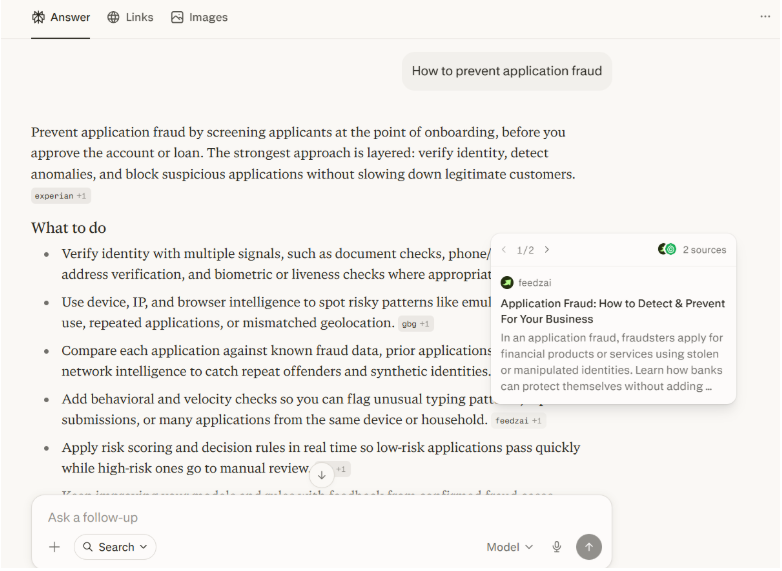
Source – Perplexity
Many of its resources are written for people trying to understand a fraud challenge rather than evaluating a vendor. That gives Feedzai a chance to show up even before someone is actively building a vendor shortlist.
Over time, this kind of content helps build topical authority and brand recall around fraud prevention, financial crime, payment risk, and related problem areas.
Sift takes a similar approach. Its reports, webinars, and research resources cover topics such as account takeover fraud, stolen identities, scams, and online abuse.
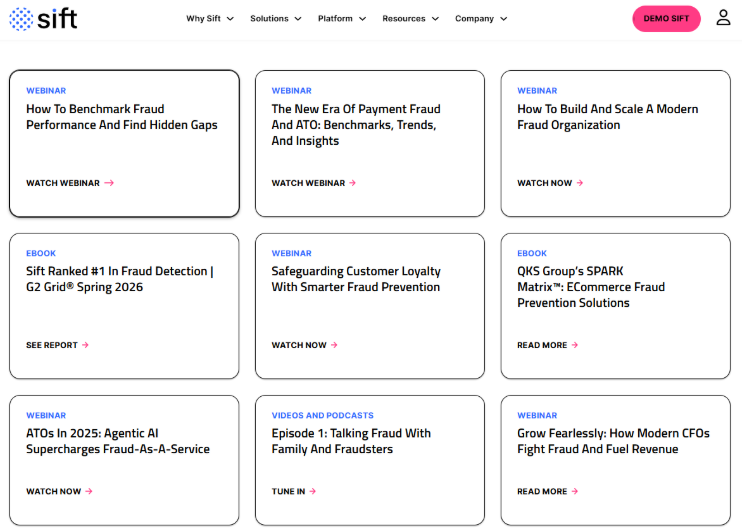
Source – Sift
We saw a similar pattern when we searched for “how to benchmark fraud performance” in Gemini. Sift appeared as a source in the results, which is not surprising given that the company already has content covering that topic.
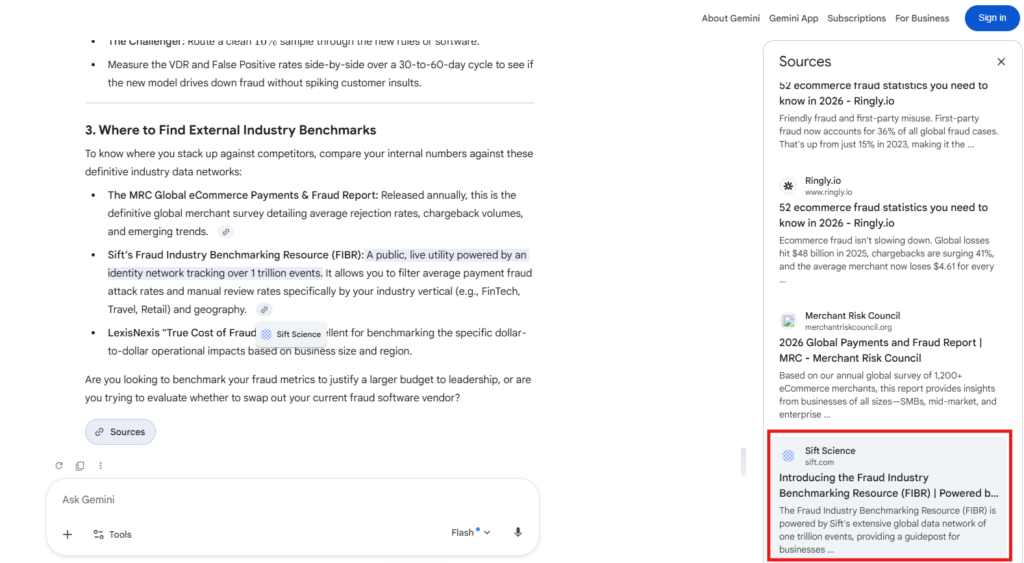
Source – Gemini
Rather than limiting their content to product education, both companies have built resources around the fraud problems people are already trying to solve.
That matters because AI visibility is not built only by showing up for “best software” or “top platform” searches. It is also built by showing up repeatedly for problem-led searches that shape how people understand the category.
When a fraud management company consistently appears for the problem areas that people are already searching for, the brand becomes easier to remember. It also becomes easier for AI tools to connect the company with those fraud problems.
These are some of the patterns that we saw at work for these companies. If you are wondering how to improve AI visibility for your fraud management brand, the next section breaks down what you can do.
Recommended Read: A Fraud Alert is Only the Start. Feedzai’s Farol Takes On the Work That Follows.
5 Ways To Make Your Fraud Management Brand More Visible In AI Search
Most fraud management companies already publish content around fraud trends, online scams, payment risk, account takeover, and more. But publishing around the category is not the same as building AI visibility.
To show up more often in AI recommendations, your content needs to help AI tools understand where your platform fits across different buyer searches. That includes searches where buyers are building a shortlist, comparing tools, evaluating specific fraud problems, or researching conversations outside your website.
The five playbooks below show how fraud management companies can turn existing expertise into content assets that are easier for buyers to find and easier for AI tools to understand, cite, and recommend.
1. Create Shortlist Content For Specific Fraud Workflows
Many buyers start by asking AI tools which fraud management products are worth evaluating. But broad searches like “best fraud detection software” or “top fraud management platforms” are crowded.
A better starting point is to build content around the specific workflows, industries, and problems your buyers already care about. For example, you can create articles or listicles around searches like:
- Best fraud detection software for e-commerce companies
- Top account takeover prevention tools
- Best AML transaction monitoring tools for fintech brands
- Best chargeback prevention tools for online retailers
- Top identity fraud detection tools for digital banks
These queries are a clear reflection of how search behavior is changing. People now share their problems with AI tools and ask very specific questions instead of only searching broad category terms.
However, generic listicles will not work. To get recommended by AI tools or at least cited as a source, the content needs to answer a few questions clearly:
- What specific use case, industry, or fraud problem the listicle is focused on
- Which tools or platforms are included, and why they made it to the shortlist
- Which type of company each tool is best suited for
- What criteria buyers should use to evaluate those tools
- Where your platform fits in that shortlist
- What proof supports your recommendation
This gives buyers a clearer way to evaluate options. It also gives AI tools more specific content to reference when someone searches for fraud management software by workflow, industry, or use case.
2. Build Comparison And Alternative Content Around Known Competitors
Once buyers move beyond shortlist-building, they usually start comparing specific tools.
They may search for:
- [Competitor] alternatives
- [Your Product] vs [Competitor]
- [Competitor 1] vs [Competitor 2]
- Best alternatives to [Competitor]
- Fraud detection tools like [Competitor]
A useful starting point is to identify the competitors your buyers already know and create content around those searches.
These articles should clearly explain how the tools compare across features, pricing, integrations, use cases, support, deployment, and ideal customer fit.
They should also show where your product fits, where it performs better, and what proof supports that positioning.
The goal is to make the comparison easier for buyers. When your content explains the trade-offs clearly, it also becomes easier for AI tools to understand where your platform belongs.
The patterns we found are not unique to fraud management software. We saw something similar while researching endpoint security platforms, where vendors with strong comparison and alternative content appeared more often in AI recommendations. You can read our detailed analysis here.
3. Turn Customer Outcomes Into Citable Proof
Most fraud management companies already have results they can talk about. They know where fraud rates dropped, false positives came down, chargebacks reduced, or manual review became easier.
The problem is that this proof often stays inside sales decks, internal reports, or customer success notes.
Challenger brands should make those outcomes easy to find and easy to understand.
That can mean creating:
- Customer stories with clear before-and-after metrics
- Use-case pages backed by real results
- Video testimonials
- Proof-led landing pages
- Comparison content supported by customer outcomes
The goal is to make your evidence visible. AI tools and buyers should be able to quickly understand what problem you solved, what changed after implementation, and what kind of company saw the result. The clearer your proof is, the easier it becomes for buyers and AI tools to trust your positioning.
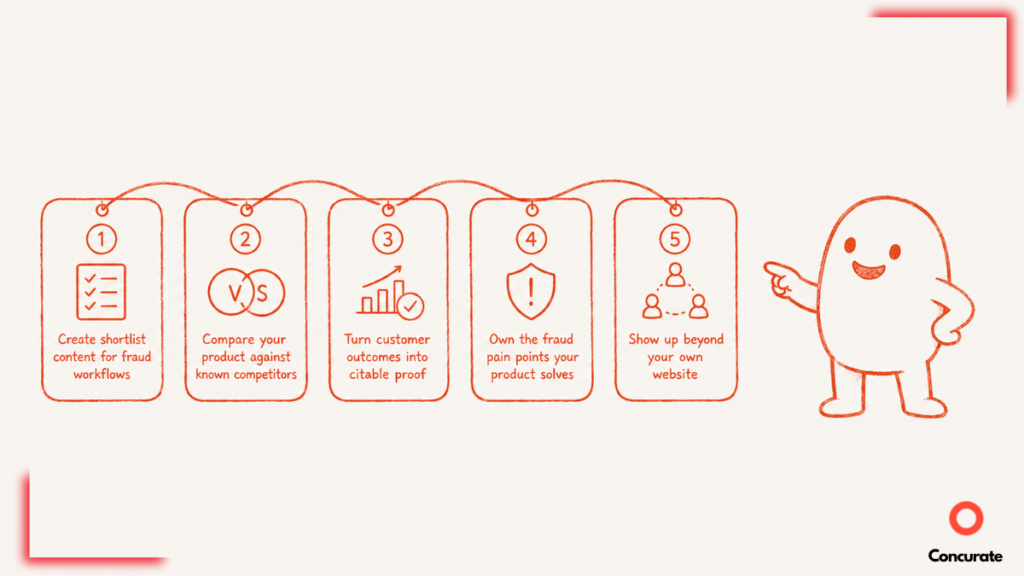
4. Create Content Around The Fraud Pain Points Your Product Can Actually Solve
People do not always search for fraud prevention software directly. Many start by searching for a specific problem they are trying to solve.
For fraud management companies, that does not mean creating content around every fraud topic in the market. It means identifying the pain points your product can genuinely support and building focused content around those problems.
For example, if your platform helps reduce chargebacks, create content around chargeback prevention. If it helps detect fake identities, create detailed resources and analyses covering identity fraud. The goal is to connect each pain point with a real product capability, use case, and proof.
This kind of content helps buyers understand where your platform fits in their day-to-day fraud challenges. It also helps AI tools connect your brand with the specific fraud problems your product is actually built to solve.
5. Expand AI Visibility Beyond Your Website
A company’s website is only one part of the picture. People researching fraud prevention solutions rarely rely on a single source. They watch videos, read review platforms, follow LinkedIn discussions, and turn to Reddit or industry communities while comparing tools.
Around 32% of software buyers now use Reddit during their research process, particularly when comparing platforms and looking for real user experiences. In fact, when we reviewed the companies appearing most often in AI recommendations, we noticed that their visibility was not limited to their websites either, and neither should yours be.
For fraud management companies, that can mean repurposing existing expertise into formats such as:
- LinkedIn posts
- Short YouTube explainers
- Webinar clips
- Podcast conversations with industry experts and more.
The goal is not to be active on every channel. It is to make your expertise easier to find in the places buyers already spend time. Over time, those touchpoints help create a more complete picture of what your company does, who it serves, and the problems it helps solve.
That said, building this kind of AI visibility is not easy for every internal marketing team. It takes a clear strategy, consistent execution, and a strong understanding of how buyers search across AI platforms, search engines, and third-party channels.
That is why many fraud management companies may choose to work with specialized digital marketing agencies that understand financial fraud prevention platforms and can help strengthen visibility across the right channels.
And that is where a partner like Concurate can help.
How Concurate Helps Fraud Management Companies Improve AI Visibility
We understand that improving AI visibility is not about publishing more content. It is about knowing which searches your brand is missing from, why competitors are showing up instead, and what content or third-party signals can close that gap.
At Concurate, we have developed our proprietary Perfect Match Framework to check where your fraud management brand appears across AI tools like ChatGPT, Gemini, Claude, Perplexity, Copilot, and more.
We then identify visibility gaps and build a content roadmap to improve your chances of being discovered across the right buyer searches. The deck below explains our Perfect Match Framework.
If you want to see where your fraud management platform stands today, book a call with us. We’ll help you identify the gaps, prioritize the opportunities, and build a roadmap for improving your AI visibility for fraud management software.
Explore More AI Visibility Studies by Concurate
We’ve also analyzed how AI tools recommend software across other B2B categories. Explore the studies below to see which vendors appear most often, what patterns emerge, and why certain brands consistently make AI-generated shortlists.
- 4 Reasons DeepIP, Solve Intelligence, and Patlytics Win AI Visibility
- 5 Reasons Why Snowflake, Domo, Mode, and Anomaly AI Appear in AI Recommendations for Data Analytics Queries (and What Competitors Can Do)
- Best DDoS Protection Software for 2026: Recommended by ChatGPT, Perplexity & Claude (and Why They Rank)
- 5 Reasons Why Workato, Boomi, And MuleSoft Keep Appearing In iPaaS AI Recommendations
Frequently Asked Questions
1. Our fraud management platform is smaller than companies like Feedzai and Sift. Can we still appear in AI recommendations?
Yes. AI visibility is not only about brand size. It depends heavily on how clearly your content matches what buyers are actually searching for. Smaller companies can still appear in AI recommendations if they create focused content around specific fraud prevention processes, industries, or business problems buyers actively research.
2. We publish blogs regularly. Why are we still not appearing in AI answers?
Publishing regularly is not enough on its own. Many fraud management companies create blogs that do not match real buyer searches. AI tools prefer content that clearly answers questions buyers ask on a topic or before choosing the software.
Disclaimer: This article is based on publicly available information from agency websites, case studies, and third-party platforms. The evaluation reflects our independent analysis, and we recommend checking each agency’s website or speaking with their team for the latest details on services, pricing, and results.