


| TL;DR: Fraud management software companies often have strong products, measurable customer results, and deep technical expertise. But AI tools can only recommend products they clearly understand. If your positioning is unclear, AI tools may not know when to recommend you. This guide covers eight GEO agencies for fraud management software companies, including Concurate, AUQ, and Walker Sands. It also explains why these companies miss AI recommendations, what to look for in a GEO agency, and how to improve AI visibility internally. |
Fraud management software companies have a very different content challenge from most B2B SaaS categories.
They are not just selling software. They are selling trust in a product that helps financial institutions, payment providers, ecommerce platforms, and marketplaces detect and prevent fraud.
That means buyers need more than feature lists. They want to understand the types of fraud the platform detects and how it fits into existing risk workflows. They also want to know what makes it different from competing solutions and whether there is evidence that it works.
But much of that information never reaches the public eye. It stays inside product demos, sales conversations, customer discussions, and private documentation. As a result, AI platforms often lack the context needed to recommend the product with confidence.
This guide covers eight GEO agencies that help fraud management software companies make that expertise more visible to AI systems. But before we get to the list, let’s look at why many fraud management companies struggle to appear in AI recommendations.
5 Reasons Why Fraud Management Software Companies Struggle To Show Up In AI Recommendations
From what we have seen, the gap usually does not come from one missing piece of content. The problem is that AI tools do not find enough clear, consistent signals about what the product does, who it helps, what results it has delivered, and why buyers should trust it.
That visibility gap usually starts in five places:
1. Their Positioning Is Too Broad Or Inconsistent
Fraud management is not one simple category. Some companies position themselves as fraud prevention platforms. Others describe themselves using terms like risk management, digital trust, financial crime prevention, or identity protection. The problem starts when a company tries to cover too many of these ideas at once or explains the product differently across its website.
As a result, it becomes harder to understand whether the product is designed for ecommerce chargebacks, digital banking fraud, marketplace risk, or something else. Without that clarity, AI tools may understand that your company works in fraud management, but not when it should be recommended.
2. Their Best Customer Proof Is Not Public
Many fraud management companies often have customer stories backed by real results. They have helped customers reduce chargebacks, catch more fraudulent transactions, and spend less time reviewing suspicious activity.
The challenge is that these stories often stay inside sales presentations, customer meetings, or internal reports. AI tools cannot reference information they cannot access.
A customer story that explains the fraud problem and the outcome provides far more context than a generic product claim. That’s why, if the strongest customer results are not public, they cannot support AI recommendations.
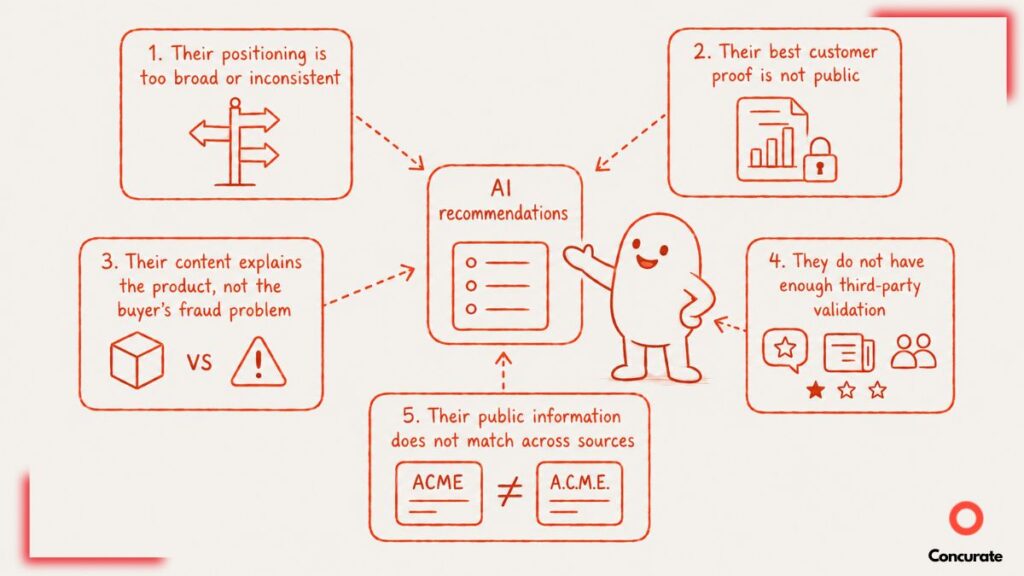
3. Their Content Talks About The Product, Not The Buyer’s Fraud Problem
Product features often take center stage in fraud management content. The focus is often on dashboards, integrations, detection methods, and risk models. Buyers, however, are usually trying to solve a specific problem. They start with a fraud issue they need to fix.
If your content focuses mostly on the product, AI tools may understand what the platform does. But it may not understand the specific fraud problems they should be recommended for.
4. They Do Not Have Enough Third-Party Validation
Fraud management software plays a direct role in preventing losses and protecting customer accounts. As a result, buyers rarely rely on a vendor’s website alone. They look for reviews, industry publications, partner mentions, and independent discussions before shortlisting a product.
AI tools look for many of the same signals. They need more than your own website to understand whether your product is trusted, relevant, and credible in the market.
For example, if your website says you help ecommerce companies reduce chargebacks, but there are no public customer stories, review signals, analyst mentions, or industry references supporting that claim, AI tools have limited external evidence to rely on to support a confident recommendation.
These visibility gaps can make it difficult for fraud companies to earn a place in AI answers. This is where GEO agencies for fraud management software companies can help.
But not every agency will be the right fit for your business. So before you choose one, here are the key questions you need to ask.
5 Questions To Ask When Choosing A GEO Agency For Your Fraud Management Software Company
Fraud management buyers do not always search for software in the same way as other B2B buyers. They often start with a specific fraud problem or workflow. That means the agency you choose should understand how fraud buyers research, what proof they need before trusting a vendor, and which sources AI tools rely on when generating recommendations.
Here are five questions that can help you identify whether an agency truly understands GEO for fraud management software or is only applying a generic AI visibility approach.
1. Do They Test the AI Questions Your Fraud Buyers Actually Ask?
A good GEO agency does not begin with a generic keyword list. They begin by understanding the exact questions your buyers ask when they are trying to solve a fraud problem or shortlisting providers.
Broad searches like “best fraud detection software” and “top fraud prevention tools” still matter because buyers may use them to build an initial shortlist. But fraud buyers rarely stop there. They also ask AI tools more specific questions based on the fraud problem they are facing, the industry they operate in, or the vendor they are currently evaluating.
For example, a buyer may ask:
- Which fraud prevention tools are best for stopping fake accounts on online marketplaces?
- What are the best alternatives to [competitor brand name]?
- Which fraud detection platform do digital banks use to prevent account takeovers?
These questions help you see whether AI tools understand your product in the same way your buyers do.
A strong GEO agency should check where your brand appears, where competitors appear instead, and which public sources AI tools are using to support those recommendations. That gives you a clearer picture of the content, proof, and third-party signals you need to improve.
| Question to ask: Which AI questions will you test for our fraud management software, and how will you make sure they match how our buyers search? |
2. Do They Understand The Different Fraud Problems Buyers Are Trying To Solve?
Fraud management software buyers do not all search for the same problem.
An ecommerce company evaluating fraud software may be focused on stopping payment fraud. Whereas a digital bank may be more concerned about account takeovers.
A GEO agency should understand which of these problems matter to your buyers before building the strategy. Otherwise, they may create broad fraud management content that tries to cover everything. The result is often content that looks relevant on the surface but does not reflect the problems your buyers are actually trying to solve.
The right agency should identify the fraud challenges most relevant to your audience and build visibility around those topics.
| Question to ask: How will you identify the fraud problems our buyers care about and turn those insights into a content strategy? |
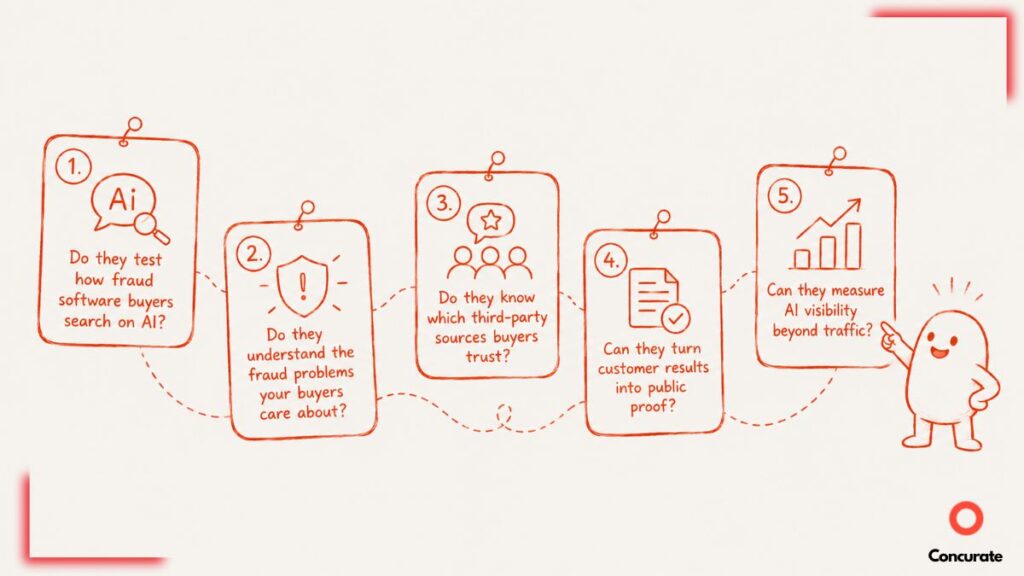
3. Do They Know Which Third-Party Sources Fraud Buyers Actually Trust?
Fraud buyers do not rely only on a vendor’s website. Before trusting a fraud management platform, they often look beyond the company’s own content. This may include review sites like G2 or software directories such as Capterra. It may also include different publications, LinkedIn discussions, customer stories, and discussions in industry communities.
But not every outside source matters equally. A mention in a trusted industry publication or a well-known review platform may influence buyers far more than a generic guest post or low-quality backlink.
That is why a GEO agency should know which third-party sources matter for your category. The right agency should be able to explain which outside sources matter and why. It should also help you understand how those sources influence the way buyers and AI tools see your company.
| Question to ask: Which third-party sources do our buyers and AI tools trust, and how will you help us build visibility there? |
4. Can They Turn Customer Results Into Content AI Tools That Can Understand?
Fraud management companies often have strong customer results. You may already have customers who detect fraud faster or improve account security after using your product. But those results often stay inside sales decks, customer calls, internal reports, or gated case studies.
A GEO agency should know how to turn that proof into public content without making exaggerated claims. The goal is not to publish vague lines like “we help reduce fraud.” The goal is to show what problem was solved, who it was solved for, and what changed after using the product.
For example, a case study showing how a payment company reduced stolen payment card transactions is more useful than a broad claim about preventing fraud. The same applies to a digital bank, explaining how it improved account security.
That makes it easier for buyers to evaluate the product and understand where it fits. It also gives AI tools clearer evidence to reference when discussing vendors in the space.
| Question to ask: How will you turn our customer results into clear, public proof that buyers and AI tools can understand? |
Recommended Read: How to Craft Compelling SaaS Case Studies and Testimonials using ChatGPT?
5. Can They Measure Real AI Visibility Progress, Not Just Website Traffic?
Traffic is not enough to measure GEO. You need to know whether your company is showing up in the AI answers buyers use to evaluate vendors and build shortlists.
That means measuring more than how much content was published and how much traffic it generated. A good agency should show whether your brand appears for the right buyer questions. It should also show which competitors appear instead and whether AI tools are mentioning or recommending you.
There is a meaningful difference between being mentioned and being recommended.
Being mentioned when AI tools answer general questions about fraud prevention is useful. But appearing when a buyer asks which fraud platform is best for account takeover protection at a digital bank is far more valuable.
| Question to ask: How will you measure whether AI tools are recommending us for the searches that matter to our buyers? |
The right GEO agency can help your fraud management software company turn customer proof, industry expertise, and buyer-focused content into stronger visibility across AI search. Now, let’s look at some of the GEO agencies specializing in this space.
Top 8 GEO Agencies For Fraud Management Software In 2026
To compile this list, we prioritized agencies with a clear approach to AI visibility and experience working with complex B2B software categories where trust, technical clarity, and proof matter.
We also considered their ability to build trust and visibility beyond a company’s own website.
On that note, here are the eight agencies worth considering:
- Concurate
- AUQ
- HawkSEM
- Walker Sands
- Skale
- Omnius
- MaximusLabs
- Directive
Now, let’s take a closer look at each agency.
1. Concurate
Many fraud management software companies have built a strong product and solved real customer problems. But that does not always translate into visibility when buyers ask AI tools for recommendations for a specific problem.
Often, the issue is not the product itself. It is that AI search engines do not have enough context to understand when your platform is the right fit. That’s the gap we bridge at Concurate.
Source – Concurate
We are a boutique content marketing and GEO agency helping B2B SaaS companies appear in AI-generated answers when buyers are actively evaluating solutions. For fraud management software companies, we help AI tools understand who your product is built for, the challenges it solves, and the situations where it should be recommended.
How We Build AI Visibility for Fraud Management Software Companies
We follow our Perfect Match Framework to make sure your product is clearly understood by AI tools and positioned in the right buying conversations. Here is what the framework looks like:
Let me paint a more elaborate picture of how we approach GEO for fraud management software:
- Define the ideal buyer: We start by understanding who your platform serves. A fraud solution built for ecommerce merchants needs a different strategy from one designed for banks, fintech companies, payment processors, or marketplaces. We identify the problems buyers are trying to solve and what makes your product the right fit.
- Benchmark AI visibility: Next, we test how your brand appears across AI search platforms for real buyer searches.
- Audit your existing content: We review your product pages, solution pages, customer stories, comparison pages, pricing pages, and educational resources. The aim is to see whether they clearly explain your platform. We also check whether AI tools can easily understand who your product is for and what problems it solves.
- Build the strategy: Based on the audit, we identify the categories and content that are most likely to improve AI visibility. We also prioritize the content that can have the biggest impact on helping AI tools understand and recommend your product.
- Create content: We work with your internal experts and sales team to capture insights that generic research cannot provide. Those insights become content that clearly explains your product, use cases, and differentiators to both buyers and AI tools.
- Monitor performance: We keep checking where your brand appears in AI answers and whether AI tools are sending visitors to your site. This helps us measure what is improving, identify new opportunities, and refine the strategy as AI search evolves.
The goal is to make your product easier for AI tools to understand, so it appears in the buying conversations where it’s genuinely the right fit.
Pricing: Our Pricing plans start at $5,000 to $7,500/month, while one-time projects begin at $3,500.
Notable Clients: Athena Security, PQAI, Triangle IP, Pinch Patent Drawings, InspireIP
Rating: 5/5 (2 reviews)
2. AUQ
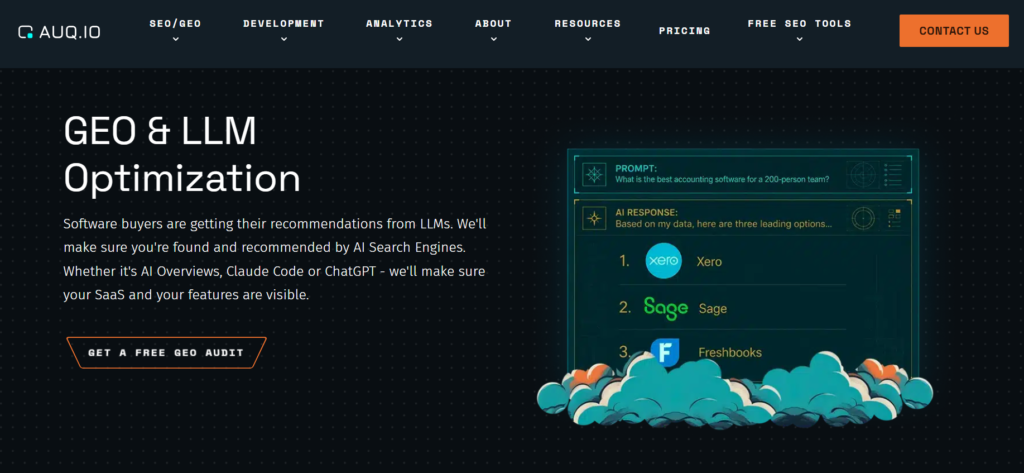
AUQ is a GEO and SEO agency that helps technical SaaS companies improve their visibility across AI search platforms and traditional search engines.
Source – AUQ
The agency focuses on making sure AI tools can better understand what a company does and when it should be recommended. Instead of only offering advice, AUQ also handles the work needed to improve visibility, including content, technical updates, and website improvements.
For fraud management software companies, this can include creating comparison pages, product documentation, and educational content that answers the questions buyers ask while evaluating different platforms.
The agency has experience in the category, having worked with Fraud.net. According to a published case study, AUQ helped the fraud prevention platform generate 1,230 AI citations while increasing its ranking keyword footprint by 85%. That experience gives AUQ direct exposure to the challenges of improving AI visibility in the fraud prevention space.
Pricing: Starts at $4,500/month
Notable Clients: Fraud.net, Microblink
Rating: 4.9/5 (7 reviews)
3. HawkSEM
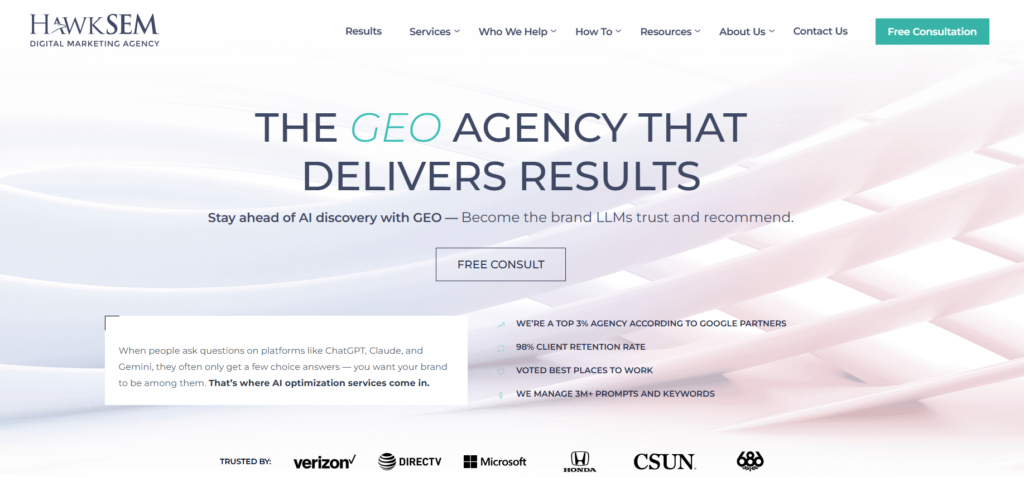
HawkSEM is a digital marketing agency that offers GEO services designed to help brands become more visible across AI-powered search platforms.
Source – HawkSEM
Their approach focuses on improving how AI platforms understand a company’s expertise, retrieve its content, and reference it in responses across AI tools.
For fraud management software companies, this is particularly relevant because buyers often research vendors through specific questions around fraud prevention, risk management, and compliance. HawkSEM focuses on understanding those buyer journeys and creating structured, answer-first content that AI systems can easily interpret and cite.
Pricing: Starts at $1,550/month
Notable Clients: Feedzai, LendingPoint, Datadog
Rating: 4.9/5 (33 reviews)
4. Walker Sands
Walker Sands is a B2B marketing agency that offers GEO services alongside SEO, content, PR, and digital marketing.
Source – Walker Sands
The agency works with technology companies across areas such as cybersecurity, financial technology, AI, cloud, and IT services. For fraud management software companies, this experience can be valuable because GEO efforts often require a strong understanding of technical products and complex buying journeys.
Their GEO approach focuses on helping brands improve how they are understood and referenced by AI platforms. They begin by analyzing how AI engines currently perceive a brand and identifying visibility gaps across AI-powered search experiences. The agency then focuses on strengthening authority signals through content, website optimization, strategic PR, and earned media efforts.
Pricing: N/A
Notable Clients: Entrust, Sophos, Tessian, ZayZoon
Rating: 4.8/5 (9 reviews)
5. Skale
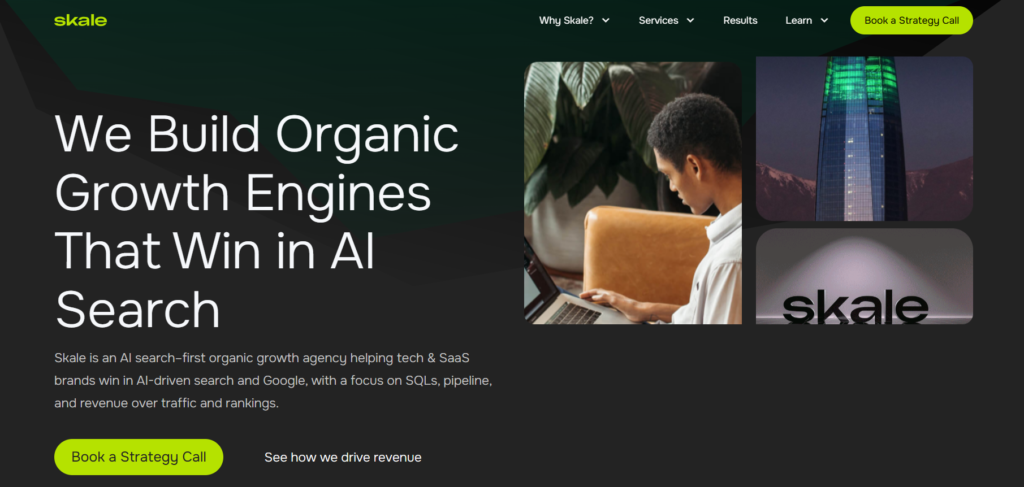
Skale is an organic growth agency that helps SaaS and technology companies improve their visibility in AI-driven search and traditional search engines.
Source – Skale
It combines GEO, SEO, content production, and link building to generate a qualified pipeline. They emphasize building organic growth strategies around a company’s brand and ideal customer profile.
For fraud management software companies, Skale may be a fit if the goal is to build stronger visibility around educational, comparison, and evaluation-stage topics.
Skale’s approach to topical authority, expert-backed content, and buyer-focused search strategies can help companies build visibility around fraud prevention, identity, and risk-related topics.
Pricing: Starts at $4000/month
Notable Clients: SEON, Meridian, Wealthsimple
Rating: 4.9/5 (16 reviews)
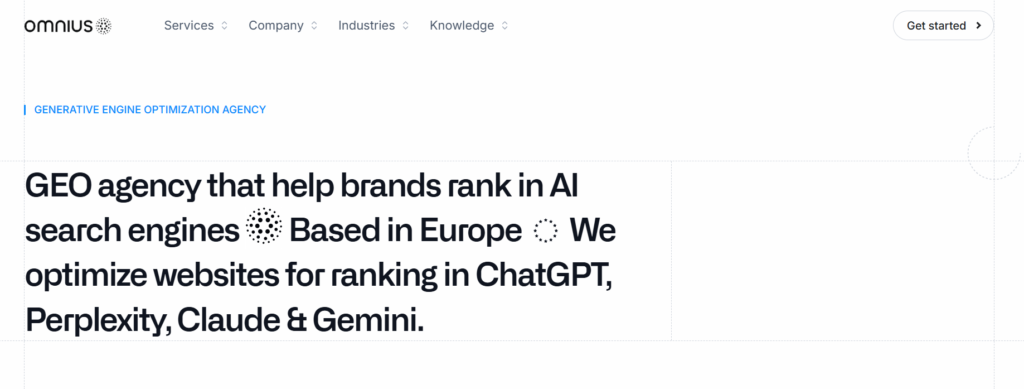
6. Omnius
Omnius is a B2B SEO and GEO agency that works with SaaS, fintech, and AI companies.
Source – Omnius
Omnius views GEO as an additional layer on top of SEO rather than a replacement for it. They help companies improve visibility across search engines and AI tools. They also work on making the company’s expertise easier for AI systems to understand.
Fraud management software buyers often research topics such as fraud prevention, compliance, payments, and risk management long before they engage with a vendor. The agency focuses on building strong content around key topics and making the brand visible across search, AI tools, and other trusted sources.
Pricing: N/A
Notable Clients: Payoneer, WorldFirst, Meniga, Paypercut
Rating: N/A
7. MaximusLabs
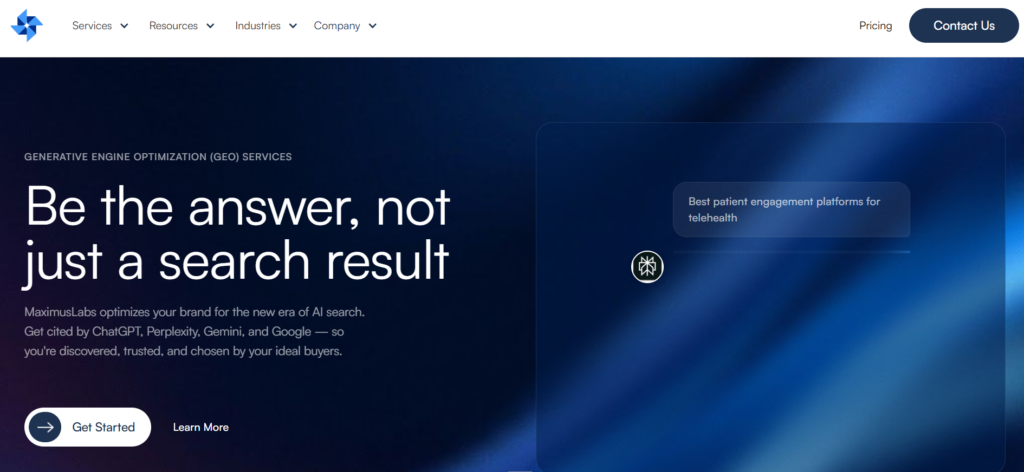
MaximusLabs helps growth-stage SaaS, AI, fintech, eCommerce, and B2B companies improve their visibility across AI-powered search platforms.
Source – Maximus Labs AI
It positions GEO around a simple idea: helping brands become the sources AI platforms cite and recommend. Rather than focusing solely on rankings, the agency emphasizes AI visibility across LLMs and Google AI Overviews.
As more software buyers use AI tools to research vendors and compare options, being included in those answers is becoming increasingly important. MaximusLabs focuses on helping companies build the credibility and content needed to be discovered and referenced by AI platforms.
Pricing: Starts at $1,299/month
Notable Clients: UnderDefense
Rating: N/A
8. Directive
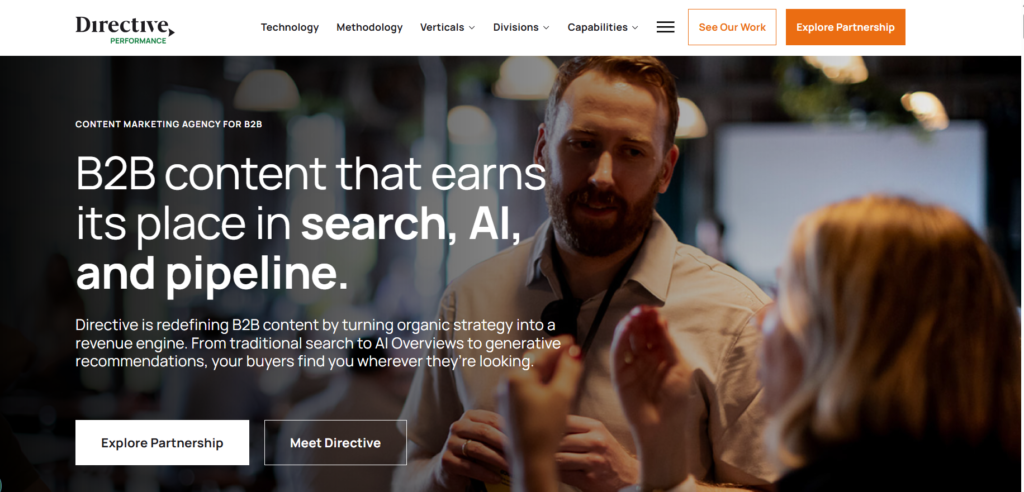
Directive is a B2B marketing agency that combines content marketing, SEO, and GEO to help brands stay visible across traditional search and AI-driven discovery platforms.
Source – Directive
The agency approaches GEO as part of a broader content strategy built around how buyers actually research software today.
Its GEO work focuses on building the content and brand presence that AI tools are more likely to find, use, and cite. Directive also studies which sources AI platforms cite and what content formats appear most often in AI-generated answers, using those insights to shape content strategy.
Additionally, the agency builds AI visibility into its content strategy so brands can show up where buyers look for answers.
Pricing: N/A
Notable Clients: Inscribe
Rating: 4.8/5 (56 reviews)
The agencies above can help improve how your fraud management software company shows up across AI search platforms. But there are also a few changes your team can make internally to strengthen the signals AI tools rely on. Let’s look at those next.
What Fraud Management Software Companies Can Do Internally To Improve AI Search Visibility
If you are just getting started with GEO, there is still a lot you can do before bringing in an agency. These steps will not replace a complete AI visibility strategy. But they can make it easier for buyers and AI tools to understand your product, expertise, and customer outcomes.
Here are a few places to start:
- Turn buyer questions into content: Your sales team already knows what buyers ask before choosing a fraud platform. Questions about implementation, integrations, migration, or competitor alternatives should not stay inside sales calls. Turn them into FAQs, comparison pages, and short explainers that buyers and AI tools can easily understand.
- Publish proof that buyers can verify: If you have customer success stories, make them easier to find. Instead of relying on broad claims, explain the challenge a customer faced, what changed after implementation, and the results achieved. Specific examples provide stronger signals than generic marketing statements.
- Keep public information up to date: Review your website, G2 profile, Capterra listing, partner pages, and other public sources. Product descriptions, use cases, and feature information should be accurate and consistent wherever buyers may find them. In fact, you can request your existing buyers to share a review on these sites.
These steps can help create a stronger foundation for AI visibility. But for fraud management software companies, internal improvements are only one part of the work.
Buyers in this category rarely choose a vendor after reading one product page. They compare options, check proof, look for trusted mentions, and ask AI tools which platforms are suitable for their specific fraud problem.
That is where Concurate can help. We help fraud management software companies build the content, proof, and external visibility needed to show up more clearly in AI-led buying journeys.
Looking To Improve AI Visibility For Your Fraud Management Software Company?
Fraud management software buyers often start their research long before they book a demo. Increasingly, that research happens through ChatGPT, Perplexity, Gemini, and other AI tools.
Our GEO Services: If you want your fraud management software company to appear more often in AI-generated recommendations, learn more about our GEO services here.
Our Content Marketing Services: If you also need support with content marketing, generating thought leadership content, or LinkedIn ghostwriting, learn more here.
Want practical marketing ideas you can actually use? Our weekly newsletter shares lessons from real campaigns, what’s working today, and the insights we’ve gained from testing them ourselves.
Frequently Asked Questions
1. Do AI platforms recommend established fraud vendors more often than newer companies?
Yes. Established fraud vendors often appear more because AI tools have more public signals to work with, such as reviews, customer stories, and industry references.
However, newer companies can still earn visibility if they publish clear use-case content, customer proof, and third-party validation around the fraud problems they solve.
2. How long does it take for GEO efforts to improve AI visibility for a fraud management software company?
There is no fixed timeline because AI platforms update their knowledge and recommendations differently. Some improvements can appear within a few weeks, while others may take several months. The timeline depends on your starting point. It is affected by how much public information, proof, content, and outside coverage already exist.
3. Is GEO different from traditional SEO for fraud management software companies?
Yes. Traditional SEO focuses heavily on rankings and website traffic from search engines. GEO focuses on helping AI platforms understand when your company should be included in generated answers and recommendations. While there is some overlap between the two, GEO places more emphasis on clearly explaining what your product does, who it helps, and when it should be recommended.
Disclaimer: The information presented in this article is compiled from publicly available sources, including company websites, industry reports, and social media. All trademarks, brand names, and logos mentioned are the property of their respective owners. We do not claim any ownership of third-party marks, nor do we imply endorsement or affiliation. This article is intended for informational purposes only.