

| TL;DR: We tested seven buyer-style property management software queries across ChatGPT, Gemini, and Perplexity. AppFolio, Yardi, and Buildium appeared more frequently than other platforms. Their established market presence likely helps, but we also found three recurring content patterns that help AI tools understand where each software fits, which buyers it serves, and why it may be worth recommending. This article explains those patterns and what challenger brands can do to improve their own visibility. |
Property management software is a crowded category. According to G2, there are 600 property management software solutions, and many promise the same things: automated rent collection, maintenance tracking, tenant portals, built-in accounting. A property manager comparing five vendor sites may read nearly identical copy on all five.
That is one reason more buyers are turning to AI when they start evaluating software. For instance, a regional property manager may need software that can handle leasing, rent collection, and maintenance requests without becoming too complex for day-to-day use. Instead of opening ten vendor websites and comparing similar feature lists, they may describe their situation to ChatGPT and ask for the top tools.
As always, we were curious to find who wins those recommendations. That’s why we ran seven buyer-style queries across AI platforms. The same handful of names came back again and again.
So we reviewed their content to identify the patterns that may be contributing to that visibility. This article breaks down the three patterns we found and what challenger brands can learn from them.
Which Property Management Software AI Recommends Most Often
To understand which property management software AI recommends most frequently, we tested these seven queries across ChatGPT, Gemini, and Perplexity:
- Top property management software for real estate companies
- Top property management platforms for residential property managers
- Top property management software for multifamily properties
- Top commercial property management software for office, retail, and industrial properties
- Top enterprise property management software for large real estate portfolios
- Top property management software for rent collection and tenant screening
- Top property management software for maintenance requests
We chose these prompts because they reflect the way property management software buyers compare tools in real life. They rarely search from one broad category alone. Their searches usually change based on property type, portfolio size, or the operational problem they need to fix.
Across these prompts, three vendors appeared more consistently than the rest: AppFolio, Yardi, and Buildium.
So we started looking at the patterns that made these software easier for AI tools to recommend.
3 Reasons Why AppFolio, Yardi, And Buildium Keep Appearing In AI Recommendations
These companies that appeared most consistently did more than describe their software. They created clear signals that helped AI platforms understand where each software fits, which buyers it serves, and why it may be worth recommending.
Across the three companies, these patterns repeatedly stood out.
1. They Publish Content That Helps Buyers Build Shortlists
These companies consistently publish the kind of content buyers look for when they are narrowing their options.
A property manager searching for “top property management software for multifamily properties” is already making comparisons with existing options they might already be using. They want to know which vendors should be on their list before they spend time on demos, pricing pages, or sales calls.
Listicles help here because they give AI tools a ready-made structure: relevant vendors, category context, and a simple reason each tool belongs in the shortlist.
Buildium does this well. On its website, it publishes shortlist-style content around property management software categories and related terms.
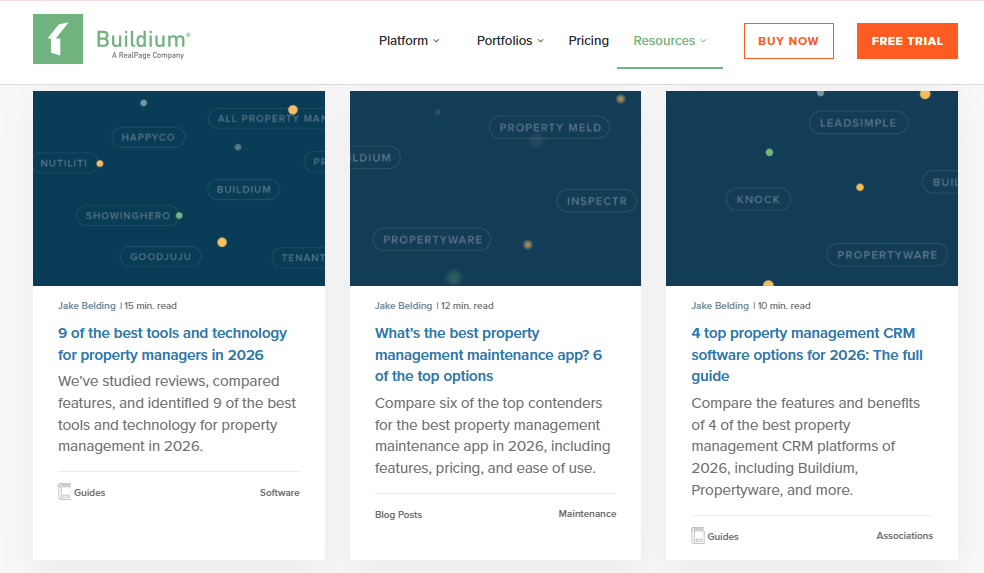
Source – Buildium
This strategy seems to be working well. When we ran a query on ChatGPT for top property management CRM software platforms, Buildium appeared at the top of the list, along with other vendors that showed up repeatedly in this study.
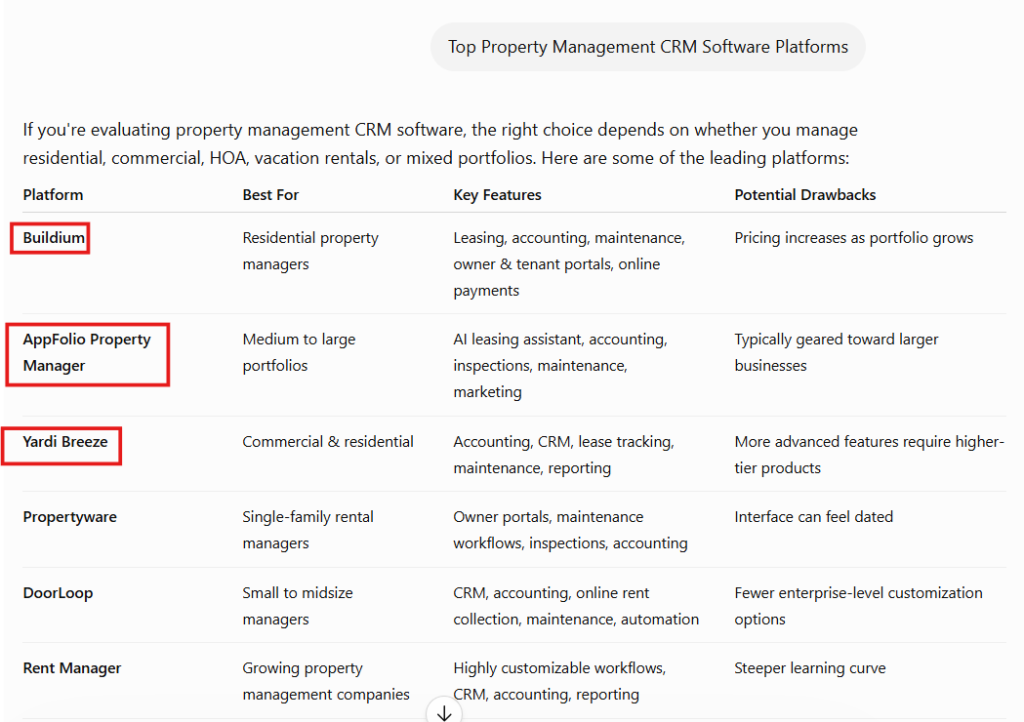
Source – ChatGPT
That result makes more sense when you look at Buildium’s own content. It has a guide titled 4 Top Property Management CRM Software Options for 2026, which matches the exact search intent.
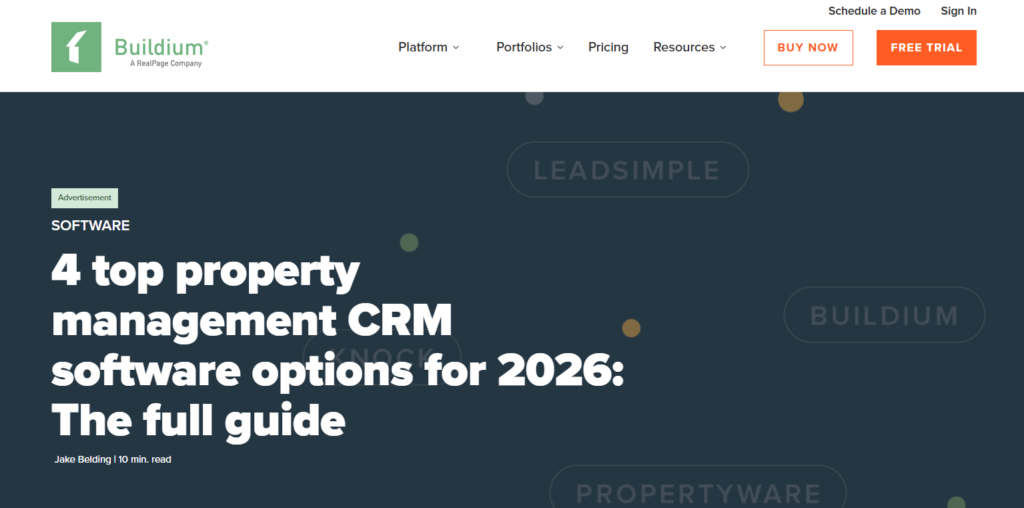
Source – Buildium
This likely helps Buildium’s visibility because AI tools can find content that already answers the kind of shortlist question buyers are asking.
AppFolio follows a similar approach with articles such as Best Property Management Software 2026: Top 6 Companies Compared. This gives AI tools another structured source for understanding which platforms belong in the category and how AppFolio compares with other options.
The key takeaway is simple: If a property management software company wants to improve its chances of appearing in AI recommendations, shortlist content gives AI tools a relevant source to use.
2. They Support Their Claims With Concrete Results
Here’s the thing. Many property management software companies make similar claims: save time, reduce manual work, improve communication, and automate operations. The companies that appeared more often gave AI tools proof that made those claims easier to trust.
AppFolio’s JW Property Services case study is a good example. Rather than making broad claims about reducing manual work, AppFolio supports them with results from a property management company overseeing more than 330 units. It shows a 75% reduction in manual work, a 50% reduction in accounts payable time, and a 60% reduction in communication time.
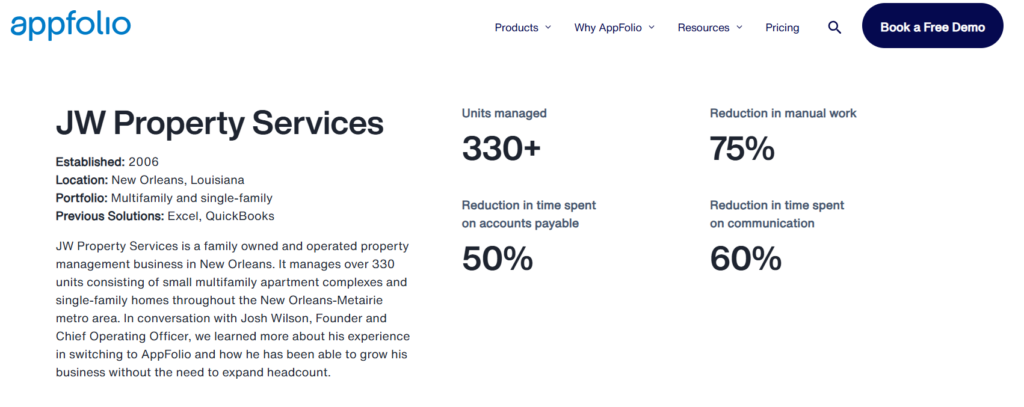
Source: AppFolio
Those numbers help AI tools connect AppFolio with a clear outcome: helping growing property managers reduce admin work without adding more people.
Buildium does the same with its Common Cents Property Management customer story. The case study shows a 1,500-door company using Buildium to cut HOA violation handling time by 77%. That gives AI tools a specific reason to associate Buildium with HOA operations, automation, and reporting.
Buildium also supports the written story with a video version of the case study, which includes a detailed customer testimonial.
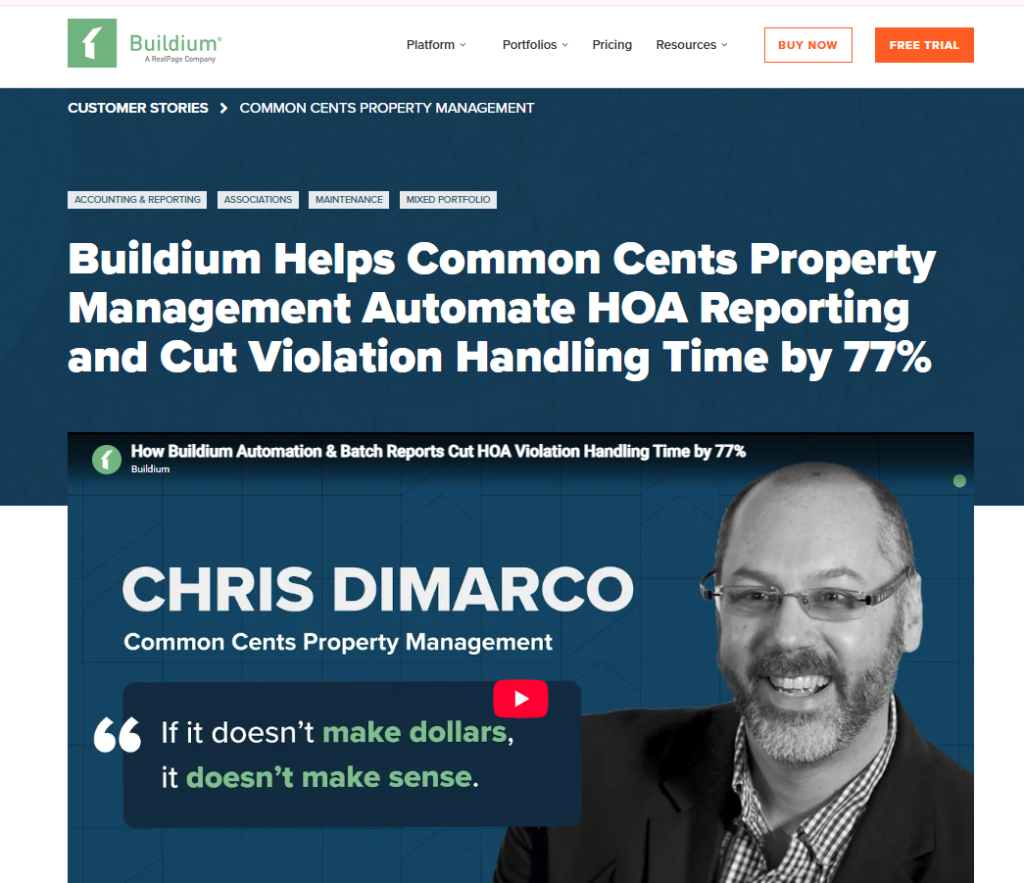
Source: Buildium
The video adds context to the written case study by letting buyers hear directly from the customer and understand how the workflow changed. It also gives AI tools another source connecting Buildium with the customer’s problem and measurable result.
And it isn’t limited to written case studies on the website. Yardi also publishes customer stories on YouTube. By doing so, the company extends its customer proof beyond its website. This gives AI tools another source for understanding who uses Yardi, what problems it solves, and which buyers it may suit.

Source – YouTube
That is why specific proof matters. AI tools can repeat broad claims, but measurable customer stories give them concrete evidence to support a recommendation.
How do you get your SaaS brand noticed by AI tools? Our senior content strategist sits down with B2B SaaS marketing expert Aditi Syal for a 30-minute conversation. Watch it below!
3. They Create Content For Different Property Use Cases
The companies that showed up repeatedly have content beyond the usual features buyers see on most property management software websites.
They create content around the different situations buyers actually care about. Yardi, for example, has resources for use cases such as multifamily, single-family, affordable housing, community associations, commercial properties, senior living, self-storage, and investment management.
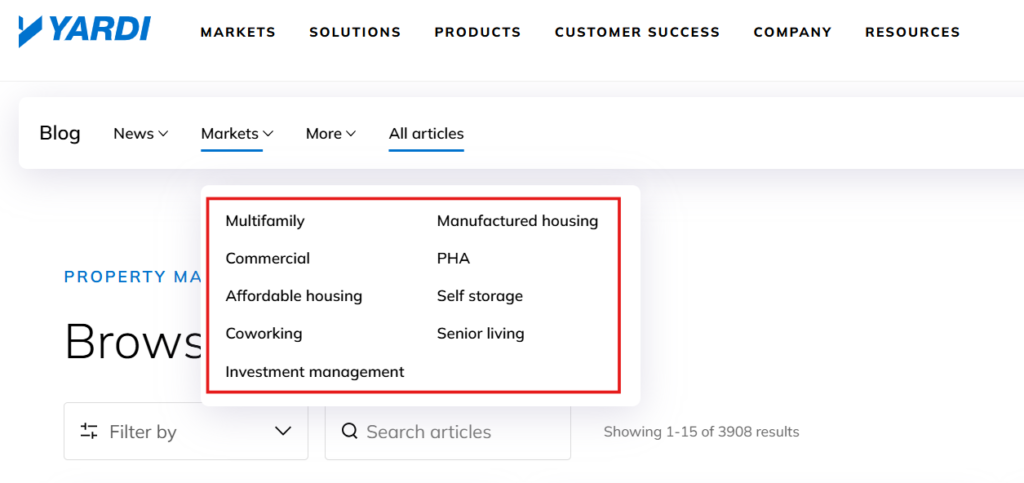
Source – Yardi
AppFolio and Buildium also create content around different use cases.
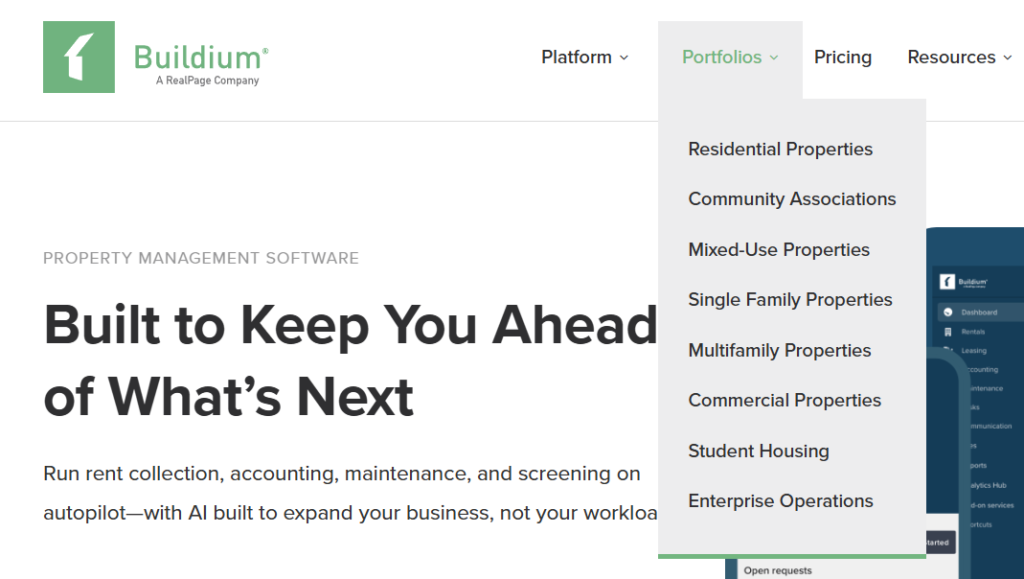
Source – Buildium
A generic landing page can tell AI tools what the software does, but in short. Whereas Use-case based content, either in the form of landing pages or blogs, gives buyers clearer information about when the software is relevant and whom it may suit. Over time, this builds topical authority, meaning the company becomes associated with a wider range of property management topics.
We saw the same pattern when we tested more specific use-case searches.
When we searched ChatGPT for top property management software for team management, all three companies appeared in the recommendation list.
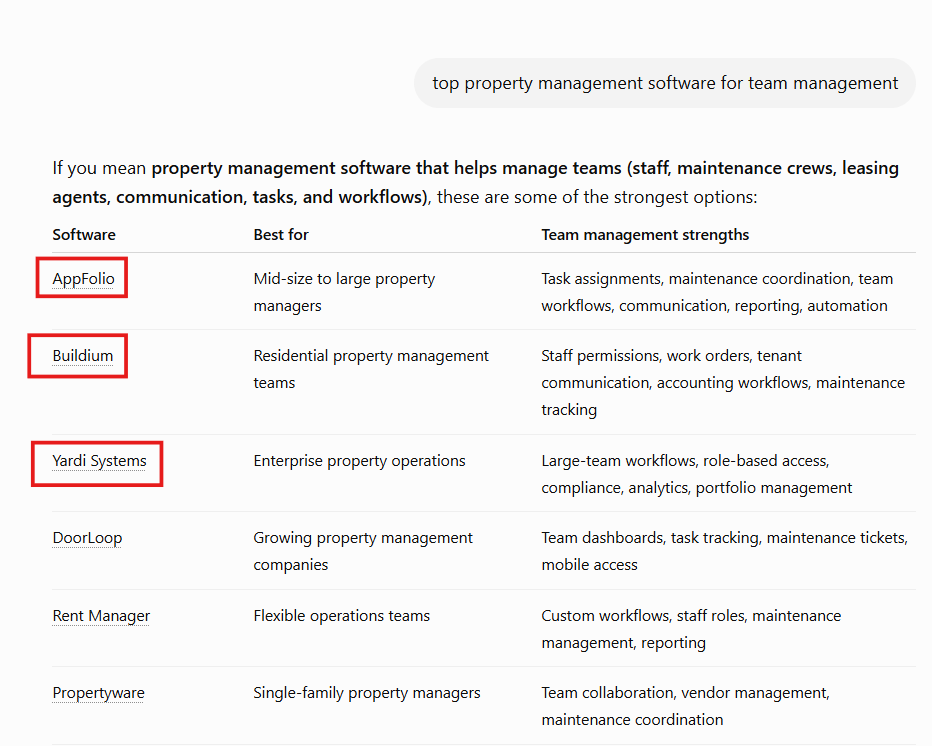
Source – ChatGPT
We saw the same pattern in Gemini for the query on top property management software for lease management, where all three appeared again.
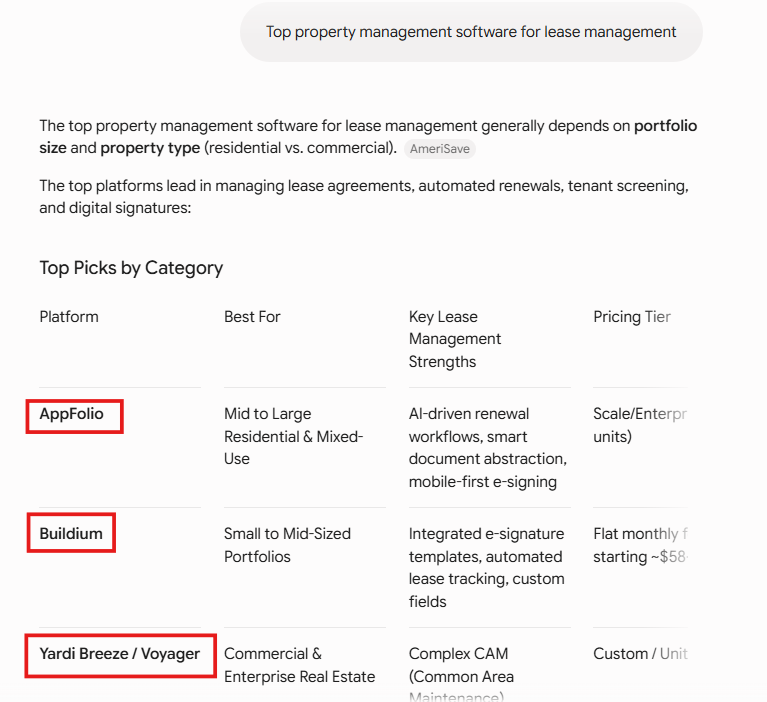
Source – Gemini
Looking across these examples, the pattern is clear. Use-case content makes it easy for AI platforms to connect their products with specific buyer needs.
The good news is that challenger property management software companies don’t need to match their content volume. They simply need to create the right signals. Here are three strategies to help them do that.
3 Strategies Challenger Property Management Software Companies Can Use To Get Recommended In AI Answers
At this point, you might be thinking, “That’s easy for AppFolio or Yardi to do.” Yet the patterns we found are well within reach for challenger brands.
You do not need to be the biggest name in property management software to show up in AI answers. But you do need to make it easy for AI tools to understand who your product is for and what proof supports your claims.
Here are three ways challenger property management software companies can build those signals.
1. Build Content Buyers Use To Evaluate Software
You can start by creating listicles based on how property management buyers find tools.
Broad topics like “best property management software” are dominated by established vendors with extensive public evidence like reviews or use-case resources.
A smaller brand may have a better chance with more specific searches tied to portfolio type, company size, or daily operations.
For example, you can create listicles on:
- Top property management software for mid-sized companies
- Top tools for managing multifamily properties
- Best property management software for rent collection
- Top property management software for maintenance requests
However, the content should not be a plain vendor list. It should explain which software suits which situation, the use cases it supports, and what proof supports the recommendation. That makes the shortlist useful for buyers and gives AI tools a clearer source to use when answering recommendation queries.
2. Create Comparison And Alternative Content
Many challenger property management software companies publish product pages and educational articles but neglect comparison and alternative content. And it happens more often than you’d expect.
That is a missed opportunity because buyers ask AI tools these questions when they are already evaluating options. They may be replacing software, checking if a popular tool is too complex, or looking for something that fits their portfolio better.
For instance, when we searched for Yardi alternatives, Buildium appeared in the recommendation list. This was not surprising because Buildium has an article on 5 of the best Yardi alternatives worth exploring in 2026.
This gives AI tools a relevant source that connects Buildium to the exact comparison buyers are asking about.
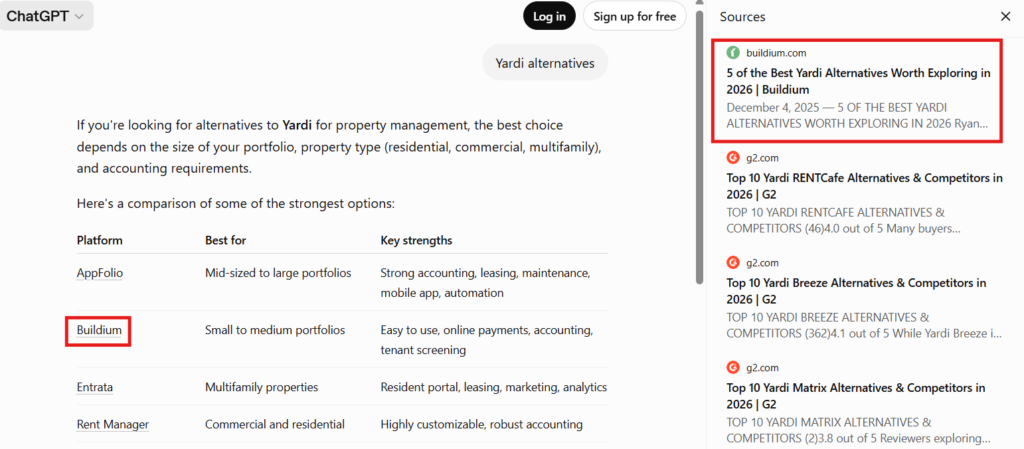
Source – ChatGPT
As a challenger brand, you can create comparison and alternative content like:
- Top alternatives to [popular property management software]
- [Your Brand] vs a [popular property management software]
- Top alternatives for residential property managers
- Top property management software like [competitor category]
For challenger brands, the goal is not just to publish this type of content. It is to give AI tools enough context to place your product beside the vendors buyers already know and explain why you are worth considering.
3. Create Visibility Beyond Your Website
Think about your own buying process. You probably don’t stop after reading a vendor’s website.
Similarly, a buyer may first read your product page. But they would usually look elsewhere before trusting the recommendation. They may watch a YouTube customer story to see how another property manager uses the software. Some may check Reddit, G2, or Capterra to hear what users say outside the company’s own channels.
LinkedIn adds another layer because it lets founders, sales leaders, and customer-facing teams explain the problems they see every day, from maintenance delays to reporting gaps.
CMO’s Note: Building visibility on LinkedIn also requires consistent posting. Your founders and customer-facing teams may have useful insights to share, but they may not have the time to turn those insights into regular content. That is where our LinkedIn ghostwriting services can help. We turn their expertise into practical posts that software buyers can find, learn from, and trust.
These third-party mentions create a wider footprint around your brand and make it easier for AI tools to understand who your software is designed for.
Of course, creating the right AI signals requires more than publishing content consistently. It takes expertise in content strategy, customer proof, and third-party visibility, which is where a GEO agency that caters specifically to property management, like Concurate, can help.
How Concurate Helps Property Management Software Companies Improve AI Visibility
Your software may be a strong fit for a specific buyer. But if AI tools cannot see that clearly, they will recommend the companies with more visible public evidence.
That is what we at Concurate help fix through our proprietary Perfect Match Framework.
We start by defining the buyer you are actually trying to reach: their portfolio type, pain points, buying triggers, and reasons they may choose you over a better-known software.
Then we test the prompts those buyers are likely to ask across AI platforms and Google AI Overviews. We look at where your brand appears, where competitors appear, and whether AI tools understand your product correctly.
Next, we study the content and sources shaping those answers. The gap may be missing alternative content, weak use case coverage, or limited customer proof.
From there, we build the content and visibility signals needed to close those gaps.
Our goal is not to make your brand appear in every AI answer. It is to help it appear in the right answers, for the right buyers, with enough proof to make your software easy to recommend.
If you want to see where your property management software stands today when it comes to AI visibility, or need help improving it, book a call with us.
Frequently Asked Questions
1. Do AI tools recommend the same property management software every time?
No, AI answers can change based on the exact prompt, platform, location, timing, and sources each tool decides to use. That is why one search is not enough to judge visibility. Property management software companies should track a group of buyer-style prompts over time instead of relying on a single ChatGPT or Gemini answer.
2. Can a newer property management software company appear in AI recommendations?
Yes, but it needs to be strategic. A newer company may struggle with broad prompts like “best property management software.” It can improve its chances of appearing by creating content around the buyer searches where it has the strongest fit. This includes alternative pages, specific listicles, use case articles, customer proof, and third-party mentions.
3. What is the difference between ranking on Google and appearing in AI answers?
Google ranking is about where a webpage appears for a particular search query, often tracked through target keywords. AI visibility is about whether your brand appears in the direct answer to a specific buyer question. FYI, AI tools may combine information from your website, reviews, comparison articles, customer stories, and other public sources when generating that answer.
Disclaimer: The information presented in this article is compiled from publicly available sources, including company websites, industry reports, and social media. All trademarks, brand names, and logos mentioned are the property of their respective owners. We do not claim any ownership of third-party marks, nor do we imply endorsement or affiliation. This article is intended for informational purposes only.