


| TL;DR: Property management software is a crowded category. AI tools often recommend the same popular names, like AppFolio, Yardi, and Buildium, while many strong challenger brands are left out. The problem is usually not the product. It is that AI platforms do not have enough clear information to understand when and why to recommend them. This guide covers ten GEO agencies, including Concurate, Siana Marketing, and LSEO, that can help property management software companies improve their AI visibility. It also explains four reasons these companies struggle to show up in AI answers and five questions to ask before hiring a GEO agency. |
Property management software is one of those categories where the same names show up everywhere.
Ask ChatGPT for “best property management software for a 500-unit residential portfolio” or query Perplexity for “property management platforms with accounting integration“. In most answers, you will see popular names like Entrata, Yardi, and Buildium appear repeatedly.
In fact, we found a similar pattern in our property management software AI visibility study. Companies like AppFolio, Yardi, and Buildium appeared more consistently in AI recommendations than other platforms.
However, there are other property management software companies, too. Some of them handle specific portfolio types, property classes, or operational workflows better than the popular names in the category. However, most of the time, they still do not get recommended when buyers describe the exact situation where their product is actually a better fit.
The reason is simple: their content was never built for that moment. When a buyer describes their situation and asks for a recommendation, these companies often get left out because their content does not clearly explain where they fit, who they serve, and why they should be considered.
That is the gap that generative engine optimization agencies help close.
In this guide, we will cover ten GEO agencies that help property management software companies improve their visibility in AI search. But before we get to the list, let’s first understand why so many companies in this category struggle to show up in AI answers.
4 Reasons Why Property Management Software Companies Struggle To Show Up In AI Recommendations
Property management software companies can publish a lot of content and still fail to appear when buyers ask AI platforms for recommendations.
The issue is not always content volume. It is whether the company has built the right signals around third-party trust, category positioning, audience specificity, and buyer intent. If those signals are weak, AI platforms have fewer reasons to recommend the company, even if it ranks for relevant searches.
Here are four common gaps to watch for:
1. They Assumed Being Listed On G2 And Capterra Was Enough For Third-Party Discovery
Most property management software companies invested heavily in review platforms early because that is where buyers historically went to compare tools. They collected reviews, optimized their profiles, and called it a day.
However, AI platforms do not only pull trust signals from G2 and Capterra when generating property management software recommendations. They pull from across the entire web, including industry publications, professional community discussions, regional association content, and specialist blogs.
Companies that concentrated their entire third-party presence on getting reviews on software comparison platforms often have a thin footprint everywhere else. As a result, AI platforms may not find enough outside proof to connect them with specific property management needs or use cases.
2. They Built Their Content Roadmap By Looking At What Popular Platforms Were Publishing
The natural instinct for a challenger brand in a crowded category is to look at what Yardi, AppFolio, or Buildium are publishing and create something similar.
That is where many companies go wrong. Competitor research can show you what the top companies in the category already talk about, but it cannot tell you where your product deserves to be recommended.
When property management software companies blindly follow the same roadmap, they often end up covering broad topics in a slightly different voice. That may help them publish more content, but it does not give AI tools enough reason to cite them as the right fit for a specific buyer situation.
3. They Treated All Property Managers As One Audience
A property manager running 20 single-family rentals has completely different software needs from an operations leader managing thousands of multifamily units across several cities.
Most property management software companies write content for a generic property manager that speaks clearly to neither. AI platforms cannot match generic content to specific buyer scenarios. The result is visibility for no one in particular.
4. They Invested In Product Marketing Before Category Education
Most of their content explains what the software does. It does very little to explain the specific operational problems the software helps solve for different types of property teams.
For example, a company may explain its maintenance tracking feature. But it may not have content on how growing property teams can reduce delayed maintenance requests, manage work orders across multiple buildings, or improve communication between tenants, owners, and vendors.
Buyers who are not yet aware of the company cannot find it through problem-based searches because that content does not exist. By the time the buyer reaches the vendor evaluation stage, the shortlist has often been built from the companies that appeared during pain-point-based searches.
These visibility challenges are not impossible to fix, but they do require the right strategy to tackle, which is where GEO agencies can help.
But before you make the choice, let’s take a look at some questions that can reveal whether they truly understand the property management software category.
What To Ask A GEO Agency Before You Hire One For Your Property Management Software Company
Not every GEO agency that works well for the general SaaS category will understand the specific dynamics of property management software. The category has its own buyer vocabulary, professional communities, and competitive structure.
Here are five questions that separate agencies genuinely equipped for this niche from agencies that will apply a generic framework and call it done.
1. Have They Helped A Challenger Brand Compete In A Category Dominated By Bigger Names?
This is a fundamentally different challenge from building content for a new or emerging category. When established vendors have five to ten years of indexed content, backlinks, and AI citations, a challenger brand cannot win by publishing similar content more frequently.
For example, a company serving single-family rental operators may have opportunities very different from a platform targeting large multifamily portfolios.
The right agency should know how to identify the specific questions, use cases, and buyer situations where a challenger brand has a real chance to show up.
| Question to ask: Can you show examples of how you helped a challenger brand compete in an established software category with dominant incumbents? |
2. Do They Understand Your Customers Beyond Generic Research?
A GEO agency cannot build strong AI visibility for a property management software company by relying only on Google searches and reading competitor blogs.
They need to understand the real problems your buyers face. For example, why do property teams look for new software? What slows them down? What are they unhappy with in their current tools? What makes them choose one platform over another?
That understanding can come from customer interviews and sales conversations with customer success teams and past client calls. The source matters less than the depth of understanding.
If the agency skips this step, the content will usually stay generic. It may describe the category, but it will not reflect the actual problems, objections, and decision points that buyers bring up when they are evaluating software.
| Question to ask: How do you understand our customers before building the content strategy? Do you speak to our sales, product, or customer-facing teams as part of the process? |
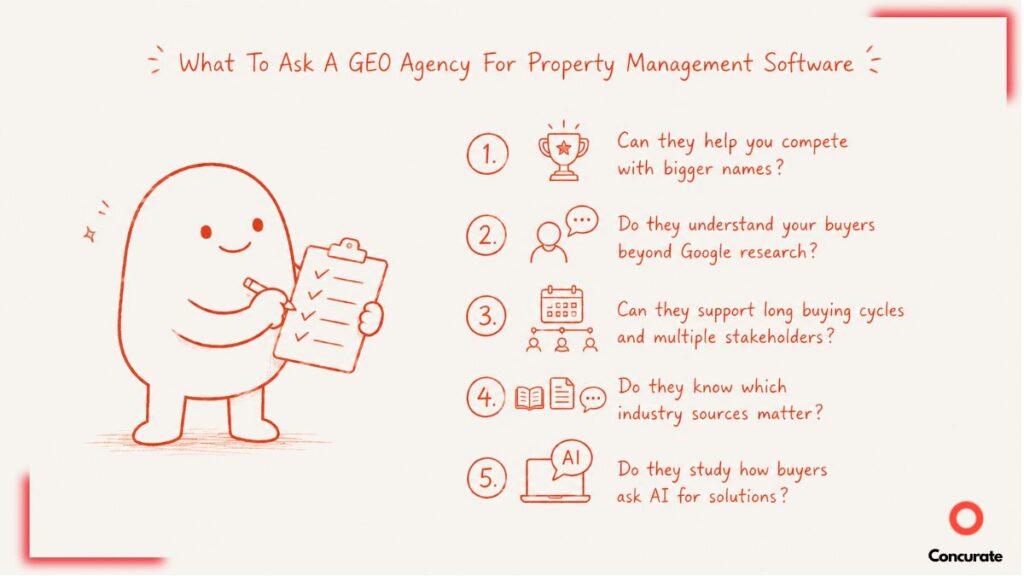
3. Can They Build Content for a Long Evaluation Cycle With Multiple Decision-Makers?
Property management software purchases at the enterprise level involve property managers, IT leads, finance teams, and sometimes ownership groups or C-suite executives. The evaluation period can run anywhere up to six months.
Each stakeholder searches differently and needs different content to move forward. If they describe a single content strategy aimed at a single buyer persona, they have not thought about how enterprise property management software deals actually close.
For instance, a property manager may focus on maintenance workflows and tenant communication. On the other hand, a finance leader may care more about reporting, portfolio performance, and owner distributions.
| Question to ask: How do you approach content planning for a buying committee with multiple stakeholders and a long evaluation timeline? |
4. Do They Know Which Third-Party Sources Matter in Property Management Software?
AI platforms do not understand a property management software company based only on its own website. They also look at what the wider web says about the brand, the category, and the problems buyers are trying to solve.
That is why third-party visibility matters.
For property management software companies, this could mean getting mentioned in the places where property managers, multifamily operators, landlords, and real estate teams discuss software, workflows, and operational challenges. These may include industry publications, multifamily-focused platforms, property management forums, regional apartment associations, podcasts, newsletters, or community discussions.
A good GEO agency should be able to identify which of these sources actually matter for your category. It should not stop at a generic plan for backlinks, guest posts, or PR.
| Question to ask: Beyond our website, what is your plan for building visibility in the communities and publications where property managers actually discuss software? |
5. How Do They Research The Way Your Buyers Describe Their Situation To AI Platforms, Specifically?
A property manager searching Google types short keywords. The same person asking ChatGPT describes their full situation, including the property type, current software challenges, and the integrations they need. They also explain what their existing solution cannot do and why they are looking for a replacement.
For example, instead of searching for “property management software,” they may ask, “What is the best property management software for a 500-unit multifamily portfolio that needs QuickBooks integration and stronger maintenance tracking?”
That level of detail matters. If your product is a good fit for that situation, your content should clearly explain why. It should cover the portfolio type, integration need, workflow challenge, and use case in enough detail for AI tools to understand where your software fits.
A good GEO agency should not stop at keyword research. It should study how buyers ask specific questions across ChatGPT, Perplexity, Gemini, and other AI platforms, then build content that answers those questions clearly.
| Question to ask: How do you research the specific ways property management software buyers describe their situation to AI platforms when evaluating solutions? |
Now that you know the gaps to watch for and the questions to ask, let’s look at the GEO agencies that can help property management software companies improve their visibility in AI search.
Top 10 Generative Engine Optimization Agencies For Property Management Software Companies
For property management software companies, AI visibility is not only about publishing more content. It is about making the right information easy for AI tools to understand.
Some of that information sits in leasing pages, rental listings, vacancy marketing tools, and property websites. But a lot of it also sits across feature and integration pages, help content, case studies, and sales-led messaging.
That creates a problem. AI platforms may see that a company offers maintenance tracking, accounting integrations, tenant communication, or leasing workflows. But they may not understand which portfolio type, property class, team size, or operational problem the software is best suited for.
That is why the following GEO agencies matter. They can help connect the dots between what the product offers, who it is built for, and when AI tools should recommend it.
- Concurate
- Siana Marketing
- LSEO
- First Page Sage
- Black Propeller
- Thrive Internet Marketing
- WebFX
- SEO Brand
- Onely
- FlyDragon
Now, let’s analyze each of these agencies in detail, starting with Concurate:
1. Concurate
Concurate works with property management software companies that have strong products, but little visibility in AI recommendations.
Often, the platform is useful in specific buying situations. But their content does not make those situations clear enough for AI tools to pick up.
That is the problem we solve at Concurate.

Source – Concurate
We are a boutique content marketing and GEO agency helping B2B SaaS and high-growth companies show up in AI-generated answers when buyers are actively evaluating options. For property management software companies, that means helping AI tools understand who your product is for, what problems it solves, and when it should be recommended.
How We Build AI Visibility For Property Management Software Companies
We approach GEO through our Perfect Match Framework.
Our goal is to ensure your brand shows up in AI answers when your product is actually the right match for the buyer’s situation. Here’s what that looks like in action:
- Define the ideal buyer: We start by understanding who your software is built for. A company selling commercial property management software will need a different strategy from one serving mixed-use real estate portfolios. We look at the problems that make these buyers search for a new platform, the features they care about, and the situations where your product is a strong fit.
- Benchmark current AI visibility: We check where your brand appears today when buyers ask AI tools specific questions. This includes prompts around real situations, such as finding rental property management software for a growing residential portfolio, commercial property management software with accounting workflows, or real estate property management software that can handle leasing, maintenance, and reporting in one place. This helps us understand where your brand already appears, where competitors are showing up instead, and which recommendations you are missing.
- Audit what already exists: We review your website content, technical setup, third-party mentions, and AI visibility signals. For property management software companies, this may include feature pages, integration pages, pricing pages, comparison content, help content, case studies, and pages around maintenance tracking, rent collection, tenant communication, reporting, and owner portals. This shows us whether your current content actually explains the product clearly enough for AI tools. If not, that’s what we think about in the next step.
- Build the strategy: We identify which pages need to be created, updated, or strengthened. For example, a company serving residential property managers may need stronger content around tenant screening, lease renewals, and maintenance requests. This turns the audit into a practical content roadmap. It tells us which pages can improve visibility fastest, which third-party mentions matter, and where the brand needs stronger proof before AI tools are likely to recommend it.
- Create content with real insight: We do not build content from generic research alone. We use inputs from sales calls, customer conversations, interviews with in-house experts, and market research. That helps us create content that reflects the real questions property managers ask when they are comparing real estate property management software options.
- Monitor what changes: We keep checking how your brand appears in AI answers over time. We also track which pages attract AI-referred traffic, which prompts start surfacing your brand, and whether your visibility is improving for the property management software searches that matter most.
This helps us understand what is working, what needs to be adjusted, and whether the strategy is actually improving your presence in AI recommendations.
You see, GEO is not a one-time content push. It needs ongoing testing, updating, and refinement.
The core idea is simple: content should not just generate traffic. It should help the right buyers discover, evaluate, and shortlist your product. Book a call with us to see how your platform can start showing up where buyers are actually making decisions.
Who Are We Best For?
Property management companies with large, frequently updated listings and strong local data that aren’t being surfaced in AI-driven discovery.
Pricing
Our monthly retainers usually fall between $5,000 and $7,500, and specific one-off projects begin at about $3,500.
Notable clients
PQAI, Datacipher, Triangle IP, Pinch Patent Drawings, Athena Security, InspireIP
Rating: 5/5 (2 reviews)
2. Siana Marketing
Siana Marketing is a GEO agency built specifically for the proptech, construction tech, and real estate space.

Source – Siana Marketing
Their work starts with understanding how buyers evaluate solutions at each stage, from discovery to decision. That insight is then used to shape content around real use cases, like leasing workflows, asset tracking, and operational efficiency. As a result, the messaging stays grounded in what the product actually does, which makes it easier to follow.
The agency also organizes content in a clear, question-led format so key information is easy to find and reuse. This structure improves how both users and AI systems understand the offering without needing to piece together scattered details.
Best For: Companies that need content built around real buyer journeys and product use cases.
Notable PropTech/Real Estate Clients: The Corcoran Group, HomeVestors, Oliver Realty
Rating: NA
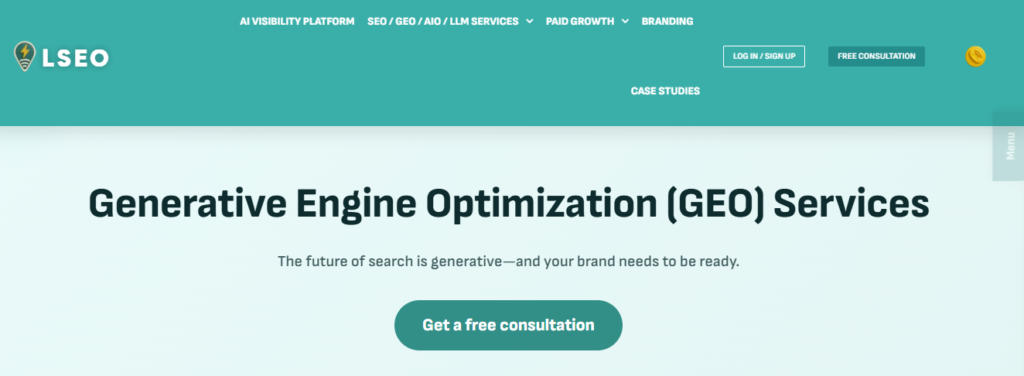
3. LSEO
LSEO is a full-service agency that brings SEO, content, and conversion into one connected system.
Source – LSEO
Their GEO work begins by reviewing how the website is structured and how information is currently presented. From there, they reorganize pages so each one has a clear purpose and supports a broader content flow.
Apart from this, LSEO aligns technical fixes, content updates, and authority signals so they reinforce each other. This reduces AI confusion that often comes from disconnected efforts. The agency also uses internal tools to test and refine GEO strategies over time. In the end, the result is a cleaner and more consistent presence that’s easier to understand for AI across all touchpoints.
Best For: Teams that need to clean up structure, align content, and improve overall clarity across their site.
Notable PropTech/Real Estate Clients: Redfin
Rating: 5/5 (10 reviews)
4. First Page Sage
First Page Sage is an SEO and GEO agency widely recognized as one of the earliest to formally build generative engine optimization into its core service offering.

Source – First Page Sage
Their approach centers on thought leadership content, the kind AI models naturally pull from when generating responses about a product category. For real estate and proptech, they’ve built a dedicated framework that addresses the specific challenges of property-related GEO. This includes local market visibility, transaction-based content, and the exact queries buyers and asset managers use when evaluating technology solutions.
Their work spans large REITs, national brokerages, property management firms, and real estate investors, making them a versatile GEO option for proptech companies at different growth stages.
Best For: PropTech platforms that want thought leadership-driven content delivering consistent AI citations over the long term.
Notable PropTech/Real Estate Clients: The Corcoran Group, Apollo Group, We Buy Ugly Houses
Rating: NA
5. Black Propeller
Black Propeller is a performance-driven digital marketing agency that brings paid search and GEO together under one roof.

Source – Black Propeller
They look closely at campaign data to understand which messages and keywords are actually driving results. These insights are then carried into content and search efforts, which keep the strategy grounded in real performance.
In addition, the agency reviews campaigns frequently and makes regular updates to improve both visibility and conversions. This creates a steady loop where each channel informs the other. Because of this connection, the strategy stays aligned with user behavior and adapts more quickly to changes.
Best For: Companies that want SEO strategies shaped by real campaign performance and conversion data.
Notable PropTech/Real Estate Clients: Valet Living
Rating: 4.8/5 (81 reviews)
6. Thrive Internet Marketing
Thrive Internet Marketing is a full-service internet marketing agency that brings GEO into an already broad stack of services covering SEO, PPC, content, social media, and web development.
Source – Thrive Internet Marketing
What makes them practical for proptech companies is their strategy-first approach. Moreover, they have a dedicated real estate digital marketing practice and offer GEO specifically for large language models, including ChatGPT, Gemini, and Perplexity.
They highlight having an internal R&D team to test AI SEO strategies before rolling them out to clients. According to them, their GEO implementation reflects what’s currently working rather than outdated methods, making them a better option.
Best For: Brands that want one agency handling SEO, GEO, and paid media under a single, strategy-first model.
Notable PropTech/Real Estate Clients: HomeFirst
Rating: 4.6/5 (106 reviews)
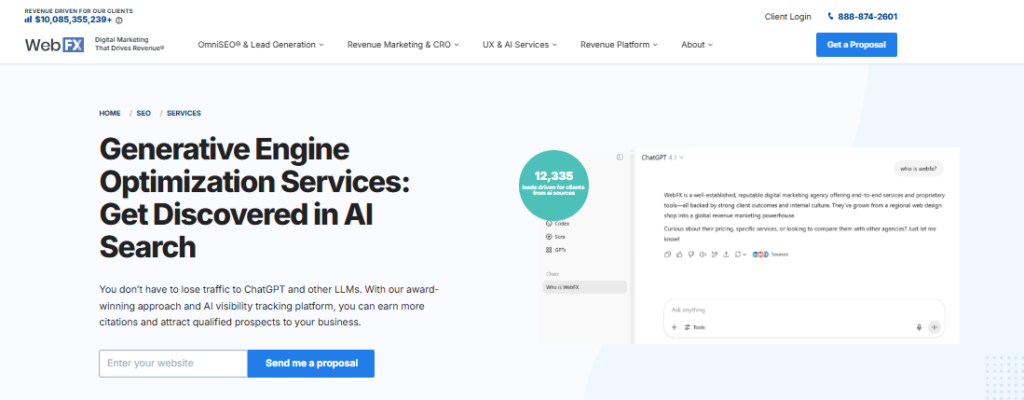
7. WebFX
WebFX is one of the largest full-service digital marketing agencies in the US.
Source – WebFX
Their biggest differentiator is RevenueCloudFX, a platform they built to connect AI visibility work directly to closed deals. Instead of reporting on citations or traffic, their platform can show exactly how their work is moving revenue, which is something most agencies simply cannot do.
They also have a dedicated real estate team that understands MLS data, IDX architecture, and structured data. This helps companies selling into the property market get recommendations grounded in how those platforms actually work, not generic advice applied across industries.
Best For: Large property technology platforms that need AI visibility tied directly to revenue.
Notable PropTech/Real Estate Clients: SelectROW, Property Management, Inc. (PMI)
Rating: 4.9/5 (441 reviews)
8. SEO Brand
SEO Brand is a digital marketing agency that focuses on improving how proptech platforms present their value.
They work on how listings, tools, and services are described so users can quickly understand what makes one option better than another. When users compare platforms, unclear messaging often leads to drop-offs. SEO Brand fixes this by refining how features, pricing, and benefits are explained across pages.
The agency also aligns messaging across blogs, landing pages, and ads, so users see the same narrative at every touchpoint. This consistency makes it easier for AI systems to interpret the platform and surface it in relevant queries.
Best For: Platforms that struggle to clearly communicate their value when users compare multiple tools or listings.
Notable PropTech/Real Estate Clients: Sotheby’s International Realty
Rating: 4.9/5 (105 reviews)
9. Onely
Onely is a technical SEO agency that fixes deep issues on large, complex websites.

Source – Onely
In proptech, a lot of data sits inside dynamic listings, filters, and JavaScript-heavy pages. If these aren’t structured well, important pages never get indexed. So, Onely identifies these gaps and works with engineering teams to fix them at the code level. Basically, they specialize in making sure search engines and AI tools can properly access and understand site content.
Once these issues are resolved, listing pages and property data become visible and easier to interpret.
Best For: PropTech and VR platforms with complex, interactive websites where technical issues prevent search engines and AI tools from properly accessing and understanding their content.
Notable PropTech/Real Estate Clients: Realtor.com
Rating: 5/5 (18 reviews)
10. FlyDragon
FlyDragon is a marketing agency that focuses on improving local search visibility.

Source – FlyDragon
They help property platforms show up for searches tied to specific cities and neighborhoods. They do this by building content around location intent, such as pricing trends, property types, and area-specific queries. This makes pages more relevant when users search with a location in mind.
The agency’s approach stays focused on one market at a time, which helps build stronger visibility where demand actually exists.
Best For: Companies and agents wanting stronger visibility for city and neighborhood-level property searches.
Notable PropTech/Real Estate Clients: Century 21, Rosenthal Group, United Realty Group
Rating: NA
So, these were the leading AI SEO agencies for property management companies. Now, let’s look at a few things your team can do internally to make it easier for AI tools to understand.
What Property Management Companies Can Internally Do To Improve GEO
While hiring an expert agency is the fastest way to dominate AI search results, your internal team can start laying the groundwork right now.
I even made a starter-friendly video you can share with your team:
These steps won’t replace a full-scale strategy. But they’ll prepare your website for better AI visibility while you look for the right partner.
Here’s how you can get started:
- Publish clear FAQs on your website: Identify the specific questions your potential customers ask, such as “How do virtual property tours impact lease times?” or “What are the benefits of property management software for multi-family units?” and write brief, clear answers for each of them. AI tools love this format because they can easily pull your answer directly into their generated response.
- Keep your business information consistent across the web: If you refer to your product as a “Property Management System” on your home page but call it a “Tenant Portal” in your sales brochure, AI models may get confused about what you actually sell. So, use the same key terms consistently in your website copy, blog posts, and social profiles. This helps AI tools build a clear and strong profile of your brand identity.
- Share detailed case studies that focus on facts: AI tools ignore marketing hype, but love specific data points. So, instead of just saying that your software saves time, give a concrete example like “Our platform helped XYZ client reduce manual tasks by n% in just 3 months.” By including such data-driven case studies, you make it easy for AI models to use your brand as a trusted example of success.
The steps above can help your team build a stronger foundation for AI visibility. But if you want to turn those fixes into a focused GEO strategy, that is where the right partner, like Concurate, can help.
What’s the wait?
Need Help Getting Recommended By AI Platforms?
Our GEO Services: If your goal is to increase visibility across ChatGPT, Perplexity, Gemini, and other AI search platforms, learn more about our GEO services and the results we achieved for our clients here.
Our Content Marketing Services: If you also need support with curating pain-point-specific content, thought leadership content, or simply LinkedIn posts for your brand or executives, learn more about working with us here.
Frequently Asked Questions:
1. Why does my property management software keep getting left out of AI recommendations even when it ranks well on Google?
Ranking well on Google does not always mean your brand will show up in AI recommendations.
A property management software company may rank for broad terms like “property management software” or “rental property management software.” But when someone asks ChatGPT a more detailed question, the answer depends on whether your content clearly explains where your product fits.
For example, AI tools need to understand whether your software is better for residential property managers, multifamily teams, commercial portfolios, or mixed-use real estate companies. They also need enough context around the problems you solve, such as maintenance tracking, rent collection, tenant communication, accounting, leasing, or reporting.
If that information is missing or scattered across your site, AI tools may not recommend you, even if your pages perform well in traditional search.
2. How long does it take for GEO work to show up in AI recommendations for property management software?
You can usually start seeing early movement in AI recommendations in around three months, especially if your website already has clear positioning, useful content, and some third-party mentions.
But the timeline depends on your starting point. If your product pages, comparison content, case studies, and outside mentions are weak, it can take longer to build enough context for AI tools to recommend you confidently.
Read Next: Top 10 Generative Engine Optimization Agencies for Marketplace Startups
Disclaimer: The information presented in this article is compiled from publicly available sources, including company websites, industry reports, and social media. All trademarks, brand names, and logos mentioned are the property of their respective owners. We do not claim any ownership of third-party marks, nor do we imply endorsement or affiliation. This article is intended for informational purposes only.