


| TL;DR: When a buyer asks AI platforms to recommend a billing revenue management platform, the brands that appear are the ones AI platforms can find clear, credible answers from. Chargebee has spent years publishing content around the exact questions subscription businesses ask before choosing a billing platform. As a result, it shows up as a recommended product and as a cited source. This breakdown looks at how each content strategy contributes to that visibility and why it works. |
Ask ChatGPT or Perplexity to recommend a billing platform for a subscription business, and Chargebee keeps showing up in 3 out of 5 searches.
The company, which is a billing and revenue management platform for subscription businesses, has an advantage that most businesses in the category don’t. It started long before buyers used AI to research software. Chargebee started publishing content around billing, churn, pricing, recurring revenue, and SaaS metrics, building topical authority.
Over time, Chargebee expanded that foundation to answer the questions buyers ask throughout their research. That’s not it. Their visibility also extends beyond their website, giving AI platforms a broader set of sources to draw from.
This article examines how those signals work together and how they help Chargebee appear in AI recommendations.
How Chargebee Turns Content Into AI Visibility
Chargebee’s AI visibility does not depend on one type of content. It has built a broad content ecosystem that helps AI platforms understand what the product does, where it fits, and why buyers should consider it.
Let’s look at how each strategy contributes to that visibility.
Strategy 1: Chargebee Shows Up Before Buyers Start Looking For Billing Software
Some of Chargebee’s AI visibility comes from searches where the user is not looking for a billing platform at all.
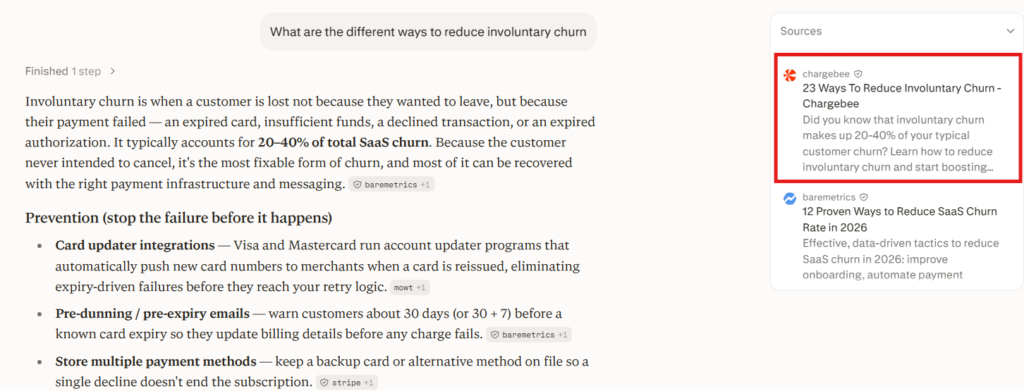
When we asked Perplexity what are the different ways to reduce involuntary churn, it used Chargebee’s 23 Ways to Reduce Involuntary Churn as a source.
Source – Perplexity
The article gives Perplexity a detailed answer to draw from. It divides the subscription lifecycle into six stages and provides 23 tactics covering payment prevention, retries, dunning communication, and recovery.
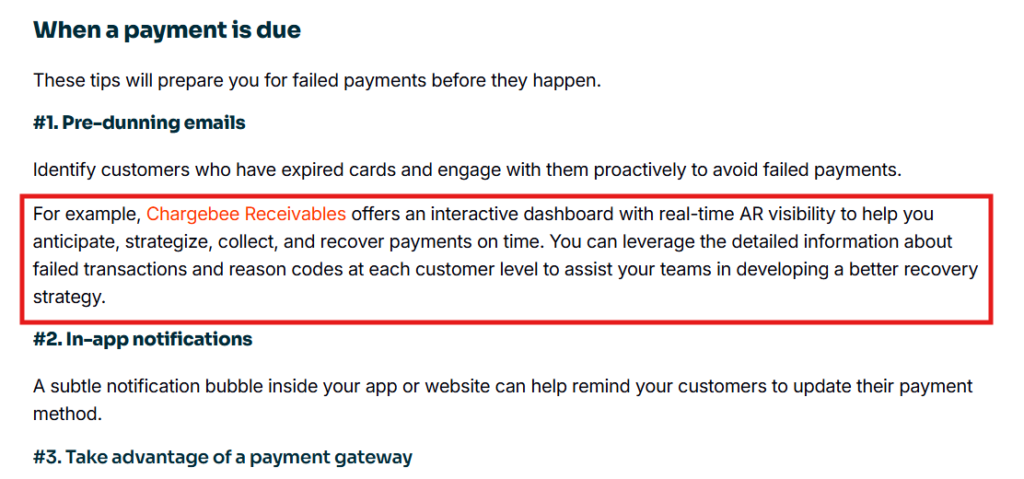
Chargebee also brings its product into the discussion where it is relevant rather than saving the mention for a final call to action.
Source – Chargebee
The product mention works because the reader’s problem and Chargebee’s product are connected inside the explanation itself. Someone researching failed payments can learn how to reduce them while also seeing where billing infrastructure can help.
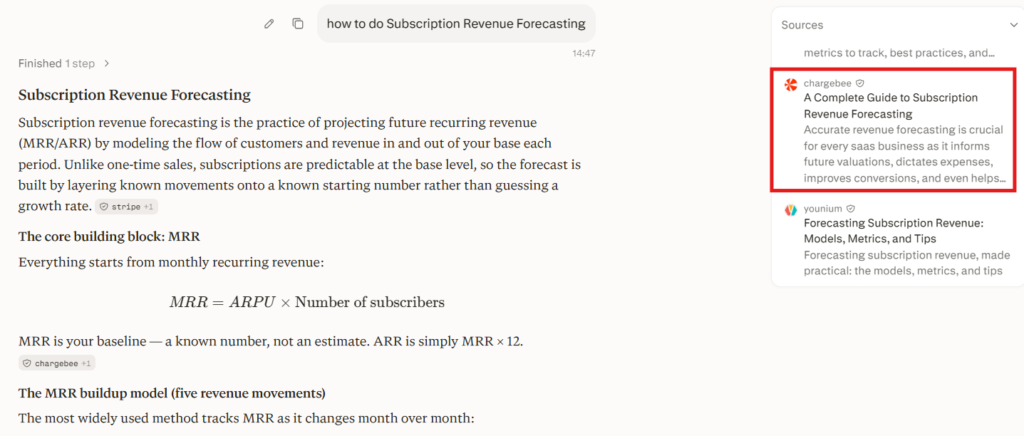
We found the same pattern when we asked Perplexity about how to do subscription revenue forecasting. Chargebee’s Complete Guide to Subscription Revenue Forecasting appeared as a source.
Source – Perplexity
The guide directly matches the question and provides a step-by-step forecasting process. It includes formulas and spreadsheet examples that readers can use to project revenue. Perplexity can draw from a complete process rather than offering a general explanation.
This gives Chargebee an earlier route into AI-assisted research. The brand does not have to wait until a buyer asks for the “best subscription billing software.” It can appear while that buyer is still trying to understand churn, forecasting, revenue recognition, or another problem that eventually creates demand for billing software.
That is the larger value of problem-led content for AI visibility. It helps AI platforms connect a brand not only with its product category, but with the problems that make someone need the category in the first place.
Strategy 2: Chargebee Is Getting Ahead Of Emerging AI Monetization Questions
The company is extending its billing expertise into AI monetization, where companies are still deciding how to charge for AI products and agents.
When we searched for how to price AI agents, Perplexity used Chargebee’s Selling Intelligence: The 2026 Playbook for Pricing AI Agents as a source.
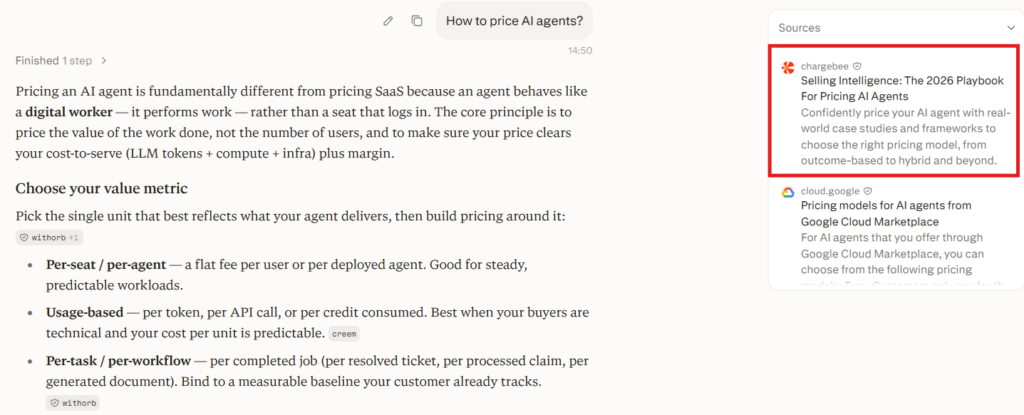
Source – Perplexity
The playbook goes much deeper than listing a few pricing models. It explains why AI agents are difficult to price, using examples from Intercom, Replit, and Cursor. It explains how companies can charge for results, actions, completed workflows, or a combination of these. Along with that, it highlights when each option may work.
Chargebee has also published related articles on the same subject:
- How to Price Your AI Product
- How SaaS Companies Can Monetize AI with Modern Billing
- 4 Challenges While Pricing Your AI
- Chargebee’s Usage-Based Billing, Reimagined for the Age of AI
Together, these articles cover several connected questions around AI pricing, usage measurement, margins, customer value, and billing infrastructure.
This gives Chargebee more than one opportunity to appear when someone asks an AI platform about monetizing an AI product. It also builds a clearer association between Chargebee and the emerging AI monetization category.
The user may not be searching for Chargebee or even an AI billing platform yet. But because Chargebee has already answered the underlying question, its content can still become part of the AI answers.
Strategy 3: Its List-Based Content Helps Buyers Build Their Software Shortlists
AI platforms are increasingly becoming part of the software evaluation process. Buyers ask them to shortlist tools before visiting review sites or vendor websites. They bring possible options, selection criteria, and reasons for considering each product together in one place.
We found the same pattern in our analysis of the patent drafting platforms AI tools recommend. Listicles helped those platforms appear when buyers asked AI to suggest products within the category.
When we searched Perplexity for the best subscription payment gateways, Chargebee’s article on the same appeared as a source. This article answers the same question the user is asking. It gives the AI platform relevant options, selection criteria, and reasons for including each platform.
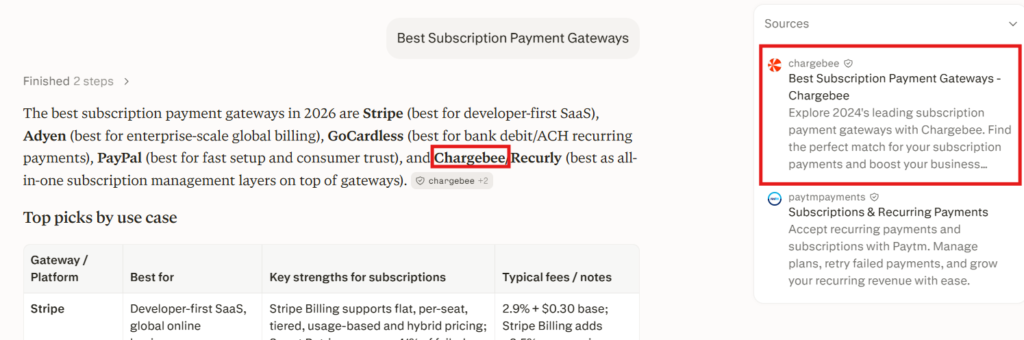
Source – Perplexity
Here, the buyer did not search for Chargebee, but still encounters the brand because Perplexity cites its article. This gives Chargebee visibility during category research and connects it with expertise in subscription payments.
We found a similar pattern in expense management. Our analysis of why Ramp, Brex, and Expensify appear in AI searches shows how shortlist content helps software brands enter the conversation while buyers are still comparing options.
Strategy 4: Comparison And Alternative Content Answers The Questions Buyers Have Before Switching
Chargebee also creates comparison and alternative content for buyers weighing billing platforms or considering a replacement.
Its includes:
- Chargebee vs Stripe
- Chargebee vs Zuora
- Recurly Alternative
- Paddle Alternative
- Best PayPal Alternatives
Comparison content mirrors the question an AI platform needs to answer. It evaluates two products against similar criteria, making their differences easier to identify and explain.
Alternative content creates another route into the answer. Someone looking for alternative opinions on Recurly or Paddle can still discover Chargebee because it is discussed directly alongside that competitor.
We found a similar pattern in our NICE CXone AI visibility analysis. Comparison and alternative searches gave the company opportunities to appear while buyers were weighing competing platforms.
That is what makes this content especially valuable. The buyer may have entered the search with Stripe, Zuora, Recurly, or Paddle already in mind. Comparison and alternative content gives Chargebee a way into that evaluation before the buyer has decided which vendors belong on the shortlist.
It also gives AI platforms explicit context about Chargebee’s competitive position: which products it is compared with, where it differs, and which requirements may make it a better fit. That makes it easier for AI to explain not just that Chargebee exists, but when someone should consider it.
Strategy 5: Third-Party Proof Gives AI Platforms Evidence To Recommend Chargebee
Chargebee has built a presence beyond its website. On YouTube and LinkedIn, it publishes platform guides, customer stories, and content around AI monetization and billing intelligence.
These channels keep Chargebee visible around the subjects it wants to be associated with. Review platforms such as G2 and Gartner Peer Insights provide independent validation.
This aligns with our study of where ChatGPT gets its information for SaaS recommendations. We found that AI platforms use review sites and other independent sources to validate product fit and support recommendations.
We saw this when we searched Perplexity for Zuora alternatives; Chargebee appeared as a recommendation. The platform cited Gartner Peer Insights, where Chargebee also appeared first among the listed Zuora alternatives.
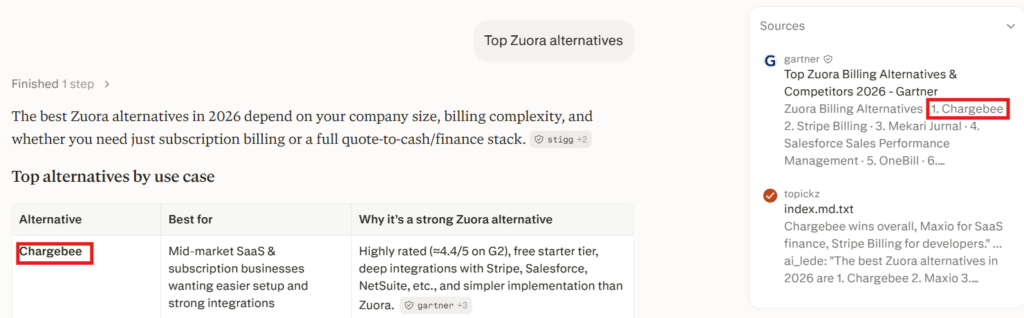
Source – Perplexity
Perplexity was not relying only on Chargebee’s own claims. It found a third-party source built around customer reviews that connected Chargebee directly with Zuora alternatives.
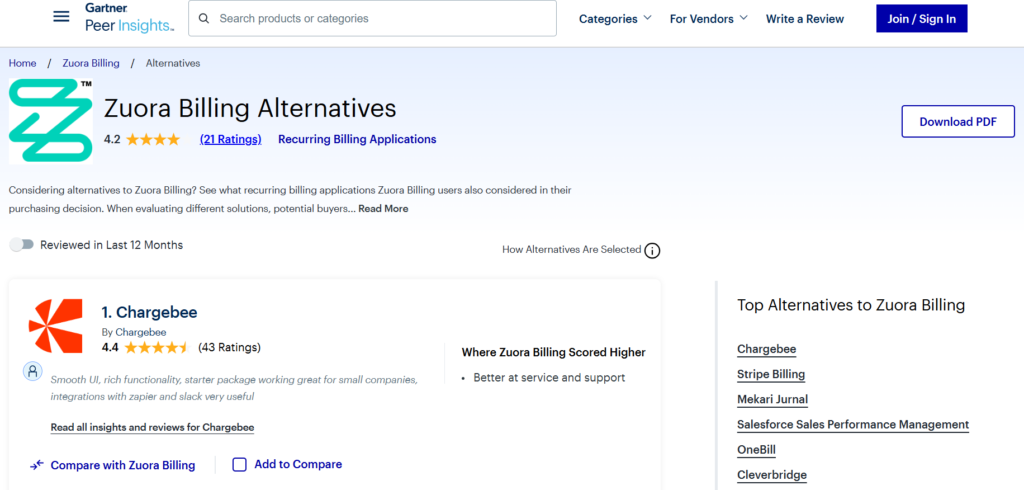
Source: Gartner
Here, third-party visibility did more than strengthen Chargebee’s credibility. It helped the company become one of the recommendations by an AI platform.
Strategy 6: Chargebee Uses Integration Guides To Answer Compatibility Questions
A billing platform must work with the systems a company already uses. Chargebee helps buyers check compatibility through dedicated integration guides and technical documentation.
When we asked ChatGPT Which billing software integrates with Salesforce?, Chargebee was recommended. Both its Salesforce integration guide and Salesforce documentation appeared as sources.
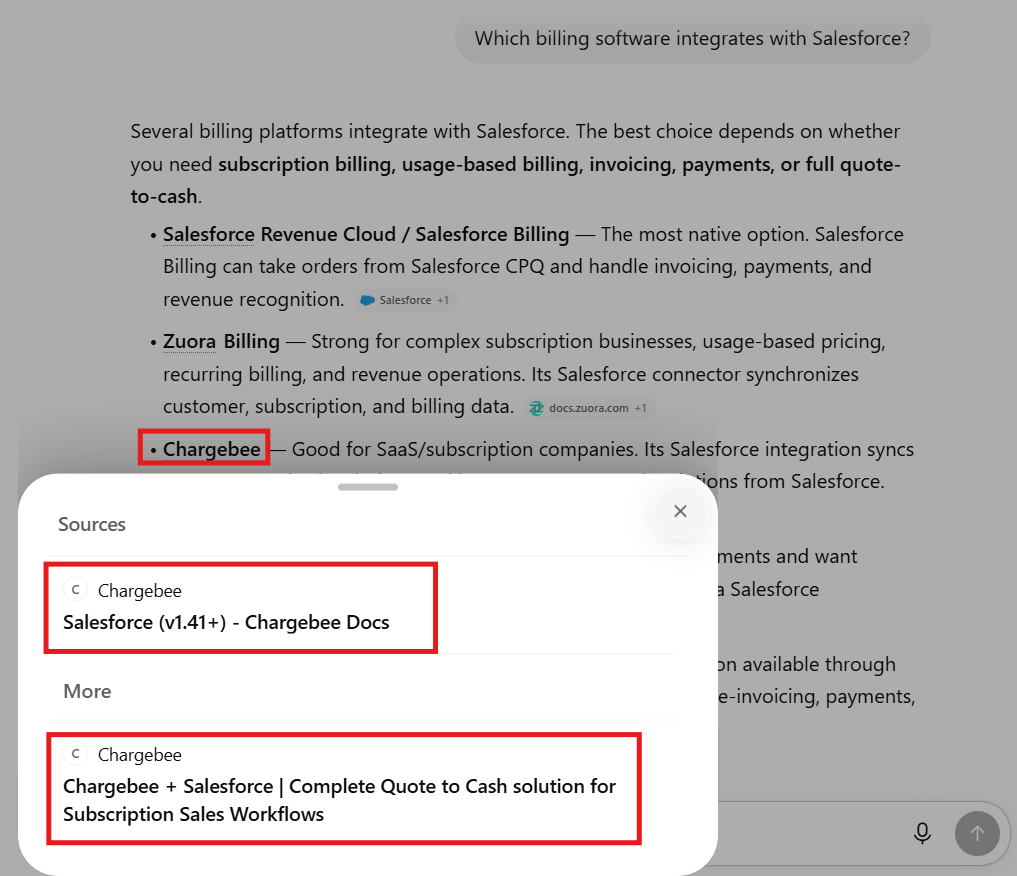
Source – ChatGPT
We saw the same pattern with What subscription platform works with Stripe? Chargebee was recommended, and its Stripe integration guide appeared as a source.
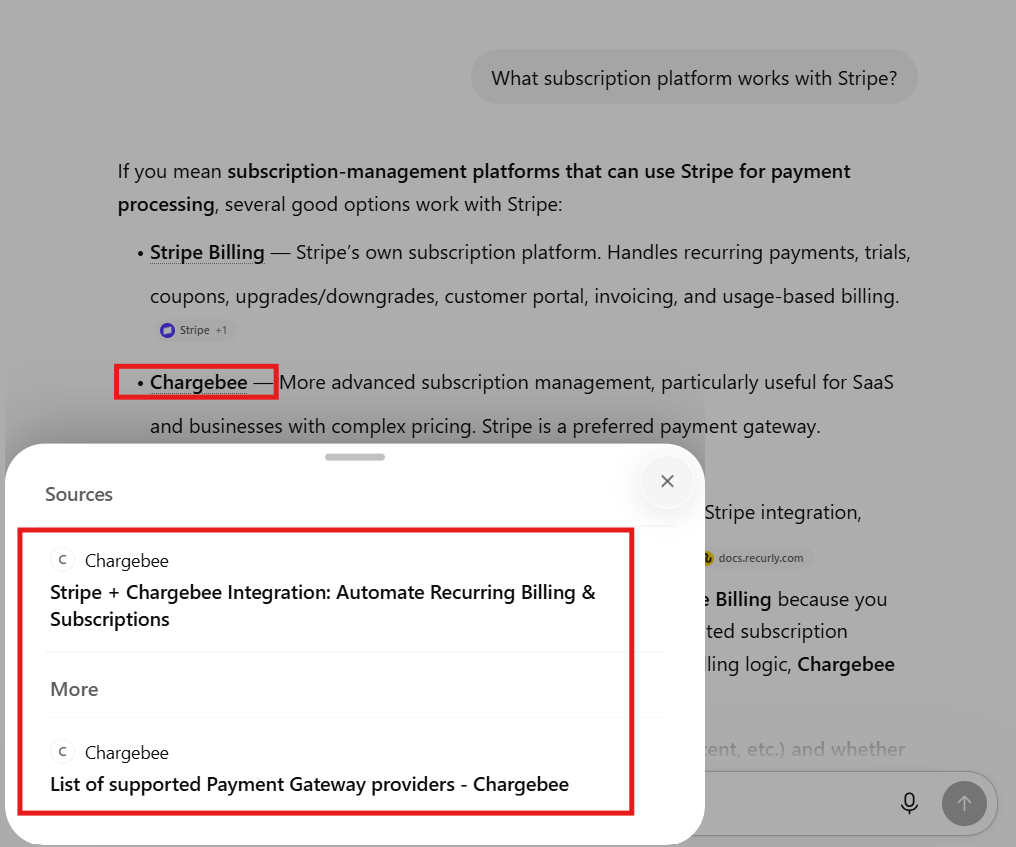
Source – ChatGPT
These searches depend on precise compatibility information. Chargebee provides a commercial explanation of what each integration supports, while its documentation explains how the connection works.
The documentation strengthens the product claim with implementation details. AI platforms can recommend Chargebee and cite first-party evidence instead of inferring whether the integration exists.
Chargebee has similar content for other widely used systems it integrates with, such as:
- HubSpot Integration
- QuickBooks Integration
- Xero Integration
- Avalara Integration
- Sage Intacct Integration
For buyers, this content confirms whether Chargebee fits their existing technology stack. For AI platforms, it creates a clear connection between Chargebee and the software named in the query.
Strategy 7: Use Case And Industry Pages Show AI Platforms Where Chargebee Fits
Chargebee’s use case and industry pages carry far more information than a typical sales page.
Their use case content covers a specific billing problem, the workflow involved, and how Chargebee handles it. Industry content shows how those capabilities apply to businesses with different billing models and requirements.
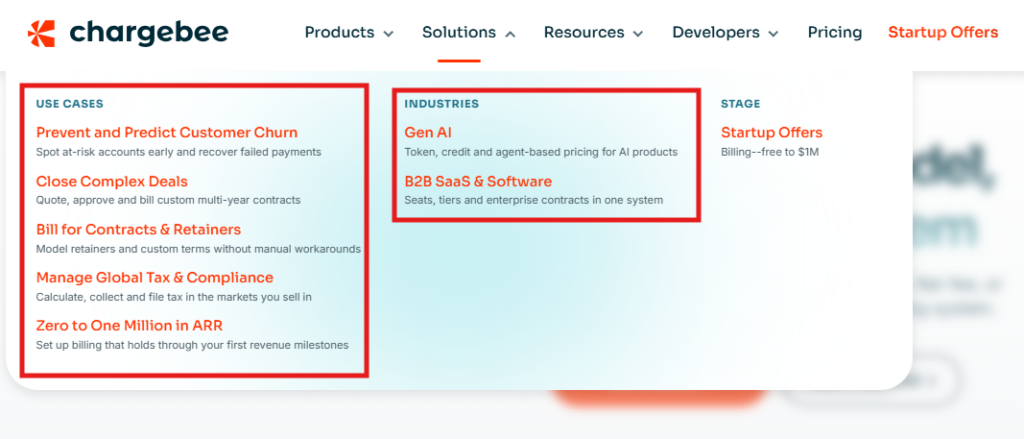
Source – Chargebee
When we searched for the top SaaS billing software, Chargebee was recommended, and its B2B SaaS and Software content also appeared as a source.
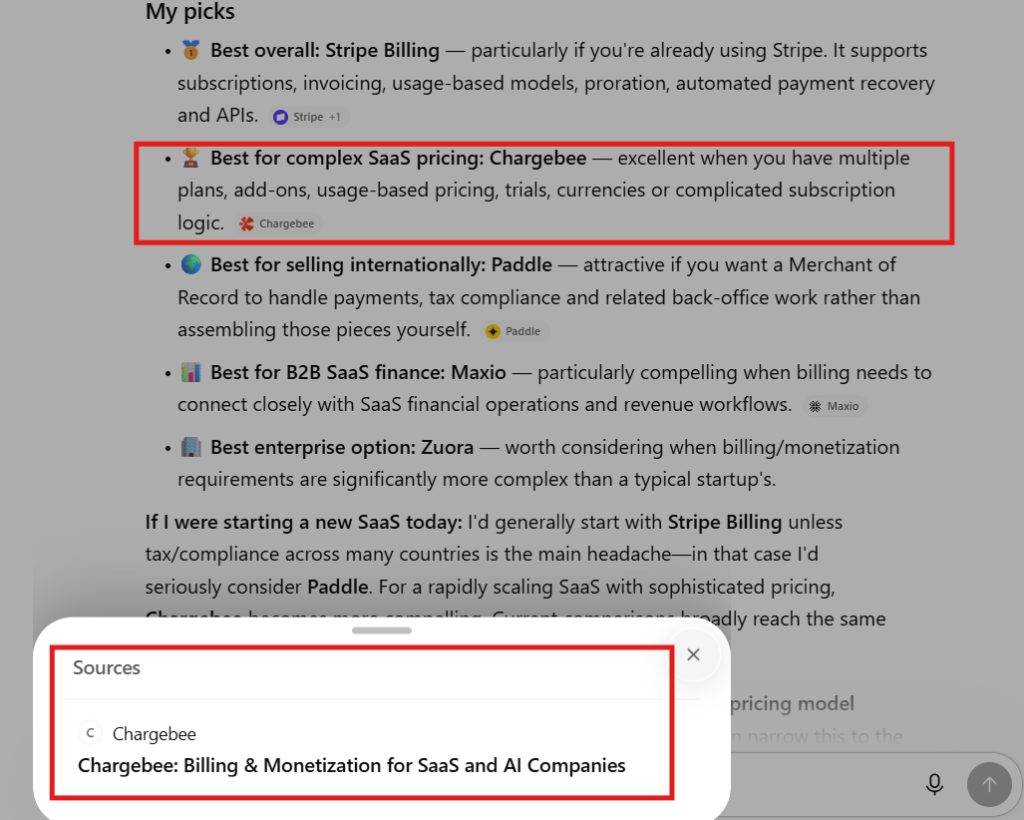
Source – ChatGPT
An AI platform needs clear product information to explain why a tool belongs in its recommendation. Detailed use cases, capabilities, and workflows give it specific information to draw from.
Chargebee’s industry-specific content provides that depth in a format that still keeps the product central. The reader understands both the problem and how the software addresses it.
Because the industry content directly addresses the query, AI platforms can use it as supporting evidence. Chargebee gains visibility twice: as the recommended software and as a source supporting that recommendation.
Strategy 8: Customer Stories Give Buyers Proof And AI Platforms Evidence To Cite
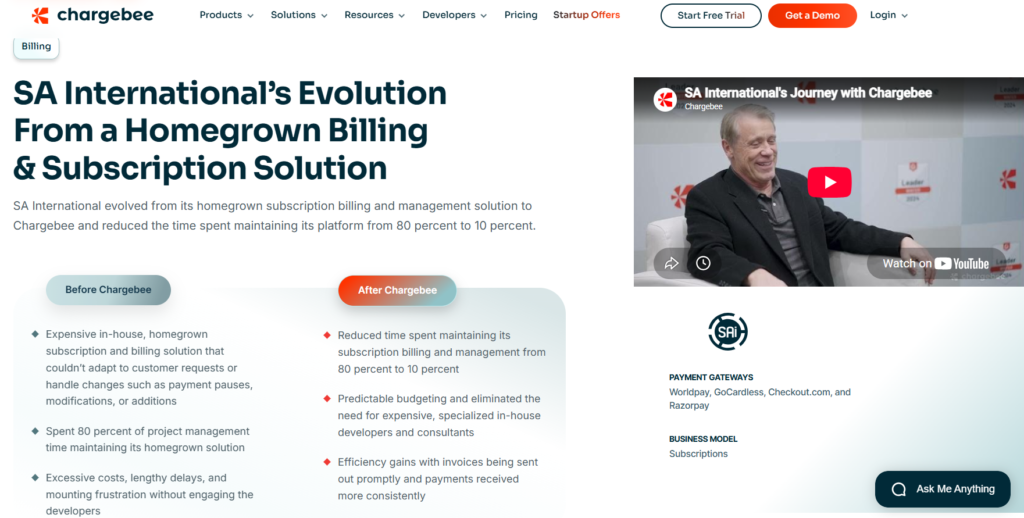
Chargebee’s customer stories go beyond general claims about saving time or simplifying billing. They document the original problem, the implementation, and the measurable change that followed.
SA International’s story is a strong example. After replacing its homegrown billing system, the company reduced maintenance time from 80% to 10%.
Tasks that previously took weeks for them could be completed within two or three minutes. SA International CFO Rick Marden confirms the improvements through direct quotes and an embedded video testimonial.
Source – Chargebee
The story gives readers everything needed to assess the result: a named customer, the problem it faced, what changed, and numbers showing the impact.
The same structure also makes the content valuable for AI platforms. AI platforms can support a Chargebee recommendation with a measurable result from a named customer. The testimonial video adds another layer of first-hand proof for buyers reviewing the story.
Give AI Platforms A Reason To Recommend Your Brand
Chargebee gives us a simple way to think about AI visibility. Start with the questions buyers ask, then make sure your brand has a useful answer for each one.
A buyer may want to understand a problem, compare products, confirm an integration, or see whether the software has delivered results. Chargebee has created content for each of these questions.
The topics will differ for every B2B brand, but the approach remains the same. Find the questions buyers ask AI before choosing a product. Answer them clearly, connect your product naturally, and support important claims with customer results and third-party reviews.
The harder part is identifying which answers are missing from your current content.
At Concurate, we use our proprietary Perfect Match Framework to identify the buyer questions your brand should appear for and the content gaps keeping it out of AI recommendations.
Source – Concurate
If AI platforms keep recommending competitors when your product belongs in the conversation, book a call with us. We’ll uncover why they appear instead and build a focused plan to put your brand in contention.
Frequently Asked Questions
1. How can a B2B brand measure its visibility on AI platforms?
You can monitor a consistent set of buyer questions across AI platforms. You can then record whether your brand is mentioned, recommended, or cited. This provides a practical benchmark, although results may change between searches and platforms.
2. How often should content be updated for AI visibility?
Reviewing your content every six to twelve months is a good rule of thumb. However, you should update it sooner if your product, pricing, integrations, or industry information changes. This helps AI platforms find the latest information when describing or recommending your product.
3. What makes a subscription billing platform more likely to be recommended by AI?
A billing platform needs content that helps AI understand where it fits and why a buyer might choose it. That means covering questions across the research and buying journey. For instance:
- Explain practical billing problems: You can cover churn, payment recovery, recurring revenue, usage-based pricing, and revenue forecasting.
- Target software selection questions: Publish useful listicles, comparisons, and alternative content for buyers evaluating their options.
- Show where the product fits: You should explain relevant integrations, industry requirements, billing models, and use cases.
- Support product claims: You need to use documentation, customer stories, results, and practitioner insights to provide specific evidence.
- Build visibility beyond the company website: Reviews and independent coverage can reinforce how the product performs and who it suits.
Together, this content gives AI platforms more relevant information to use when comparing and recommending subscription billing software.
Disclaimer: The information presented in this article is compiled from publicly available sources, including company websites, industry reports, and social media. All trademarks, brand names, and logos mentioned are the property of their respective owners. We do not claim any ownership of third-party marks, nor do we imply endorsement or affiliation. This article is intended for informational purposes only.