

| TL;DR: Many sales tech companies have strong products but struggle to get considered because buyers never discover them during evaluation. They do not find them when they search for vendors on Google or ask AI tools for recommendations. The same established names keep showing up, while newer competitors stay invisible. This guide covers nine B2B marketing agencies that can help sales tech companies show up when buyers are actively evaluating vendors, including Concurate, Velocity Partners, and Omniscient. It also explains why sales tech brands stay invisible, what to ask before hiring an agency, and how to improve visibility across Google and AI search. |
Sales tech companies have a very specific marketing challenge.
Their buyers often start evaluating tools before they ever speak to sales. A VP of sales might Google “best sales engagement platform” or ask ChatGPT, “which tool should I use for my SDR team of 25 people”. Or they might simply ask Claude for alternatives to Gong.
These are not just awareness searches. They are the moments when buyers start building their shortlist.
But many sales tech companies are missing from these moments. They may have a strong product, but they do not show up when buyers are looking for the right sales tech solution, finding alternatives to known vendors, or trying to understand which tool fits their team.
That is where the right B2B marketing agency can help close the gap. This guide covers nine B2B marketing agencies that understand how sales tech buyers research software. They can help improve visibility and show up in the right moments. But before we get to the list, let’s understand why many sales tech companies never make the buyer’s shortlist.
4 Reasons Why Sales Tech Companies Struggle To Get Discovered
Sales tech companies can invest heavily in marketing and still fail to get discovered during the buying process. The problem is rarely marketing effort alone. More often than not, it comes down to whether the company is visible where buying decisions happen.
Here is where it usually goes wrong:
1. They Build Product Pages, Not Buyer Research Content
Before buyers book a demo, they usually spend time researching the category. They search for topics like “how to improve sales outreach response rates,” “best sales engagement platforms,” or “top conversation intelligence tools.”
The companies that appear most often in these searches have spent years building resources around these topics. They publish in-depth guides, playbooks, best practices, and role-specific content that helps buyers long before they are ready to buy.
Many sales tech companies, on the other hand, rely mainly on product pages, pricing pages, and a handful of blog posts. They invest in explaining the product but not in creating the content buyers search for before they are ready to buy.
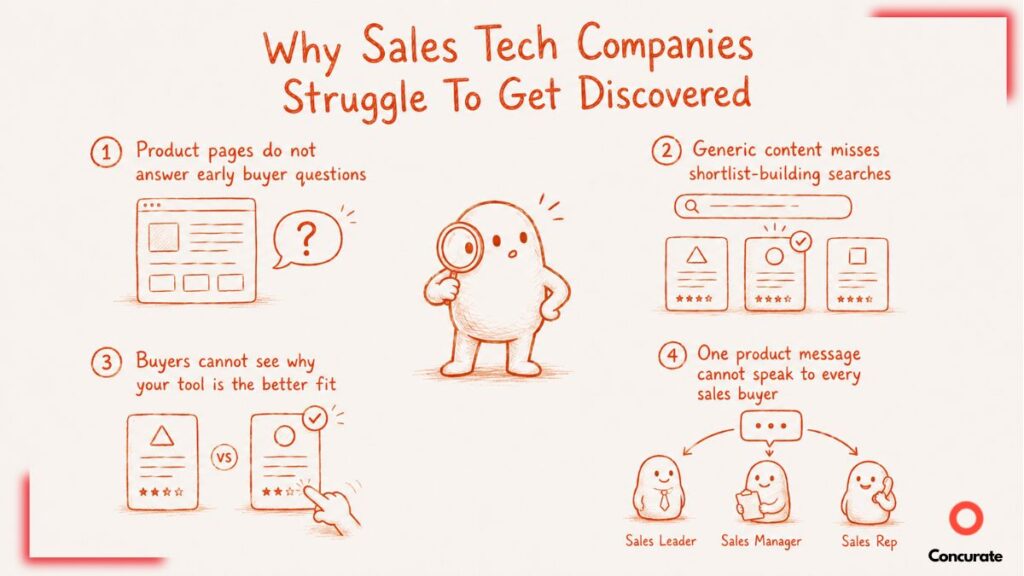
2. They Miss The Specific Questions Buyers Ask Before Shortlisting Tools
Buyers rarely stop at broad questions like “What is a sales engagement platform?” As they get closer to a decision, they ask more specific questions. They Google or ask AI tools, “What’s the best conversation intelligence tool for a remote sales team?” or “Which sales engagement platform is best for a small SDR team?”
Companies like Gong and Apollo have created content that answers these specific questions for every buying scenario. Whereas most challenger brands rely on a single product page or a generic message that tries to appeal to everyone. As a result, when buyers ask specific questions, they are more likely to discover companies that have already answered them.
3. They Do Not Explain Why They Are The Better Fit Over Other Sales Tools
Most buyers compare several tools before making a decision. They want to understand how one product differs from another, which features matter, and which option is the best fit for their team.
Many sales tech companies never answer these questions themselves. They focus on describing their product rather than explaining how it compares with other options or where it is the better choice.
So, if your content does not cover these conversations, buyers are more likely to judge your product based on what AI tools, review sites, or your competitors say about you.
4. They Use The Same Product Message For Every Type Of Sales Buyer
Different sales buyers look for different outcomes from the same sales tool. A sales leader may care about forecast accuracy, a sales manager may care about coaching and pipeline visibility, and an account executive may care about reducing admin work and closing more deals.
However, many sales tech companies make the mistake of explaining their product in one broad way. They describe what the product does, but do not show how it solves role-specific problems.
The result is generic messaging that feels relevant to everyone, but specific to no one. Buyers are more likely to consider products that clearly address their role, team, or use case.
Solving these visibility challenges takes more than publishing more content or running more campaigns. Sales tech companies need a strategy built around how buyers discover tools, compare vendors, question fit, and build trust before a sales conversation even happens.
The right agency can help you do that. The next step is knowing how to identify one.
Now, let’s look at the factors worth evaluating before you make a decision.
5 Factors To Consider Before Choosing A B2B Marketing Agency For Your Sales Tech Company
Choosing a marketing agency for your sales tech company involves more than reviewing case studies or comparing service offerings.
The right agency should be able to identify why buyers are not discovering your product in the first place. That could mean low visibility on Google and AI platforms, unclear positioning, low conversion from existing traffic, or a combination of these challenges.
Here are the key questions to ask before signing with an agency.
1. How Do They Plan To Improve Visibility Across Both Google And AI Search?
Sales tech buyers no longer rely on Google alone. They also use AI platforms like ChatGPT, Claude, and Perplexity to research software, compare vendors, and build their shortlist. That means your product needs to be discoverable across both channels, not just one.
An agency should be able to explain how it approaches each of them. The strategy for improving Google rankings is not always the same as the strategy for increasing the chances of being recommended in AI-generated answers.
If the agency only talks about rankings and has no clear view of Generative Engine Optimization, it may be overlooking a growing part of the buyer journey.
| Question to ask: Do you have a clear strategy for improving both Google rankings and AI search visibility for sales tech companies? |
2. Can They Build Content For Different Types Of Sales Buyers?
A sales tech product is rarely evaluated by just one person. A VP of sales may be looking for better forecasting, whereas a revenue operations manager may care more about integrations, reporting, and data accuracy. Even though they are evaluating the same product, they are looking for different answers.
An agency that uses the same messaging for every buyer is likely to overlook these differences. The right agency understands how different buyers evaluate software. They create content that speaks to each of them without making them sound the same.
| Question to ask: Can you show examples of how you have created content for different types of sales buyers evaluating the same product? |
3. Do They Have A Strategy For Comparison Content?
Most buyers compare multiple sales tools before making a decision. They want to understand how the tools differ, which features matter most, and which option is the best fit for their team.
For instance, a sales manager evaluating two sales engagement platforms may want to compare their features and reporting capabilities. They need enough information to decide which tools deserve a place on the shortlist.
The right agency understands that these are some of the most important questions buyers ask before making a purchase. They create balanced comparison pages that help buyers evaluate their options while clearly explaining where your product is the better fit.
| Question to ask: How would you approach creating comparison content for a sales tech product competing with established vendors? |
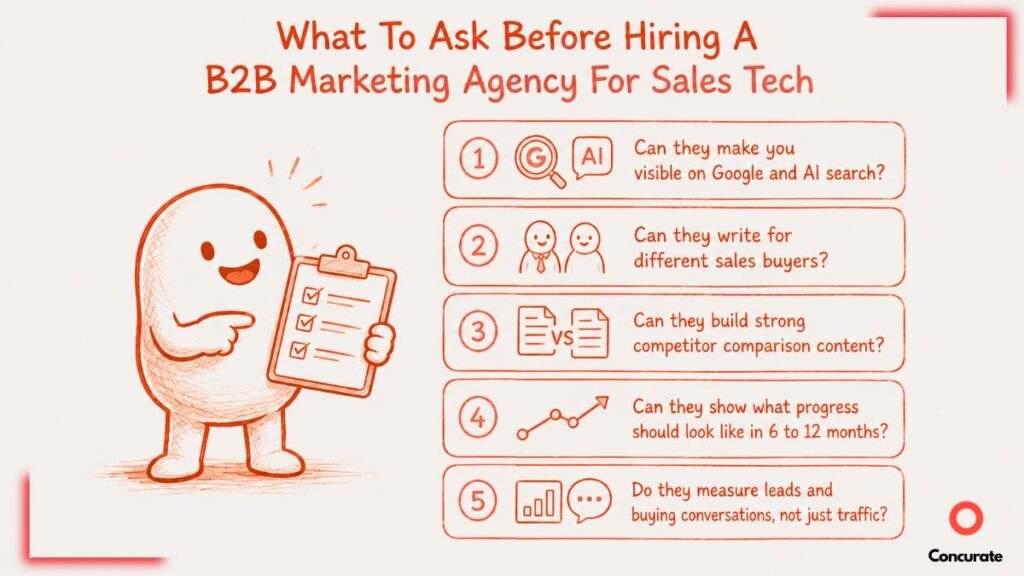
4. What Results Should A Sales Tech Company Expect In Six To Twelve Months?
Every marketing initiative takes time to build momentum, but an agency should still be able to explain what progress looks like along the way. If the answer is limited to vague promises like more awareness or traffic, ask them to be more specific. They should be able to define what success looks like over the first six months and beyond.
The stronger agencies outline clear milestones instead of broad promises. Early milestones may include stronger Google rankings, better visibility in AI search, and improved performance for comparison and decision-stage content. Over time, those improvements should translate into more qualified leads, higher conversion rates, and a stronger pipeline.
| Question to ask: What milestones should we expect in the first six months and after one year? |
5. Do They Measure More Than Traffic And Rankings?
Traffic and rankings are useful metrics, but they only show whether people are finding your content. They do not show whether that content is helping buyers compare products, evaluate your solution, or move closer to a purchase.
If an agency reports only on traffic, keyword rankings, and impressions, you are seeing content performance rather than business impact. The stronger agencies go beyond traffic and rankings. They also track which content contributes to qualified leads, demo requests, and sales conversations.
| Question to ask: Beyond traffic and rankings, how do you measure whether your marketing influences buying decisions? |
Now that you know what to look for in a marketing agency, let’s look at some of the B2B marketing agencies worth considering for sales tech companies.
Top 9 B2B Marketing Agencies For Sales Tech Companies
Sales tech companies need marketing that does more than generate awareness. Buyers compare products across Google, AI platforms, and review sites before they ever book a demo.
The agencies in this list understand the buying journey. They have experience working with B2B software companies and helping them become easier to discover during evaluation, not just at the awareness stage.
When selecting these agencies, we looked for agencies that had experience working with B2B brands and evidence of results through client work, case studies, or customer outcomes.
Before we go further, here’s a quick comparison of the agencies covered in this guide:
| Agency | Services Offered | Google Visibility | GEO Capability | Delivery Model | Best Fit For |
| Concurate | Content marketing, SEO, GEO, LinkedIn Ghostwriting, YouTube Channel Management, Thought leadership content | Excellent | Excellent | Strategy + Execution | Sales Tech & B2B SaaS |
| Velocity Partners | Brand strategy, content marketing, campaign strategy, creative | Good | Limited | Strategy + Execution | B2B Technology |
| Omniscient | SEO, technical SEO, content marketing, digital PR, analytics | Excellent | Excellent | Strategy + Execution | B2B SaaS |
| Animalz | Content strategy, thought leadership, AEO, research, LinkedIn distribution | Good | Excellent | Strategy + Execution | B2B SaaS |
| Heinz Marketing | Demand generation, messaging, GTM strategy, sales enablement, AI consulting | Good | Limited | Strategy + Execution | B2B Technology |
| New North | Branding, content marketing, paid media, marketing operations | Good | Limited | Strategy + Execution | B2B Technology |
| Codeless | SEO, GEO, content marketing, consulting | Excellent | Good | Strategy + Execution | B2B SaaS |
| DemandMaven | Customer research, messaging, GTM consulting | Limited | Limited | Strategy Only | B2B SaaS |
| Rank Wizards | SEO strategy, content marketing, link building, optimization | Excellent | Moderate | Strategy + Execution | B2B SaaS |
Here’s the lineup:
- Concurate
- Velocity Partners
- Omniscient
- Animalz
- Heinz Marketing
- New North
- Codeless
- DemandMaven
- Rank Wizards
Let’s explore each agency one by one.
1. Concurate
If you’re building a sales tech product, chances are the problem isn’t capability; it’s perception.
Buyers may consider your product. But before that, they hesitate. They compare you to familiar names. They Google, skim, cross-check, and quietly move on if something feels unclear or unconvincing.
Our work is about fixing those moments.
We do this through our Perfect Match Framework, where we map your product to the exact buyer pains, decision-stage queries, and proof points that matter during evaluation. It helps us decide what content to create, where it should show up, and what it needs to say for buyers to trust you.
We’ve done this repeatedly across various SaaS platforms.
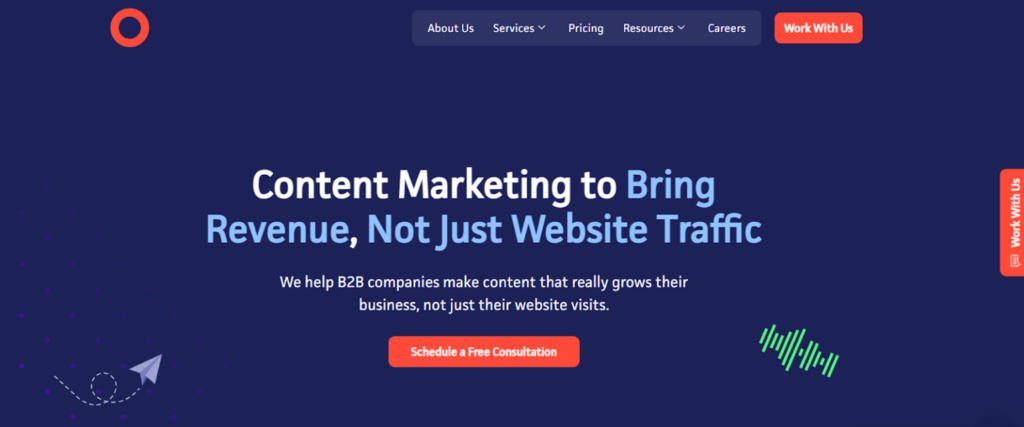
Source – Concurate
At Concurate, we don’t start with channels or formats. We start with how your buyers actually make decisions. We try to understand:
- The questions they ask in private
- The objections they never say out loud
- The moment where trust either clicks or disappears
For sales tech companies, this tends to show up in a few places. Missing comparison pages, use cases that stay too high-level, blogs that talk features but don’t calm buyer doubts, and gaps in visibility at the exact moment prospects are comparing tools.
Our work is about fixing those moments.
We’ve done this repeatedly across various SaaS platforms. Breaking down why some brands dominate “best” and “vs” searches, why others quietly lose mindshare, and how content can be rebuilt to show relevance, authority, and confidence. Not by stuffing keywords, but by answering buyer questions better than anyone else.
What this looks like in practice:
- High-intent SEO and comparison content that shows up when buyers are shortlisting tools.
- Case studies and use-case narratives that sound like real sales conversations, not marketing copy.
- Visibility across AI surfaces and answer engines so your product shows up where modern buyers ask questions
- Distribution across search, LinkedIn, and YouTube channels so content actually gets visibility across mediums.
We don’t promise overnight spikes or vanity metrics. We focus on sustained visibility where it matters most, during evaluation and decision-making.
If you’re tired of explaining your product again and again on sales calls, that’s a signal. Your marketing should be doing that work before the call even happens.
That’s what we help you build.
Best for: B2B SaaS and sales tech companies that need stronger visibility across Google and AI search during the consideration and decision stages. Also a good fit for companies that want to build LinkedIn-led thought leadership.
Notable clients: Inspire IP, Triangle IP, Datacipher, Athena Security, and others
Pricing: Our partnerships typically range from USD 5,000 to USD 7,500 per month, with project-based work starting at USD 3,500.
2. Velocity Partners
Velocity positions itself around helping B2B companies tell clear, structured stories about complex products and markets. Their work typically combines marketing strategy, creative execution, and performance planning so messaging, campaigns, and distribution stay aligned rather than operating in silos.
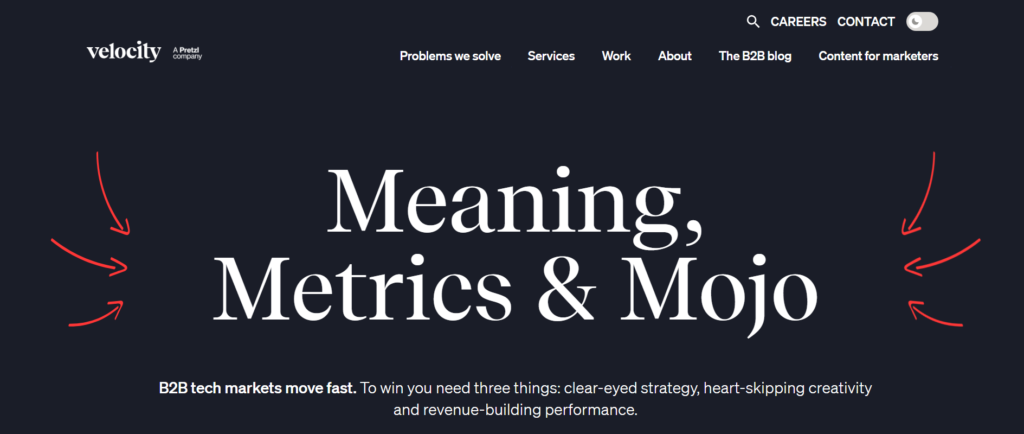
Source – Velocity Partners
Their approach focuses on shaping narratives early, then carrying those narratives across brand assets, campaigns, and ongoing marketing programs.
Much of their work sits at the intersection of positioning, content, and campaign execution, with an emphasis on consistency across touchpoints and measurable outcomes tied to broader marketing goals.
Best for: B2B tech companies that need sharper positioning, stronger narrative, and campaign ideas that make complex products easier to understand.
Notable clients: Geotab, OnProcess, CID, Sprint, LiveRamp
Pricing: Velocity does not disclose pricing on its website. Engagements are defined based on scope and project requirements following initial discussions.
3. Omniscient
Omniscient Digital operates as an organic growth agency focused on SEO, content, and search visibility across both traditional search engines and AI-driven discovery. Their services cover SEO strategy, technical SEO, programmatic SEO, digital PR, link building, analytics, and large-scale content production, with strategy typically grounded in deep upfront research.
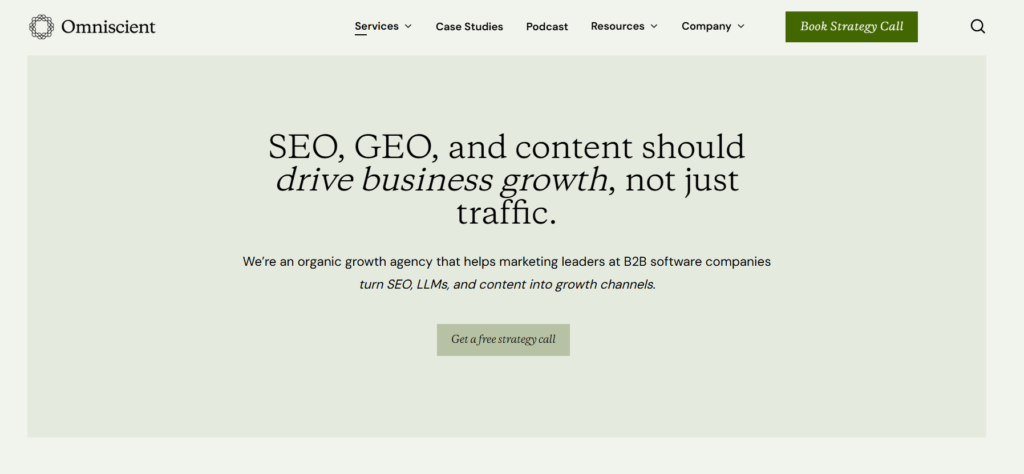
Source – Omniscient
Instead of running isolated SEO projects, Omniscient structures its work around ongoing systems that evolve with changing search behavior.
Their emphasis leans toward building topical authority, maintaining consistency in publishing, and adapting content to discovery surfaces like AI answers and LLM-powered search, with performance reviewed continuously rather than at campaign endpoints.
Best for: B2B SaaS companies that want to turn SEO, GEO, and content into a structured organic growth program.
Notable clients: Jasper, Smartling, Order.co, GatherContent, Vendr, TikTok Shop
Pricing: Omniscient lists a baseline for full-service engagements, with monthly retainers starting at approximately $10,000 and expanding based on program scope.
4. Animalz
Animalz focuses on content programs built around research, narrative depth, and long-term compounding value. Their services span thought leadership, SEO and Answer Engine Optimization, survey-driven whitepapers, LinkedIn-led distribution, and scalable content production. Much of their work blends proprietary research with structured content systems rather than standalone blog execution.
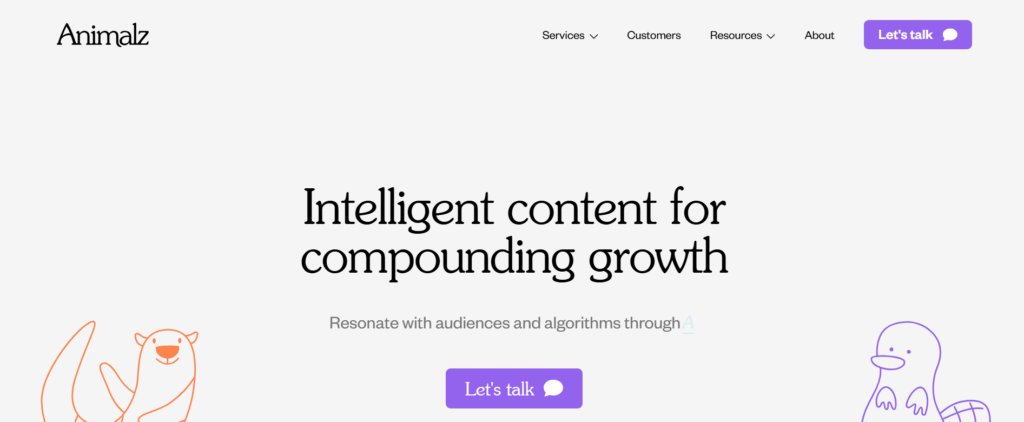
Source – Animalz
Their operating model leans heavily into shaping perspective and authority through consistent publishing across multiple formats, including zero-click discovery surfaces and AI-driven answer environments where buying opinions often form early.
Best for: SaaS companies that want research-backed thought leadership and high-quality content built for long-term authority.
Notable clients: Airtable, Amplitude, Atlassian, Auth0, Intercom, Okta, UiPath, Wistia
Pricing: Their pricing details aren’t published on the website. You can discuss engagement terms directly with their team.
5. Heinz Marketing
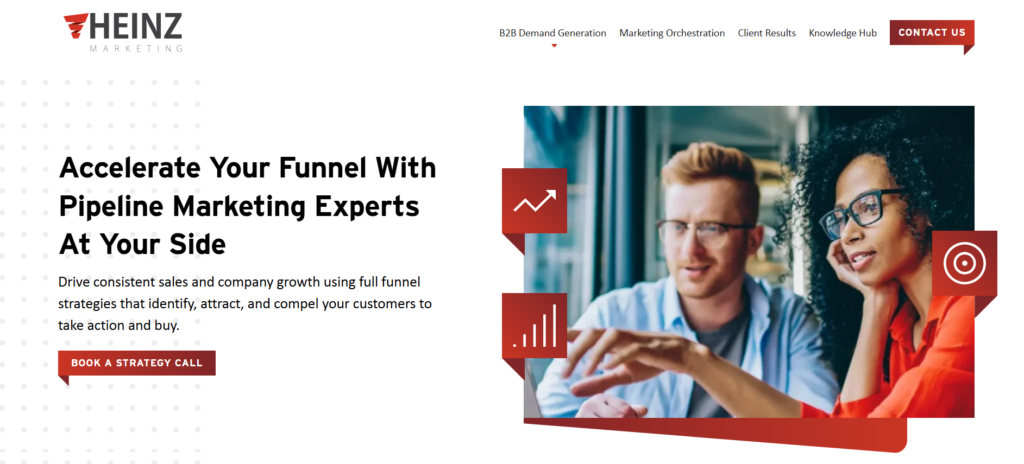
Heinz Marketing operates around a pipeline-first view of B2B growth, focusing on how demand generation, messaging, and sales execution connect across the entire buyer journey.
Their services span target market consulting, content and messaging development, sales cycle optimization, campaign strategy, AI and technology assessment, and metrics refinement.
Source – Heinz Marketing
Rather than treating marketing as a set of isolated programs, their work is organized around identifying bottlenecks in how buyers move from interest to revenue. This often involves close examination of buyer intent, internal alignment between teams, and the operational mechanics that influence deal progression over time.
Best for: B2B companies that need demand generation, GTM strategy, and sales-marketing alignment tied to pipeline growth.
Notable clients: Uptempo, Microsoft, Cisco, Hyland
Pricing: Heinz Marketing does not share rate cards publicly and scopes commercial terms after assessing pipeline goals and engagement complexity.
6. New North
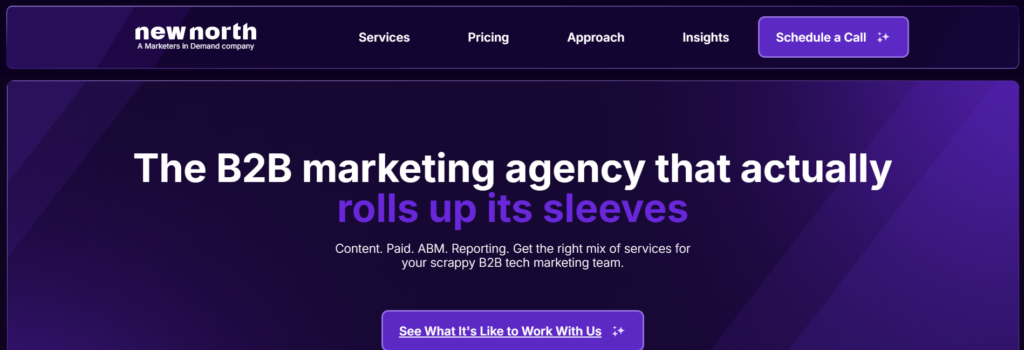
New North presents itself as a strategy-and-execution partner for lean B2B tech teams that need clarity, momentum, and consistent output without building everything in-house.
Their services span branding and positioning, content creation, paid media, account-based marketing, marketing operations, and sales enablement, with an emphasis on turning strategy into tangible work rather than decks.
Source – New North
Instead of billing by hours, they use a points-based system that allows teams to prioritize work, shift focus between initiatives, and maintain predictable spend.
This structure supports ongoing execution across campaigns, content, paid channels, and enablement assets while keeping planning and delivery closely connected.
Best for: Lean B2B tech teams that need a hands-on marketing partner for strategy, campaigns, content, paid media, and execution.
Notable clients: Bazaarvoice, Zerofox, COTA, Cycle Labs, Fauna
Pricing: New North publicly shares a monthly investment range, with clients typically spending between $6,000 and $15,000 depending on scope and priorities.
7. Codeless
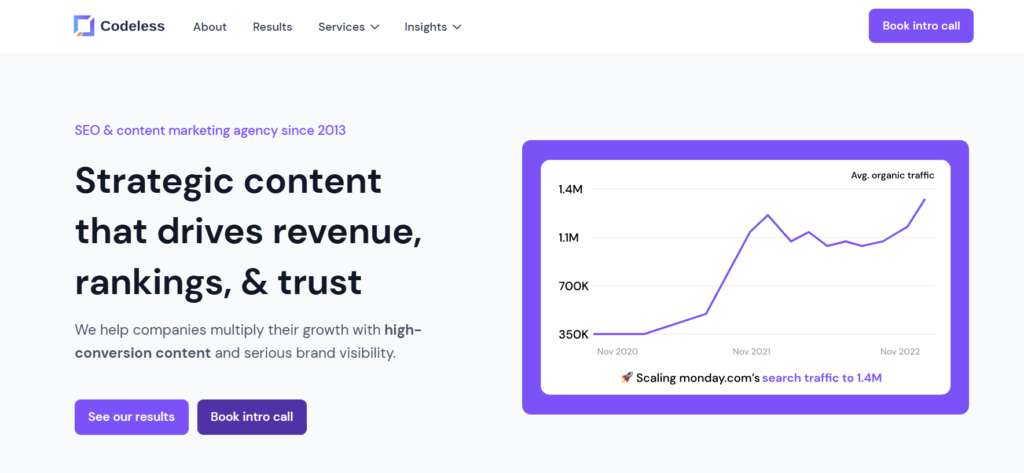
Codeless positions itself as a content and SEO/GEO agency built around repeatable systems rather than ad-hoc production. Their services span SEO and GEO strategy, revenue-focused content creation, coaching and consulting, and full end-to-end execution that covers research, writing, optimization, and publishing.
Much of their emphasis is on building a structured content engine that can scale without creating internal chaos.
Source – Codeless
Their work typically focuses on strengthening brand visibility, improving search and AI discovery, and turning content into a durable growth asset rather than a short-term traffic play.
Best for: SaaS teams that need scalable SEO, GEO, and content operations without building the full system in-house.
Notable clients: Monday.com, Remote, Robinhood, Matomo, Freshworks, Miro
Pricing: Codeless does not publish fixed rates. The engagement costs are determined based on goals, content volume, and production scope.
8. DemandMaven
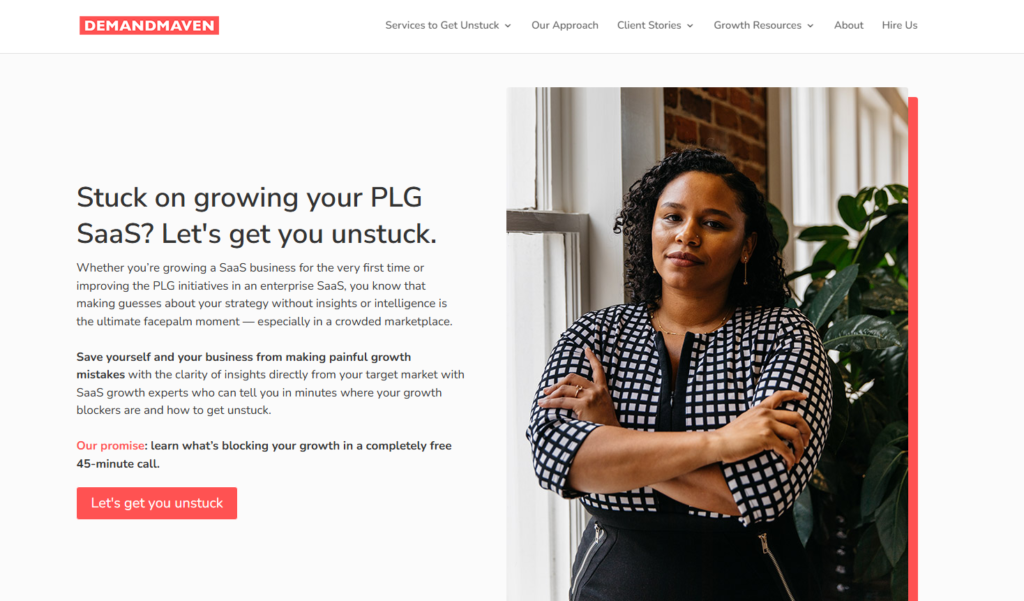
DemandMaven operates as a growth consultancy centered on customer insight rather than campaign execution. Their work spans Jobs-to-be-Done research, customer discovery, growth audits, GTM engagements, pricing and monetization studies, and activation strategy.
Source – DemandMaven
Their engagements are typically diagnostic in nature. DemandMaven helps teams replace assumptions with evidence by mapping real customer behavior, identifying friction across onboarding and acquisition, and translating insight into clear strategic priorities.
The output often feeds directly into positioning, messaging, pricing, and GTM decisions rather than day-to-day marketing execution.
Best for: SaaS companies that need customer research, positioning insight, and GTM clarity before scaling marketing execution.
Notable clients: Freshworks, SparkToro, Redokun, SearchPilot, Hamilton Rock
Pricing: DemandMaven does not publish standard fees. The project costs are defined after a discovery call based on research depth and engagement scope.
9. Rank Wizards
Rank Wizards positions itself as an organic marketing agency with a strong focus on SEO-led growth for SaaS companies and startups.
Their services revolve around SEO strategy, content development, link building, and ongoing optimization, supported by a structured process that moves from deep business understanding to execution, tracking, and reporting.

Source – Rankwizards
Their work is shaped by an emphasis on adaptability and iteration. Rank Wizards leans into testing quick wins alongside longer-term SEO initiatives, with regular performance reviews and transparent documentation guiding next steps.
The agency’s operating style reflects a hands-on, execution-heavy approach designed to steadily compound visibility and inbound demand over time.
Best for: SaaS companies and startups that want SEO-led growth through content strategy, optimization, and link building.
Notable clients: AppyPie, Brevo, FluentCRM, ThriveDesk, TradingView, TubeOnAI
Pricing: Rank Wizards does not display standardized pricing, with engagement costs typically discussed after understanding scope and growth objectives.
That brings us to the end of our list. While you evaluate your options, there are a few things your marketing team can work on internally to prepare.
5 Things That Your Team Can Fix In-House
Before you bring anyone in, there are a few things you can work through on your own. Think of these as small resets that help you see your marketing more clearly.
- Listen to how prospects describe you: The words they use on calls and emails are often more useful than anything written in your pitch deck.
- Check where buyers discover alternatives: Not every channel matters. What matters is whether you show up when people are actively comparing or questioning their current setup. Try to strengthen your positioning across such platforms.
- Look at your site like a buyer, not a marketer: Search your product name with “vs” or “alternatives” and see what actually shows up. If the answers aren’t yours, that’s the first gap to fix.
- Clean up one real use case: Pick the use case that sales talks about every week. Rewrite it so it sounds like a situation a buyer recognizes, not a product walkthrough.
- Make your blogs answer buying questions: Not what the feature does, but whether it’s the right choice. A few small edits can shift the tone without rewriting everything.
You can do all of this yourself. But when you want to do it faster, deeper, and without losing momentum, that’s where the right agency like Concurate starts to matter.
Why Concurate Is A Strong Fit For Sales Tech Companies
At Concurate, we don’t come in with generic SaaS playbooks or surface-level content. We spend time understanding how your buyers evaluate tools, what creates trust during comparisons, and where deals quietly stall. Then we build content that shows up at those exact moments.
It’s the same approach we’ve used while breaking down and rebuilding visibility for sales and contact-center platforms, which were the likes of Nextiva, Dialpad, Talkdesk, Aircall, and others.
If your product works, but the market hasn’t caught up yet, that’s not a positioning problem. It’s a visibility one.
And that’s the gap we help you close. Book a call and let us help you sort this!
Steal the SaaS growth strategies that actually work. Download SaaS Growth Hacks for practical tactics, real-world examples, and actionable takeaways.
Frequently Asked Questions
1. How is marketing for sales tech companies different from other B2B SaaS?
Sales tech buyers are skeptical, comparison-driven, and already familiar with category leaders. Marketing needs to focus less on awareness and more on credibility, differentiation, and proof. Content that answers buying objections, compares alternatives, and shows real use cases performs better than broad thought leadership.
2. What channels work best for sales tech marketing?
Sales tech companies tend to see the strongest results from organic search, comparison pages, review platforms, and buyer-intent content. LinkedIn, YouTube, and email also work well when messaging reflects real sales workflows. The key is showing up where buyers evaluate tools, not just where they discover them.
3. When should a sales tech company consider working with a marketing agency?
It usually makes sense when internal teams know the product well but struggle to translate it into buyer-ready messaging at scale. If deals stall due to trust, unclear differentiation, or lack of visibility during evaluation, external support can help bridge that gap faster.
4. Should sales tech companies focus on Google or AI search first?
Both. Today’s buyers use Google alongside AI platforms throughout their research process. The strongest content strategies improve visibility across both channels by creating content that answers buyer questions, supports product comparisons, and addresses specific use cases. Agencies like Concurate build content with both traditional search and AI-driven discovery in mind, rather than treating them as separate marketing channels.
5. What if the product positioning is unclear? Should a sales tech company hire an agency first?
Yes. If a sales tech company is still unclear about its ICP, messaging, category, or competitive positioning, it should work with an agency that can help establish those fundamentals first.
The right agency can help the team understand who they are speaking to, what pain points matter most, how the product should be positioned, and where content can support the buyer journey. Once that clarity is in place, content becomes much easier to plan, create, and connect to actual sales conversations.
Disclaimer: The information presented in this article is compiled from publicly available sources, including company websites, industry reports, and social media. All trademarks, brand names, and logos mentioned are the property of their respective owners. This article is intended for informational purposes only.