

| TL;DR: Harvey has built one of the strongest content engines in legal AI, with content that supports buyers from early education to final evaluation. But despite its strong presence across Google and AI search, it has lost rankings for 1,002 organic and non-branded keywords. In this breakdown, we look at how Harvey’s content strategy works, where its search visibility is shifting, what may be causing those changes, and what the company can do to improve its ranking again. |
Harvey is the most recognized name in legal AI.
Search for legal AI software recommendations, whether through Google or an AI assistant, and its name is likely to appear. That visibility is probably driven by several factors, from its product and customer base to its funding and overall brand momentum. But its content strategy may also be playing an important role.
The company publishes constantly. Product updates, benchmarks, practice-area guides, customer stories. This gives buyers, search engines, and AI platforms a steady stream of useful material through which to discover and understand the company.
Harvey has built a content engine most legal tech brands would envy. But here is something interesting we noticed.
Over the last six months, Harvey stopped ranking for more than 1,000 organic keywords. Plenty of them were high-intent searches that real buyers make every day when they are looking for a tool. At first glance, that seems surprising for a company with such a strong content presence.
So we ran a full teardown of Harvey’s content marketing. We mapped what it does across the funnel, from awareness to the decision stage. We also analyzed the keywords it lost and gained and examined where its search visibility is shifting.
In this article, we break down the company’s strategy, those gaps, and explore how it could strengthen its visibility going forward.
How Harvey Uses Content Across the Buyer Journey
Harvey does not start every conversation by talking about itself.
Instead, it starts with the work legal professionals are already trying to improve. That could be around legal research, contract review, drafting, governance, or legal operations.
As readers move forward, the questions naturally become more serious. They go from understanding how AI can help to evaluating which platform can support their organization safely and at scale.
Harvey’s content follows that progression closely. It would be better to show rather than tell.
Let’s dig in to see Harvey’s content strategy across each stage of the buyer journey.
The Awareness Stage: Educating Before Introducing the Product
Harvey’s early-stage content focuses on the everyday questions lawyers are already searching for. Questions like:
- How do I conduct legal research properly?
- How do I write a stronger brief?
- Where can AI help, and where should I be careful?
This approach works because the reader does not need to know the company before finding the content.
They may simply be looking for a better way to complete a task. Harvey answers that question first, then introduces how AI could make the process faster or easier.
Here are some strong examples of blogs that target this kind of search:
| Article | What It Covers |
| The Working Guide to AI for Attorneys | Gives lawyers a practical introduction to where AI can support their daily work. |
| How to Use AI as a Lawyer: The Workflows, Risks, and Rules | Explains possible use cases while addressing accuracy, confidentiality, and responsible use. |
| How to Do Legal Research in Six Steps | Captures readers through an established legal process and introduces opportunities for AI assistance. |
| How to Write an Effective Legal Brief | Reaches lawyers through a core drafting task rather than a product-led search. |
| What Is Legal Tech? A Guide for Modern Legal Professionals | Places AI within the wider set of systems used by modern legal teams. |
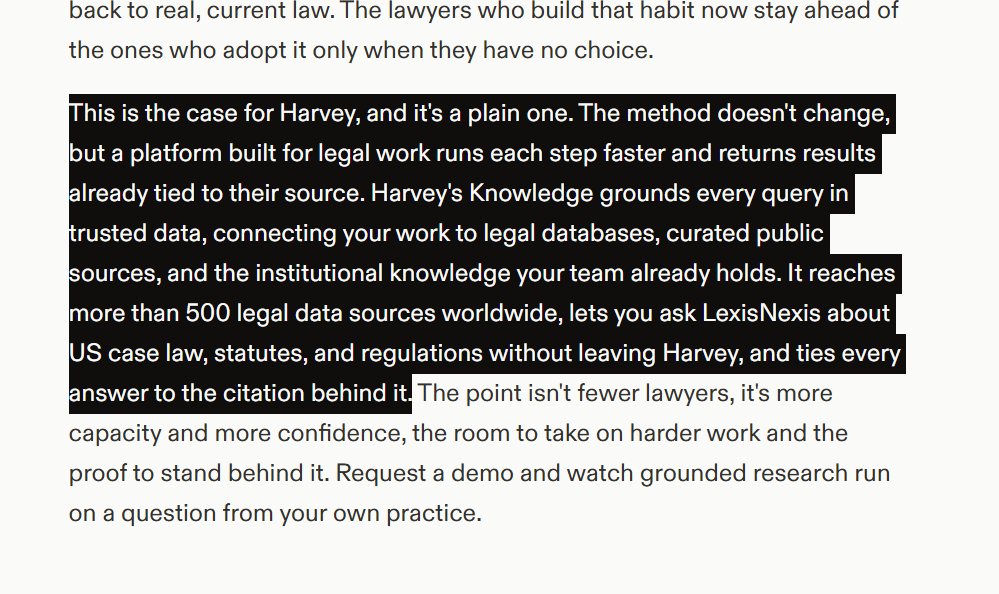
Rather than stopping at educational advice, Harvey shows how those approaches work in practice. A lawyer exploring legal research can see how the company grounds answers in trusted legal sources, provides inline citations, and explains the reasoning behind each response.
But they don’t stop there. They use the real estate to convey where Harvey fits in the workflow. The snapshot below is taken from the guide on how to do legal research.
Source – Harvey
We saw a similar pattern in our AI visibility study for patent drafting software. Solve Intelligence and Patlytics also create content around the work patent professionals already perform, then naturally show where their products support that work.
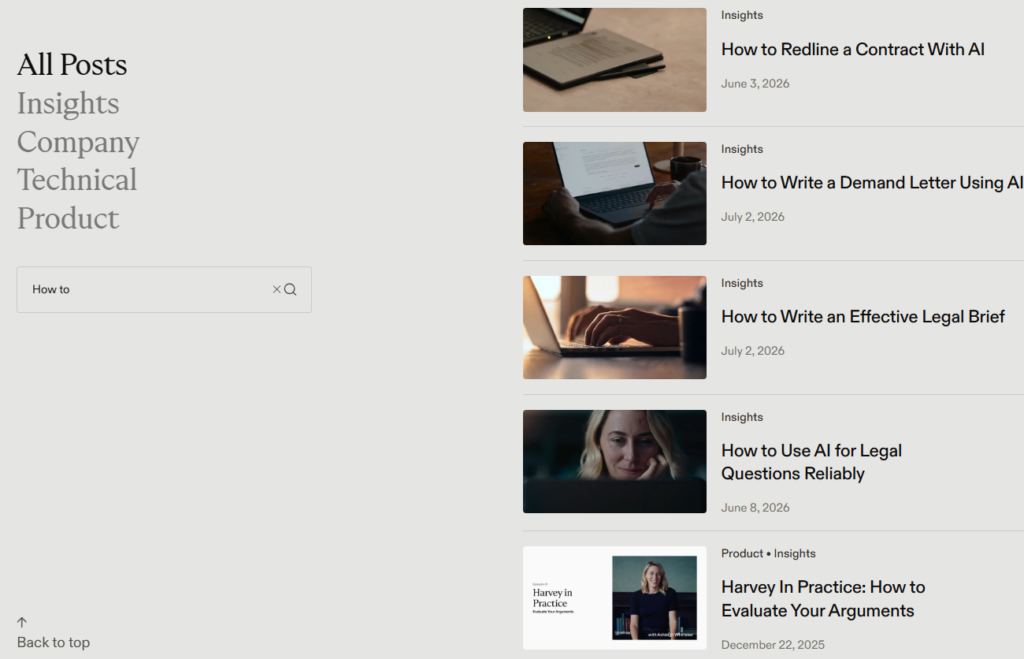
Its large number of how-to articles plays an important role here too.
Source – Harvey
These articles meet legal professionals while they are trying to complete a specific task, whether that is writing a brief, reviewing a contract, or conducting research. This helps Harvey build visibility across the different day-to-day tasks lawyers care about, rather than relying only on broad searches for legal AI software.
The company also publishes regular updates around Agents, Contract Intelligence, Command Center, integrations, and new AI models. At this stage, these updates help readers understand how legal AI is evolving and the kinds of tasks it can increasingly support. They keep Harvey connected to the wider learning journey without turning every piece into a direct product pitch.
That is what makes this type of content valuable. It keeps the brand relevant even when the reader is searching for help with the task, not the software. By the time readers begin evaluating legal AI tools, the company is already familiar to them.
The Evaluation Stage: Harvey Influences the Buyer’s Evaluation Criteria
Once legal teams understand what AI can do, their questions begin to change.
They are no longer only asking whether AI can draft or review a document. They want to know which platform will suit their day-to-day legal work, how it will be governed, and whether the organization is ready to adopt it.
Harvey creates content for these questions too.
Here are a few examples:
| Article | What It Does |
| What to Look for in Contract Review Software for Legal Teams | Gives buyers practical criteria for comparing contract review platforms. |
| How to Evaluate AI Case Management Software for Your Law Firm | Helps firms assess how AI fits within an established software category. |
| What Should I Look for in an In-House Legal Software Solution? | Addresses the legal and operational needs of corporate legal departments. |
| How to Assess Your Legal AI Governance | Introduces the controls, responsibilities, and oversight needed for safe adoption. |
| AI Maturity in Legal and Why Some Teams Move Faster | Helps organizations determine whether they are ready to scale AI beyond experimentation. |
At the same time, it makes sure the brand remains visible wherever buyers may be researching legal AI. This combination helps the company influence what buyers evaluate and stay present while they build their shortlist.
Harvey also carries this story beyond its website. Its YouTube channel features product demonstrations, video case studies, and interviews, while their LinkedIn keeps buyers engaged through feature announcements, customer stories, and expert clips.
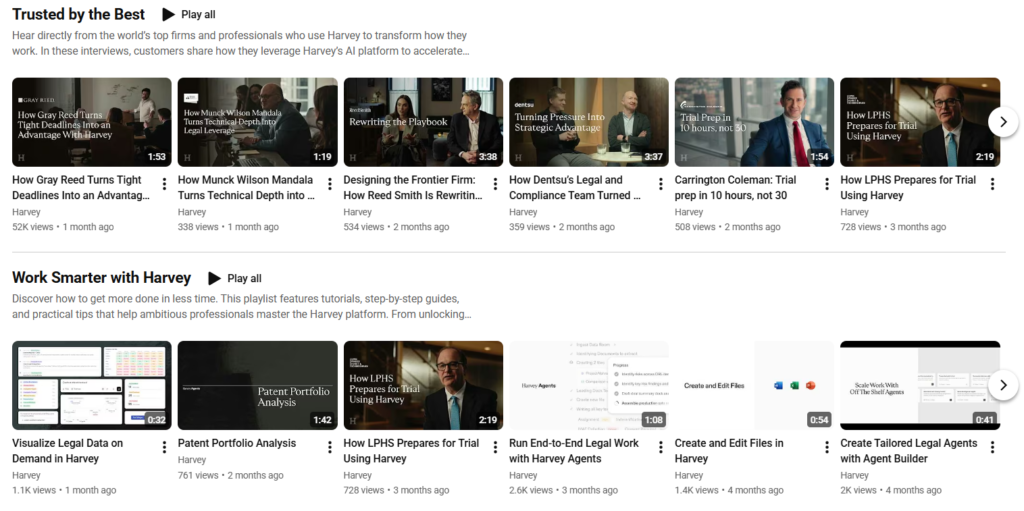
Source – YouTube
These channels strengthen Harvey’s wider public presence by giving buyers more signals to discover the brand, understand its capabilities, and see proof from customers and legal professionals. Together with the company’s website content and media presence, they create stronger signals around what the company does and where it fits in the legal AI market.
That visibility may also help AI platforms understand and recommend Harvey more confidently. When we asked ChatGPT for the top legal AI platform, it appeared at the top of the list.
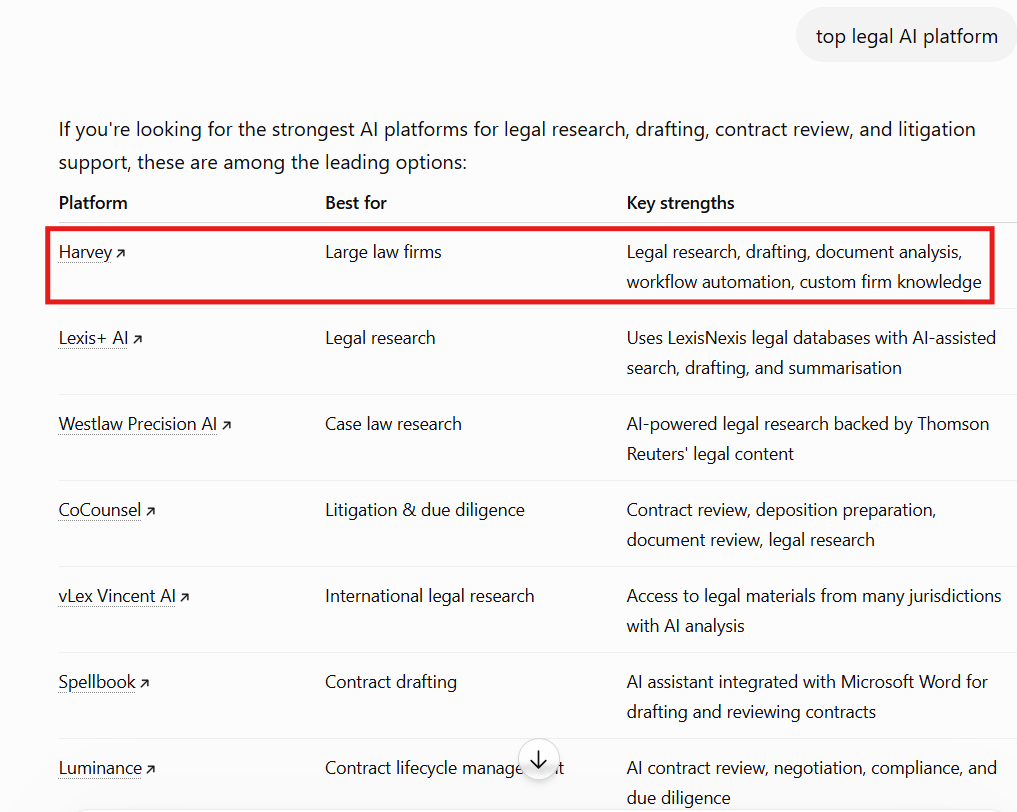
Source – ChatGPT
We found a similar concentration in our study of legal case management software across more than 1,000 AI recommendations, where Clio, MyCase, and PracticePanther emerged as the three most visible platforms.
This is an important consideration-stage win. Someone searching for the “top” platforms is no longer learning about legal AI. They are building a shortlist.
By appearing at that moment, Harvey becomes one of the first platforms the buyer is likely to research, compare, and potentially invite for a demo.
The Decision Stage: Harvey Uses Proof to Make the Choice Feel Safer
By this stage, buyers are not looking for another article explaining legal AI. They want to see Harvey in action, understand the results other legal teams achieved, and clear the concerns that could block approval.
The company handles this through assets built specifically for serious buyers. Its live demos are separate for law firms and in-house departments, so each audience sees features and use cases relevant to its own priorities.
Customer stories then show why firms selected Harvey, how they rolled it out, and whether lawyers actually adopted it.
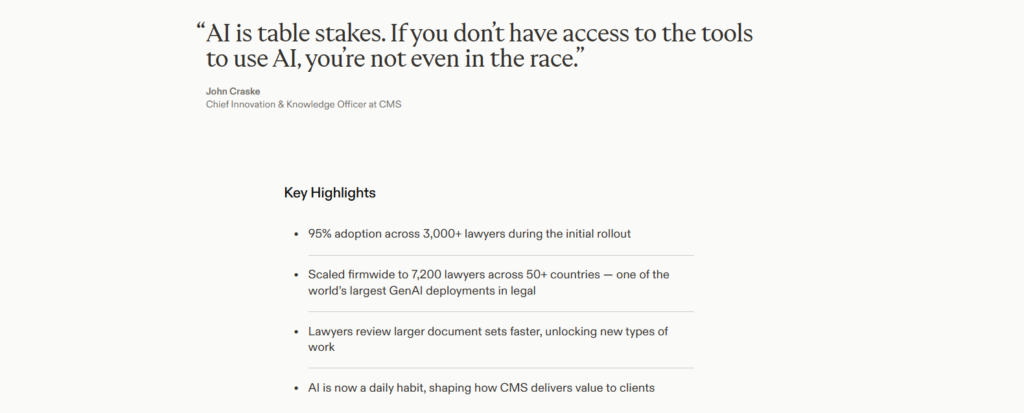
Source – CMS Case Study
This is where Harvey moves beyond explaining its platform. It gives buyers the proof they need to feel confident about choosing it.
Strong Visibility Can Still Hide Ranking Losses
Harvey already performs strongly across Google and AI search. It ranks for valuable legal AI topics and appears prominently in tools like ChatGPT.
That is what makes the next finding interesting.
Despite this visibility, the company lost rankings for a significant number of organic keywords during the 6-month period we analyzed. This does not weaken its broader strategy. But it may point to older pages losing ground, shifting search intent, or competitors gaining stronger positions.
We reviewed the lost keywords, affected pages, previous rankings, and topics where the decline was most visible to identify where Harvey could recover lost ground.
How We Found These Keywords
To find these keywords, we went straight to Harvey’s organic keyword data on Ahrefs.
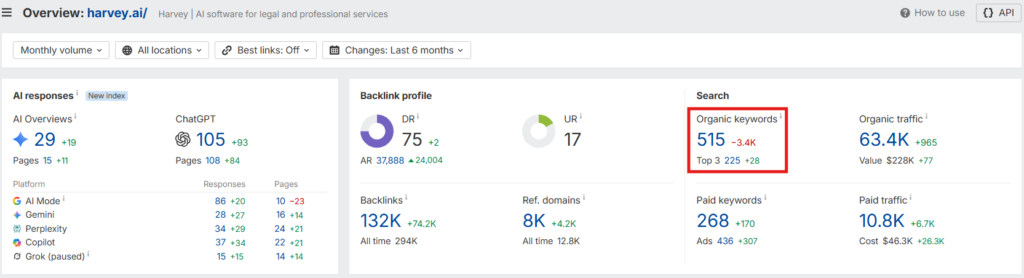
Source – Ahrefs
We compared six months of data from January to July 2026 and applied commercial and transactional keyword filters. The company had lost rankings for 4,158 keywords in total during this period.
We then separated the data into branded and non-branded searches to understand the scale of the decline more clearly.
We found that Harvey lost rankings for 1,002 non-branded keywords during the six months.
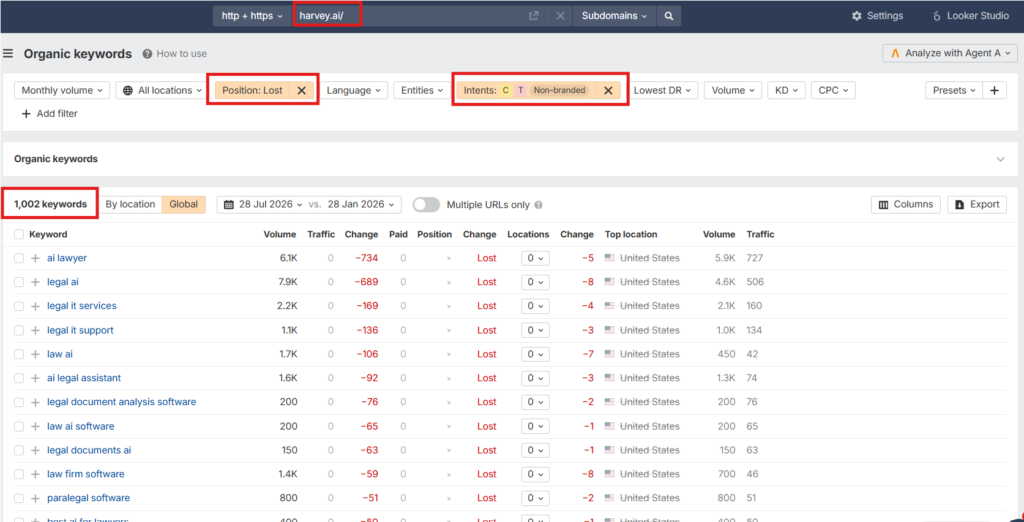
Source – Ahrefs
The company also lost rankings for 740 branded keywords containing the Harvey name.
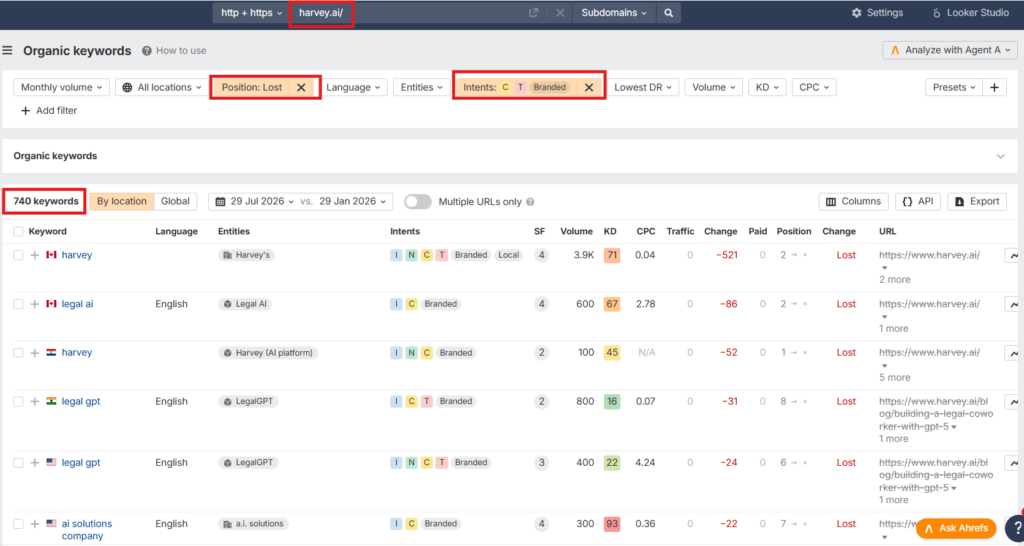
Source – Ahrefs
We reviewed both groups separately because they reflect different types of search behavior. In the next section, we take a closer look at the non-branded keywords where the decline was most valuable to analyze.
The High-Intent Keywords Harvey Lost Rankings For
The keywords on this list are not random misses. They are all commercial and transactional searches, which means they come from buyers actively looking for a legal tool or solution.
Some are category-led, such as “law firm software” and “legal research software.” Others point to a more specific need, such as “AI legal assistant,” “paralegal software,” or “legal due diligence software.”
Together, they show the different ways buyers search within the legal software market, from exploring a category to finding the right tool for a specific task
Here are the ones worth focusing on, where Harvey lost ranking.
| Keyword | Volume |
| legal ai | 8470 |
| ai lawyer | 6070 |
| legal it services | 2200 |
| legal it support | 1150 |
| ai legal assistant | 2000 |
| law ai | 1700 |
| legal document analysis software | 200 |
| law ai software | 200 |
| legal documents ai | 150 |
| law firm software | 1360 |
| legal gpt | 1260 |
| paralegal software | 800 |
| best ai for lawyers | 400 |
| lawyer ai | 520 |
| it services for law firms | 1400 |
| lawyer software | 700 |
| ai tools for lawyers | 380 |
| law firm website builder | 300 |
| legal it solutions | 350 |
| ai software for law firms | 230 |
| ai for legal documents | 180 |
| legal research software | 1070 |
What ties this list together is intent. Almost every term here belongs to someone comparing options or getting ready to choose, which is exactly the stage where visibility is most valuable. The drop is not limited to these evaluation-led searches. It reaches into Harvey’s core category term too, which is where we will look next.
Harvey Slipped on Its Own Category Terms Too
Losing a few use-case search keywords is one thing. But the drop reached the terms that sit right at the heart of what the company does.
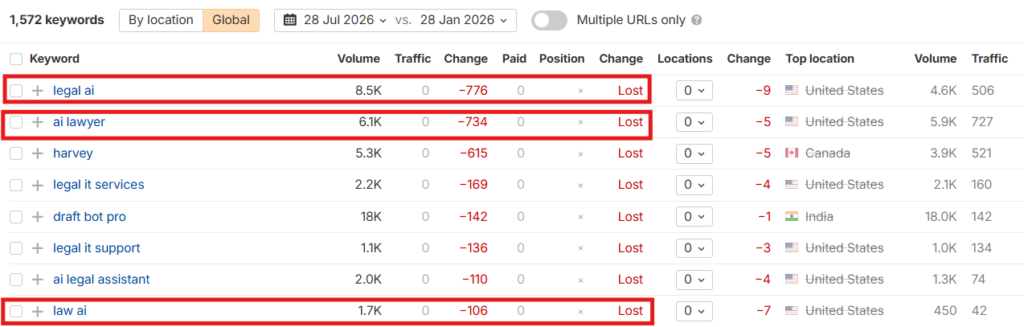
Source – Ahrefs
Take “legal AI.” With a monthly search volume of around 4,700 and a keyword difficulty score of 62, it is both valuable and difficult to rank for. The company had previously ranked near the top for this term. But over the six months, its position slipped, leading to a noticeable drop in estimated monthly traffic.
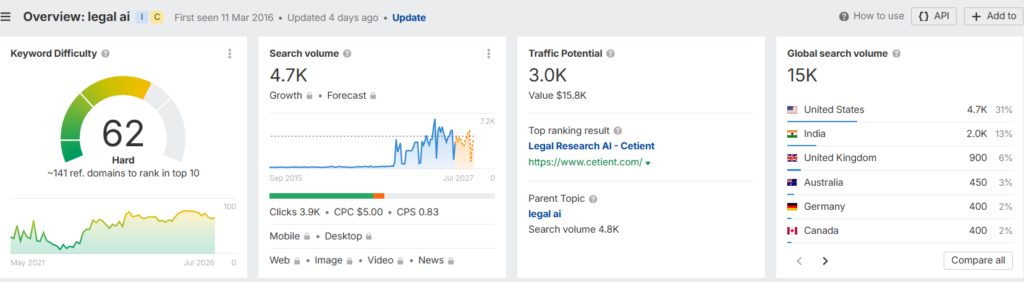
Source – Ahrefs
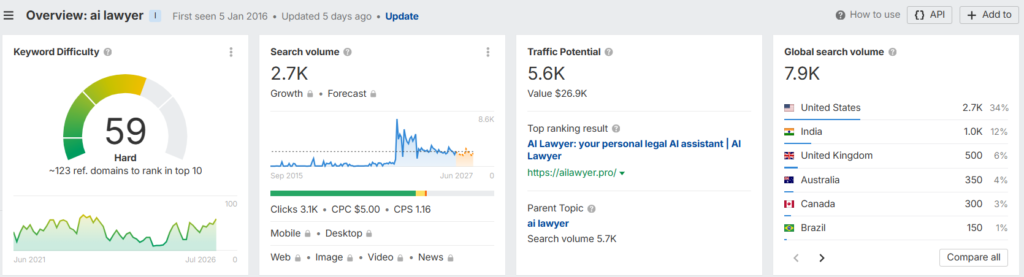
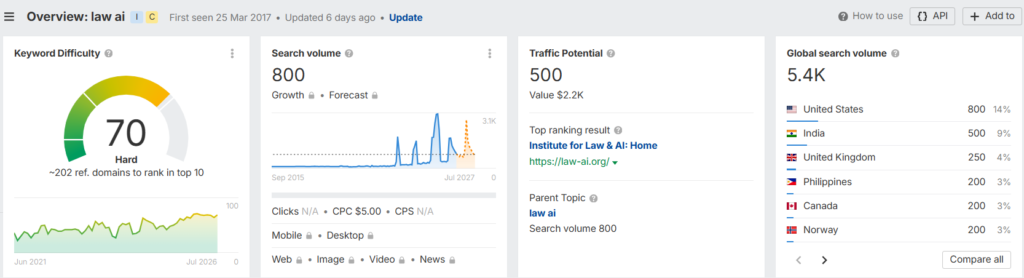
The same pattern showed up on “ai lawyer” and “law ai.” Both are high-intent searches and the kind of terms a buyer uses at the very moment they start looking for a legal AI tool.
“AI lawyer” has a monthly search volume of around 2,700 and a keyword difficulty score of 59.
Source – Ahrefs
“Law AI”, which is synonymous with Legal AI, has a monthly search volume of around 800 and a keyword difficulty score of 70.
Source – Ahrefs
Both are difficult terms to rank for, which makes Harvey’s earlier visibility even more significant. Despite that competition, the company had ranked for both before losing those positions.
So why does this matter so much?
When even the leading brand in a category no longer dominates every high-intent search, those keywords become more open to competition. Buyers searching these terms are rarely looking for one specific company. They are trying to find the solution that best fits their needs.
And increasingly, search results favor listicles, comparison pages, and in-depth guides alongside product pages. That creates an opportunity for focused legal AI brands willing to invest in the right content.
But here is what makes Harvey interesting. These losses are not a sign that its content is failing. Look closely at what the company is gaining at the same time, and a clear choice starts to show. Harvey is not losing ground everywhere. It is moving it.
What Harvey Was Doing Right (And Still Is)
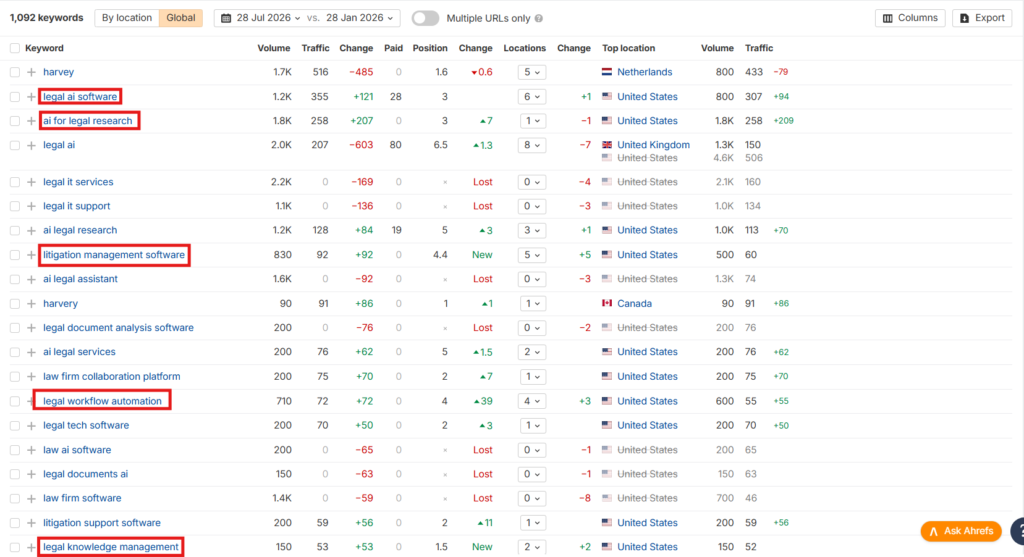
The clearest proof of that choice is in the keywords Harvey is winning right now.
Source – Ahrefs
These are the legal AI searches Harvey is climbing for right now:
| Keyword | Status |
| litigation management software | Brand new ranking, strong traffic |
| legal workflow automation | New ranking, fast-growing |
| legal knowledge management | New, growing |
| redlining tool | New |
| case management software for lawyers | New |
| AI for legal research | Up sharply |
Each one points at a specific capability, whether that is a workflow, a type of automation, or a way of managing legal knowledge. They sit right next to what Harvey actually builds, from Agents and Deep Research to Command Center, Contract Intelligence, and Workflow Builder.
So Harvey’s strongest rankings are gathering in one place. They cluster around its products and its brand, while the broad, top-of-category terms are the ones slipping away.
That split is the part worth sitting with. The company is gaining wherever its content points at a product, and losing wherever the search stays generic. Which leaves one question worth answering: what is actually driving that?
Why This May Be Happening
There may not be one single reason behind the decline. But a few patterns are worth looking at:
- Overlapping articles: Harvey has several posts around contract review, including:
Some of these pages may be competing for closely related searches.
- A shift towards specific workflows: Harvey is gaining visibility for terms tied closely to its products and use cases, while some wider category terms are slipping. This suggests its recent content is building stronger relevance around specific legal workflows.
Whatever the exact mix, the direction is consistent. The company is getting stronger on brand and product, and lighter on the broad category terms around them.
Understanding why the rankings changed is only half the picture. The more useful question is what Harvey can do next.
What Harvey Can Do to Recover Its Organic Rankings and Gain More Visibility
The good news is that most of these losses are recoverable. The broad category terms did not disappear because Harvey had become less relevant. They slipped for reasons that can be addressed.
Here is where the work could begin.
1. Invest More in Category Listicles
For many broad legal AI searches, Google increasingly favors listicles and curated software roundups over standalone product pages. Harvey could strengthen its presence with content such as:
- Top Legal AI Tools
- Top Contract Review Software
- Leading AI Platforms for Law Firms
These pieces of content can help the company compete for high-intent category searches while introducing the brand alongside other established solutions.
2. Create More Comparison and Alternative Content
Buyers rarely evaluate one platform in isolation. They compare vendors, look for alternatives, and weigh features before making a decision. Harvey could capture this demand with pages such as:
- Harvey vs. [Competitor Brand]
- Harvey Alternatives
- Best Alternatives to [Competitor Brand]
Beyond attracting comparison-stage buyers, this content also gives AI search engines clearer signals about where the company fits in the competitive landscape and how it differs from other legal AI platforms.
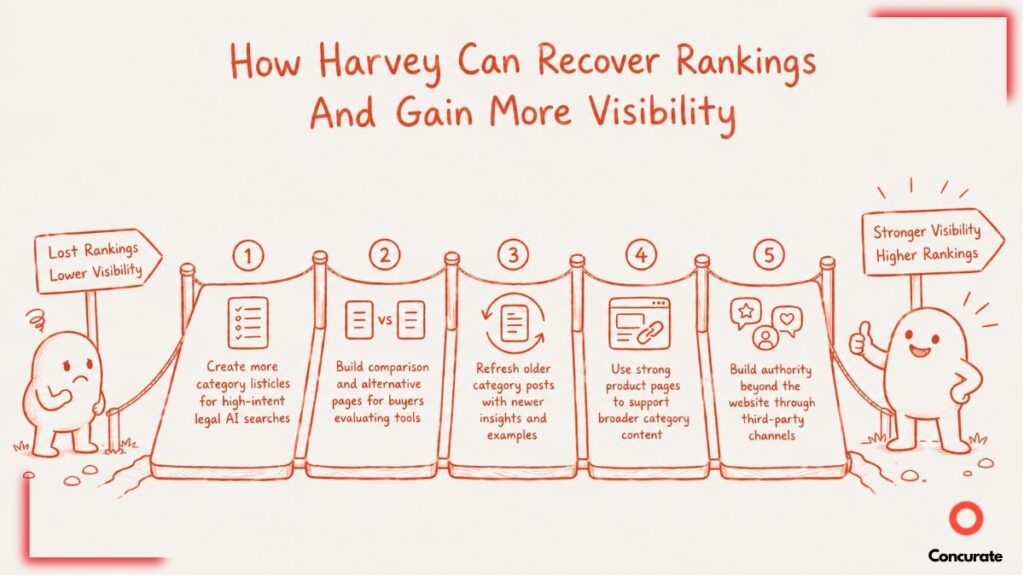
3. Refresh Older Category Posts With Fresh Insights
Many of the lost keywords are tied to older category pages that have not been refreshed in some time. Updating these pages could be one of Harvey’s quickest opportunities to regain visibility.
That means adding recent industry developments, new legal AI capabilities, expert perspectives, current examples, and original insights rather than making small cosmetic edits. Search engines and AI assistants increasingly favor content that reflects the latest information and offers genuine value beyond basic definitions.
Regularly refreshing these pages can help the company maintain stronger rankings, improve AI visibility, and signal that its content remains accurate and relevant for today’s legal buyers.
4. Use Strong Product Pages to Support Broader Content
Harvey is already gaining visibility for several product and workflow-specific terms.
Those stronger pages could support industry-wise pages through more deliberate internal linking. For example, a page performing well for “legal workflow automation” could link to a broader guide on legal automation or legal AI software. This helps readers move between related topics while also making the relationship between Harvey’s product content and industry-focused content clearer to search engines.
5. Build Authority Beyond Your Website
Harvey already has strong authority on its own website. The next opportunity is to strengthen its presence across the wider web, where both buyers and AI assistants look for trusted information.
Alongside recovering high-intent keywords, Harvey could publish more educational YouTube content, participate in Reddit discussions, and build an active subreddit. It could also contribute expert insights to industry publications, encourage more independent reviews and analyst mentions.
These third-party signals reinforce the company’s expertise and help AI assistants understand that its authority extends beyond its own website. Combined with strong on-site content, they can improve both organic visibility and AI recommendations.
The next step is to direct more of that authority towards the valuable searches where visibility has slipped. It requires focused analysis, regular updates, and consistent execution, which is where the right B2B content marketing partner can make all the difference.
How Concurate Helps Legal AI Brands Build and Protect Search Visibility
Harvey’s case shows that even a strong content engine needs regular attention.
Rankings shift. Search intent changes. New competitors enter the category. And pages that once performed well may need a different format, stronger evidence, or a clearer connection to the product.
This is where Concurate can help.
We work with B2B SaaS companies to understand where their visibility is growing, where it is slipping, and what content can close those gaps.
That could include:
- Analyzing lost keywords and identifying the pages worth recovering
- Refreshing, consolidating, or repositioning older content
- Building comparison, alternatives, and category-led pages for high-intent searches
- Strengthening internal links between educational content and product pages
- Tracking how the brand appears across Google and AI tools such as ChatGPT, Perplexity, and Gemini
Our approach to content marketing is not about publishing more for the sake of it.
It is about building the right content around the searches buyers make, improving what already exists, and making sure strong product positioning translates into stronger visibility.
For legal AI companies, that means being present when buyers are learning, comparing options, and deciding which platform deserves a closer look.
Frequently Asked Questions
1. How should legal AI companies make accuracy claims?
Accuracy claims should be specific, qualified, and backed by evidence. Legal AI software companies should explain what was tested, which tasks or documents were included, how performance was measured, and where human review is still required. Broad statements such as “eliminates errors” or “always produces correct answers” are difficult to support. Buyers are more likely to trust transparent testing, realistic expectations, and evidence from real-world use.
2. How often should legal AI content be updated?
There is no fixed schedule for updating legal AI content. Your content should be reviewed whenever the product changes, regulations or guidance are updated, or customer questions evolve. Content covering privacy, security, compliance, and AI capabilities usually requires more frequent updates than general company news. Regular reviews help keep information accurate, maintain trust, and support both search visibility and AI recommendations.
Disclaimer: The information presented in this article is compiled from publicly available sources, including company websites, industry reports, and social media. All trademarks, brand names, and logos mentioned are the property of their respective owners. We do not claim any ownership of third-party marks, nor do we imply endorsement or affiliation. This article is intended for informational purposes only.