

| TL;DR: Insurance firms sell protection against situations buyers hope they never face. That makes content marketing harder here than in most categories. Buyers are skeptical; many policies look similar at first glance, and compliance review can make every page sound less specific. This guide covers ten content marketing agencies for insurance firms, including Concurate, Directive, and Gregory. It also explains why insurance content usually underperforms and what to ask before you hire an agency. |
Insurance is one of the hardest categories to write content for, and most firms feel it.
The blog is active, with new posts published every week, and traffic may even look decent. But when a buyer starts researching insurance, or asks ChatGPT which insurer fits their situation, the firm doesn’t show up. And where it does, it reads like every other carrier: the same reassurances, the same “we’ve got you covered,” nothing a wary buyer can tell apart from the option right above it.
A few things cause this. Insurance content often passes through strict compliance review, so the specifics get softened until every page sounds the same. Many firms publish basic “what is [X] insurance” explainers because they’re easy to produce. However, they do little for buyers who are already comparing options. And because buyers arrive skeptical, generic marketing only makes them trust the firm less.
There’s also a distinction when evaluating insurance content marketing agencies. Some are built to produce content at volume. Others know how to turn the expertise inside your underwriting, claims, and sales teams into content that earns trust and influences buying decisions. Most insurance firms need the second kind, but most agencies are built for the first.
The ten agencies below understand the difference between simply publishing insurance content and creating content that actually earns trust. But first, let’s look at where content efforts tend to break down for insurance firms.
4 Reasons Why Insurance Firms Struggle With Content Marketing
Plenty of insurance firms pour real money into content and still watch it change nothing about who buyers shortlist. The issue usually isn’t volume or effort. It’s whether the content actually matches how a wary insurance buyer thinks, checks options, and makes a decision.
Here’s where it tends to break down:
1. Their Content Looks The Same As Every Other Insurer’s
Many insurance policies are more alike than buyers realize. That similarity often carries over into the content, leading insurers to explain the same products in almost identical ways.
That’s why so much insurance content reads the same way. They publish the same insurance guides, use the same reassuring tone, and make similar promises about protection and peace of mind.
When every firm sounds alike, buyers have no way to tell them apart, and neither do AI tools. To stand out, content must show what is genuinely different. This may include how you handle claims, the specific situations you handle well, or the expertise your organization brings.
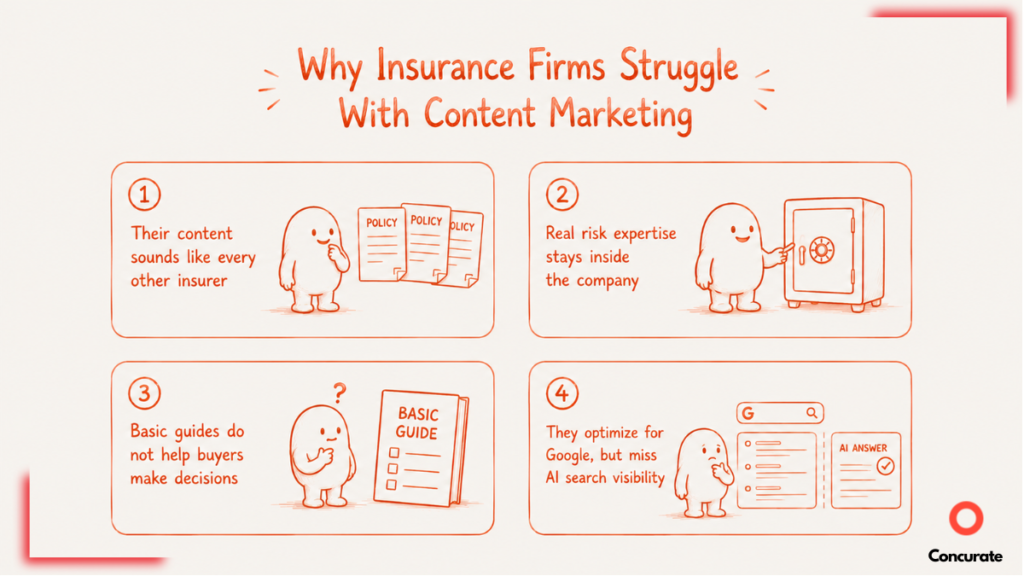
2. Their Deepest Expertise Never Reaches Buyers
Insurance firms are full of people who genuinely understand risk. Underwriters know why some applications get declined. Claims specialists know why claims get denied and where policies fall short. Risk experts can identify gaps in insurance coverage buyers may miss.
That knowledge is exactly what a skeptical buyer wants to see. It is specific, honest, and hard for any competitor to copy. It is also the kind of content AI tools can recognize as genuinely useful.
But buyers rarely get to see that expertise. These experts are cautious about saying the wrong thing and usually are not writers. So the job of creating content falls to a marketing team that doesn’t have access to that depth.
The result is surface-level content that repeats what every other insurer already says. The firm’s biggest advantage, the judgment and experience of its own people, never reaches buyers or the AI tools shaping their shortlists.
3. They Publish Basic Explainer Content When Buyers Need Help Choosing
Explainer content is easy to produce, so insurance firms usually lean on it. Articles like “what is umbrella insurance” or “types of business insurance” fill their blog.
The problem is that this content mostly helps buyers understand the basics. It does far less for a buyer who is closer to making a decision.
Someone comparing commercial liability policies, or trying to decide whether their business needs property insurance, isn’t looking for a basic overview. They want comparisons, guidance on which insurance suits them, and answers to “Is this right for my situation?” That decision-stage content is usually missing, which is exactly the content that helps a buyer move forward.
4. They Are Not Visible In AI Search
More buyers now start their research on AI platforms. A small-business owner might ask ChatGPT for “the best insurance for a small contractor,” or a founder might ask Perplexity whether a 20-person company needs cyber insurance, and which are the best options.
Those recommendations often shape the buyer’s shortlist. Firms that don’t appear may never enter the buyer’s research at all.
Most insurance firms are still optimizing for Google rankings alone and have no strategy for AI search. And because so much of their content is made too generic during compliance review, AI tools have little reason to cite or recommend them specifically.
Understanding these gaps makes it easier to build a stronger content strategy. This is where the right content marketing agency for insurance firms can help.
4 Questions To Ask A Content Marketing Agency Before You Hire Them
Picking the right agency takes more than skimming their case studies and liking a few writing samples. What matters is whether the agency understands what makes insurance difficult. Buyers are cautious, compliance shapes every word, and valuable expertise often remains internal.
The four questions below help reveal whether an agency understands insurance or relies on a generic approach.
1. Can They Write Content That Earns Trust With A Skeptical Buyer?
Insurance buyers are often skeptical. They worry about hidden exclusions and reasons their claim might be denied. Content that leans on cheerful, generic reassurance only deepens that doubt.
So the agency you hire needs to write in a way that builds trust with a wary reader. That usually means being specific about what is and isn’t covered, being honest about limitations, and answering the uncomfortable questions instead of avoiding them.
| Question to ask: Can you show us content you’ve written that builds trust with a cautious, skeptical buyer rather than just reassuring them? |
2. Can They Pull Expertise Out Of Your Internal Team?
Your best content isn’t sitting in a keyword tool. It’s in the heads of your underwriters, claims specialists, and risk experts, who know why claims get denied and where policies fall short.
A generic agency may rely on keyword research and public sources. The resulting content often sounds like every other insurer. A strong agency starts by interviewing your experts, then turns that knowledge into content no competitor can easily copy.
Without a clear interview process, the agency may produce surface-level content based only on information already available online.
| Question to ask: What’s your process for capturing knowledge from our internal team and turning it into content? |
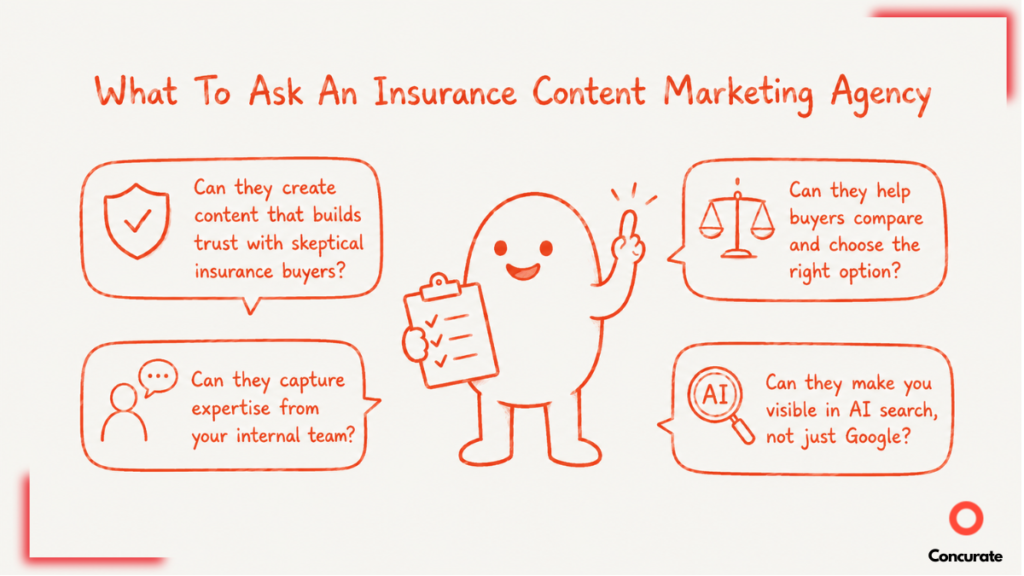
3. Do They Build Content For Buyers Who Are Ready To Decide, Not Just Learn?
It is easy to produce explainer content like “What is rent guarantor insurance?” Creating content for buyers actively comparing providers requires far more product and customer understanding.
Those buyers aren’t looking for definitions. They want help comparing options and deciding which solution best fits their situation. Agencies should be able to show examples of content built for that stage of the buying journey. However, if their portfolio is mostly awareness-stage explainers, that is what you’ll get.
| Question to ask: Is your content is built for buyers who are actively comparing options? |
4. Do They Have A Strategy For AI Search, Not Just Google?
More insurance buyers now begin their research inside ChatGPT, Perplexity, and Google AI Overviews. They ask which insurer is best for a specific business type or situation, and the tools recommend a list of providers. If you’re not on it, you may never enter the buyer’s shortlist.
Many agencies still focus primarily on Google rankings. If the answer is limited to schema and technical optimization, they’re solving only part of the problem.
The agencies that actually improve AI visibility build decision-stage content that matches how buyers describe their problem to an AI tool. They also track whether you’re being mentioned and recommended, not just whether traffic went up.
| Question to ask: How do you build visibility for us in AI search, and how will you measure whether AI tools are recommending us? |
Now that we’ve covered how to evaluate the right agency, let’s look at the ones helping insurance firms turn expertise and trust into visibility.
10 Best Content Marketing Agencies For Insurance Firms In 2026
Finding an agency that truly understands insurance isn’t easy. Many offer content marketing services, but far fewer have experience navigating the industry’s unique challenges.
To compile this list, we looked for agencies with experience working with insurance companies. We also considered publicly available client work or case studies, as well as a track record of creating content for regulated industries. While each agency has a different approach, all have established experience in the insurance space.
Here’s a quick look at the agencies featured in this guide:
- Concurate
- Directive
- Gregory
- WebFX
- Mint Studios
- Balance
- Thrive
- First Page Sage
- CSTMR
- Goose Digital
Let’s take a look at each agency one by one.
1. Concurate
We are a boutique B2B content marketing agency that helps companies explain complex products in a way buyers can understand, trust, and discover.
This is especially relevant in insurance, where people rarely make decisions after reading one page. They compare options, ask whether they qualify, and often turn to Google or AI tools before contacting a company.
At Concurate, we begin with those questions before deciding what content needs to be created.
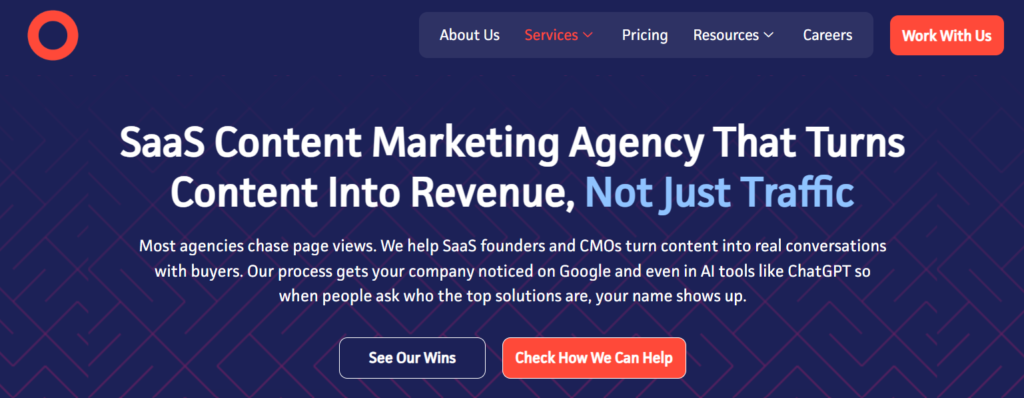
Source – Concurate
That approach has become even more important now that AI can produce basic informational content at almost no cost. Our co-founder explains why we believe companies should publish less, but give Google and AI platforms something original and useful to reference in this video.
How This Works In Practice
Let me share an example from recent client work.
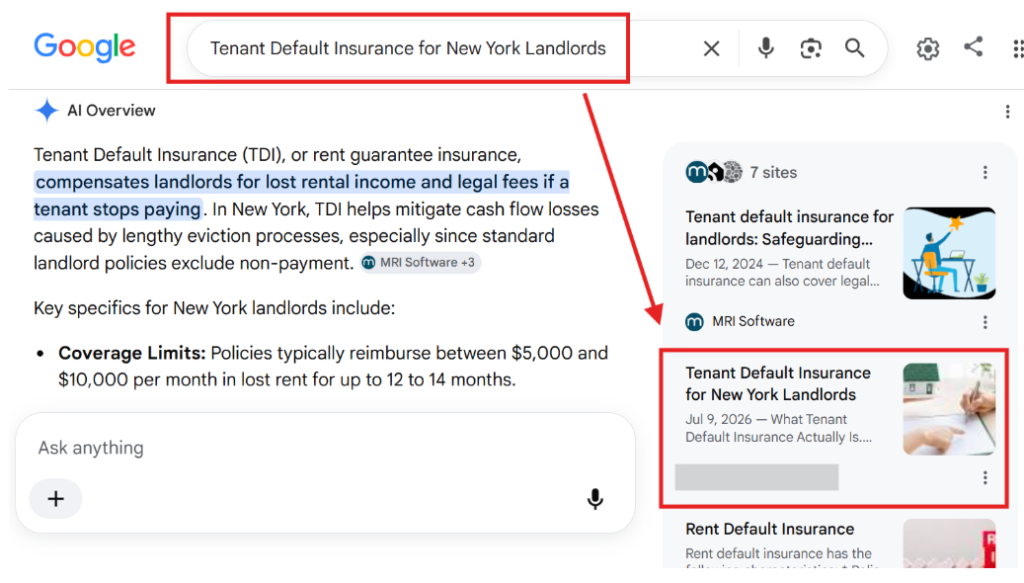
We were working with an insurance company that specialized as a lease guarantor. They needed help with establishing themselves as the right option when people were looking for insurance guarantors. As part of our content strategy, we chose topics closely tied to how potential customers compare their options.
Within three days of publication, the article reached position five on Google. Google also featured it as a source in an AI Overview.
Claude later drew information from the article and included the brand among the recommended options for a related query.
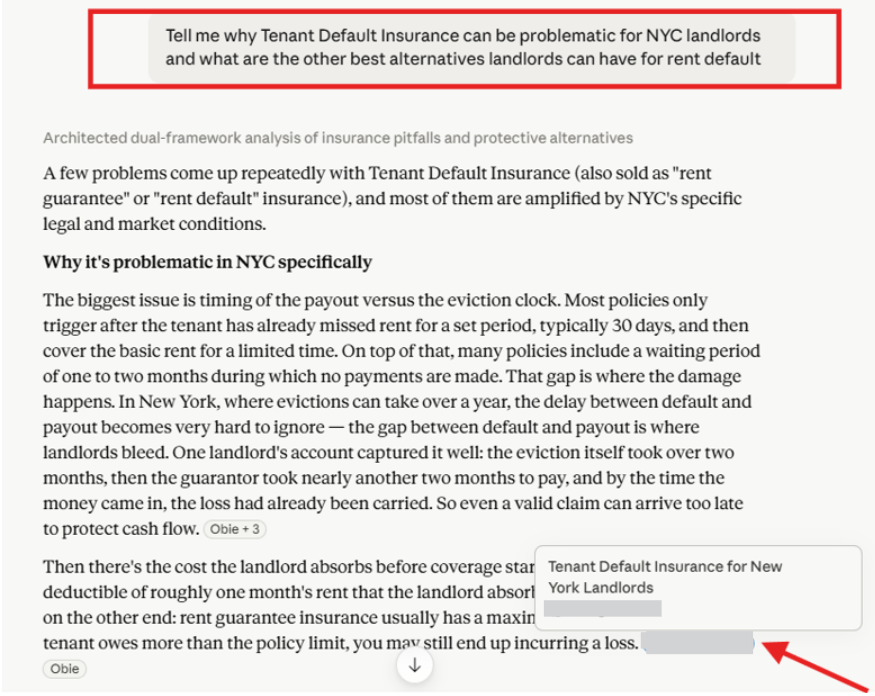
Within our first week of working together, the brand had already gained visibility across Google Search and AI-generated results.
This is the kind of work we focus on at Concurate: content built around a real buyer question, grounded in the company’s expertise, and strong enough to earn visibility across both Google and AI platforms.
Best for: Insurance and insurtech companies that need to explain a complex offering and improve their visibility across Google and AI platforms.
Notable Clients: InspireIP, Triangle IP, Datacipher, PQAI, Athena Security, and Panda Guarantee.
Pricing: Partnerships typically range from $5,000 to $7,500 per month, with one-time projects at $3,500.
Clutch Rating: 5/5 (2 reviews)
2. Directive
Directive is a B2B marketing agency for finance and insurance firms. Its strategies account for compliance requirements, buyer trust, risk considerations, and the longer decision-making cycles common in these industries.

Source – Directive
Their approach combines SEO, content production, customer insights, reporting, and distribution into a single content strategy. As part of its approach, it also extends to visibility across traditional search, AI Overviews, and platforms such as ChatGPT and Perplexity.
Best for: Insurance firms that want content to support lead generation and customer acquisition.
Notable Clients: Allstate, Eden Health, and Otsego Mutual Insurance Company.
Pricing: You can contact their team for more information.
Clutch Rating: 4.8/5 (56 reviews)
3. Gregory
Gregory works with insurance carriers, brokers, managing general agents, and insurtech companies that need clear content for complex products. Their content approach focuses on turning internal expertise into useful narratives. This includes thought leadership, blog posts, white papers, case studies, ebooks, video, podcast, and webinar content.

Source – Gregory
The agency combines content with executive positioning, media outreach, SEO and GEO optimization, social and email distribution, and performance reporting. Its wider communications work also covers messaging, media training, awards, speaking opportunities, crisis communications, and event support.
Best for: Insurance firms that want content and PR to work together, particularly when visibility, media credibility, and customer trust are equally important.
Notable Clients: NFP, Allianz, Penn Mutual, and Cyberwrite.
Pricing: You can contact their team for more information.
Clutch Rating: 4.8/5 (3 reviews)
4. WebFX
WebFX is a full-service digital marketing agency that offers dedicated content marketing support for insurance providers. Beyond blog writing, they develop content strategies, write sales and website copy, create graphics and videos, promote content, and track performance. Insurance firms can use WebFX for formats such as articles, online guides, infographics, and explainer videos.
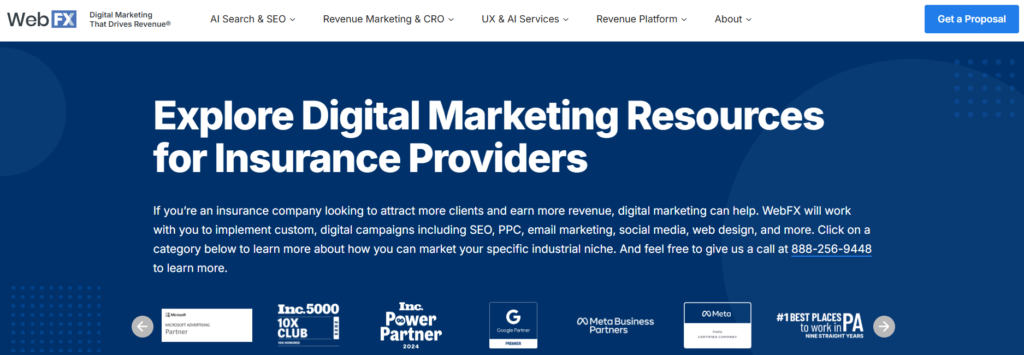
Source – WebFX
WebFX also connects content with SEO, paid advertising, email, social media, and web design. Their RevenueCloudFX platform also helps companies track how content contributes to leads and revenue.
Best for: Insurance firms that want one agency to manage content alongside SEO and other digital marketing channels.
Notable Clients: HCC Insurance, Select Insurance, and Caldwell & Gregory.
Pricing: Custom content marketing plans start at $2,000 per month.
Clutch Rating: 4.9/5 (450 reviews)
5. Mint Studios
Mint Studios is a specialist content marketing agency for financial services and fintech companies. Rather than focusing on publishing volume alone, it builds content programs designed to support customer acquisition and commercial growth.

Source – Mint Studios
The agency starts with a review of content, SEO, and LLM visibility. It then identifies topics for buyers closer to a decision through interviews with sales, product, and subject-matter experts. Finally, the team tracks performance in HubSpot and Google Analytics, connecting content to form submissions, opportunities, deals, and revenue.
Best for: Insurance and insurtech firms with complex products that want content tied directly to leads and revenue.
Notable Clients: Confused.com, PolicyMe, Fintel Connect, and Modulr.
Pricing: You can contact their team for more information.
Clutch Rating: N/A
6. Balance
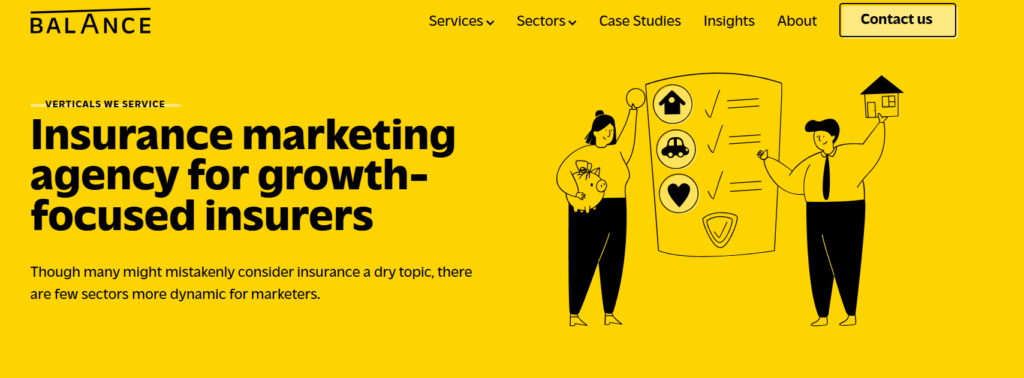
Balance is a financial services marketing agency that works with banks, insurers, wealth managers, advisors, and fintech companies.
Source – Balance
The agency builds content around credibility, compliance, and performance. It includes landing pages, blogs, white papers, guides, and thought leadership pieces. Balance also uses keyword research, audience data, and search behavior to shape campaigns and improve existing content.
When it comes to content, they explain complex topics clearly while accounting for regulatory requirements. Moreover, instead of treating content as a standalone channel, Balance combines it with SEO, digital PR, paid media, social media, and broader digital strategy.
Best for: Insurance firms that need compliant content across several formats and want it connected with SEO and other digital channels.
Notable Clients: Allianz, Pure Property Finance, Hodge, and Aldermore.
Pricing: You can contact their team for more information.
Clutch Rating: N/A
7. Thrive
Thrive is a full-service digital marketing agency with dedicated content marketing services and specific support for life insurance companies, agents, and brokers. They handle strategy, website copy, blog writing, social media content, email campaigns, video scripts, ad copy, and content optimization.

Source – Thrive
The agency utilizes audience research, keyword analysis, and client review to guide production. They also combine content with SEO, PPC, conversion optimization, web design, reputation management, and email marketing.
Best for: Insurance firms and e-learning companies that want content built around search visibility, thought leadership, and lead generation.
Notable Clients: Berryman Products, Stovall Constructions, and The Farah Law Firm.
Pricing: Custom pricing on a month-to-month basis. You can contact their team for more information.
Clutch Rating: 4.6/5 (108 reviews)
8. First Page Sage
First Page Sage is a marketing agency that uses expert-led content to generate qualified leads for insurance companies. Their approach involves interviewing internal experts and identifying commercially valuable search topics.

Source – First Page Sage
The agency creates blog articles, landing pages, guides, white papers, research pieces, and thought leadership content built to rank and convert. As part of their broader organic growth strategy, they bring together technical SEO, conversion optimization, and performance tracking.
Best for: Insurance firms that want content built around search visibility, thought leadership, and lead generation.
Notable Clients: AssuredPartners, Newfront Insurance, and Advisors Excel.
Pricing: You can contact their team for more information.
Clutch Rating: N/A
9. CSTMR
CSTMR is a specialist marketing agency for financial services companies across banking, lending, payments, investing, insurance, and fintech. They combine content with strategy, branding, SEO, email, social media, PR, and digital experience design.
Source – CSTMR
As an agency, they work with companies that need to launch financial products, refresh their positioning, or build a stronger foundation for growth. Rather than treating content as a separate channel, CSTMR aligns it with brand messaging, performance marketing, and the customer experience.
Best for: Insurance and fintech companies that want content connected with branding, product launches, and wider marketing strategy.
Notable Clients: QuoteWell, Boundless Rider, and Acrisure.
Pricing: You can contact their team for more information.
Clutch Rating: 4.9/5 (7 reviews)
10. Goose Digital
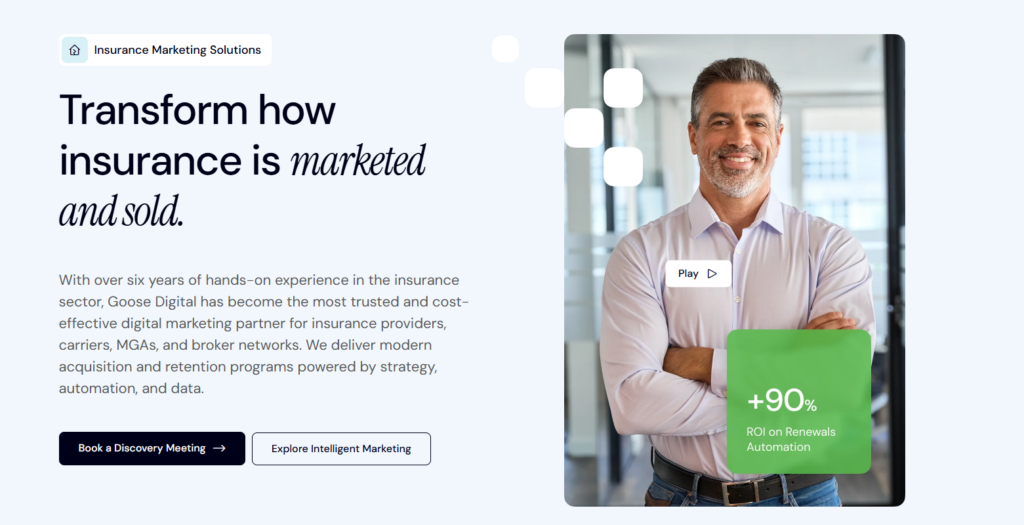
Goose Digital works with insurance providers, carriers, managing general agents, and broker networks that want to connect marketing strategy with automation and data.
Source – Goose Digital
As part of its strategy, the agency plans content around relevant buyers, campaigns, and different stages of the customer journey. Its services include creating content calendars, campaign roadmaps, blogs, videos, sales collateral, and creative production.
Goose Digital also helps teams improve how they manage content ideation, approvals, and publishing. For instance, their insurance marketing programs combine content with SEO, paid media, resources that help brokers market and sell, and campaign execution.
Best for: Insurance organizations that want content supported by marketing automation, CRM systems, and campaign reporting.
Notable Clients: Aviva, Intact Insurance, and Northbridge Financial.
Pricing: Custom pricing for retainers, one-time projects, or flexible support hours available upon request.
Clutch Rating: N/A
Choosing the right agency is only the first step. What ultimately drives results is how well your content helps buyers understand your product, evaluate their options, and move confidently toward a purchase.
Turn Your Team’s Expertise Into Content Buyers Trust
At Concurate, we help insurance companies turn what their teams know into content buyers can actually use. This may involve explaining a complex product, resolving questions that delay decisions, or helping buyers compare options with more confidence. The aim is to make your expertise easier to find, understand, and trust.
Our Content Marketing Services: We create content that explains your offering, supports comparisons, and helps buyers take the next step.
Our GEO Services: We improve your visibility across Google AI Overviews, ChatGPT, Perplexity, Gemini, and other AI platforms where buyers now research companies and build shortlists.
Have questions or want to see if Concurate is the right fit for your business? Email nitesh.gupta@concurate.com or schedule a call through our calendar.
Looking for marketing ideas backed by real experience? Get weekly insights from campaigns we’ve run, experiments we’ve tested, and strategies that are delivering results today.
Frequently Asked Questions
1. How long does insurance content marketing take to show results?
Some early indicators, such as improved search rankings, higher impressions, or visibility in AI-generated search experiences, may appear within a few days to weeks. More meaningful outcomes, including qualified traffic and lead generation, typically take three to six months. The timeline depends on factors such as your website’s authority, competition, topic selection, publishing frequency, and compliance review processes.
2. Which metrics matter most for insurance content?
Traffic alone does not show whether content is driving business results. Insurance firms should also track qualified inquiries, quote requests, demo or consultation requests where applicable, rankings for high-intent searches, and visibility across AI search experiences. Feedback from sales teams can also reveal which content helps answer buyer questions and supports conversion.
3. How much does a content marketing agency for insurance firms cost?
Pricing varies widely based on the scope of work. A one-time content project typically costs much less than an ongoing engagement covering strategy, subject-matter expert interviews, writing, SEO, design, publishing, and performance reporting. Insurance content often requires additional research and compliance review, which can also affect costs. You need to compare agencies based on deliverables, expertise, and reporting rather than price alone.
4. How soon should an insurance firm expect content to generate leads?
Lead generation usually takes longer than improvements in rankings or traffic. While a well-targeted article may generate an inquiry shortly after publication, building a consistent pipeline typically requires several months of publishing, optimization, and distribution. The strongest results come from creating content around real buyer questions and pairing it with clear conversion paths and effective sales follow-up.
Disclaimer: The information presented in this article is compiled from publicly available sources, including company websites, industry reports, and social media. All trademarks, brand names, and logos mentioned are the property of their respective owners. We do not claim any ownership of third-party marks, nor do we imply endorsement or affiliation. This article is intended for informational purposes only.