

| TL;DR A SaaS company built an AI-powered personalization product but sent a nurture sequence that felt anything but personal. From broken merge tags to repetitive messaging, the emails undermined the very promise the product was built to deliver. Here are five lessons every B2B SaaS marketer can learn from it. |
Only one-third of email marketers use personalization today, despite research showing it can increase revenue by 10-15%. Yet, most marketing teams keep sending the same message to the same list and wondering why nobody is converting.
Most B2B SaaS nurture sequences are just scheduled reminders that a product exists, dressed up as emails.
Now imagine a company that is actually trying to solve this problem. They are building an AI-powered profile page that speaks in your voice, captures leads, and works around the clock. While you’re stuck in back-to-back meetings, people can still learn what you do, book a consulting call, or find the right way to reach you without waiting for a response.
This is a genuinely strong product with real ambition and a great website copy.
So when I signed up and landed in their nurture sequence, I expected that same energy in my inbox.
What followed was one of the most avoidable email marketing failures I have seen.
Don’t get me wrong, I work in content, and I have made my own fair share of email mistakes. But this sequence had problems that no one should be shipping in 2026.
Mistake 1: They Built an AI Personalization Product and Forgot to Personalize the Email
The first email I received was a feature announcement. They were launching an AI twin for the profile page. The promise was a digital version of me that spoke in my voice, knew my story, and answered visitor questions automatically.
The email opens with: Hi ,
Just a comma, no name. The first name field is completely empty.
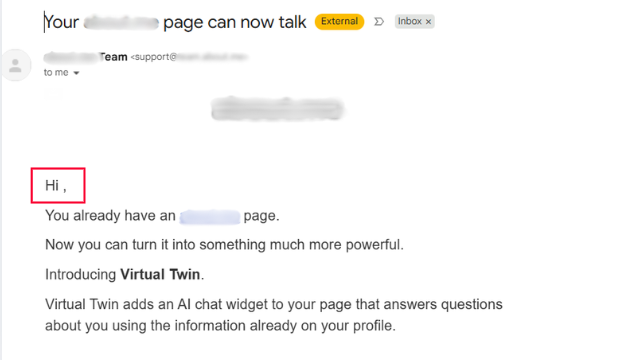
This is not a small oversight.
This is a company selling personalization technology that could not execute the most basic personalization in email marketing.
It is the equivalent of a gym sending a fitness email that starts with “You look great, [NAME].”
Then the body copy arrives. One long sentence describing the product like it is a tooltip in a settings menu. No hook. No story. No reason to care. Just a feature definition and a CTA.
You have someone’s attention for eight seconds. They spent it on a technical specification.
What You Should Do Instead
Your first email is a first impression. Lead with the problem your reader has, not the feature you built.
The fastest way to create emails that get opened is to give readers a reason to care before you ask them to care about your product.
And for the love of email marketing, check your merge tags before you hit send.
Mistake 2: They Introduced a Demo and Made You Leave to Find It
Two months into the sequence, I received an email introducing a fictional AI persona to show what the product feels like in action.
This is actually a smart instinct. Show, don’t tell. Bring the product to life through a character instead of describing it in paragraphs.
Except the email did not show me anything.
It introduced the persona, showed a photo, and then asked me to visit a completely different website to experience the demo. The copy essentially said: she can explain what the product is, how it works, and how to set one up for yourself.
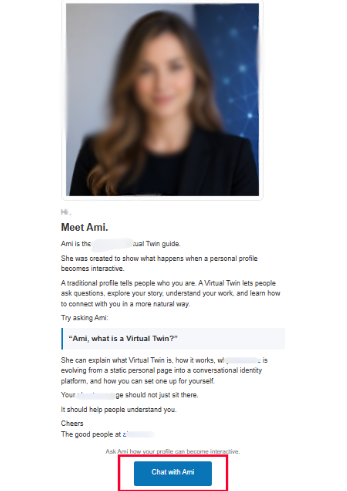
So the demo was someone else explaining the product, somewhere else, that I had to go find.
They turned that slight curiosity into a commute.
What You Should Do Instead
If you are using a demo to drive action, remove every step between curiosity and experience. Show a real conversation snippet inside the email itself. Give the reader a taste before asking them to travel.
Mistake 3: Ami Was in Every Email. The Website Had Never Heard of Her.
By this point, Ami had appeared in every email I received with the same photo, the same blazer, and the same expression.
After weeks of this, she felt like the face of the product as far as I was concerned.
Then I clicked through to the website.
And there was Brad.
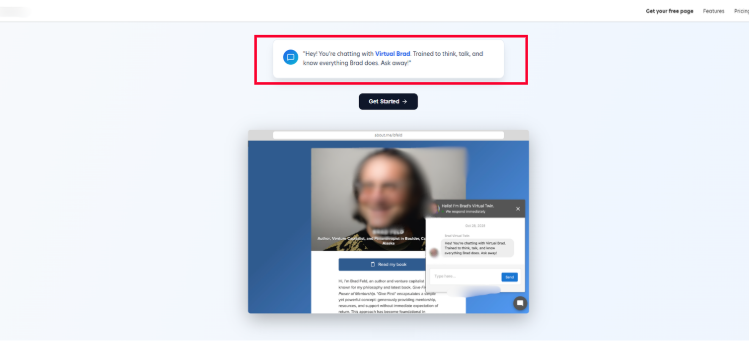
No introduction. No explanation. No mention of Ami anywhere.
Just a completely different person representing the same product in a completely different place.
It is like corresponding with someone’s assistant for weeks, showing up at the office, and being told the assistant does not work there.
What You Should Do Instead
The journey between your emails and your website is not two separate experiences. It is one. A reader moves between them constantly, and every time something feels inconsistent, you lose a little trust. Make sure the face, the voice, and the story are the same everywhere.
Mistake 4: They Found One Good Line and Abandoned It Immediately
Buried inside a later email was this opening: “Most people do not read profiles anymore. They skim. They click. They leave.”
That was a genuinely good opening. It had real rhythm, real insight, and for one brief moment, the sequence woke up.
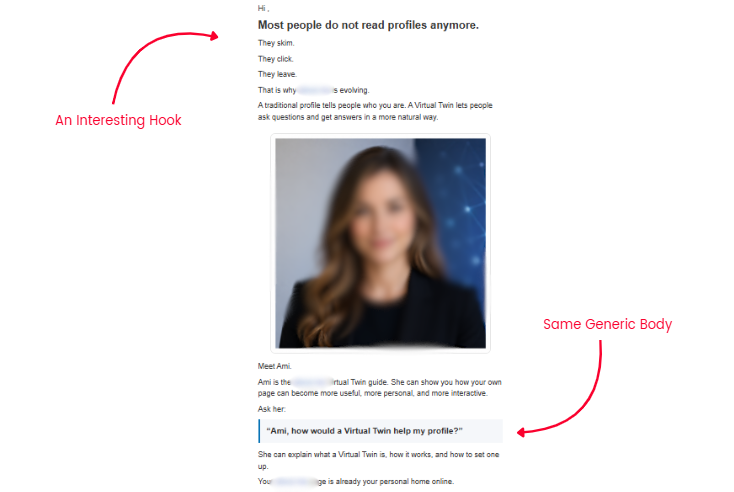
And then the email immediately retreated into the exact same pitch as every email before it.
Same message. Same Ami photo. Same CTA.
It is like watching someone nail the opening joke and then read the rest of the set from a terms and conditions document.
Finding a strong line is hard and most email copy never gets there. But finding it and not following through is almost worse, because now the reader knows you are capable of better.
To make things worse, three emails landed in my inbox in ten days during this stretch. One arrived just one day after the previous one, with nothing new to say.
What You Should Do Instead
When you find a voice or an insight that works, build the whole email around it. Do not use a strong hook as a disguise for a weak body. Many teams write a strong opening and then abandon the same principles that make SaaS copywriting effective in the first place.
Also, before you schedule a follow-up, ask yourself one honest question: does this email say anything the last one did not? If the answer is no, do not send it.
Mistake 5: They Saved the Most Interesting Thing for Last
After weeks of the same message, a new email arrived and for the first time in the entire sequence, it told me something genuinely new.
There is a built-in CRM. Lead capture straight from your profile page, contact management, and full conversation history stored automatically.
That is a completely different value proposition and it should have been Email 2.
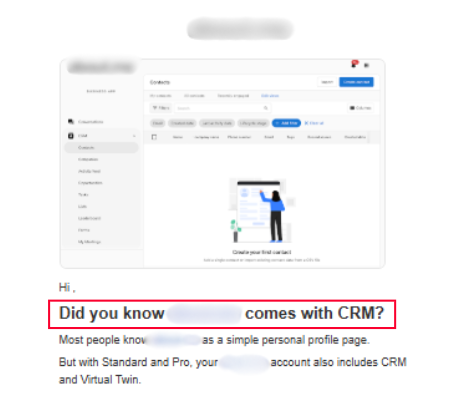
Instead, it arrived after most readers had already made up their minds, either upgrading, unsubscribing, or developing a quiet dread of seeing Ami’s blazer in their inbox.
They had two strong reasons to upgrade the emails. Instead, they chose to repeat one until readers went numb before mentioning the other.
That is not a nurture sequence. That is a monologue with a plot twist nobody stayed for.
What You Should Do Instead
If your product has more than one strong reason to buy, do not save the best for last. Spread your value across the sequence so every email gives the reader something new to consider. Buyers need different information at different points in the decision-making process.
A nurture sequence should feel like a conversation that gets more interesting over time, not a waiting room where the good news finally arrives on your way out.
The Real Problem With This Sequence
It was not one bad email. It was a pattern, and once I saw it, I could not unsee it.
The entire sequence had zero curiosity about me as a reader. What do I do? Why did I sign up? What problem am I trying to solve?
They never tried to understand how buyers make decisions.
They only talked about the product, the feature, and Ami, over and over, without once making it about the person on the other end.
There was also a clear disconnect between the product and the marketing.
The website speaks with real confidence and a sharp point of view. The emails retreat into feature descriptions and safe, forgettable sentences.
Somewhere between the product page and the email editor, the voice got completely lost.
That is the real irony here. This company built a product that promises authentic, personalized, always-on communication in your voice. Their nurture sequence was the opposite of everything that product stands for.
If their AI twin had written these emails, it would have probably done a better job.
Note: The company name and identifying details in this post have been masked. This is part of the B2B Email Roast series where we look at real nurture sequences, break down what went wrong, and share what good looks like instead.