

| TL;DR: I went looking for how to differentiate in an AI marketing world, and Mark Schaefer’s Audacious framework gave me a lens: you cut through by disrupting one of three things: the message, the medium, or the messenger. Does it work in B2B SaaS? Yes. Clay disrupted the message by coining the GTM Engineer identity. Ramp disrupted the medium with a glass box and an actor from The Office. Cursor disrupted the messenger by letting users tell the story. But the bigger question I kept hitting was: how do you find your own audacious idea? The answer is that audacity is never day one. It sits on a boring foundation of customer signals and decision-stage SEO and GEO. Build that first, then go bold at whatever budget you can afford. |
To differentiate in an AI marketing world, Mark Schaefer, author of Audacious, says: “Dig down deep to find the humanity that AI cannot touch.”
I first heard Mark say this on a recent evening bike ride through the Chinese Garden in Singapore. I was listening to a podcast episode where Mark was a guest on The Business of Marketing. He told a story about e.l.f. Cosmetics that stopped me mid-pedal.
e.l.f. Cosmetics relentlessly asked one question: where are our customers right now, and how do we reach them in a new way? That signals-first approach led them somewhere no beauty brand had gone: Roblox. So they launched e.l.f. Up!, a Roblox game that taught entrepreneurship and financial literacy to Gen Z players, promoted across TikTok, YouTube, and their Discord community.
Now, it wasn’t a cosmetics ad. It wasn’t even a product experience. It was e.l.f. showing up on the platform where their audience already lived, in a format that the audience easily embraced. By 2025, the game had 22 million lifetime visits and a 96% approval rating.
The “disruption” Mark highlights: e.l.f. didn’t change their story (affordable cosmetics for young women). They changed where the story was told and who the storyteller was: the Roblox community itself.
That invites us for a deep dive into Mark’s framework.
Audacious – Disrupt Message, Medium or Messenger
Mark Schaefer spent years studying one question: why do some campaigns break through while everything else gets scrolled past? His answer, laid out in Audacious, is a three-lever framework. Disrupt at least one of these three things, and you have a shot at cutting through.
- Disrupt the Message
- Disrupt the Medium
- Disrupt the Messenger
Disrupt the Message
Most content in any category follows the same template. Audiences recognize it instantly and tune out. Disrupting the message or the narrative means breaking the rules of how your category communicates. Liquid Death sells water but markets like a heavy metal band. The moment your audience forgets you are selling something, you have their full attention.
Disrupt the Medium
Stop fighting for attention in overcrowded channels. Find where your audience already lives and show up there in a format native to that environment. e.l.f. Cosmetics skipped Vogue and built a game on Roblox. Spotify delivered a music video inside an Excel spreadsheet.
Disrupt the Messenger
Step back and hand the mic to someone else. Nielsen research shows people trust a stranger before they trust an ad. The question is not how do we say this better. It is who, if they said this, would our audience actually believe.
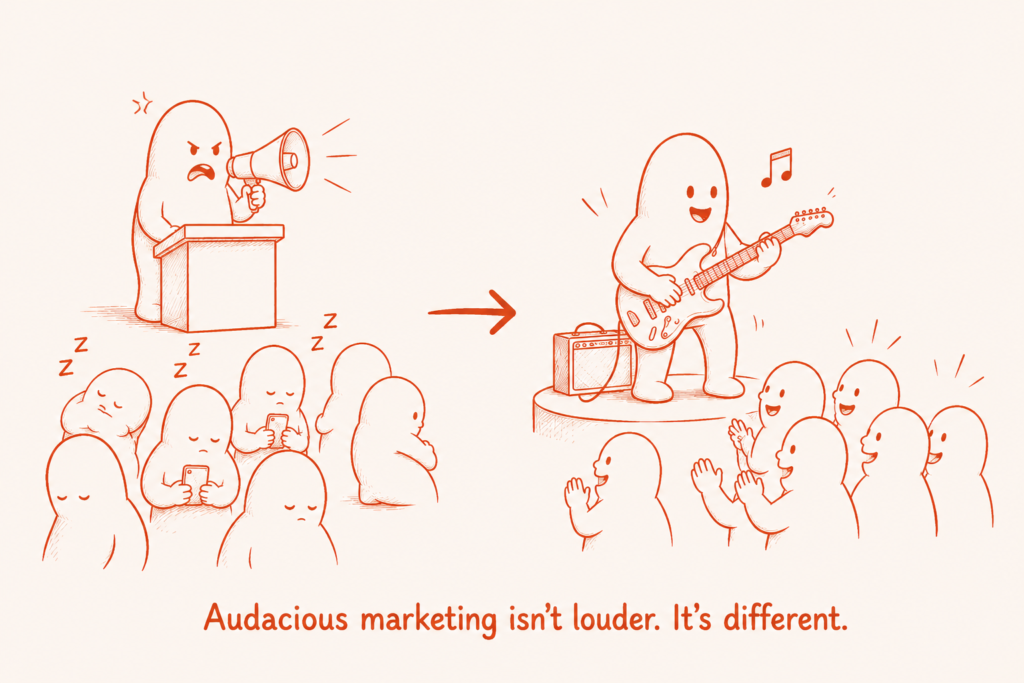
The question is whether this framework translates to B2B SaaS, a space historically allergic to creative risk. The answer, it turns out, is yes.
B2B SaaS Examples Using Audacity to Cut Through the Noise
Almost every B2B SaaS company tells the same story its category tells. “We save you time, cut your costs and automate the busywork.” On that axis, every tool sounds identical. AI-generated content has only made the sameness worse.
And then there are B2B SaaS brands cutting through the noise like Clay, Cursor, and Ramp.
Clay: Disrupt the Message
Going back to the Liquid Death example. The job-to-be-done for water is to quench thirst. Every water brand does that, so on the functional axis they are interchangeable. Liquid Death ignored the functional job almost entirely and sold a different one:
- Emotional job: feel rebellious, edgy, in on the joke.
- Social job: signal a tribe and an identity to everyone watching you hold the can.
Liquid Death refused to tell water’s story of purity and mountain springs. It told an identity story instead. Same liquid. Completely different job.
Clay did the same thing to sales software.
The category story for Clay is dull and crowded. “Data enrichment and lead automation platform.” Nobody gets excited about that, and a hundred tools claim it. So Clay did not sell the functional job. They coined a new identity: the GTM (Go-to-Market) Engineer.
Clay gave a name to people stuck between sales and engineering: the GTM Engineer. That identity was the emotional and social job nobody else named. Practitioners claimed it, built communities, put it in their bios. Clay rode it from $1M to $100M ARR and a $3.1B valuation.
I made a short video on exactly how Clay pulled this off.
Ramp: Disrupt the Medium
Ramp sells corporate cards and expense management software. As their Head of Creative Experimentation, Kendall Tucker told Marketing Brew, accountants have used the same software for 30 years and are not looking for alternatives. The hard part was making them feel a problem they had learned to tolerate.
You cannot capture demand that nobody is expressing. So here is what Ramp did.
In October 2025, they put Brian Baumgartner, the actor who played Kevin from The Office, in a glass box in Manhattan’s Flatiron Plaza. For seven hours, he processed expense receipts by hand while Ramp’s software did the same job automatically beside him. A live tracker showed the widening gap. They livestreamed the whole thing.
The activation drew roughly 10,000 people in person. The X livestream alone pulled hundreds of thousands of views, 377,000 views at the time of writing the article. By Ramp’s own estimate, the campaign reached at least 85 million views across platforms.
From Mark’s lens, Ramp disrupted the medium to deliver the message with this crazy idea to magnify the pain.
Cursor: Disrupt the Messenger
Cursor, which sells AI-powered coding agents, spent zero dollars on marketing. No campaigns. No content team. No outbound sales until late 2025. What they had was a product so visibly, demonstrably better that developers could not stop talking about it.
The messengers were never Cursor’s marketing team. They were the users. A developer posted a screenshot of something no plugin could do. Then another. Then Ricky Robinett posted a video of his 8-year-old daughter building a Cloudflare-powered chatbot in 45 minutes during her second-ever coding session. It spread to TikTok with 85,000 likes. “Vibe coding” became a meme. The team amplified user wins and never tried to control the narrative.
According to Sacra, Cursor went from $1M to $100M ARR in 12 months, faster than Wiz, Deel, and Ramp, making it the fastest-growing SaaS company of all time at that milestone. Bloomberg reported it crossed $2B ARR by February 2026, with over one million paying customers.
Cursor never handed anyone a mic. They built a product so visibly different that users picked it up themselves. The real lesson for B2B SaaS is this: work on the cause, and the mic gets picked up as the effect.
How Do I Actually Find My Own Audacious Marketing Idea
Audaciousness does not happen on day zero.
Clay, Cursor, and Ramp did not launch with a glass box or a coined identity. Work backward, and you find years of unglamorous groundwork underneath every bold move.
That groundwork starts with signals. You mine sales calls, support tickets, Reddit threads, G2 reviews, the exact words customers use. The more signals you process, the sharper your audacious idea gets.
While you collect those signals, you build the boring foundation: SEO and GEO (Generative Engine Optimization). And this is where founders sometimes get the priorities wrong.
The old playbook chased informational traffic, the “what is a P-card” explainers. That game is ending. AI now answers those questions inside the search result, so the user never lands on your site. Informational content leaks straight to the machine. Do not build your foundation on it.
Build on decision-stage content instead- the content that catches buyers at the moment of choosing and feeds your pipeline. We tore down Ramp’s SEO engine and Ramp’s GEO visibility, and the pattern is clear – listicles, comparison pages, and case studies.
Ramp owns the shortlisting queries, ranking #1 for “best business credit cards” (41K volume), “best small business credit card,” and “best credit card for business,” catching buyers while they are still drawing up their list.
Ramp has built comparison pages for nearly every competitor a buyer might weigh: Brex, Expensify, Concur, Airbase, Navan, Coupa, and more- 20+ structured pages showing where Ramp fits as the alternative.
They back those pages with switching case studies carrying real numbers. Their Piñata story: receipt compliance up to 95%, 20 hours a month saved, month-end close cut by three days.
On top of that sits the underrated weapon: tiny tools. Ramp ranks #1 for “mileage reimbursement calculator,” “invoice generator,” “per diem calculator,” no login wall, just a free utility that solves a real task and pulls in exactly the buyer they want.
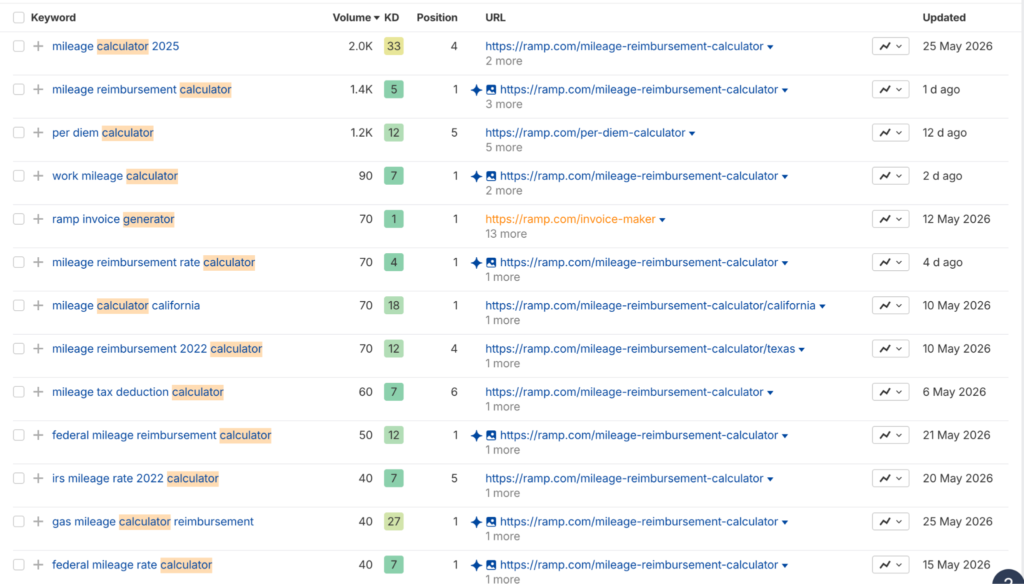
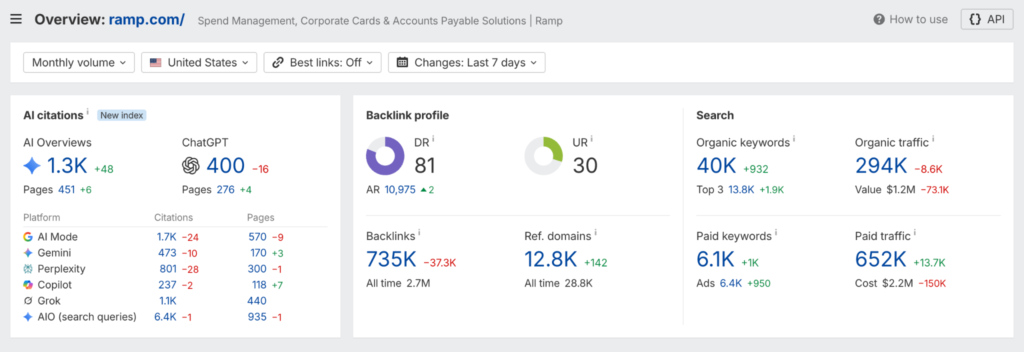
Here is the part we feel strongly about. Since we ran that teardown, Ramp’s organic traffic nearly doubled, from 121K to 294K a month. Impressive. But traffic is not the point. Pipeline is.
While you build the foundation, keep running experiments. And here is one of my personal life hacks when it comes to running those experiments: everything scales down.
No budget for an actor in a glass box? Film yourself doing the painful manual task on a kitchen timer, one take, post it as a short video. Same insight, one-thousandth the cost. Start with the smallest version that tests the idea, then scale what works, when it’s time to get audacious.
Concurate – Let’s Differentiate from The Commoditized AI Content
We founded Concurate in 2019. Our first clients came through referrals and cold outreach. Once we had the money and the resources, we started doing inbound for ourselves, the same boring foundational work we just walked you through.
But the reason our clients stay with us for years is simpler than any framework: the leads, demo requests, and signups we bring them, and the way we approach content. Well-researched. Engaging. Actionable. The results say it best:
- A B2B FinTech client: 24 high-intent leads from just three blog posts, no ad spend.
- Triangle IP, an early-stage patent SaaS: 565 user signups through pain-point SEO and product-led content.
But do not take our word for it. Gus Guida, Head of Sales and Marketing at Ratio Tech, calls us the partner who got into the weeds and delivered like an in-house team. Watch his testimonial below.
And while we have not made our audacious move yet, we have built something proprietary: our GEO framework, Perfect Match. The idea is that content should pull leads from Google, ChatGPT, or any channel who are so well-qualified that sales feels like a piece of cake. The pain that inspired this framework was our own wasted effort: sales call preparation, proposal creation, and a pilot article, only to learn the client did not have the budget to hire us. If this makes you want to talk, book a call.
Frequently Asked Questions (FAQs)
1. Why do Most B2B SaaS Listicles Fail?
Well, even AI can write B2B SaaS listicles, but those listicles rarely bring demo requests and signups. Here is why:
- Lack of hyperspecificity: If the reader cannot see themselves in it, they scroll past.
- Ignoring the human factor: In enterprise deals, people matter more than features. Buyers watch how your team shows up during customizations, onboarding, etc.
- Weak proof: A sanitized two-paragraph case study convinces no one. Show the problem, how frictions were overcome during solution implementation, and a result the reader recognizes.
- No video testimonials: A written quote is easy to dismiss. A real person on camera from a known company is a different category of proof.
- No proprietary layer: A framework your team built, data from your own tool, research tied to your category. Content only you can produce signals expertise AI cannot replicate.
2. What Are Some Examples of Content that Concurate has Written but AI Cannot Write?
AI cannot access tools; AI does not live experiences like us; AI cannot come up with something that we have not originated yet.
- Data-backed articles
- What 100 Recent Apple Patents Reveal About Who Decides at the USPTO (Combined data from BigQuery (Google Patents) and the TIP Tool)
- We Audited The Blogs Of Fintech Companies With $10M-$50M ARR. Here’s Why Most Struggle With AI Visibility (for topical authority around GEO)
- Experienced Based Thoughtleadership
- Our own proprietary framework for attracting ideal customers from AI tools so that discovery calls are just a formality to close
- The Perfect Match (sixth card on the home page)