



| TL;DR: Forbes Council membership starts at $2,500+ a year. Many members never publish. Of those who try, most make the same mistakes and face resistance from Forbes editors. This article covers five tips to help you write your debut piece the right way. It also walks you through what working with a ghostwriter looks like, if you’d rather not do it alone. |
I’ve spent the last seven years ghostwriting Forbes articles for council members along with my team at Concurate. In that time, we’ve worked with council members across industries, some of whom had been paying their annual fees for over a year without publishing a single piece.
A Forbes Business Council membership costs between $2,500 and $5,000 a year, plus a $600 initiation fee. That’s a real number. And yet, most members either don’t write at all or they write the wrong thing.
The platform isn’t about visibility for its own sake. It opens doors with media, government agencies, and enterprise buyers, but only when you use it right.
If you’re staring at a blank page, wondering how to write your debut Forbes piece, these five things are where I’d tell you to start.
- Look for the Gap Between a Report and the Ground
- Connect a Trend to What You See from Where You Stand
- Stop Promoting Your Product or Service
- Share Stories Only You Can Tell
- Balance Your Argument and Keep it Actionable
1. Look for the Gap Between a Report and the Ground
The easiest articles to write are the ones that agree with everyone. They’re also the easiest to ignore.
I was working with a technology leader in the AI space. When she first came to me, she wanted to write about how AI is transforming case management. It was a reasonable instinct. A BCG report had already made the case with hard numbers: one bank reduced false positives by 30% and improved case resolution time by 40%. The story seemed obvious.
I pushed back. Not because the data was wrong, but because it was already out there. Any Forbes reader in this space had seen a version of that report. What they hadn’t seen was someone explaining why, despite all of this, so many organizations were adopting AI in case management and not seeing a significant change on the ground.
That became the article. Instead of confirming what BCG had already said, it investigated the gap between what the research promises and what practitioners actually experience.
Forbes editors love references to credible research from BCG, McKinsey, HBR, Gartner, or Forrester. And our client brought something the report couldn’t: real experience of watching AI implementations play out inside actual organizations. That’s a recipe for success: insights plus story.
2. Connect a Trend to What You See from Where You Stand
When a trend breaks, Forbes covers it, and council members see an opportunity. But the pieces that actually get published aren’t the ones that explain what the trend is. They’re the ones where the author shares a specific vantage point on it, something only they can see from where they stand.
Take multi-agent systems. Gartner named multi-agent systems a top strategic technology trend for 2026. Numerous publications have covered it. Forbes Council members have covered it too, and the ones that landed each came from a completely different place.
One member looked at it from an enterprise architecture angle, writing about the architectural shift multi-agent AI systems are driving inside enterprise computing. Another came at it from an organizational trust perspective, arguing that trust-driven multi-agent AI could change everything about how businesses deploy these systems. A third came from a security background and wrote about the multi-agent security challenge and what it means for trust in an era of autonomous AI.
3. Stop Promoting Your Product or Service
The most common mistake council members make is treating their Forbes article as a channel to promote their brand. I understand the instinct. You’ve paid $3,100 or more. You want something in return. But this is exactly where members get it backwards.
A well-written Forbes article lets the reader conclude on their own that the author is worth reaching out to.
Let me explain, so a gym once offered me a free month and removed every possible barrier to showing up. I still never went back. Here’s why. No amount of removed friction replaces the moment a person decides for themselves. A Forbes article works the same way. The reader who finishes your piece thinking ‘I need to talk to this person’ will find you in two clicks through your bio. That conclusion has to come from within.
Forbes draws 109.2 million global monthly unique visitors, according to its own 2025 Media Kit. That audience shows up because they trust the editorial judgment. The moment a council post reads like a brochure, it breaks that promise. That’s why Forbes editors flag it.
4. Share Stories Only You Can Tell
Stories are the most underused asset in a Forbes article. Not case studies. Not data points. Actual moments that happened to you or someone you know, that made you stop and think differently about something.
One leader I worked with noticed something odd in a restroom in a state in the USA. The faucet sensor worked for the person next to her. It didn’t work for her. She looked into it and found that sensors had been tested primarily on lighter skin tones, with darker skin absorbing more infrared light and failing to trigger the sensor. That small observation in a washroom became a compelling argument in a Forbes article on AI bias in public health. It stopped readers because it was specific, personal, and impossible to fabricate.
You live moments like this every day. A client call that revealed something broken in how your industry operates. A product that failed in a way nobody talks about. A pattern you’ve noticed across ten years of work that nobody has named yet. The skill is learning to recognize those moments and connect them to what’s happening at the industry level.
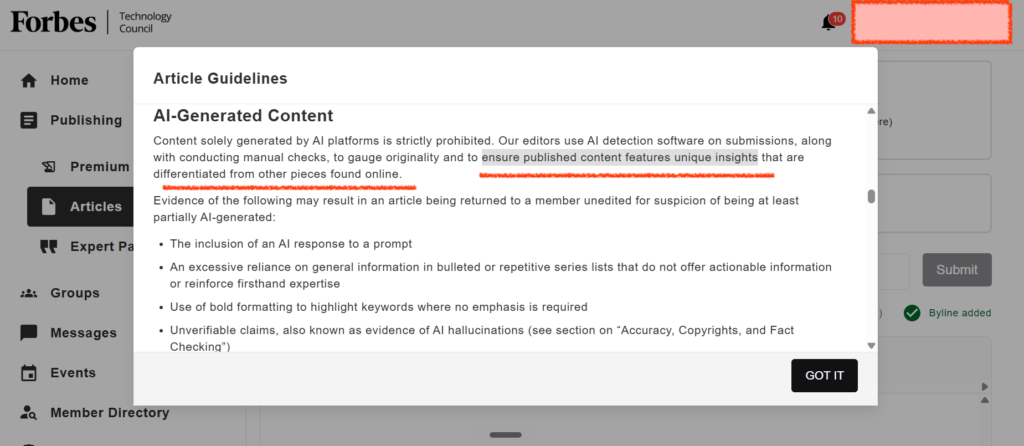
This matters more now than it ever has. As AI tools have made content easier to produce, Forbes editors have responded by raising the bar on exactly this: firsthand observation, specific experience, things no tool can generate.
5. Balance Your Argument and Keep it Actionable
One formula that has worked consistently across the hundreds of Forbes articles I’ve ghostwritten is this: if you’re advocating an idea, don’t just make the case for it. Tell the reader what stands in the way of adopting it, and then tell them exactly how to overcome those obstacles.
Forbes editors call this balance. What they’re really asking for is intellectual honesty. An article that only sells an idea reads like a pitch. An article that acknowledges the hard parts and still shows a way through reads like expertise.
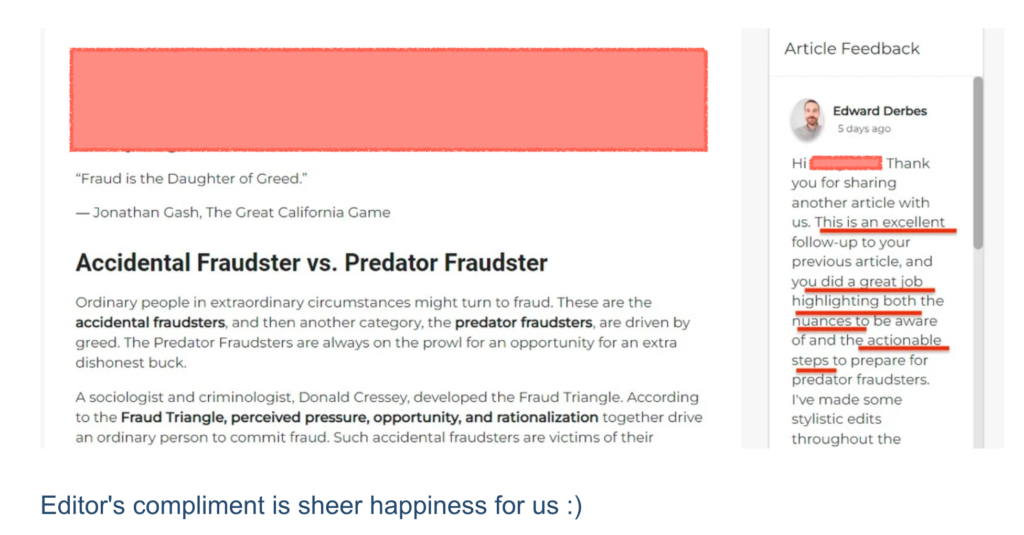
We have often received notes like the one shown below. An editor at Forbes wrote that the article did ‘a great job highlighting both the nuances to be aware of and the actionable steps to prepare’.
The tips are free. The hard part is execution. That’s what ghostwriters are for.
Concurate – Your Ghostwriters for Forbes Articles
If you’re looking for one, Concurate is a content marketing agency that has ghostwritten articles for Forbes Business Council, Forbes Technology Council, and Forbes Finance Council members for over seven years. Book a call here if you’d like to explore working together.
If they’ve raised more questions, the FAQ section below covers the most common ones. You can also connect with my colleague, Nitesh, on LinkedIn and take the conversation forward from there.
Frequently Asked Questions (FAQs)
1. How does Concurate Approach Ghostwriting Forbes Articles?
It depends on where the client is when they come to us. If you already have a topic, we research it and come up with interview questions so we can write in your voice. If you don’t have a topic yet, we can help identify one based on your expertise and what Forbes editors are likely to publish.
Once we zero down on the topic, here is what the process looks like:
- We research and interview you (45 minutes) to capture your voice and angle.
- We write the draft and send it to you for review.
- You approve or request revisions. We make the edits.
- We submit through your Forbes membership portal.
- If editors come back with feedback, we handle the edits, take your approval, and resubmit.
- In most cases, the article moves straight to proofreading and gets published.
The full process takes around four weeks: roughly ten days on our end, two to three weeks at Forbes. Most clients aim to publish one article every four to five weeks, However, realistically we have seen them writing five to six articles a year.
You can also read more about three content ideas for Forbes that fuel thought leadership if you’re still figuring out your angle.
2. How Much Does Concurate Charge to Ghostwrite a Forbes Article?
$1,200 USD per article. That includes topic research, a 45-minute interview, the draft, revisions, submission, and handling any editor feedback through to publication. Everything.
3. Has Concurate Written Forbes Articles for Leaders in My Industry?
We’ve written Forbes articles for leaders in fintech, enterprise AI, fraud investigation, weapon detection systems, digital twins, women’s leadership, robotics, and more. But industry experience is actually the wrong thing to evaluate in a ghostwriter.
We’ve seen a patent attorney fail to write compelling content for the Intellectual Property space. Deep domain knowledge doesn’t automatically translate into good writing. What translates into good writing is the ability to ask the right questions.
A ghostwriter who asks intelligent questions can get inside a difficult subject quickly, understand what’s genuinely interesting about it, and write something that sounds like the expert in the room. That’s the skill worth evaluating.