


| TL;DR: We analyzed how AI platforms like ChatGPT, Gemini, Claude, and Perplexity recommend fintech SaaS companies and found that several $10M+ ARR brands barely show up, even though they have real customers, proven products, and years of market presence. The core issue is that their content doesn’t clearly connect their brand to high-intent searches, buyer questions, comparison moments, use cases, or external discovery channels. If your fintech SaaS company isn’t showing up in AI answers, you’re likely missing from buyer shortlists before prospects even visit your website. This article breaks down why that happens and shares a few practical ways to improve AI visibility for your fintech platform. |
Over the last few months, we’ve looked at a lot of fintech SaaS companies that were doing objectively well as businesses. Many had been around for years and were already in the $10M+ ARR range.
But when we searched for them across ChatGPT, Perplexity, and Google, for even basic “best fintech software” queries, most of them were surprisingly hard to find. In many cases, smaller competitors with lesser revenue had far stronger visibility.
That’s a problem because AI tools are increasingly shaping how buyers discover and shortlist software vendors. In fact, 51% of B2B software buyers now start their research with an AI chatbot more often than Google. And from what we observed, many fintech SaaS companies still aren’t positioned well for that shift.
After auditing these fintech companies’ blogs and content strategies more closely, a few patterns began to emerge. In this article, we’ll break those patterns down and look at what other fintech SaaS companies can learn from them.
How We Selected the Fintech SaaS Companies for This Audit
Once we started noticing that several established fintech SaaS companies had surprisingly weak AI visibility, we wanted to test whether this was an isolated issue or a broader pattern. So, we did a structured experiment:
- We know that AI visibility takes time to build. So, we started by creating an initial list of 15 fintech SaaS companies that:
- had been around for at least 5 years
- operated in established fintech categories
- were estimated to be in the $10M to $50M ARR range
- Then we tested how visible these companies actually were across ChatGPT, Perplexity, Claude, and Gemini. We ran a mix of broad and high-intent buyer queries to see which companies consistently appeared across AI-driven search journeys. Some of the queries we used included:
- best fintech SaaS platforms
- best software for finance teams
- best financial workflow automation software
- best credit risk management software
From our initial list of 15 companies, a few appeared occasionally in one or two searches. But five companies consistently showed very weak visibility across platforms and query variations. These were LoanPro, Bectran, VoxSmart, NYMBUS, and Modern Treasury. So, we decided to audit their blogs and content strategies more closely.
4 Reasons Why These High ARR Companies Rarely Get Cited by AI Tools
After identifying the companies that were invisible to AI tools, we moved to the harder question: why. But before digging further, we ruled out the obvious explanations.
First things first, the names on our list weren’t struggling startups. From LoanPro to Modern Treasury, all have real customers, proven products, and legitimate market traction. So clearly, the AI visibility gap wasn’t due to weak products or bad reviews. Additionally, these companies pull in $10-$50 million in ARR and have been in the market for a significant amount of time. So, lack of funding or brand recognition wasn’t a reason either.
Hence, we knew they were missing something specific. Something tactical that the AI-visible companies had figured out. So, we analyzed their blogs, resource pages, and content engines to see what gaps existed. And the pattern was mostly consistent across all five:
1. They’re Missing the Content That Buyers Actually Search For
When buyers evaluate software options, they usually look for content that helps them make a decision. Think top tools lists, product comparison content, use-case pages, and customer success stories. This kind of content answer the questions buyers already have when they are trying to understand which vendor fits their needs. They also give AI tools clearer information to pull from when someone asks which product to choose, how one tool compares with another, or which software fits a specific use case.
However, almost none of the companies on our list seemed to be publishing such content. In fact, this was the most glaring pattern we observed in our audit.
Take LoanPro, for example.
If you head to LoanPro’s blog, you’ll find they’ve got a few case studies on their blog, with some of them appearing more like short outcome summaries than full case studies built to help buyers evaluate the platform.
From what we’ve seen, case studies that convert well usually show the before, the after, and the business reason behind the switch. LoanPro’s content doesn’t always do that. And when we looked for comparison pages, we couldn’t find any.
You might wonder, “What’s the problem with that?” If someone searches “LoanPro vs Turnkey Lender” or “LoanPro vs Nortridge,” they may not find LoanPro’s own perspective. Instead, they may find peer review sites like Software Advice’s coverage on the topic, or competitor-written pages like Nortridge Vs. LoanPro comparison article.
That’s a missed opportunity. LoanPro clearly has strengths worth explaining, especially around API-first lending infrastructure, automation, and developer-led flexibility. But without its own comparison or evaluation content, it leaves others to frame those strengths for buyers.
NYMBUS takes this pattern even further.
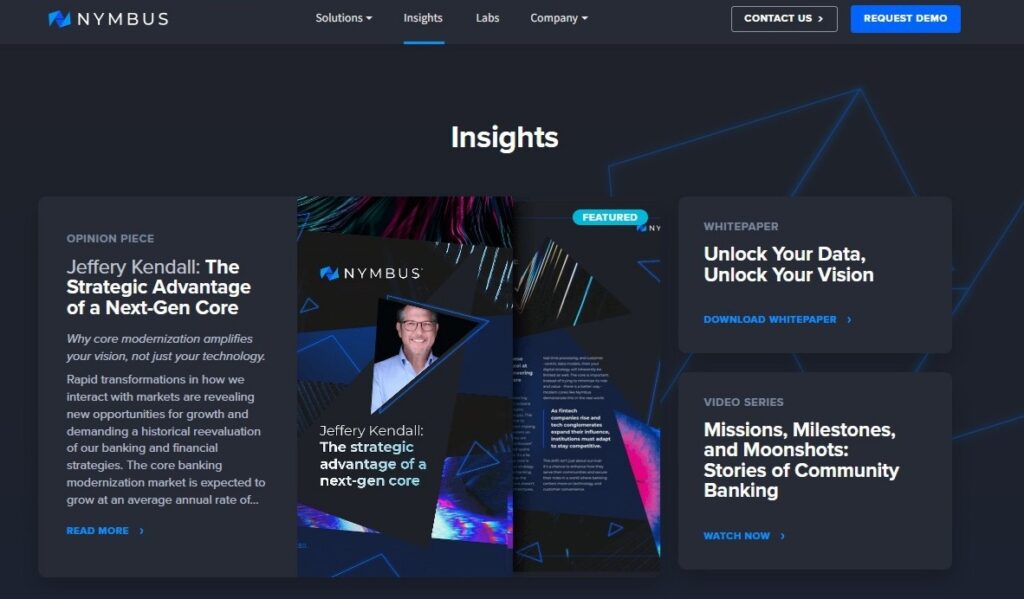
Source – NYMBUS
For starters, they don’t even have a traditional blog. Instead, you’ll find an Insights page with a mix of articles, whitepapers, videos, webinars, infographics, toolkits, and opinion pieces.
The limited content library touches on useful themes related to banking. However, it may not always help a potential buyer understand whether NYMBUS is the right fit for their specific use case.
That creates a discoverability gap. When AI tools look for helpful decision-making information, they need clear content around customer problems, use cases, comparisons, and outcomes. They want to see “Here’s how we solved X problem for Y type of company” or “Here’s why you’d choose us over Competitor Z.” Without that, there’s not much for them to reference when buyers ask which vendor fits their needs.
If you want to write powerful SaaS case studies and testimonials with ChatGPT, read our guide here.
2. They’re Stopping at Publishing Educational Content
Educational content isn’t necessarily ineffective. In fact, many fintech SaaS companies rely on it to explain industry trends, answer common customer questions, and build visibility around broader topics.
The issue usually comes down to differentiation. When educational content stays too broad or closely mirrors what dozens of other companies are already publishing, it becomes harder for buyers or AI systems to associate that expertise with a specific brand.
Bectran’s blog is one example.
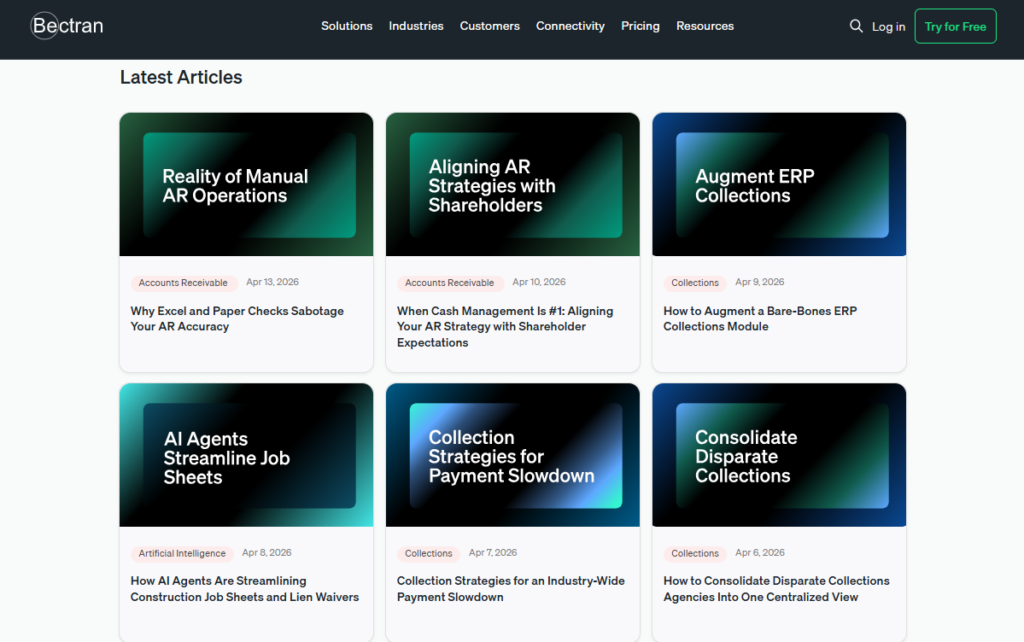
Source – Bectran
Scroll through, and you’ll see articles like “Why Excel and Paper Checks Sabotage Your AR Accuracy” or “Collection Strategies for an Industry-Wide Payment Slowdown.” These are relevant topics for finance and credit teams, and the information itself is useful. However, most of the content stays fairly high-level.
However, much of the content is framed as broad industry education first, with Bectran’s product capabilities appearing later in the article.
From what we observed, there are limited examples where the content brings in proprietary insights, original research, customer-backed learnings, or a particularly strong point of view that distinguishes Bectran from other fintech vendors writing about similar subjects.
In a few cases, the content references Bectran’s product capabilities. But overall, the blog leans more toward general industry education than brand-led expertise.
VoxSmart follows a similar playbook.
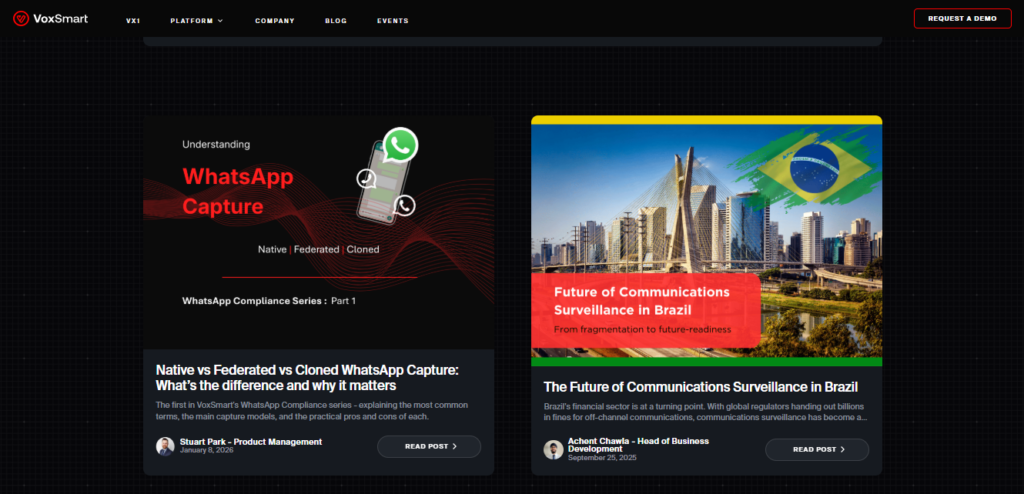
Source – VoxSmart
VoxSmart’s barely active blog talks about communications surveillance, regulatory compliance, and fintech trends.
However, much of the content appears designed to explain industry topics broadly rather than showcase insights that feel uniquely tied to VoxSmart’s experience, customer base, or product perspective.
In both cases, the content is informative and relevant, but often interchangeable with what many others in the industry are publishing. That creates a visibility problem, especially in AI-driven discovery environments.
Basically, when content lacks proprietary insights, differentiated positioning, strong customer proof, or a distinct perspective, AI systems have fewer signals connecting that expertise to a specific company. As a result, the brand becomes harder to associate with ownership of a category, problem area, or use case.
3. Their Strong Content Engine Is Not Fully Mapped to Buyer Evaluation Paths
This pattern showed up across several fintech SaaS companies in our audit. Modern Treasury is one of the examples of the same.
Source – Modern Treasury
Modern Treasury has a dedicated Journal section on its website that covers topics like payment operations, RTP, FedNow, reconciliation, and financial infrastructure. The content is well-organized, educational, and clearly backed by strong domain expertise. In fact, compared to several other companies in our audit, Modern Treasury already has a much deeper and more active content engine.
However, the gap becomes clearer when we look at how that content maps to buyer-intent searches. Modern Treasury ranks for 4,500+ organic keywords overall, but when we filtered for non-branded commercial and transactional keywords in Ahrefs, only 62 keywords remained. Most of those also appeared to be tied to educational or informational content rather than clear buyer-evaluation pages.
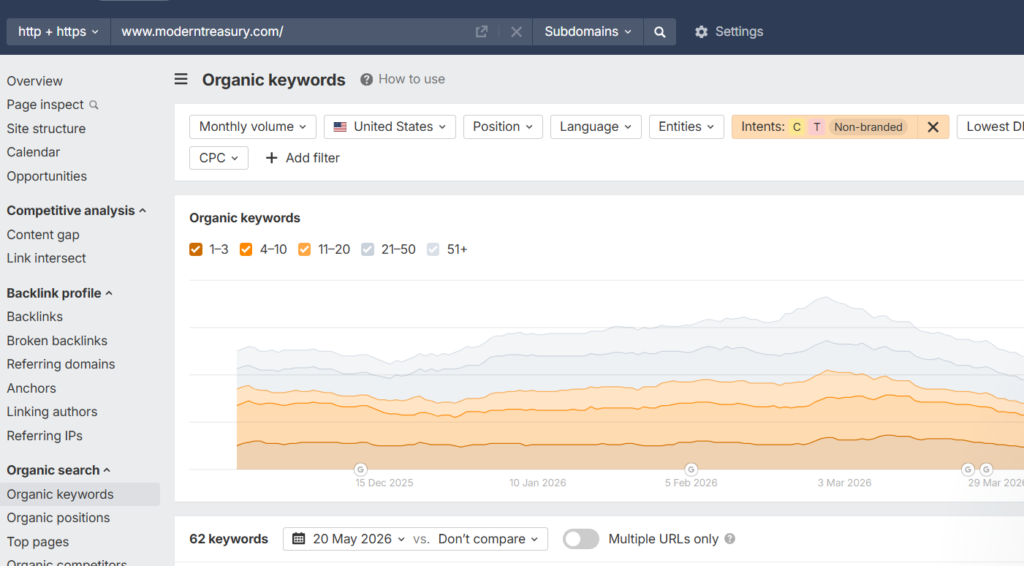
In other words, the issue is not content quality or volume. The opportunity is to connect that existing depth more directly to how buyers evaluate vendors during the decision-making process.
For example, Modern Treasury has detailed explainers on payment infrastructure and treasury operations. But we couldn’t find many visible examples of decision-stage content expanding systematically across:
- industries,
- use cases,
- buyer scenarios,
- competitor comparisons,
- or implementation workflows.
This distinction matters because strong educational content alone does not always create strong evaluation-stage visibility. A brand can rank for many informational topics and still miss searches where buyers are comparing options, shortlisting vendors, or looking for implementation fit.
Modern Treasury’s current strategy may already be working well for building awareness and authority around payment infrastructure topics. However, expanding that foundation into more decision-stage content could help the company capture more commercial search opportunities. It would also give AI systems clearer repeated context around which industries, operational problems, and buying scenarios Modern Treasury is most closely associated with.
4. They Have Limited Presence Across External Discovery Channels
This one surprised us. We’re talking about companies with tens of millions in ARR that still appear to have a relatively limited presence on platforms where buyers and industry professionals already spend time, such as YouTube and LinkedIn.
Take LoanPro, for example.
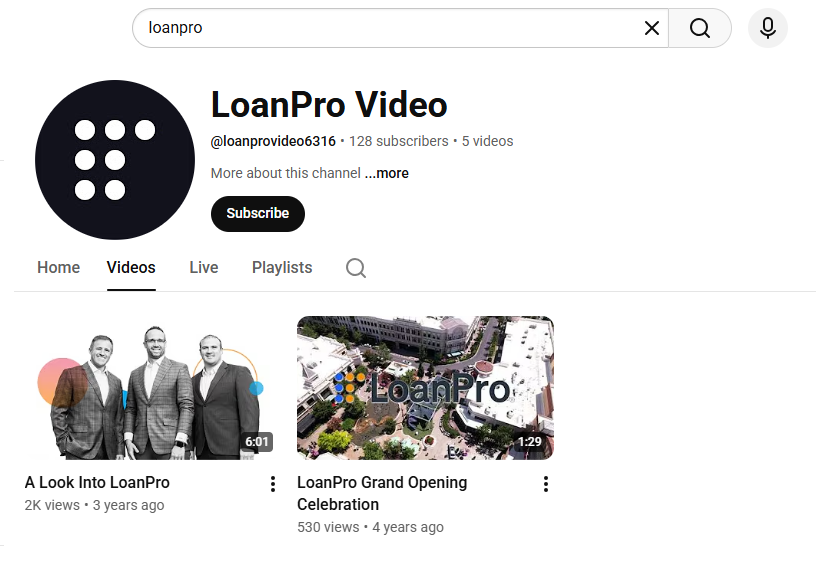
Source – LoanPro’s YouTube
LoanPro has invested in content initiatives like the “Accrued” podcast in partnership with Fintech Confidential, which shows an effort to participate in broader fintech conversations. However, beyond that, its visible presence across platforms like YouTube and LinkedIn appears relatively limited and less consistent.
VoxSmart has the same gap.
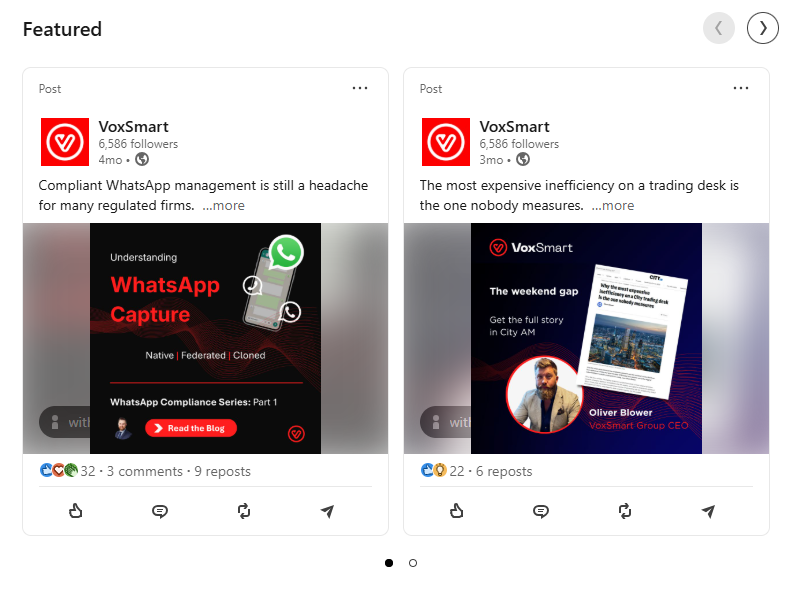
Source – VoxSmart’s LinkedIn
VoxSmart’s LinkedIn page occasionally posts company updates and industry news. But there’s no consistent content engine creating videos, hosting webinars, or sharing insights that could get distributed across platforms.
This matters because AI visibility is no longer shaped only by website content. These systems are increasingly learning from video transcripts, podcast episodes, LinkedIn posts, and webinar recordings. So, if your content only lives in one place, you’re limiting the surface area AI tools have to learn about you.
5 Tips for Fintech SaaS Companies Struggling to Dominate AI Search Results (With Real Examples)
AI visibility doesn’t improve just because a company publishes more. It improves when its content gives AI tools clear, useful, and repeated signals about what the company does, who it’s for, how it compares with other options, and where it fits in the buyer’s decision process.
Here are five practical ways fintech companies can do that, with examples from brands already getting this right:
1. Create Content Around the Searches Buyers Already Make
When buyers are close to making a decision, your content should help them evaluate, compare, trust, and move forward. That sounds obvious, but this was one of the biggest gaps we saw in the companies we audited.
So instead of only publishing generic educational pieces, build pages around high-intent searches like:
- best loan servicing software
- LoanPro alternatives
- best credit risk management software for B2B lenders
- top treasury management platforms
- best payment operations software for marketplaces
- accounts receivable automation software for finance teams
Ramp is a good example of this strategy executed well.
Source – Ramp
Ramp doesn’t just publish broad finance education. It has content around very specific buyer-stage searches like best expense management software in 2026, best accounts payable automation software, top business credit cards, etc. These pages directly match how finance buyers search when they’re evaluating tools, and so, AI tools are much more likely to cite them.
Once buyers start evaluating options, they’re already deep into the decision process. At that point, they don’t just want to know what your product does. They want to know how it stacks up against other tools, where it fits better, what trade-offs to consider, and whether it’s the right choice for their use case.
2. Help Buyers Compare Their Options Before Someone Else Does
If your website doesn’t help them answer those questions, they’ll still find answers elsewhere. And once that happens, you lose some control over how your product is explained. So, create focused comparison or alternatives pages like:
- [your product] vs [competitor]
- [competitor] alternatives
- [category] software comparison
- [product type] vs [product type]
- best [software category] for [specific use case]
Brex is a strong reference point here.
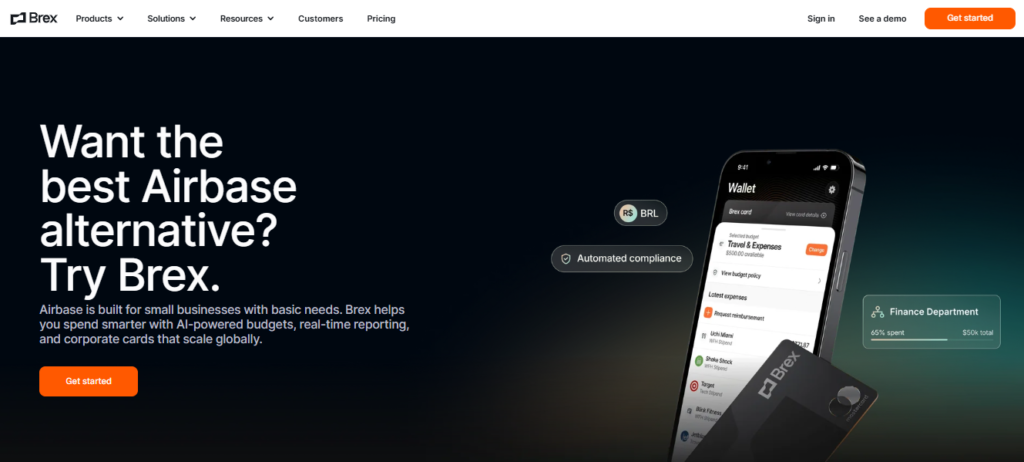
Source – Brex
It has pages like “Brex vs Airbase,” “Brex vs BILL,” etc. These pages help buyers compare tools, understand differences, and evaluate fit before speaking to sales. It also states the aspects where Brex is better than its competitors.
This approach works best when it is fair, specific, and useful. The goal is not to criticize competitors or force a comparison where it does not belong. The goal is to help buyers understand the differences between available options, while giving LLMs clean, structured information to reference.
3. Turn your blog into a repeatable content system
Most fintech SaaS companies publish a good post here, a case study there, maybe one guide every few weeks. But there’s no visible system behind it. It hinders their AI visibility because these systems need repeated signals across different buyer intents, use cases, industries, integrations, and comparison points to gain enough trust to cite you.
So, a foolproof approach is to build a repeatable content engine that targets buyer-specific queries. For example:
- best [software category]
- [software category] for [industry]
- [workflow] automation software
- [platform] integration guide
- [company] alternatives
- [company] vs [competitor]
- how [specific team] solves [specific workflow]
- case study for [industry or use case]
4. Add proof that makes the content cite-worthy
Most fintech SaaS companies already have proof that can build trust and visibility. But it’s sitting in places that buyers and AI tools can’t access, like sales decks, onboarding notes, and customer success stories.
So, instead of making broad claims like “automation improves efficiency,” use that proof to turn real outcomes into content assets. Show what changed, who it helped, how long it took, and what the result looked like.
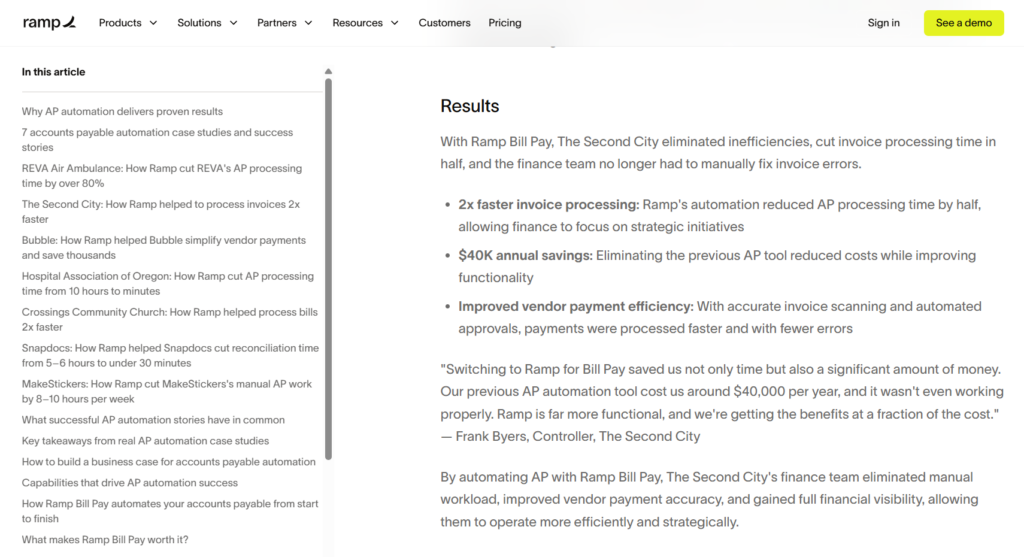
For example, see Ramp’s AP automation case study page.
Source – Ramp
It doesn’t just say AP automation saves time. It backs that claim with customer proof and quantified outcomes, such as “2x faster invoice processing” and “$40K in annual savings.”
That’s the kind of proof buyers can use when they’re building a business case. It also gives AI tools specific evidence to reference instead of pulling from vague product claims.
5. Build visibility beyond your own website
Your website matters. But it can’t be the only place where your expertise exists. So, build your company’s presence across external channels like YouTube, LinkedIn, Review platforms, and community discussion sites like Quora and Reddit.
The reason is simple: every external channel creates network effects. A YouTube video gets embedded in forum discussions. A LinkedIn post sparks conversations. A webinar recording gets referenced in buyer research. Each of these creates additional signals that tell AI tools “this company has something valuable to say about this topic.” Without that wider presence, buyers and AI tools have fewer ways to discover, understand, and trust your company.
Want to Improve Your AI Visibility in the Fintech SaaS Space? We’re Here for You!
Fixing AI visibility isn’t about gaming algorithms or chasing shortcuts. It’s about understanding what buyers actually need at each stage of their journey and building content that bridges the gap between their questions and your solution.
At Concurate, we’ve developed the Perfect Match Framework to solve exactly this problem.
We start by defining your ideal customer profile and benchmarking where your brand currently shows up in AI answers. Then, we audit your content and technical setup to identify what’s working and what’s broken. From there, we strategize a plan to get you found by the right buyers, create the content that positions you as the best choice, and monitor performance to make sure your AI visibility keeps growing. We’ve successfully applied this methodology to help several companies improve their visibility in AI overviews, so we know, it works!
If you’re a fintech SaaS company ready to fix your AI visibility gaps and start showing up in the buyer research journeys that matter, let’s talk. We’ll audit your current content strategy, identify the specific gaps holding you back, and build a roadmap to make your brand impossible for AI tools to ignore.
Still not convinced? Hear directly from one of our clients as the CMO of Silicon Valley fintech company Ratio shares their experience of building a long-term partnership with Concurate.
Frequently Asked Questions:
1. Why do AI tools recommend my competitors but not mention me in “best fintech software” searches?
AI tools may recommend your competitors more often because those competitors have built stronger discoverability ecosystems around their brand. This usually includes more comparison content, stronger backlinks, clearer positioning, and stronger coverage across high-intent searches .
2. What kind of content helps fintech SaaS companies appear in AI recommendations?
Content that helps buyers compare, evaluate, and trust a product is more likely to support AI visibility. This includes comparison pages, alternatives pages, integration pages, industry-specific solution pages, customer stories, and detailed workflow content that clearly explains who the product is built for and why buyers should choose it.
3. How can I make my fintech SaaS product easier for AI tools to understand?
You can make your fintech SaaS product easier for AI tools to understand by clearly defining your category, ideal customers, use cases, integrations, and core workflows across your website. AI systems struggle with vague messaging that sounds generic or interchangeable with every other fintech platform in the market.
4. How do I find the AI search queries my buyers are likely asking?
You can find the AI search queries your buyers are likely asking by studying demo calls, sales conversations, CRM notes, support tickets, and competitor research. Buyers often ask AI platforms the same questions they ask sales teams, especially around pricing, integrations, implementation, alternatives, and industry fit.
Disclaimer: The information presented in this article is compiled from publicly available sources, including company websites, industry reports, and social media. All trademarks, brand names, and logos mentioned are the property of their respective owners. We do not claim any ownership of third-party marks, nor do we imply endorsement or affiliation. This article is intended for informational purposes only.