

| TL;DR: Big CRM brands do not own every high-intent search. We found 50 high-intent CRM keywords where HubSpot, Salesforce, and Pipedrive had all lost rankings. The companies had not just lost ranking on generic terms, but also on branded and competitor-led keywords. For CRM companies, that creates a real opportunity. Build content around industry-specific searches, scale what works, and create comparison pages that help you show up when buyers are closer to a decision. Read all the winning strategies in this guide. |
When you look at the CRM market, there are a few popular names that dominate the market. Think Salesforce, Zoho, HubSpot, Pipedrive, and Monday.com. The truth is, there are hundreds of CRM products. 140, to be precise, if you go by Zapier’s 2025 best CRM software roundup.
Among them, the top names have strong brand recall, established authority, and years of visibility behind them. So the natural assumption is that they also dominate the search moments that matter most.
But that assumption does not always hold up.
Over the last three months, Google rankings have shifted across categories, and many companies have lost visibility for keywords they once ranked for. Popular CRM tools were no exception. They lost rankings too, including across high-intent CRM categories.
It could possibly be due to Google’s push against thin content, lower CTR, or other reasons.
However, the good news is that if you are a CRM player, this is the best time to make the most of it. In this article, we will go through some practical strategies you can adopt so you can start ranking for these high-intent terms and hold those rankings for a long time.
How We Found These 50 High-Intent CRM Keywords
To build this analysis, we started with a simple question: if some of the biggest CRM brands are so visible in the market, where are they still losing search visibility?
We began by looking at the CRM space more broadly. Across search results and industry conversations, a few names kept showing up repeatedly.
Salesforce, HubSpot, and Pipedrive were among the most prominent. Often recognized as category leaders, they made strong candidates for this analysis.
Next, we used Ahrefs to look at the organic keywords each of these domains had lost rankings for over the comparison period. Since all three websites sites rank for thousands of keywords, we narrowed the dataset using keyword filters like “CRM” and “customer relationship management” so the analysis stayed focused on CRM-related searches.
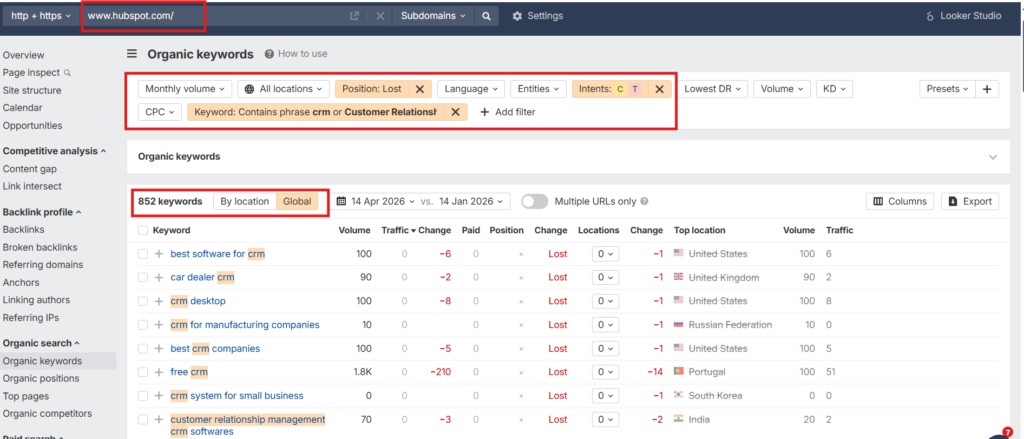
Source – Ahrefs for Hubspot
From there, we filtered for commercial and transactional intent to isolate keywords with stronger buying intent. In other words, we focused on searches from users actively comparing CRM tools or getting closer to a decision.
We repeated this process for all three websites. For instance, here is a snapshot from Ahrefs for Pipedrive and Salesforce.
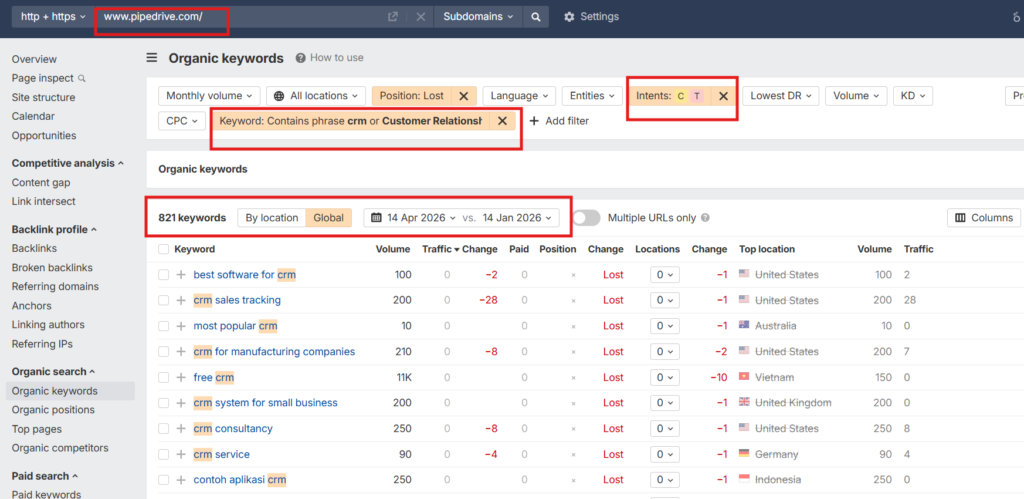
Source – Ahrefs for Pipedrive
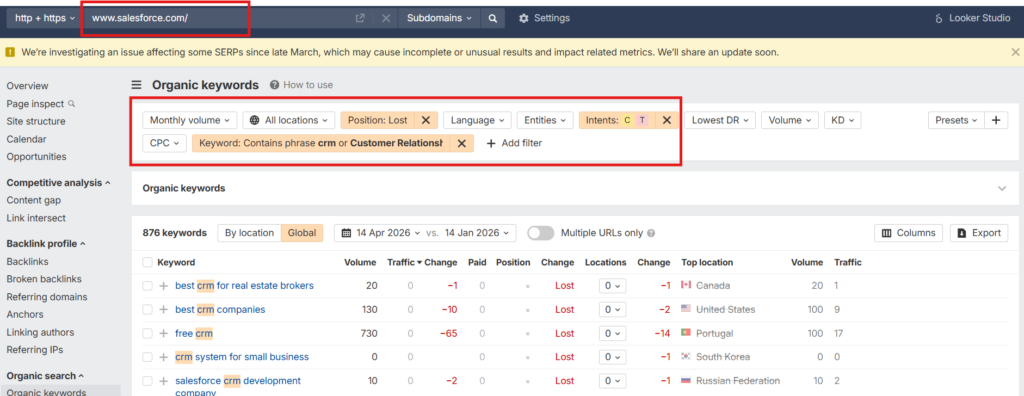
Source – Ahrefs for Salesforce
We then compared the lists to find the overlapping keywords across all three. There were 176 keywords in total, out of which there were a set of branded keywords too, like Zoho CRM, Prospect CRM, and more.
From that overlap, we removed the branded terms and narrowed the list to 50 high-intent CRM keywords based on relevance, intent, and search volume. That final list became the basis for the analysis in this article.
The 50 High-Intent CRM Keywords These Companies Lost Rankings For
Among the thousands of keywords these companies rank for, this list focuses on a much more valuable slice: 50 high-intent CRM keywords that all three lost rankings for. These are the kinds of keywords people use when they are actively evaluating CRM tools, comparing options, or looking for a solution that fits a specific business need.
What makes this list interesting is the range inside it. Some keywords are broad and commercial, such as “crm software” and “best crm.” These are the kinds of terms that buyers would normally Google when looking for a CRM. Then there are others, that are more specific and built around clear use cases, industries, or buyer contexts, such as:
- crm for lawyers
- travel agency crm
- crm software for insurance brokers
The gap is not limited to one part of the CRM market. It runs across broad software terms, small business queries, industry-specific searches, and comparison-led keywords that your potential buyers are actively searching for when looking for a CRM. Here’s the full list.
| Keyword | Volume |
| crm software | 1240 |
| best crm | 860 |
| construction crm software | 800 |
| free crm | 730 |
| best sales crm | 700 |
| crm for consultants | 450 |
| field service crm software | 400 |
| landscape crm software | 400 |
| popular crm systems | 400 |
| customizable crm software | 360 |
| crm for lawyers | 350 |
| crm software development company | 350 |
| simple crm software | 350 |
| free crm software | 310 |
| service crm software | 280 |
| best crm for small business | 270 |
| fitness crm software | 250 |
| travel agency crm | 250 |
| crm for small business | 220 |
| crm software for insurance brokers | 200 |
| free crm for realtors | 200 |
| good crm systems | 200 |
| real estate crm | 200 |
| tour operator crm | 200 |
| online crm software | 190 |
| best small business crm | 180 |
| crm for real estate | 180 |
| best crm in the market | 170 |
| best crm for real estate | 160 |
| small business crm | 160 |
| best crm for home service business | 150 |
| best crm for sales and marketing | 150 |
| best crm management software | 150 |
| crm software for charities | 150 |
| sales pipeline crm software | 150 |
| wholesale crm | 150 |
| crm for small businesses | 130 |
| crm for accounting firms | 110 |
| estate agency crm | 110 |
| best crm for ecommerce | 100 |
| best crm systems | 100 |
| crm software development companies | 200 |
| crm software for small business | 90 |
| home care crm software | 90 |
| best crm for saas | 90 |
| best crm for google apps | 80 |
| best travel crm | 80 |
| retail crm | 80 |
| ecommerce crm | 60 |
| best sales automation crm | 50 |
These Companies Were Also Losing Ground on Competitor-Led Searches
While the final list of 50 focused only on high-intent CRM keywords, that does not tell the full story. The broader set of 176 keywords also covered a number of branded and competitor-led keywords, such as the ones listed below:
| Keyword | Volume |
| hubspot crm | 49500 |
| recruit crm | 7050 |
| power crm | 6100 |
| zoho crm | 4000 |
| hubspot crm pricing | 3750 |
| google crm | 300 |
| begin crm | 290 |
| close crm | 200 |
| crm microsoft | 200 |
These companies were not just ranking for generic CRM terms. Their content was also helping them appear for searches tied to their specific competitors and branded queries. And note that, this is organic keyword data, not paid search data.
The companies have built a broader content footprint that helps them rank on these terms. How are they ranking for these branded and non-branded keywords? Let’s find out in the next section.
How These Companies Were Ranking for Branded and Non-Branded Keywords
These rankings were a result of continuous efforts and deliberate content strategy planned by these companies.
For instance, they had built industry-specific pages that helped them rank on the industry-specific keywords. Like this snapshot of the industries page created by Pipedrive:
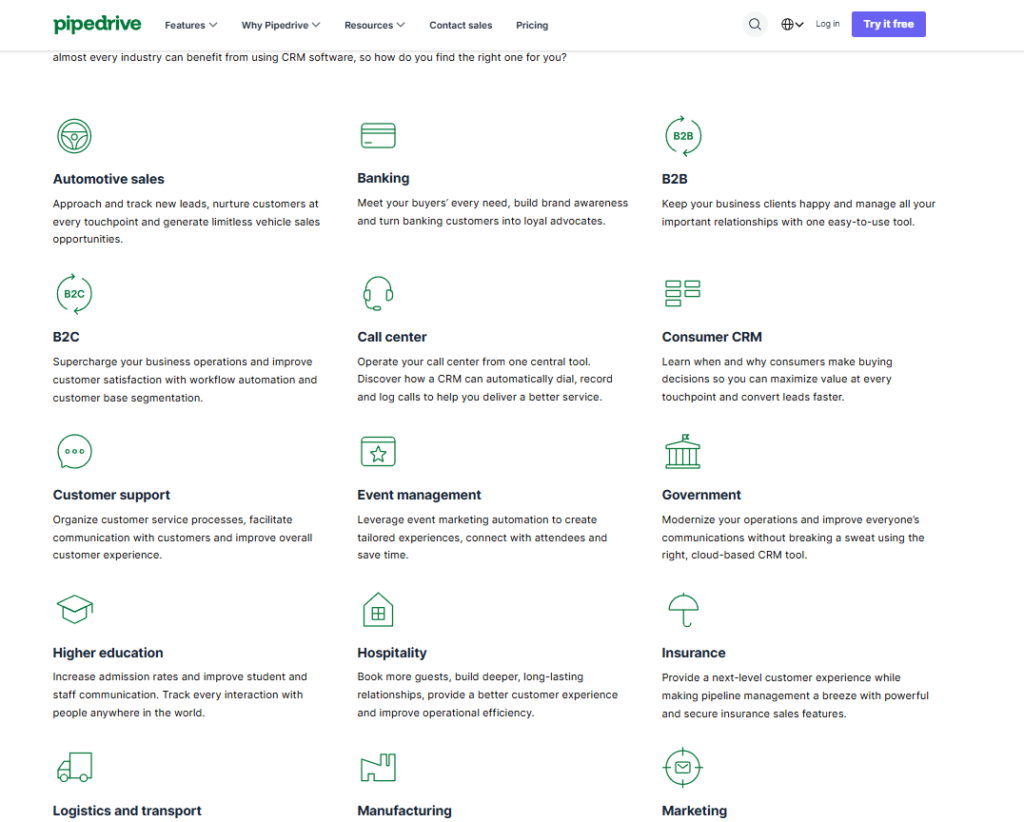
This particular page on CRM for SaaS helps them rank for keywords like Best CRM for SaaS.
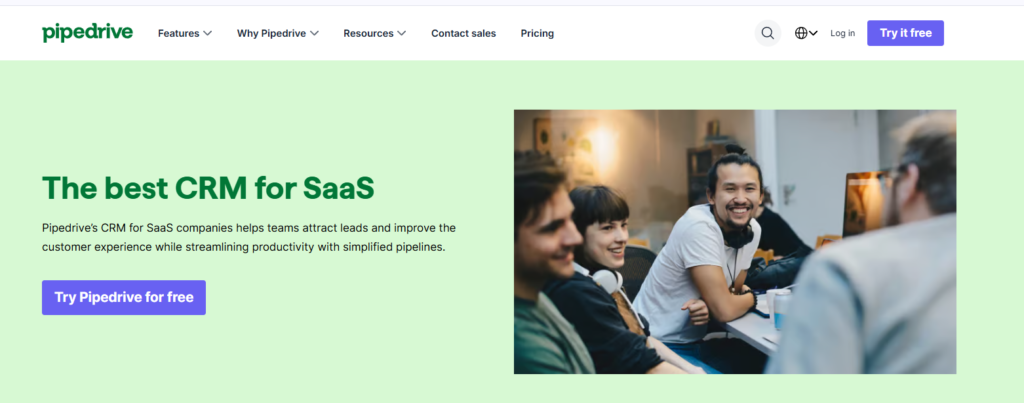
Source – Pipedrive
The strategy is not limited to pages alone. They have also published blogs that help them rank for these keywords.
HubSpot’s accounting software CRM article is a good example of the same.
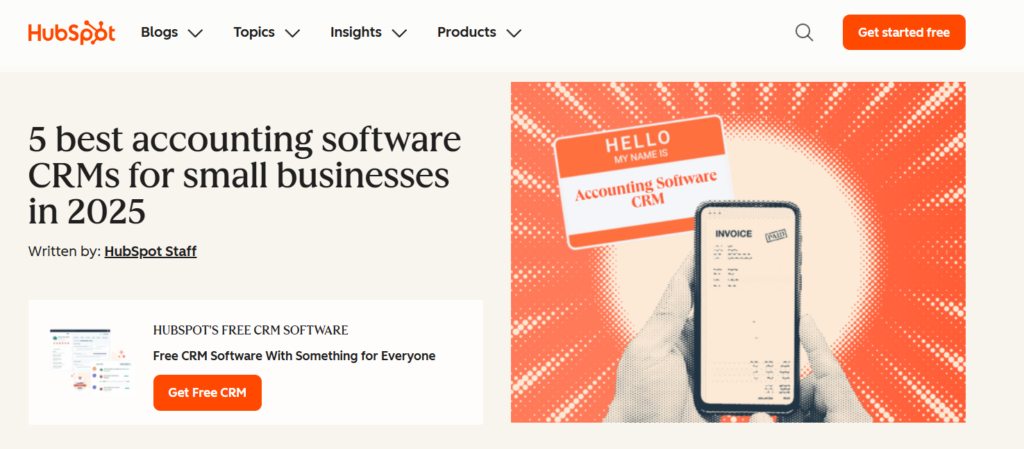
Source – Hubspot
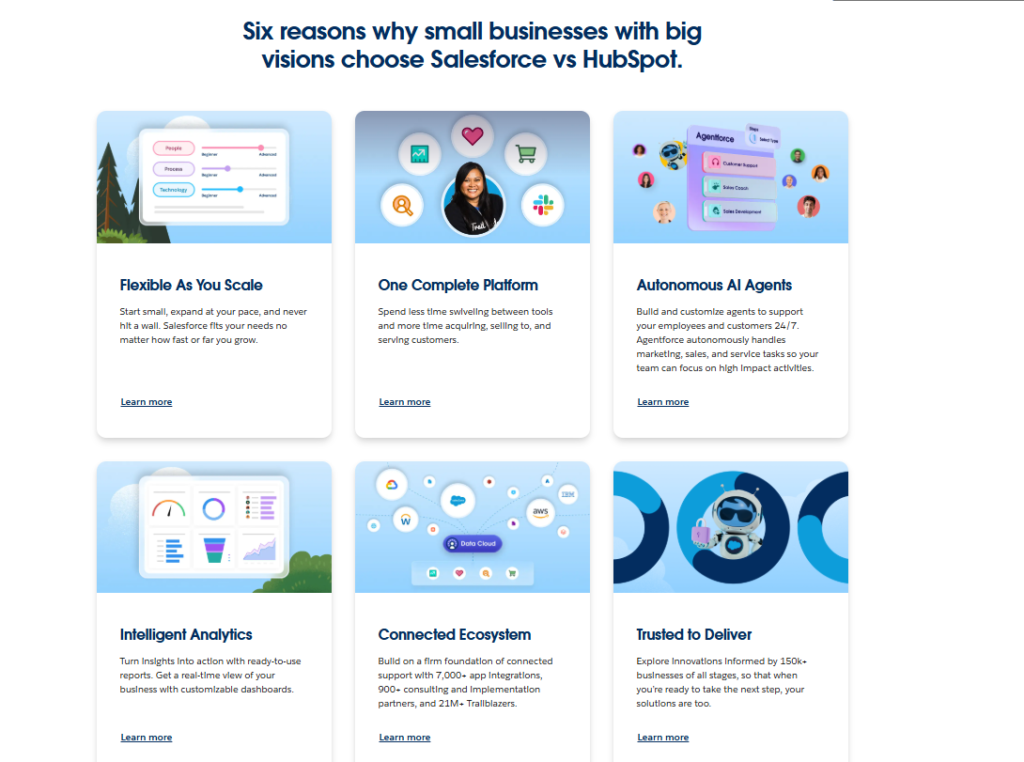
That’s just a snippet of the strategy. They were also ranking on branded competitor queries by creating comparison content.
For instance, Salesforce has created comparison pages comparing themselves with competitors like HubSpot, as shown below.
Source – Salesforce
There are a lot of playbooks in action here that are working for these companies. And you can benefit from them too. Here are some ways you can rank for some of the above top 50 terms and other competitor keywords. Let me walk you through them in the next section.
3 Strategies That Can Help You Rank for High-Intent CRM Keywords in 2026
At Concurate, we feel there are some clear patterns behind how companies rank for high-intent keywords across use cases, industries, and buyer intent. The good news is that these are not one-off tactics reserved for category leaders. They are practical plays that other CRM companies can start using too.
If you too want to rank for more than just a handful of broad CRM terms, you need a content strategy that matches how buyers actually search. That means thinking beyond one product page and building content that can help you appear in evaluation and decision-stage queries. Here are three strategies that can help you do that.
1. Create Content Around the CRM Searches Your Buyers Actually Make
When buyers search for CRM platforms, they do not just stop at broad terms like best CRM platforms. While some users do, it is only one part of the search behavior.
In many cases, your prospects are trying to find what works best for their industry, business model, or workflow.
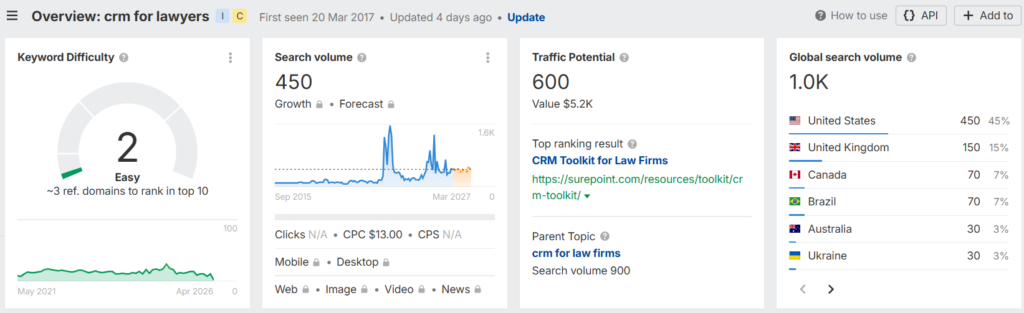
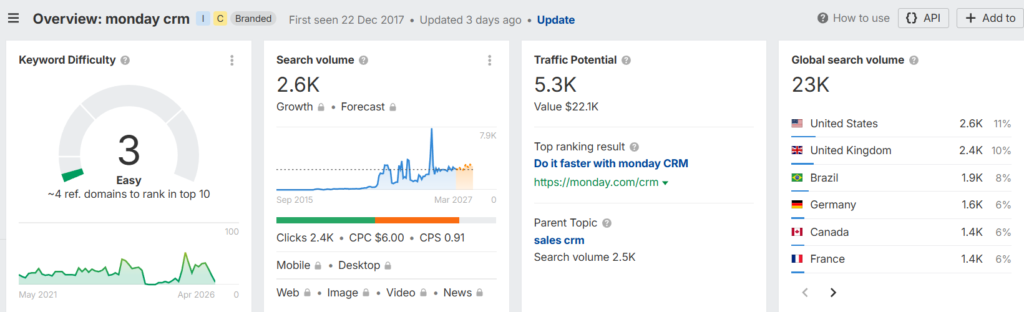
So instead of searching only for generic terms, they Google or ask AI surfaces queries like “CRM for lawyers,” “CRM for travel agencies,” or “CRM for small businesses.”
Source – Ahrefs
Source – Ahrefs
These are highly valuable terms because the buyer intent is very clear. Plus, they have high search volume, as evident from search volume trends, and can be easier to rank for. If you are not creating content around these queries, you are missing out.
So if you’re a CRM company, and your platform is better suited for a certain industry or use case, one of the smartest things you can do is build content around those keywords.
There are two ways to go about it:
- Create dedicated landing pages for each industry, just like we saw in the Pipedrive example above.
- Create blogs around those terms, which is also a very common and effective strategy.
We have seen the latter play out in practice many times. In fact, a few months ago, one of our patent-tech clients was trying to make its mark in a space already dominated by bigger, better-known tools.
By creating blog content around high-intent, high-value keywords, they were able to start ranking on multiple terms on Google within a couple of months and generate 13 organic leads in that period.
The lesson here is simple: do not just chase broad CRM keywords. Build content around the industries and use cases where your product is actually a strong fit. That is often where the real traction begins.
Related Read: How Salesforce Drives 4.5M+ Monthly Organic Visits
2. Use Programmatic SEO to Rank for More CRM Keywords, Faster
Did you know that programmatic SEO is a playbook followed by most top players across industries when they want to rank for more keywords faster?
Companies like Elevenlabs and Storylane have used it.
You can too.
Once you know that buyers are searching in patterns like CRM for lawyers, CRM for travel agencies, CRM for insurance brokers, creating landing pages are an easier alternative.
But you do not have to build every page fully from scratch. A smarter way is to create a repeatable content framework and use it across industries, use cases, and buyer contexts.
However, these are dangerous waters. Google has become much stricter with thin, repetitive content, so if considered a copy-paste exercise, it can do more bad than good. Your pages can get penalized and ranking affected.
A good way to handle this situation is to keep 40% of the page content repeatable and make the remaining 60% deeply specific to the industry, use case, and workflow you are targeting. We have seen this kind of strategy work well before.
For example, brands like ElevenLabs have used a programmatic SEO at scale approach to rank for hundreds of keywords by building around repeatable search patterns.
The lesson: use templates for speed, but make the content specific enough to deserve ranking. That is how you scale CRM SEO without flooding your site with pages Google has no reason to trust.
Related Read: Top 15 Game-Changing Programmatic SEO Tools
3. Benefit From The Authority of Bigger CRM Players
Truth be told, there are some really popular products that are searched more than others.
Think Zoho CRM, which has 334K monthly searches.
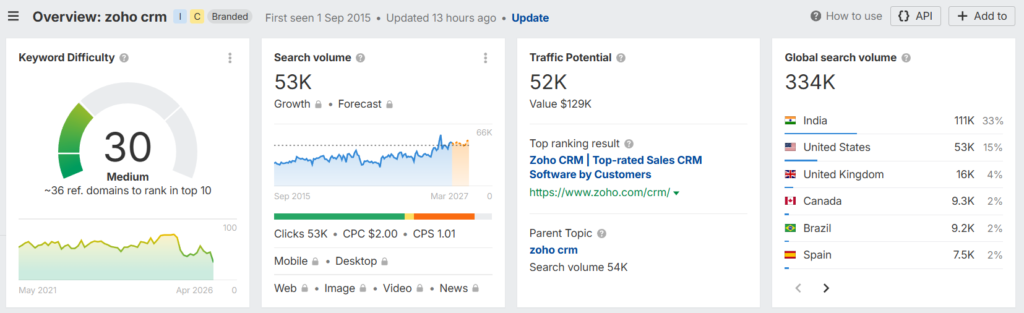
Or Monday CRM which has 23K searches.
Your buyers already know these names. So if your CRM is a less popular alternative, a more important question that comes to your buyers’ mind is: is this CRM better than the popular one, and if yes, how?
They would Google around it or ask AI surfaces like ChatGPT or Claude.
If you are not creating content to answer these comparison questions, you are missing out.
You are also missing out on the opportunity to highlight features of your product that outsiders might not know about.
A good idea here is to create comparison content like blogs or pages on topics like:
- Zoho CRM vs. Your CRM: Who offers better AI features in 2026?
- Pipedrive CRM vs. Your CRM: 10 Features You Didn’t Know You Needed
- HubSpot CRM vs. Your CRM: Who offers better lead management?
While a lot of marketers go for paid ads, each click can get very expensive very fast. So while ads are one route to go, you can also benefit from your competitor terms by creating comparison pages, just like Pipedrive and countless other CRM companies do.
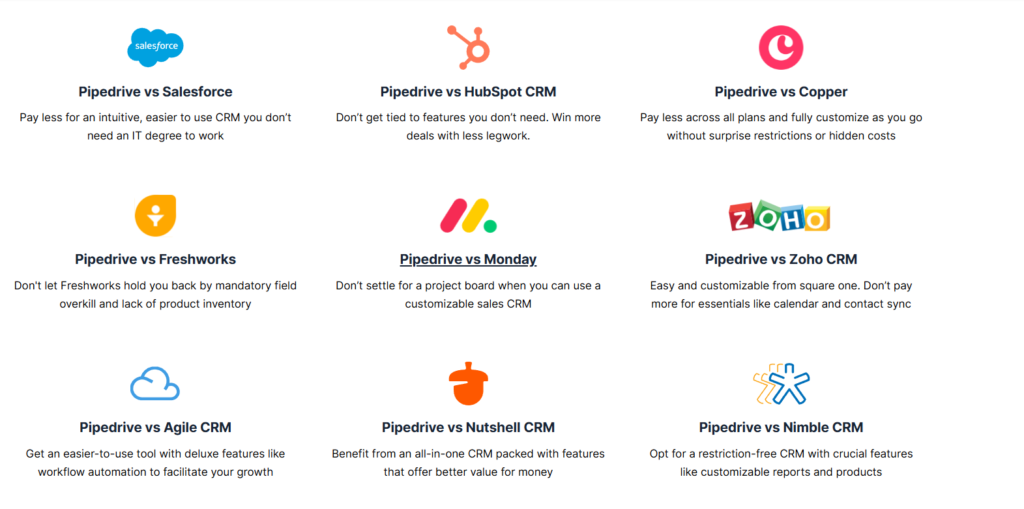
Source – Pipedrive
This works especially well because most CRM tools overlap on core functionality, but they do not shine in the same areas.
So, if your CRM has a feature or capability where it clearly performs better than a popular competitor, use that to your advantage.
Create comparison pages around that strength. Show where your product is a better fit. Add proof, customer voice, screenshots, and real use cases. This is exactly the kind of playbook larger companies already use through pages like competitor comparisons and alternative pages. You can do the same.
Instead of trying to build demand from zero, you can step into a conversation buyers are already having and position your product where it stands out.
There Are More Ways to Win These Keywords
These three strategies are not the only ways to rank for high-intent CRM keywords. There are many others you can build on from here.
For instance, you can create content around the specific pain points your users deal with every day, whether that is:
- lead leakage
- slow follow-ups
- messy quote generation
- poor visibility across deals
- or industry-specific workflow issues.
You can also build use-case pages and blog content that answer the exact questions buyers are already asking.
The core idea is simple. If you can answer your users’ questions clearly, address the problems they actually care about, and position your product around those pain points, you do not always have to be the most popular player in the market to win.
Even a less well-known CRM can build strong organic visibility if it is more focused and aligned with what buyers are searching for.
And if that is something you want to build seriously, we at Concurate can help you do it.
How Concurate Helps You Win High-Intent CRM Searches
Every agency works differently. At Concurate, our approach is simple: we help you rank for the keywords buyers search when they are evaluating solutions or are close to making a decision.
You see, we focus on the kind of queries people search when they are actively evaluating tools, comparing options, checking pricing, or trying to understand which product is the right fit. These are the moments that matter most. This is when your tool needs to show up.
That could mean building content around searches like HubSpot CRM pricing, best CRM for SaaS, CRM for lawyers, or Pipedrive alternatives. The exact query may change, but the intent stays the same: the buyer is already in evaluation mode. Our job is to help your product become visible at that stage.
We do this by creating content built around real buyer searches, so your tool can appear across both traditional search engines and GEO surfaces like ChatGPT, Perplexity, Claude, and Gemini. So when buyers are seriously comparing products, your brand has a much better chance of being part of that consideration set.
If you want your CRM product to show up at the right time, book a call with us. Let us help build the success playbook for your product.
Disclaimer: The information presented in this article is compiled from publicly available sources, including company websites, industry reports, and social media. All trademarks, brand names, and logos mentioned are the property of their respective owners. We do not claim any ownership of third-party marks, nor do we imply endorsement or affiliation. This article is intended for informational purposes only.