

| TL;DR: In the project management software market, where product messaging often overlaps, AI assistants are starting to shape which brands get noticed first. That is why agencies like Concurate, Siege Media, Omniscient Digital, and Minuttia are worth looking at. Each brings a different approach to visibility, from AI search strategy to category-driven content and organic growth. This guide helps project management companies understand which kind of GEO partner makes the most sense for their goals. |
We have observed one pattern repeatedly on calls with project management software companies. They have content. Some even rank on page one for a handful of keywords. Their blog is active too.
But when a VP of Engineering asks ChatGPT, “What is the best project management tool for a 40-person Scrum team that does not want the complexity of Jira?” they do not show up.
Or when a startup COO asks Perplexity, “Which project management software is best for distributed teams across time zones?” the company never gets recommended, even if its product is built for exactly that kind of use case.
That is the gap that many project management tools are facing today. They are not missing from AI recommendations because their product is weak. They are missing because AI platforms do not have enough clear signals connecting their product to the specific use cases buyers are asking about.
Yes, the project management category has many popular tools. But that does not mean challenger products should stay invisible.
The right GEO agency can help improve your product’s visibility. That’s why, in this article, we look at 7 GEO agencies that can help you, along with the factors to consider before choosing the right one.
But first, let’s look at why many project management tools struggle to appear in AI search results.
4 Reasons Why Project Management Companies Fail When It Comes To AI Visibility
Many project management software companies still approach content the same way they did years ago. They are publishing articles about productivity, Agile workflows, team collaboration, or project planning, and hope that visibility will follow.
That content may help your users and bring traffic. But it does not necessarily help your project management company appear when a buyer asks AI tools or Google AI Overviews which provider they should go with.
We have observed that there are a few mistakes most project management companies make that cost them visibility. Let’s look at them:
1. They Create Category-Level Content that AI Already Associates With Established Brands
A project management company may write content like “best practices for project management” or “how to improve team collaboration.” The problem is that they are competing against content from Wrike, Slack, Atlassian and more.
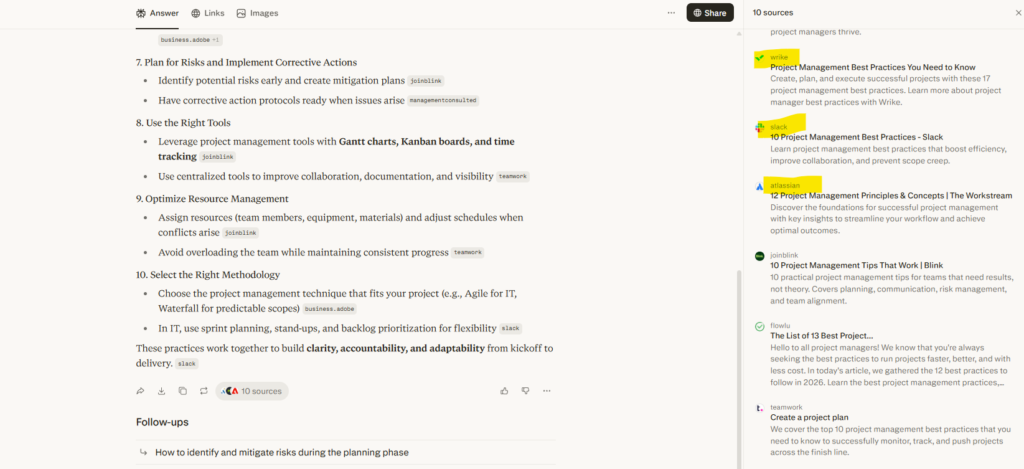
Source – Perplexity
In fact, if you ask other tools, some might refer to the Project Management Institute and other valuable sources in Project management. Even if you are creating on these topics, your chances of getting recommended by AI surfaces are slim.
2. They Target Queries that Challenger Brands Cannot Realistically Win
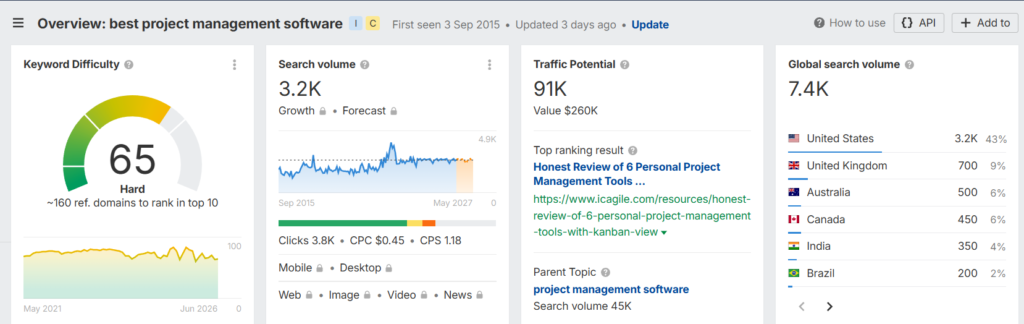
Many companies target broad searches like “best project management software.”
Let’s quickly look this up on Ahrefs.
Source – Ahrefs
This query has a global search volume of 7.4K, but the keyword difficulty is very high. For most challenger brands, ranking for this query is not realistic. Not to mention, there are already dozens of established project management tools competing for the same space.
So instead of going after a broad query that is almost impossible to win, companies should target long-tail variations where the intent is clearer, and the competition is lower.
For instance, the queries below are easier to rank and can help you earn AI visibility if your project management tool fits the particular use case.
.
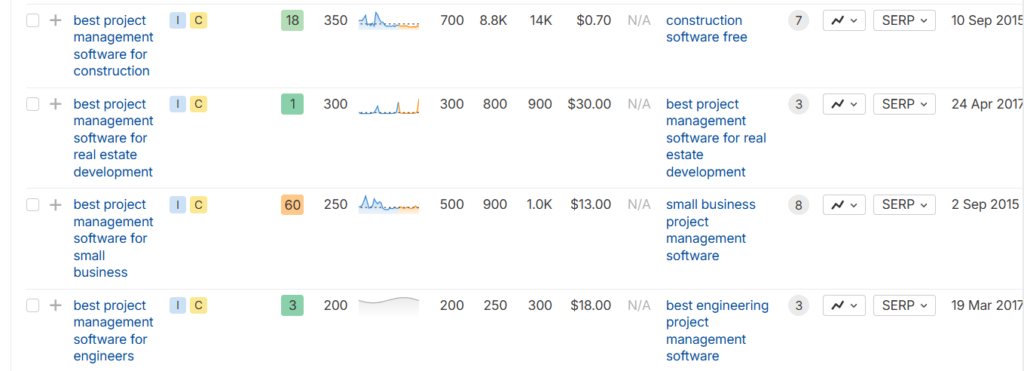
Source – Ahrefs
Your content needs to clearly show where the product fits, who it is for, and what specific problem it solves. This is where product-market fit needs to show up in the content.
3. They Never Go Deep Enough into The Product
In a category where every tool lists the same features, the only content that differentiates is content that reflects genuine product depth, specific use cases, and real customer scenarios.
For example, where does the product stand out? Is it pricing, customization, a feature that popular tools do not offer, or AI-based capabilities? These are the details the content needs to capture.
If you are not covering this in your content, AI might not recommend you, despite your tool offering a particular differentiation.
4. They Ignore Third-Party Validation That Signals Their Product Is Relevant
AI platforms are less likely to recommend a brand they have only seen on that brand’s own website. They look for signals across multiple sources.
For established project management tools, those signals often exist across review platforms, comparison articles, industry publications, online reviews, community discussions, and best-of lists. A challenger brand needs to build this type of external visibility deliberately.
Without active work across sources like LinkedIn, YouTube, G2, Capterra, review sites, industry roundups, and comparison pages, visibility can remain low. These external signals help AI platforms understand whether others also recognize your product in the category.
Now that we have looked at the common mistakes project management companies make, the next question is how to find a GEO agency that can actually help fix them.
The next section will answer the question for you.
5 Things to Look for in a GEO Agency for Your Project Management Software
Choosing a generative engine optimization agency for project management software is not the same as choosing a traditional SEO agency. Most agencies can create content and help improve rankings. The harder question is whether they can help a software company earn visibility in AI recommendations.
Project management software is a crowded category, and buyers increasingly use AI tools to research and compare options. Dentsu’s Superpowers Index 2025 found that 77% of B2B buying processes now involve AI. As a result, showing up in those recommendations is becoming harder to ignore.
Here are five questions worth asking before choosing a GEO agency.
1. Do They Understand How Dominant Tools Win AI Recommendations, And Can They Apply That To A Challenger Brand??
Asana, Monday, ClickUp, and Trello do not dominate AI recommendations by accident. Over time, they have built specific types of content that help AI platforms understand what their products do, who they serve, and where they are a good fit. That includes content template libraries, use case pages, competitor comparisons, and integration guides.
A GEO agency working with a challenger brand needs to understand these patterns in detail. More importantly, they should know how to adapt them for a product with a smaller footprint. The agencies that do this well can usually point to specific patterns they have observed and explain how those insights shape their strategy.
| Question to ask: Have you analyzed why certain project management tools appear so frequently in AI recommendations? |
2. Do they Identify Use-Case Queries That a Challenger Can Actually Win?
Many project management companies would like to appear for searches like “best project management software.” The problem is that these are often the most competitive queries in the category.
The real opportunity often sits in more specific searches. A buyer might ask for “best project management tool for construction firms under 50 users” or “agile project management software for distributed engineering teams without Jira overhead.” These are the types of queries where a smaller or newer product has a much better chance of earning visibility.
The right agency identifies specific, scenario-based queries and builds content around them. If the strategy starts with broad, high-volume searches, they may be focusing on the wrong targets.
| Question to ask: How do you identify the AI recommendation opportunities where a project management software company can realistically win visibility? |
3. Can They Build Genuinely Differentiated Content In A Category Where Everything Sounds The Same?
This is one of the hardest challenges in the project management space. Almost every second tool promises task management, Gantt charts, Kanban boards, automation, and integrations.
An agency that interviews your product team for thirty minutes and then writes content from secondary research will produce pages that sound like every other tool in the category.
The content that stands out goes deeper. It explains the specific workflows your product handles better than alternatives. It highlights the type of users for whom your tool is genuinely the right fit and the scenarios where they hold an advantage over dominant tools in the market. That information only comes from inside your company.
If an agency is not speaking with your product, sales, and customer success teams, it will struggle to uncover these insights. The result is often content that sounds too similar to everything else in the category.
| Question to ask: What is your process for gathering product and customer insights from our team? |
4. Do They Think Beyond Your Website To Build The Third-Party Signals AI Platforms Use To Validate Recommendations?
AI platforms do not recommend project management software simply because their website is well-structured. They recommend it when they see consistent signals across multiple sources, such as third-party comparison articles, community discussions, review platforms, and more.
A well-known project management tool has years of third-party mentions already working in its favor. Challenger brands often have far fewer of them, which makes visibility harder to earn.
A strong GEO agency should have a clear plan for increasing visibility beyond the website. If their strategy focuses entirely on publishing content on your site, they are only building one signal while the other signals that influence AI recommendations go unaddressed.
| Question to ask: What is your approach to building visibility for a project management software company outside the website? |
5. Do They Measure AI Shortlist Placement For Specific Use Case Queries, And Not Just General Visibility?
The goal for a project management challenger brand is not to be mentioned somewhere in an AI response. It is to appear as a named recommendation when a buyer describes the exact scenario the product is built for.
For instance, if a buyer searches for “best project management software for a remote marketing team managing client campaigns,” your product should naturally appear in the recommendations if it is built for that use case.
An agency that reports only on general AI visibility, mention frequency, organic traffic, or rankings is not measuring whether your product is actually breaking into the shortlist for the queries that matter.
| Question to ask: How do you track whether we are appearing as a named recommendation for the specific use-case queries we care about? |
By now, you know what separates a strong GEO agency from a generic SEO or content partner. The challenge is finding an agency that understands the realities of the project management software market and how AI recommendations actually work.
That’s where the next section can help.
Top 7 Generative Engine Optimization Agencies for Project Management Companies
We put together this list of seven agencies that can help project management software companies improve AI visibility. Each agency has its own strengths, but they all have a few things in common.
They have experience working with SaaS companies, a clear approach to GEO or AI visibility, and real client results, case studies, or proof of execution. We also reviewed whether their approach aligns with the challenges project management software companies face today.
Based on that, here are seven agencies worth considering:
- Concurate
- Siege Media
- Omniscient Digital
- First Page Sage
- Minuttia
- SimpleTiger
- Kalungi
Now, let’s discuss every agency in detail.
1. Concurate: Best Generative and Answer Engine Optimization Agency for Project Management Companies
At Concurate, we’re a boutique content marketing and generative engine optimization agency that focuses on helping B2B SaaS companies show up exactly where buyers are making their final decisions.
We’ve realized that for project management software, the old rules of visibility are breaking. In a space that’s incredibly crowded, being on page one of Google is no longer the win it used to be. Buyers are tired of sifting through dozens of tools that all promise the same Gantt charts and automation. Instead, they’re going to AI platforms like ChatGPT, Perplexity, or Grok and asking, “Which project management tool is best for a 50-person engineering team using Agile?”
If your software isn’t appearing in those AI recommendations, your unique features and USPs won’t even get a chance to be compared. You’re being filtered out before the buyer even lands on your site.
At Concurate, we focus on closing that gap between your tool’s capability and its actual visibility in AI search.
Source: Concurate
This is where our proprietary Perfect Match Framework comes in.
Perfect Match – Our Proprietary Framework for Turning Product Fit Into AI Visibility
Using the 6-step framework, we first identify the exact buying moments where your project management software should be recommended. That is:
- Who should be finding your product?
- What project management challenge are they trying to solve?
- What workflows, team structures, industries, or use cases should your software be associated with?
Once those buying moments are clear, we benchmark where your product currently appears across AI tools like ChatGPT, Perplexity, Gemini, and Claude. We also check which competitors are being recommended instead and what content or third-party signals may be missing.
From there, we build the content strategy around the use-case queries your product can realistically win. Our goal is not just to publish more content. It is to help your project management software appear as a recommendation when buyers are deciding which tool to choose for the exact use cases your product is built to serve.
You can see how this framework works in practice in the deck below.
We do not treat GEO or AEO as a separate, experimental service. To us, it is the natural evolution of how search works today. Our Perfect Match Framework helps us connect SEO fundamentals with buyer-intent content, internal linking, clear positioning, and the external signals AI platforms use to understand recommendations.
A massive part of our approach is creating content for the “shortlist” stage. This means we lean heavily into consideration and decision-stage content like best tool lists, deep competitor comparisons, and specific use case pages. We don’t just target broad keywords. We target the specific ways a project lead actually thinks and searches.
What this GEO approach looks like in the project management space
You see, we don’t just guess what works. We actively study the project management brands that are already dominating AI search. We analyze how their pages are structured, the depth of their content, and why AI systems choose them over everyone else. Once we understand those patterns, we apply those insights in a way that fits your specific product and your specific market.
We have done this research across some of the most well-known tools in the space, and the patterns are clear.
Take Airtable, for instance. A big part of their AI visibility comes from their template library. Pages like their project planning, CRM, and content calendar templates are structured in a way that makes it very easy for AI platforms to understand what the product does and who it is for. The result is that Airtable shows up when buyers search for things like “top no-code automation tools” or “best database software for teams,” which are exactly the kinds of queries that happen inside ChatGPT and Perplexity.
Wrike takes a slightly different approach. Their AI visibility is built around competitive and category-level content, pages that go after searches like “AI project management alternatives” and “AI work management software comparison.” They have essentially built a content engine that intercepts buyers at the moment they are comparing options, which is precisely the moment AI platforms are most influential.
Trello leans into templates, too, but what makes their strategy particularly interesting is how AI-ready their content formatting is. Their pages are clean, structured, and answer specific questions directly, which makes it easy for AI assistants to pull them into answers for queries like “top kanban board software” or “best task management software for teams.”
Across all three, the common thread is the same: structured content, clear product positioning, and deliberate coverage of the exact queries buyers type into AI platforms.
These are some of the strategies we draw from at Concurate to make sure project management companies show up in those moments.
We also know that AI models don’t just look at your website. They look at your entire digital footprint. That’s why we think in terms of content ecosystems, ensuring your brand shows up on LinkedIn, YouTube, and other surfaces that AI systems rely on to verify authority.
Our goal is to ensure you show up across every buyer touchpoint because that’s how visibility turns into conversion. After all, content should not just bring traffic. It should bring leads. When your brand shows up at the exact moment a buyer is making a decision anywhere, those leads follow naturally.
If you want your project management tool to show up where buyers are actually looking, let’s talk.
Pricing
Our monthly retainers typically range between $5,000 and $7,500, with one-time projects starting around $3,500.
Notable clients: Datacipher, Triangle IP, Pinch Patent Drawings
Rating: 5/5
2. Siege Media
Siege Media is a well-known SaaS content agency that has gradually adapted its playbook for AI-driven search. So, they are good at building content that does both: rank on Google and get picked up by AI tools like ChatGPT and Perplexity.
Source: Siege Media
When it comes specifically to GEO, their strength lies in improving a client’s content structure and clarity. They create content that directly answers questions, uses clean formatting, and is easy for AI systems to extract and cite. For project management companies, this matters a lot.
Buyers often search things like “best project management tools” or “Asana alternatives,” and AI tools pull from pages that are well-structured and data-backed. So, by writing cleanly and structuring it well, Siege helps your content show up in those answers.
They also go beyond individual blog posts. Their team maps out how your guides, comparison pages, and use case content connect. This helps AI understand your product better and builds stronger authority over time.
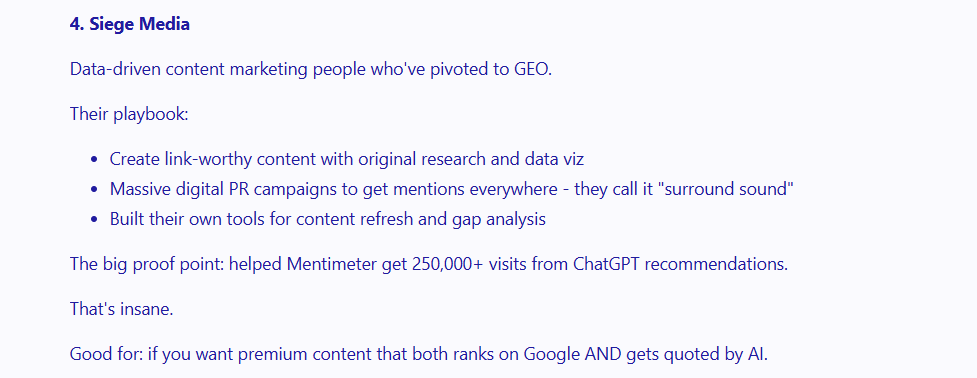
On Reddit, marketers often describe Siege as a “data-focused agency” that has adapted well to AI-driven search. Discussions usually highlight their ability to produce structured content backed by research and distribute it widely, which increases the chances of being picked up not just on Google but also in AI-generated answers.
Source: Reddit
Notable Project Management/SaaS clients: Asana, Zapier, Airtable
Pricing: Not publicly available
Rating: 4.9/5
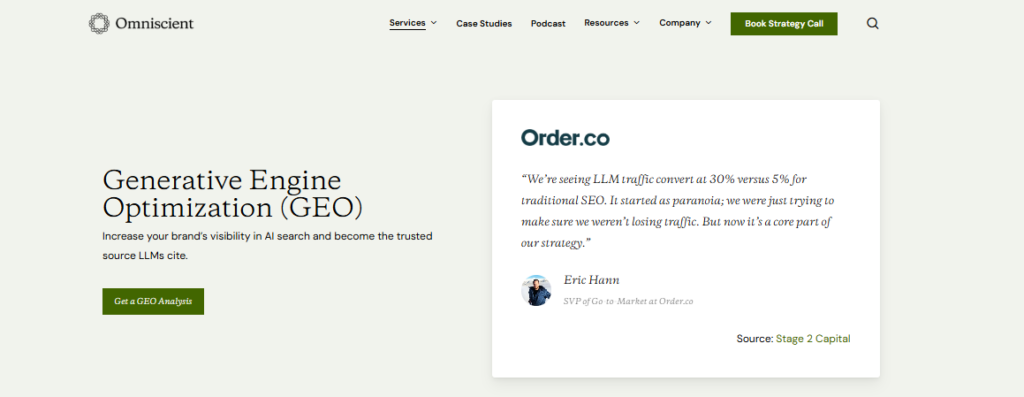
3. Omniscient Digital
Omniscient Digital is a SaaS-focused agency started by former in-house marketers from companies like HubSpot and Shopify. That background shows in how they approach content marketing.
Source: Omniscient Digital
The agency thinks in terms of full buyer journeys, not just keywords. This primarily reflects in their idea for enhancing GEO. Basically, they believe your brand should show up everywhere your buyers are looking, including blogs, comparison pages, integrations, and AI search.
So, they build content across all these touchpoints so AI tools consistently see your product as relevant and trustworthy. They call this approach the “Surround Sound SEO.”
For project management companies, this is especially useful. Buyers rarely choose a tool after reading one page. They compare options, check integrations, and look for real use cases. Having solid content spread across all these subjects boosts authority.
Besides, they also focus heavily on how content connects. So, instead of publishing isolated articles, they build clusters that reinforce each other. This makes it even easier for AI systems to understand your product and cite it.
Notable Project Management/SaaS clients: Asana, SAP, Adobe
Pricing: Not publicly available
Rating: 4.8/5
4. First Page Sage
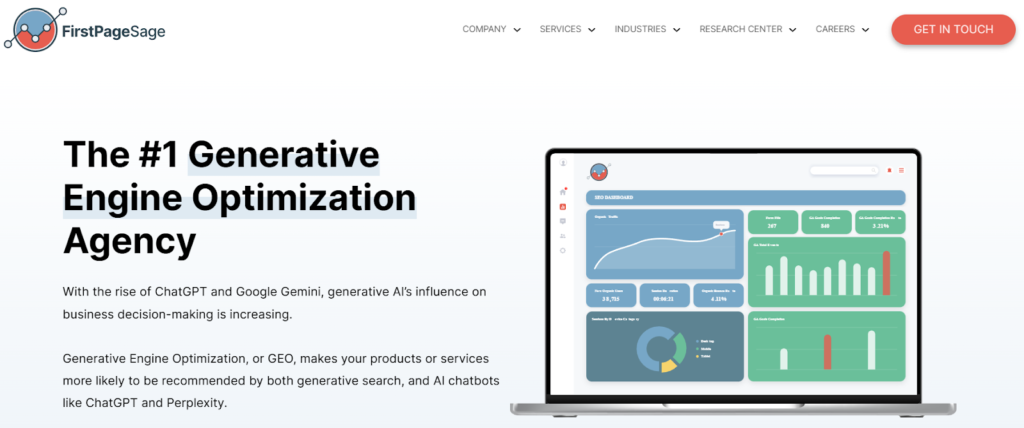
First Page Sage is a reputable content marketing agency that is often seen as one of the earliest players in GEO.
Their expertise lies in positioning brands as thought leaders in their category, so AI confidently and consistently cites them.
Source: First Page Sage
How do they do this? Simple: by making content easy for AI to understand and trust. That means clear definitions, structured sections, and in-depth explanations. They also combine this structural clarity with technical SEO and schema markup. That helps AI systems better interpret what your content is about, which increases the chances of your content being cited in their responses.
Another area where the agency excels is reputation management. Basically, they track how your brand appears across the web to maintain a strong, consistent presence. This matters for GEO because AI tools rely on such trustworthy signals from multiple sources to decide what to recommend.
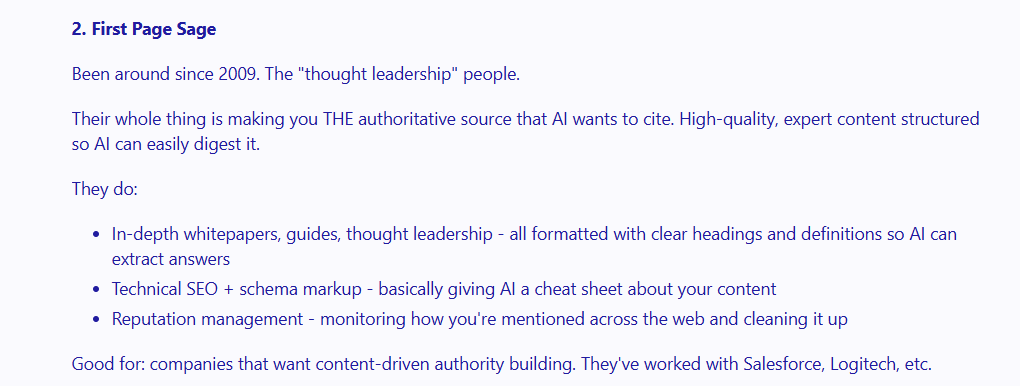
On Quora, First Page Sage is often mentioned as one of the earlier agencies focusing on GEO, especially for improving how brands appear in AI-driven search platforms.
Source: Quora
On Reddit, however, the perception is more specific. Marketers tend to associate them with thought leadership and structured content. The emphasis is on creating in-depth, clearly formatted content that AI systems can easily extract and cite, along with technical SEO support.
Source: Reddit
Notable Project Management/SaaS clients: Cadence, iGPS (though they keep their clientele mostly private, various sources confirm they have solid project management/SaaS experience)
Pricing: Not publicly available
Rating: NA
5. Minuttia
Minuttia is a B2B SaaS-only agency that builds content with a strong focus on establishing product clarity and answering real buyer questions. Because AI systems prefer such clear and authoritative content, this approach fits naturally with GEO.
Source: Minuttia
In the crowded project management space, where every other tool sounds similar, this kind of approach enables you to position yourself distinctly by clearly explaining your unique use cases, features, and differences.
Apart from this, the agency also focuses a lot on crafting value-rich comparison pages, use case guides, and deep product-led content. Again, these are exactly the types of pages AI tools rely on when generating recommendations.
Another key GEO strength of Minuttia is their constant content tracking. Basically, they keep monitoring your content’s performance in AI-driven environments. This helps you understand what AI “thinks” about your brand and where you need to improve.
All in all, their overall approach is long-term. Instead of chasing quick rankings, they build a strong content base that keeps working over time.
Notable Project Management/SaaS clients: Toggl, Insense, Respona
Pricing: Not publicly available
Rating: 4.9/5
6. SimpleTiger
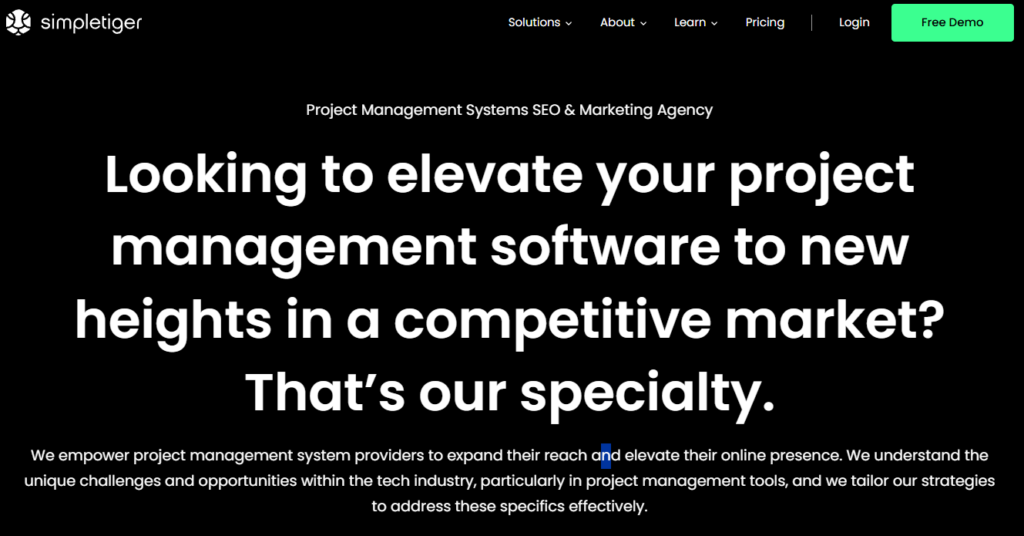
SimpleTiger is an SEO and marketing agency that has been working with SaaS companies for a long time. Their core strength is building content that ranks on Google, and they build on that same foundation for GEO, making sure clients show up in AI search results too.
Source: SimpleTiger
They do it by combining core SEO and AEO strategies, which mainly include strong keyword research, clean structure, and clear positioning. For project management companies, this helps when targeting high-intent searches like comparisons, alternatives, and feature-based queries. Apart from this, they also make it a point to simplify complex products so AI systems can interpret and recommend them.
The agency also uses their own tools to track performance and visibility, including how content shows up in AI-driven platforms. This gives teams better insight into what’s working and what needs improvement.
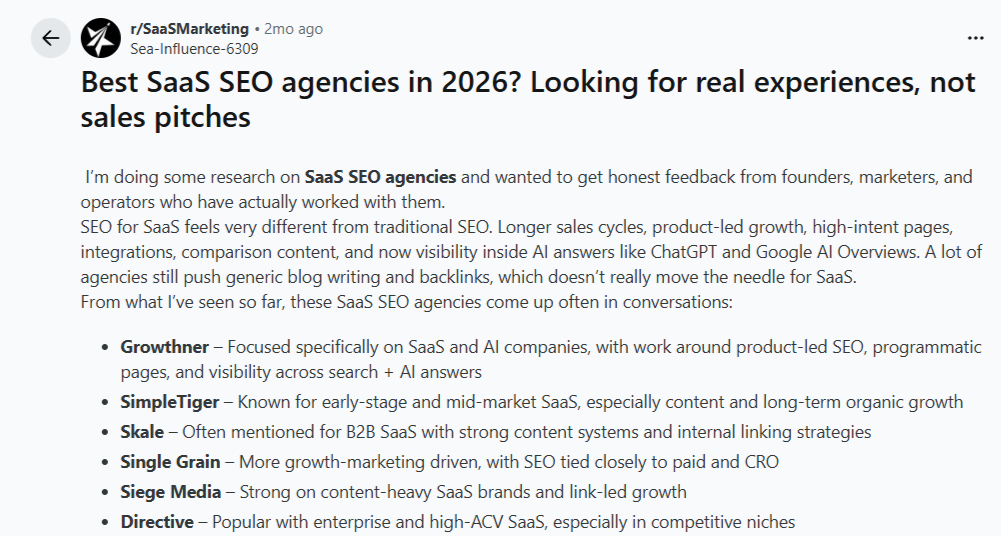
On Reddit, SimpleTiger is usually brought up in discussions around SaaS SEO for early and mid-stage companies. The feedback tends to focus on their consistency with content and their ability to build long-term organic visibility rather than chasing short-term gains.
Source: Reddit
Notable Project Management/SaaS clients: Jotform, Jungo, LeadPost
Pricing: Not publicly available
Rating: 4.9/5
7. Kalungi
Kalungi is a content marketing agency that combines strategy and execution by offering fractional CMO support along with full marketing teams. This makes them a good fit for SaaS companies that need both direction and execution.

Source: Kalungi
They usually start with positioning. In categories like project management, where many tools offer similar features, how your product is described becomes critical. Kalungi helps define that positioning clearly, so it is easy for both users and AI systems to understand what your product does and who it is for.
Once that foundation is set, they build content around it. This ensures that your messaging stays consistent across all pages and channels, instead of changing from one touchpoint to another. For GEO success, this consistency plays a key role. When AI systems see the same clear signals repeated across content, they can more confidently interpret and recommend your product.
They also work across content, SEO, web, and automation. So instead of running GEO as a separate effort, everything is aligned, which helps improve overall visibility across search and AI platforms.
Notable Project Management/SaaS clients: One Click Contractor, Assembled, Avid
Pricing: Not publicly available
Rating: NA
With this, the list of the best generative engine optimization agencies for project management companies comes to an end.
You may still need some time to decide which agency is the right fit. Until then, here are a few things your team can do internally to start improving your AI visibility.
What You Can Do In-House to Improve GEO Before Hiring an Agency
Driving meaningful GEO results, especially in a crowded market like project management, requires a comprehensive approach. But even that doesn’t guarantee results from day one. So here are three ways you can start GEO on your own before bringing a specialized agency on board:
- Audit your current AI positioning: Start by asking ChatGPT, Perplexity, and Gemini questions your buyers would ask, like “best project management tools for remote teams” or “[popular-tool-in-your-category] alternatives.” See if your brand appears and how it’s described. This shows you your current AI visibility and positioning gaps.
- Create buyer-focused content: Instead of writing general blogs, create pages that help buyers make decisions. Compare your tool with competitors. Answer questions like “Is this tool right for my team?” Clear, direct pages like these are easier for AI to pick up and summarize.
- Go deep on one clear niche: Don’t try to cover everything. Choose one strong focus, like agile teams or remote work, and create multiple pieces around it. When your content stays consistent, AI understands what you’re known for.
Full disclosure: these steps are a starting point, not a long-term solution. AI search is evolving fast, and what works today may shift tomorrow.
If your project management software already has strong features, happy customers, and useful content, but still does not appear when buyers ask AI tools for recommendations, the problem is not effort. It is positioning, content signals, and visibility across the right buyer moments.
That is where Concurate can help.
We help project management companies like yours identify the AI search queries they should be visible for, understand why competitors are being recommended instead, and build the content ecosystem needed to earn a place in those recommendations.
Ready To Improve Your Tool’s AI Visibility?
GEO Services: If you want to improve your visibility across ChatGPT, Perplexity, Gemini, and other AI search platforms, learn more about our Generative Engine Optimization services here.
Content Marketing Services: If you also need support with use-case content, comparison pages, case studies, Programmatic SEO, or LinkedIn ghostwriting, you can explore our content marketing services here.
Looking for marketing ideas backed by experience, not opinions? Our weekly newsletter breaks down what’s working, what we’ve changed, and what we’ve learned from campaigns in the real world.
Frequently Asked Questions:
1. Why are project management companies particularly vulnerable to AI-driven search disruption?
The project management space is already crowded, and most tools sound similar on the surface. When AI generates summaries, it compresses that crowded market into just a few recommendations of brands with strong topical authority and clear messaging. This means that if your positioning is weak or unclear, AI won’t highlight you.
2. What risks do project management companies face if they ignore GEO?
Project management companies that ignore GEO risk losing potential clients to their competitors. Stakeholders these days largely rely on summaries from AI and LLM tools like ChatGPT and Gemini when choosing any product or service. If a brand isn’t cited on these platforms, its competitors gain that visibility. Over time, this hampers lead generation, weakens positioning, and makes the company’s overall marketing ROI harder to justify.
3. How does GEO improve differentiation in a crowded project management software market?
GEO helps you move beyond generic feature-based messaging. Instead of competing on the same checklist of features, it strengthens your authority around specific use cases, industries, or workflows. Moreover, when your content is structured clearly for AI systems, your strengths are more likely to appear in summaries. That’s how you stand out in a market where most tools look interchangeable.
Want sharper marketing ideas that actually work? Our weekly newsletter shares practical insights from real campaigns we’ve tested, refined, and learned from. Join us and stay ahead of what’s working right now.
Disclaimer: The information presented in this article is compiled from publicly available sources, including company websites, industry reports, and social media. All trademarks, brand names, and logos mentioned are the property of their respective owners. We do not claim any ownership of third-party marks, nor do we imply endorsement or affiliation. This article is intended for informational purposes only.