


| TL;DR: Hubstaff’s SEO content looks like the same playbook every time-tracking company uses, but the formats aren’t what set it apart. We pulled six months of Ahrefs data on its page architecture and keyword rankings and found the real difference is territory. Some of its strongest pages have nothing to do with time tracking, and narrower pages exist for the exact moment someone’s shopping for software. Here’s where that territory shows up, and what’s worth borrowing for your own content plan. |
Pull up Hubstaff’s blog and skim a dozen headlines, and you’ll think you’ve got the strategy figured out. Time-tracking companies, like theirs, write about scheduling, remote work, and productivity. Hubstaff does exactly that, and at a fairly large scale.
For a SaaS company, it is easy to build an SEO strategy around what the product does. However, the harder question is how far beyond that immediate product category the content should go.
When we analyzed Hubstaff’s SEO strategy, we found something interesting. Hubstaff is a workforce management platform known for time tracking, yet some of its non-branded organic traffic comes from searches that have very little to do with time-tracking software.
That made us curious about what Hubstaff’s SEO strategy is actually built around. To find out, we analyzed six months of Ahrefs data, Hubstaff’s highest-performing non-branded pages, its commercial page architecture, and the resources it has built outside the blog. Here is what stood out.
Some of Hubstaff’s Strongest Traffic Comes From Beyond Time Tracking
The first thing that stood out in the data was where some of Hubstaff’s strongest non-branded traffic was actually coming from.
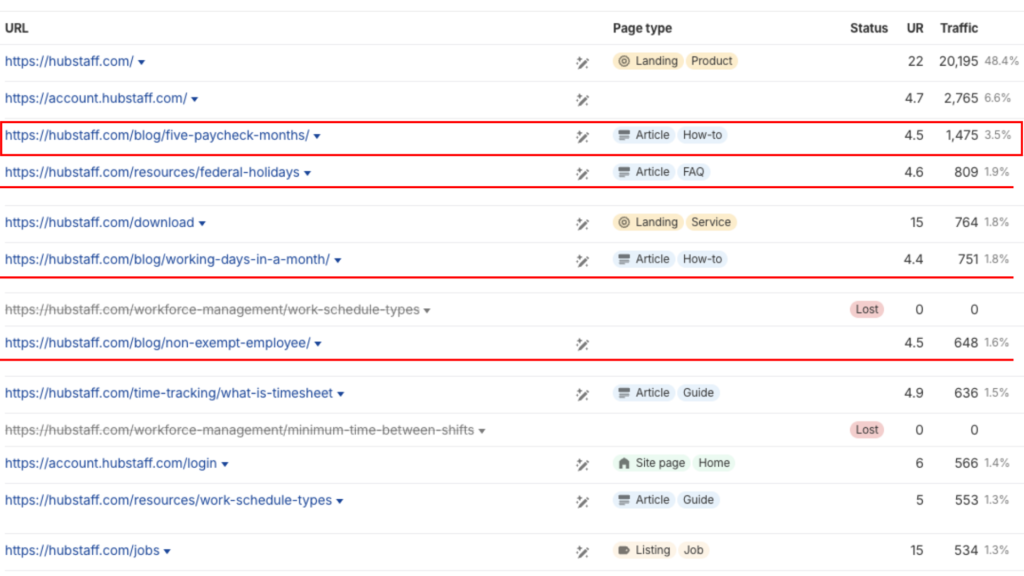
Their five-paycheck-months guide alone, covering payroll planning, FLSA and FICA compliance, and budgeting, brings in an estimated 1,475 visits a month, more than any other article on the site.
Source – Ahrefs
Interestingly, the pattern doesn’t stop there. A page on federal holidays gets 809 visits for doing nothing more than answering when the next one falls. A guide on working days in a month gets 751. What’s interesting to note is how this guide is for 2025 and not 2026. Additionally, a page explaining who counts as a non-exempt employee gets 648.
Notice what all these have in common? None of them are written for someone shopping for time-tracking software. They’re written for someone doing payroll, sorting out a pay period, or double-checking whether an employee qualifies for overtime.
That is where Hubstaff starts stretching beyond the immediate product category. It is showing up for the operational questions someone managing a workforce deals with before software selection even enters the picture.
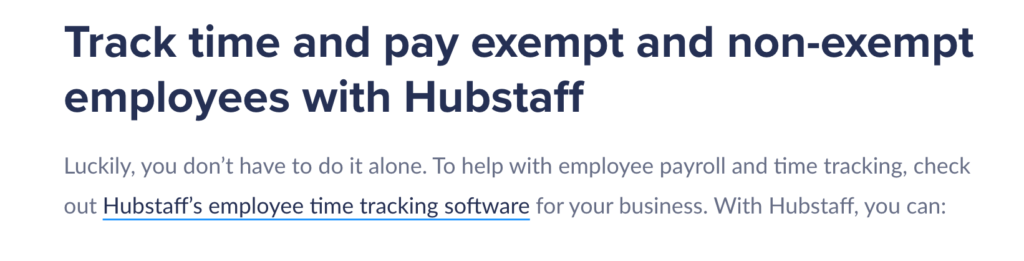
The product does get a mention early, one line inside a short “what you’ll learn” summary at the top of the page. But the real hand-off comes later. On the non-exempt employee page, the article closes by moving straight from the labor law explanation into its own section: “Track time and pay exempt and non-exempt employees with Hubstaff.” That’s not a passing mention. It’s a dedicated call to action.
Source – Hubstaff
That transition matters. Hubstaff isn’t bringing in broad traffic and leaving the reader there. The informational page eventually connects the problem being researched back to something the product can help solve.
The SEO Strategy Narrows to One Team at a Time
Hubstaff’s broader content brings in people searching for workforce-related questions. But as the search gets closer to software selection, its content becomes much more specific. Instead of relying on one generic time-tracking page, Hubstaff builds pages around individual use cases and the people searching for them.
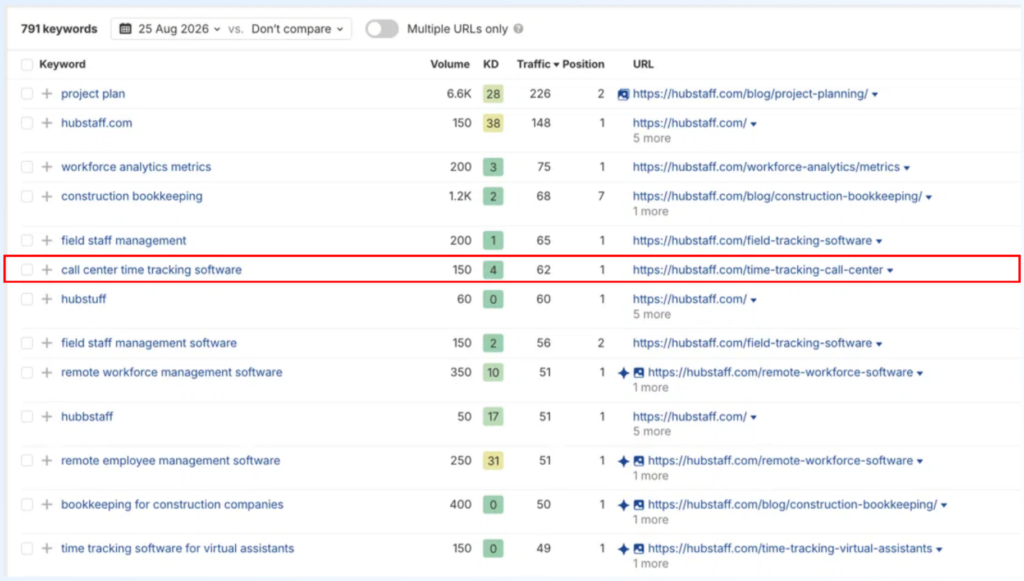
Its call center page is a good example. While the keyword
“Call center time tracking software” gets searched only 150 times a month, Hubstaff sits right at position 1 for it.
Source – Ahrefs
Curious why it ranks there, we opened the page, and it reads like it was written for one job title, not for anyone who might land there. The headline says “Call Center Time Tracking Software for Maximum Efficiency.” The feature list doesn’t say “productivity monitoring”; it says “Call center agent productivity monitoring.”

Source – Hubstaff
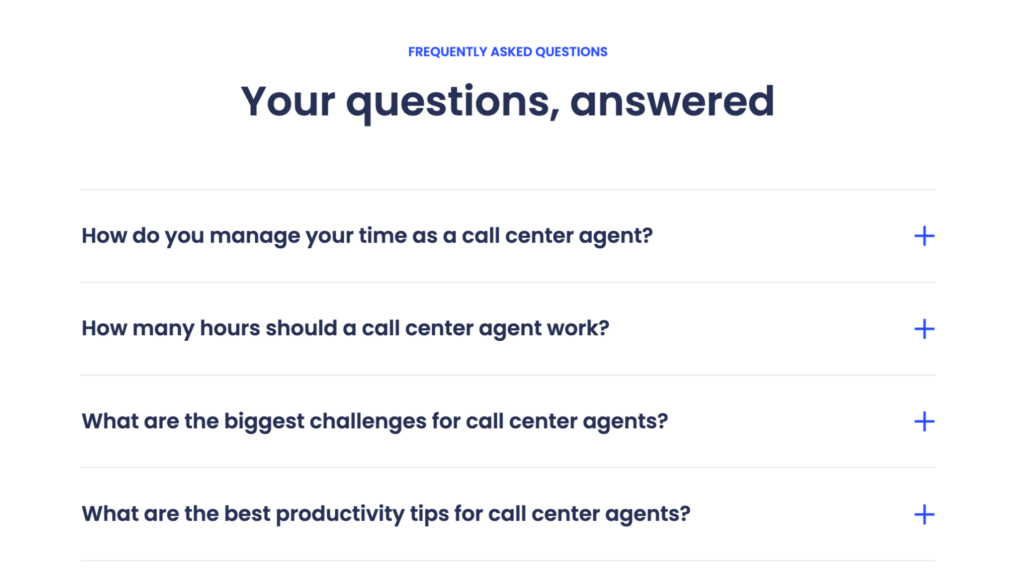
Even the FAQ stays within that context, answering questions a call-center manager might actually have, such as: how many hours should an agent work, what are the biggest challenges call-center agents face, et cetera.
Source – Hubstaff
150 searches a month sounds small, but the keyword difficulty tells the real story: an Ahrefs KD of 4, about as uncontested as a ranking gets. Almost nobody is fighting for this exact phrase, and Hubstaff built the one page specifically written for it.
That is the second layer of its strategy. The broader content brings Hubstaff into workforce-management conversations, while pages like this narrow the message for someone looking for software for a specific type of work.
The Resources Section Has Something the Blog Doesn’t
The blog and the commercial pages aren’t the only parts of Hubstaff’s content strategy. There is also a dedicated resources layer built around different kinds of content people can actually search.
Hubstaff’s resources hub is organized into eight categories, including Time Tracking, Productivity Monitoring, Workforce Analytics, Global Payments, Scheduling, Product, Reports & Research, and Webinars. Within them, the formats vary too: guides, templates, calculators, reports, and webinar recaps.
That makes this section different from a traditional blog archive. Someone looking for a timesheet template, a time card calculator, workforce benchmarks, or a product guide can all enter through the same resource ecosystem.
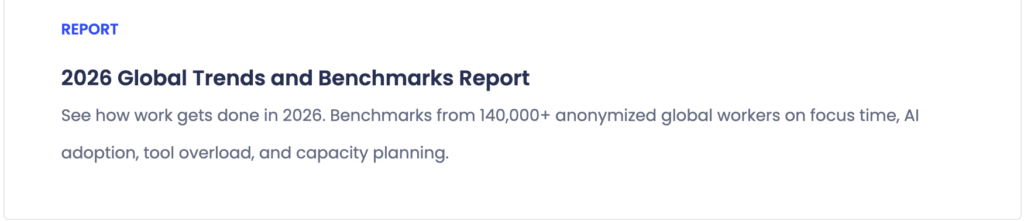
One part of that ecosystem is especially interesting for SEO authority: Reports & Research. Hubstaff publishes its own data here. The 2026 Global Work Report is built from data from over 140,000 real Hubstaff users.
Source – Hubstaff
This strategy matters because original data gets cited more than regular articles.
Moreover, these reports give Hubstaff something the rest of its content or others in the domain cannot easily replicate: proprietary evidence other publishers can reference.
We saw the same thing when we broke down Ramp’s SEO strategy: their own spend data, turned into two monthly reports, got picked up by The Atlantic and The New York Times. Hubstaff is running the same play here, just with workforce data instead of spend data, and it’s a smart one. A report explaining PTO laws can be written by anyone. A report built from 140,000 real users can’t.
Copy the Territory, Not the Page List
If you have to take one lesson from Hubstaff, it isn’t “write more articles about payroll.” It’s picking a wider operating problem your product can honestly help with, then building two layers of content around it: broad pages that answer the everyday questions inside that problem, and narrow pages that show up right when someone’s ready to buy.
The resources hub adds another layer. It gives Hubstaff room for content that doesn’t fit neatly into either bucket, from templates and calculators to product guides and original research. Some of that research can also help build citations and authority beyond search.
But the core lesson still comes down to the first two layers, and they only work if they actually link to each other, the way the non-exempt employee page hands straight off into the product, rather than simply sharing a general theme and hoping the reader connects the dots.
Most content teams start with a keyword list. Viewed together, Hubstaff’s pages look less like a keyword list and more like a map of the operational problems involved in managing a workforce.
That’s the more useful question to bring back to your own content strategy. What is the larger problem your product sits inside? And does your content cover that problem broadly enough to reach people early, while still giving them a clear path toward the specific problem your product solves?
If that connection isn’t there yet, Concurate is where we’d start looking.
Disclaimer: This article is based on publicly available information from Hubstaff’s website, Ahrefs data, and live Google search results. The evaluation reflects our independent analysis, and we recommend checking Hubstaff’s website directly for the latest details on features, pricing, and product updates.