

| TL;DR: Technical SEO does matter for AI visibility, but not every factor deserves the same attention. We reviewed 11 published sources and ran 30 live tests across ChatGPT, Perplexity, and Google AI Overview to see what actually affects citation. Our tests showed that crawlability and indexability can stop a page from being cited, while schema and page speed seem to play a much smaller role. We break down what happened in each test, where the existing research held up, where our results challenged it, and which technical fixes are actually worth prioritizing. |
Most marketers have this question lurking at the back of their mind: does technical SEO actually matter for AI visibility?
In the era where AI visibility is paramount, as a marketer, you want to leave no stone unturned that would ensure AI visibility for your brand. So people ask this question all the time to Google and AI engines. There has been content written around it too. Blog posts, research papers, academic reports. Most of them list five or six technical factors and explain how they affect Google rankings. None of that tells you which ones will actually block you from showing up in AI answers, and which ones barely move the needle.
So we got our hands dirty and went looking for real answers. To do that, we reviewed 11 published sources around the topic. Then we ran live tests of our own, against real, named brands, across ChatGPT, Perplexity, and Google AI Overview.
What we found gave us a much clearer picture of which technical SEO factors actually matter for AI visibility. Before we get into the results, here’s exactly how we tested it.
Our Methodology: What We Reviewed and How We Tested It
We started by reviewing existing material around technical SEO and AI visibility. We found 11 relevant sources, ranging from academic and industry research to independent experiments and official Google documentation.
In the table below, we’ve listed each source and the technical SEO factor it examines in relation to AI visibility.
The published research gave us the claims to investigate. We then ran 30 live tests of our own across ChatGPT, Perplexity, and Google AI Overview to see whether those claims held up against real pages.
To be honest, these brands themselves aren’t special. However, we picked them because they’re just examples we came across during research.
- G2‘s review pages for Attio and Linear, because G2 restricts several AI-related crawlers in its robots.txt file. We used the pages to see whether AI tools could still retrieve G2’s rating data despite those restrictions.
- Twixor‘s new published blog post, tested before and after it appeared in Google’s index to see whether indexing changed its ability to be cited in AI answers.
- Clueso skips schema markup. Glitter uses it. We compared the two to see if schema actually changes anything.
- Dropbox‘s slow-loading Video Feedback Tool page to see whether a page with poor loading performance could still be cited in AI answers.
When an AI tool answers, there are two ways it could know. It might have just read the page, right then. Or it might just remember it from a training dataset, months ago.
From the outside, you can’t tell which one happened. Both answers look the same.
That matters here. Say we fixed something on a page, and an AI tool cited it right after. How would we know the fix actually worked, and not that the AI already knew about the page from before?
So for every test, we needed real proof.
Here’s what we looked for:
- A source list with the exact URL on it. Google AI Overview and Perplexity both list which pages they pulled from. If our test page was on that list, we treated that as evidence that the AI tool used it.
- A utm_source=chatgpt.com tag on the link. ChatGPT adds this parameter to referral URLs from ChatGPT search results. Seeing it gave us additional evidence that the link came through ChatGPT search.
- An exact URL citation was our strongest evidence. If ChatGPT, Perplexity, or Google AI Overview only named the website in general, no specific page, we still logged the answer. We just didn’t treat it as proof.
For this research, we also needed a clear definition of what counted as AI visibility. We counted a page as visible only when it was named or linked as a source in an AI answer. A brand mention without a link to a specific page didn’t count.
With the methodology clear, we can now look at what happened for each technical factor, starting with crawlability.
Does Crawlability Actually Block You From AI Search?
There are five sources that touch on this. Below, we have listed the findings from each source.
| Research / Publication | Key Finding |
| Strategic Response of News Publishers to Generative AI | Rutgers and Wharton found that large news publishers who blocked AI crawlers lost 7% of weekly traffic within six weeks. |
| The Rise of the AI Crawler | In Vercel and MERJ’s testing, GPTBot visited pages 569 million times last month, Claude 370 million times. Like most AI crawlers they measured, neither showed any sign of reading content that loads in after the page opens. Two exceptions could: Gemini and AppleBot. Both of these load a page more fully, catching content that shows up late. |
| AI Crawler Visibility and JavaScript Rendering Gaps | Axion Deep Labs reached out to 405 small business websites. For 368 of them, they were able to successfully compare what a JavaScript-reading crawler saw against what a non-reading one saw. Of those, a quarter had content some AI crawlers missed, because it only loaded in after the page opened. |
| Schema Markup and AI in 2025 | searchVIU put 8 prices on a page built for the test, some as plain text, some hidden until the page finished loading. Results varied by tool; Claude found none of them, but Gemini read the JavaScript-loaded price live. |
| AI Features and Your Website | Google says no special optimization is needed for AI Overviews or AI Mode. |
Among these sources, Rutgers and Wharton looked at what happens when a site blocks AI crawlers on purpose. That’s what our own test checks next.
For the test, we picked G2, which is a peer review site where people share reviews of products they have used. We had found that G2 blocks seven AI bots from scraping its review pages, such as:
- GPTBot
- ClaudeBot
- Google-Extended
- Applebot-Extended
- Meta-ExternalAgent
- Amazonbot
- CCBot
Then other bots aren’t named in G2’s Robots.txt file either: OAI-SearchBot, PerplexityBot, ChatGPT-User. These are associated with fetching information for search or user questions rather than training AI models.
It means G2’s reviews should still be reachable by AI tools, despite the seven blocked bots. We tested that directly.
To find out, we picked two companies with review pages on G2: Attio, a CRM tool, and Linear, a project tracking tool.
Then we asked ChatGPT, Perplexity, and Google AI Overview the same simple question about each: “What’s their rating on G2?”
It returned the following responses:
| Tool | Attio | Linear |
| ChatGPT | 4.3/5, 500 reviews | 4.5/5, 81 reviews |
| Perplexity | 4.3/5, 500-580 reviews | 4.5/5, 90-96 reviews |
| Google AI Overview | 4.3/5, 500-580 reviews | 4.5/5, 95 reviews |
Does it hold up? Yes. All three tools gave both companies the same star rating. Review counts varied a little for each one.
However, what matters is that all three tools got the star rating right, and that consistency is the real signal here.
The block didn’t stop citation. But we can’t confirm exactly how each tool got its answer, whether from OAI-SearchBot, another retrieval path, or something else.
| VERDICT: Crawlability, a core technical SEO factor, can affect AI visibility, but this test shows something narrower. Blocking those seven bots in robots.txt didn’t stop AI tools from citing the pages correctly. It just doesn’t tell us which bot supplied each answer. |
Getting past a block is one hurdle. Getting indexed is the next.
Can AI Cite a Page That Isn’t Indexed Yet?
There are two sources that touch on this. Here’s what each one found.
| Research / Publication | Key Finding |
| AI Features and Your Website | Google says a page must be indexed first. Only then can it ever show up in AI Overviews or AI Mode. |
| Schema Markup and AI in 2025 | searchVIU found that Perplexity and Google AI Mode often answer from pages already in their index, rather than checking fresh every time. |
Both sources point toward indexing mattering most for Google. However, neither says it’s a universal rule for every AI tool.
Here’s what we tested. Twixor published a new blog post, “Top 10 Use-Cases of RCS Business Messaging,” on July 6, 2026. We checked using Google’s site: search, a way to search only within one website, and the page wasn’t showing up. It stayed unindexed at the first check.
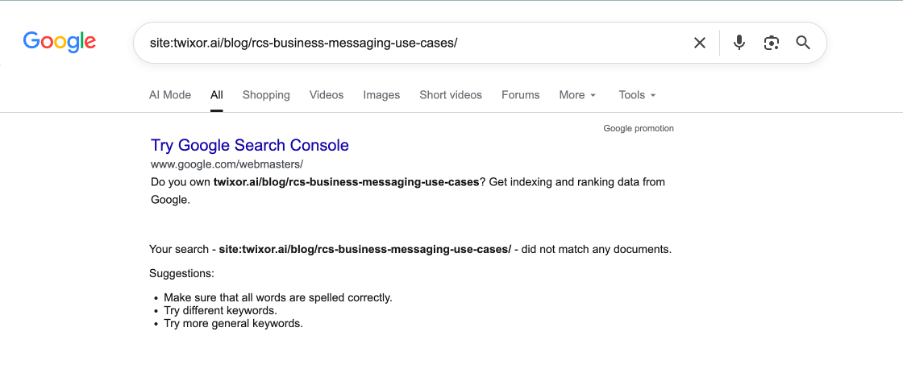
Source – Google search, taken before the page was indexed.
We asked ChatGPT, Perplexity, and Google AI Overview about the exact topic of that new post while it was still unindexed. None of them cited it.
Once the page finally got indexed, we asked again, this time two ways.
First, a plain question: “What are the top use cases for RCS business messaging?”
Then the same question with the brand name added: “What are the top use cases for RCS business messaging in Twixor?”
We wanted to see if naming the brand changed anything.
| Stage | ChatGPT | Perplexity | Google AI Overview |
| Before indexed | Not cited | Not cited | Not cited |
| After indexed, generic question | Not cited | Cited the new page directly | Not cited |
| After indexed, brand named | Not cited, cited unrelated Twixor docs pages instead | Cited the new page directly, again | Cited the new page directly, confirmed by title and date |
None of the three tools cited the page, but only Google’s behavior was actually predicted by research. ChatGPT and Perplexity’s results here are new.
After indexing, Perplexity found it without any help.
Google only found it once the question named Twixor directly.
ChatGPT never found it either way.
| VERDICT: Indexing is the floor, not the finish line. Before indexing, citation wasn’t possible for any of the three tools. After indexing, it became possible, but not automatic, and how easily each tool found the page varied. |
Being found and being understood are two different things. Schema is next.
Does Schema Markup Actually Get You Cited by AI?
There are three sources that touch on this. Here’s what each one found.
| Research / Publication | Key Finding |
| We Tracked 1,885 Pages Adding Schema. AI Citations Barely Moved. | Ahrefs tracked 1,885 pages that added schema. ChatGPT moved up 2.2%, AI Mode up 2.4%, both small enough that they could’ve happened by chance. AI Overviews dropped 4.6%. Ahrefs flagged that one as real, not just random noise- small, but real. |
| Does Schema Markup Predict AI Citation? | Kurt Fischman found generic schema made no real difference. But pages with schema packed with real facts, an actual price, a rating, had a 61.7% citation rate, compared with 41.6% for generic schema. That gap held up even after researchers ruled out other explanations. And it mattered most for smaller brands, less so for bigger, more established ones. |
| Schema, LLMs and the Low Bar for “Evidence” in GEO | Mark Williams-Cook hid a fake address inside broken schema code, nowhere on the visible page. In his test, ChatGPT and Perplexity both read it back as fact anyway, treating it as regular text, not structured data. |
Ahrefs and Fischman agree on one thing: schema on its own barely moves anything. Fischman went further and found one exception: schema filled with specific facts performed better than generic schema.
Williams-Cook’s test suggests something worth remembering: if a fact matters, put it in your regular page copy too, not just in code a visitor never sees.
Here are the two websites we tested.
Clueso, which has real authority, about 100 G2 reviews, but no schema markup anywhere.
Glitter is a much smaller brand, and it has schema in place.
We confirmed both directly in the raw source code before testing anything.
Searching each page’s source code for “application/ld+json,” the tag that signals schema markup. Clueso’s pricing page had 0 matches, whereas Glitter’s pricing page had 4.
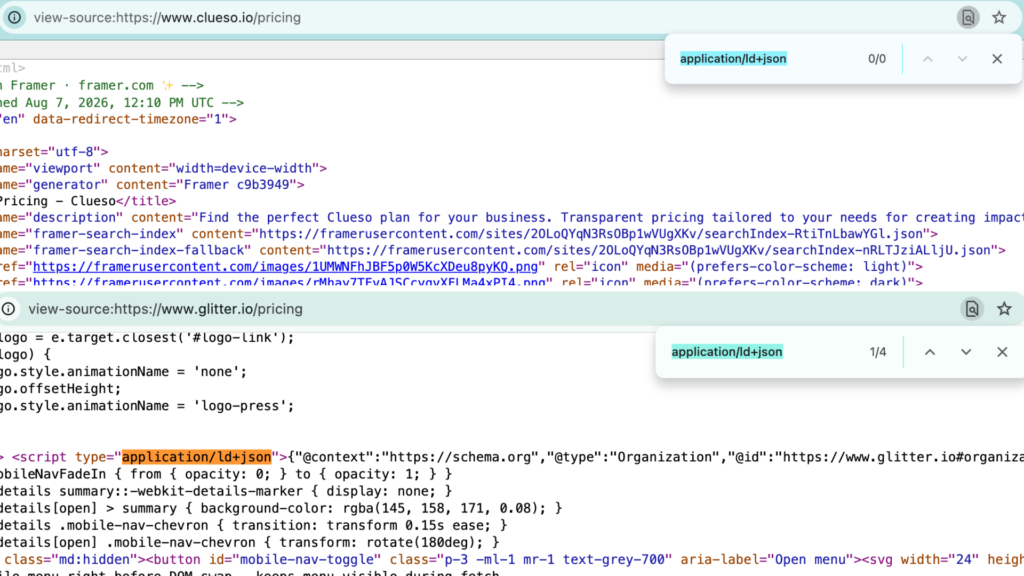
We asked all three tools real questions about each brand.
For Clueso, we asked where it stores customer data, a fact that’s visible in Clueso’s visible text; no schema needed.
For Glitter, we asked whether it’s SOC 2 compliant, a fact also represented in its schema markup.
| Brand | Schema | ChatGPT | Perplexity | Google AI Overview |
| Clueso | None | Missed the regional detail (Mumbai, Frankfurt, California) | Got it right, matched the FAQ page word for word | Got it right, named all three regions |
| Glitter | Present | Correct, with audit type and how to request the report | Correct, with audit type and how to request the report | Correct, with audit type, and offered to help access the report |
Does it hold up? Partly, and the Clueso result says something the schema sources didn’t predict.
Clueso has zero schema, so this isn’t a schema story at all.
All three tools were reading the exact same visible page. Two caught the regional detail; one didn’t. That’s not about schema; it’s about how thoroughly each tool reads plain text.
Glitter’s result is consistent with the research.
The smaller brand had real, specific schema, and all three tools got it right.
But Clueso and Glitter differ in more than just schema, brand, site, question, everything, so this can’t isolate schema as the actual reason.
| VERDICT: Schema can help, but it’s a nudge, not a requirement. Generic schema barely moves anything. Specific, fact-rich schema showed stronger citation results, especially for smaller brands still building authority. |
Schema is about what’s on the page. However, Speed is about how fast an AI tool can get to it. Let’s look at whether that has any impact.
Does Page Speed Affect Whether AI Cites You?
Dan Taylor‘s did a study that looked at 107,352 pages. However, according to him, Page speed barely relates to whether AI cites a page. Moreover, the study covers Google AI Overviews only. It never tested ChatGPT or Perplexity. It never tested one specific, genuinely slow page either, just a broad pattern across thousands of pages. That’s exactly the gap our own test checks.
Dropbox’s Video Feedback Tool page loads slowly, with a Largest Contentful Paint of 4.6 seconds on mobile. Google calls anything over 4 seconds “Poor.”
That number comes from Google’s own field data, based on real visitors to that page.
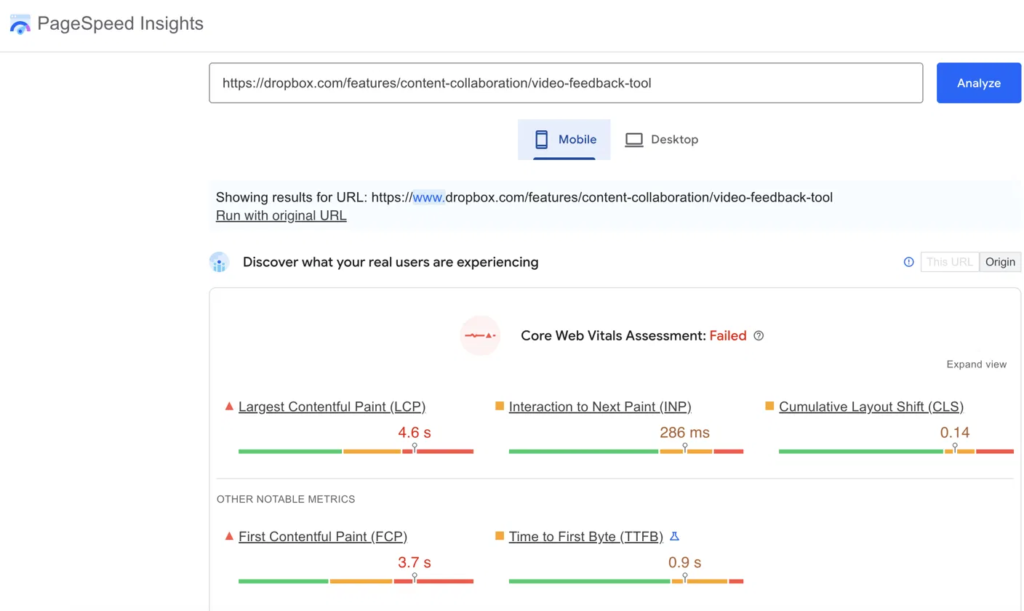
Source – PageSpeed Insights
We asked ChatGPT, Perplexity, and Google AI Overview the same question, worded to match a real feature on this exact page: does Dropbox’s video review tool let me filter comments by who left them?
All three answered correctly. Only one cited the actual slow page.
| Tool | Correct answer | Confirmed reading the slow page |
| ChatGPT | Yes | No, cited Dropbox’s Help Center and Learn pages instead |
| Perplexity | Yes | Yes, confirmed in its full source list |
| Google AI Overview | Yes | No, cited Dropbox Tech Blog and Help Center pages instead |
The findings are more interesting than a simple yes or no.
Only Perplexity actually pulled from the slow page. ChatGPT and Google AI Overview both got the answer right, but drew from different pages: Dropbox’s help center and blog instead.
Those pages are also written more directly for this kind of question.
That does not prove that speed doesn’t matter. Two tools skipped the slow page and picked other pages instead. However, there could be other reasons too, like the tool stopped after finding the relevant answers. The results were inconclusive, except for the fact that even slow pages can get referenced by AI tools.
| Verdict: page speed is mostly a small nudge, not something that blocks you. Only one of three tools cited our slow page. Paired with Dan Taylor’s much larger study, the pattern suggests speed rarely decides citation, except for the worst-performing pages. |
Now, let’s look at two other factors that are said to impact visibility:
What About Security and Mobile? Honestly, We Don’t Know Yet.
Most technical SEO checklists also mention two more things: is your site secure, and does it work well on a phone?
Both matter for appearing on regular Google search.
But for AI visibility specifically, we didn’t have enough real evidence to test either one carefully. So we’re not going to force an answer just to keep the pattern going.
On security:
This isn’t about HTTPS or anything a security team manages. It’s about whether AI bots respect a site’s request to stay away. Think of it more like etiquette than security. Here’s what research says about the same:
| Research / Publication | Key Finding |
| Perplexity is using stealth, undeclared crawlers to evade website no-crawl directives | Cloudflare says Perplexity allegedly used a hidden, disguised bot to get past sites that specifically blocked it. ChatGPT respected the same block. |
Worth being upfront about two things here.
Cloudflare sells security products that block bots, so they have a reason to make this sound serious. And Perplexity disputes the whole report, calling it technically flawed.
Even setting that aside, this report only covers one narrow thing: how one AI tool’s crawler behaves when blocked.
One report, about one company, isn’t enough to call security a real factor either way. We didn’t build a live test for this.
A genuine test would need brand-new content and a brand-new website that blocks crawlers totally. That way, a correct answer would mean something. It would show the AI fetched the page live, not just remembered.
On mobile:
No research source connects mobile experience to AI visibility directly. Google’s own mobile-first indexing documentation is about regular Search, not a separate mobile factor for AI visibility.
We checked Dropbox directly anyway. We compared what a desktop visitor sees against what a phone visitor sees, by looking at the actual code, not just how the page looks. We checked that against Google’s own rules for mobile-friendly sites.
We didn’t find any real gap between the two.
But that’s one brand. One clean result from one company isn’t enough to say mobile experience matters, or doesn’t, for AI visibility.
| VERDICT: We don’t know, and we’d rather say that than guess. Not enough got tested for either one. Forcing a verdict here would mean pretending we have evidence we don’t. |
We’ve gone through all six factors that are said to impact AI visibility. Here’s where that actually leaves us.
So Where Should You Actually Spend Your Time To Improve AI Visibility?
We suggest fixing indexability and crawler access first, especially for whichever AI systems you actually want to show up in. These are the two most capable of blocking a page from a specific AI system entirely.
Schema and page speed are worth doing, but they’re not the fire to put out first. Fix them when something’s genuinely broken. Clueso, Glitter, and Dropbox showed us what broken actually looks like, and what fine looks like too.
If we had to put this in a table, here’s what it looks like:
| Dimension | Fix first if | Skip for now if |
| Crawlability | You’re blocking bots used by the AI systems you want to surface in | You’re only blocking training bots like GPTBot |
| Indexability | A page doesn’t show up in a site: search yet | It’s confirmed indexed |
| Schema | A key fact only exists in your code, especially if you’re a smaller or less established brand | You’re established, and every fact is visible in plain text |
| Page speed | Load time is severely, consistently slow | Load time is within a reasonable range, even if not perfect |
| Security | Not enough evidence to say | Not enough evidence to say |
| Mobile | Not enough evidence to say | Not enough evidence to say |
This is one of the many research pieces we conduct at Concurate, where we are trying to understand factors that affect AI visibility and test them too, so we can achieve stellar results for our clients. You can also read our analysis of why certain AI visibility tools appear more frequently in AI recommendations to see how comparison content, practical guides, and visibility beyond the website may influence those recommendations.
If you want to understand how to improve AI visibility for your brand, book our calendar today, and we will walk you through a plan that can help you earn AI visibility in no time.
Frequently Asked Questions
1. Which technical factor should SaaS teams fix first for AI visibility?
Indexing and crawlability come first. Both can block a page from ever being cited, no matter how good the content is. Everything else, schema, page speed, only nudges the odds up or down once a page is actually visible.
2. Does adding schema markup guarantee more AI citations?
Not on its own. In Fischman’s study, schema containing specific, verifiable facts performed better than generic schema, especially for smaller, less established brands. Generic schema with no real detail behind it barely moved the needle.
3. If a page is blocked in robots.txt, will it disappear from AI answers?
It depends on which bots are actually named. Most robots.txt files block bots used for AI training. They don’t always block the bots used for real-time answers. Block the wrong one, and nothing changes. Block the right one, and that AI tool won’t be able to reach the page at all.
Disclaimer: The information in this article combines publicly available research with original testing conducted by Concurate. All trademarks, brand names, and logos mentioned belong to their respective owners. We don’t claim ownership of any third-party marks, and nothing here implies endorsement or affiliation. This article is for informational purposes only.