

| TL;DR: We analyzed how four popular AI platforms like ChatGPT, Gemini, Perplexity, and Claude recommend contract management software, and found that a small group of vendors appears far more frequently than others. By studying these companies, we identified several content and visibility strategies that help them surface consistently in AI recommendations. This article explains those patterns and outlines practical steps contract management software companies can take to increase their chances of being discovered across AI-driven search. |
If you operate in the contract management software space, chances are you are frustrated by how some popular tools capture all the attention.
Their names keep appearing across AI platforms when buyers ask questions related to the contract management space and its associated workflows.
And you heard that this visibility across AI surfaces is getting them leads, too. Meanwhile, you are wondering what exactly these competitors are doing behind the scenes that helps them appear so frequently when buyers search for solutions.
You need answers. That’s where this article can help.
This article pulls back the curtain on what these companies are doing behind the scenes. And we will also share a few strategies that can help you compete more effectively in this visibility race.
Methodology – How We Identified the Vendors Appearing Across AI Platforms
Before we look into why certain contract management platforms appear frequently across AI responses, we first needed to identify which vendors show up most often when buyers search for solutions.
To do this, we analyzed responses from four high-intent queries across AI tools, including ChatGPT, Gemini, Perplexity, and Claude. The queries were:
- Top contract management software
- Contract lifecycle management tools
- Contract management tools for enterprises
- Best contract management software for legal teams
These queries capture a mix of broad searches, enterprise-focused queries, and legal-team use cases, which are common entry points for buyers researching CLM platforms.
For each query, we recorded the vendors recommended by each AI system and compared the results to identify which companies appeared most consistently across platforms.
Here’s what we found.
Best Contract Management Software Recommended by ChatGPT, Perplexity, Claude, and Gemini
Across the four queries we analyzed and the responses generated by these platforms, 26 different contract management tools appeared in the recommendations.
However, the distribution was far from even. Some vendors appeared only once or twice, while a small group of platforms showed up repeatedly across queries.
For example, tools like Ironclad, Icertis, and Sirion surfaced consistently across nearly every platform we reviewed.
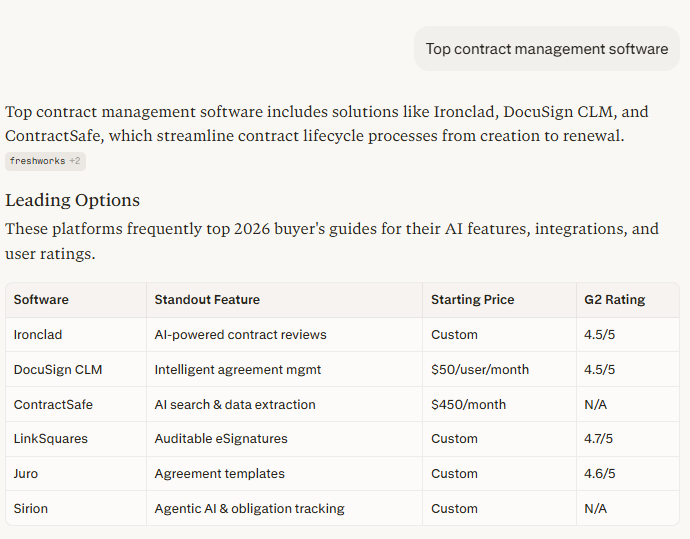
Source – Perplexity
On the other hand, several platforms showed up only occasionally. Tools such as Conga, SpotDraft, ContractSafe, and ContractWorks appeared in only a handful of responses.

Source – Claude
However, there was a clear pattern. While many vendors were mentioned once or twice, a small cluster of tools dominated visibility across high-intent pain-point-specific queries across the four AI platforms.
These were the six vendors that stood out for appearing most consistently.
| Vendor | ChatGPT | Gemini | Claude | Perplexity | Total Appearances |
| Ironclad | 4 | 3 | 4 | 1 | 12 |
| DocuSign CLM | 4 | 3 | 4 | 1 | 12 |
| Agiloft | 4 | 3 | 4 | 1 | 12 |
| Sirion | 4 | 3 | 3 | 2 | 12 |
| Icertis | 3 | 3 | 4 | 2 | 12 |
| Juro | 3 | 2 | 4 | 1 | 10 |
Next, we wanted to know why these names kept coming up. So we did some digging and here’s what we found.
Why These Contract Management Tools Show Up So Often Across AI Platforms
We wondered: what makes these platforms appear so frequently across AI responses? To investigate, we ran a few queries across common questions buyers ask around contract management.
We then examined the sources these AI platforms relied on to generate their answers.
One thing became very clear. All of these companies run strong content engines of their own. Across their websites and resource hubs, they consistently publish blogs, guides, explainers, and educational resources.
Over time, this creates a large content footprint and strong topical authority across the web. As a result, this content becomes easier for AI systems to discover, crawl, and reference.
Let me share a few examples.
Educational Content That AI Systems Frequently Cite
To start, we asked Gemini a very simple question: What is CLM? Gemini, like its peers, gave a great explanation of Contract Lifecycle Management, while also answering two other full forms: Closed-Loop Marketing and Career Lifecycle Management, just to be safe.
Fair play, now we wanted to check where they were getting this information. So we checked the sources and here’s what we found:
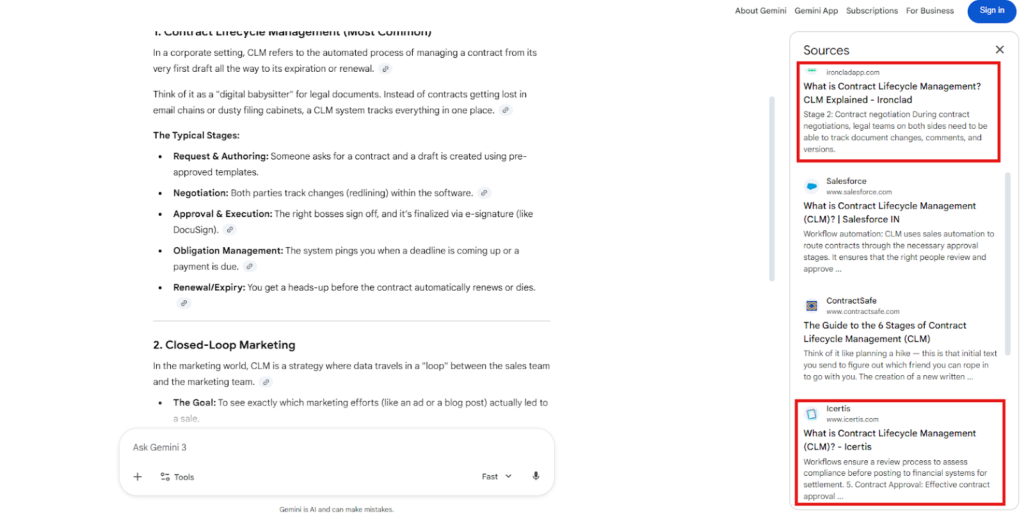
Source – Gemini
Gemini had surfaced educational content from vendors such as LinkSquares, Ironclad, SAP, and Salesforce.
At this point, we began noticing a pattern. So we continued testing additional questions that buyers might ask when researching contract management platforms.
So we asked Perplexity, “What is the total cost of ownership for CLM?”
Once again, the answer cited multiple sources explaining the cost structure of CLM platforms, including licensing costs, implementation expenses, and integration considerations. Among the referenced sources were blog posts from Sirion and Ironclad, both of which publish detailed educational resources around contract lifecycle management.

Source – Perplexity
We observed a similar pattern for operational questions as well. When searching “How to use clickwrap agreements”, educational guides from companies like Ironclad and Docusign appeared among the results.
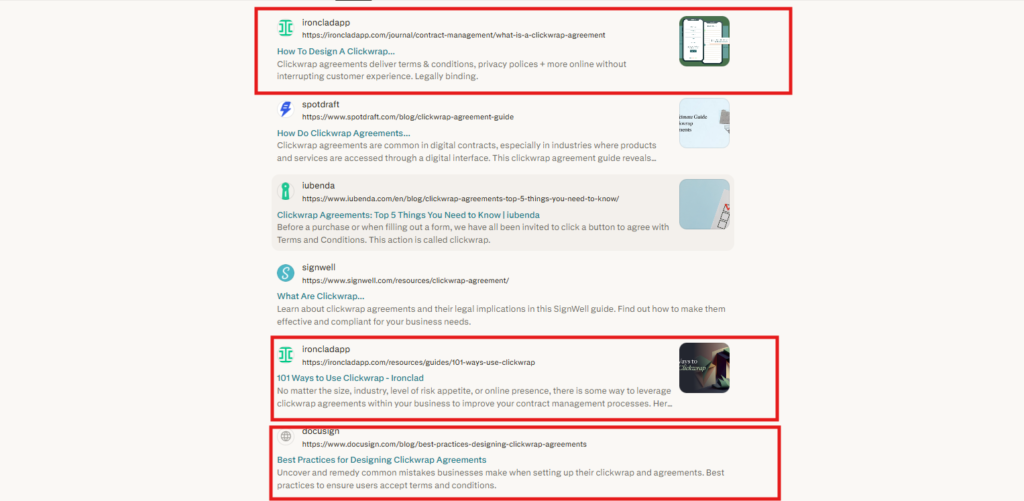
Source – Perplexity results
Taken together, these examples reveal an important pattern. The vendors that appear most frequently across AI platforms are also the ones publishing extensive educational content about the category.
For instance, Ironclad runs a large educational content hub that covers a wide range of contracting topics. Their content includes practical guides such as:
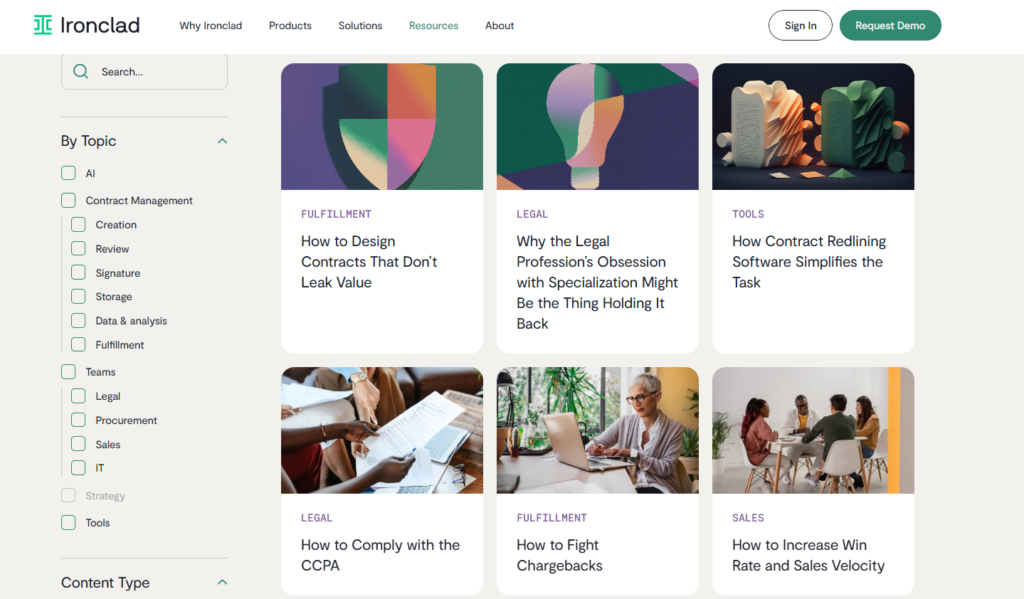
Source – Ironclad
Similarly, Sirion maintains an extensive resource hub featuring detailed blogs and guides on foundational CLM topics.
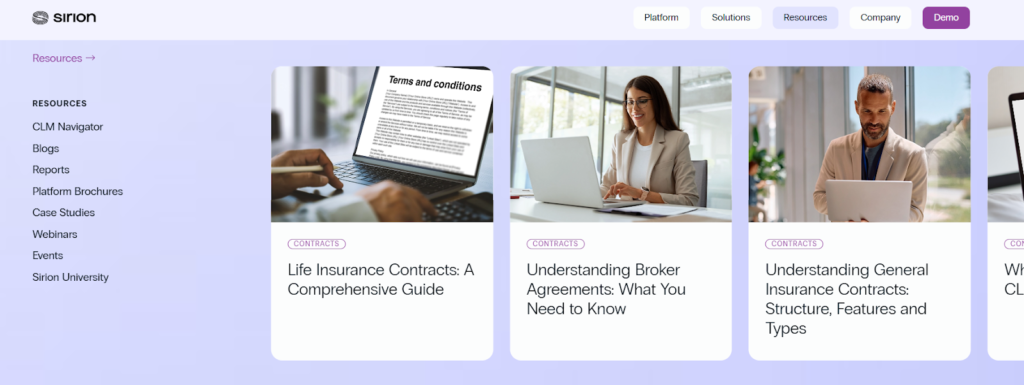
Source – Sirion
When AI systems look for authoritative sources to answer questions about contract lifecycle management, companies that consistently publish clear and educational content about the category are far more likely to be cited.
Over time, this visibility compounds, increasing the chances that these vendors continue appearing across AI-generated recommendations.
Alternative and Comparison Pages Built Around Buyer Intent
While analyzing these vendor websites, there was another interesting signal that came up. One of the companies that consistently appear in AI recommendations have built dedicated alternative hubs targeting competitor searches.
For example, Juro has an entire alternatives section where it compares itself against tools like PandaDoc, Contractbook, Ironclad, and LinkSquares. Each page is designed around a specific comparison query that buyers actively search for.
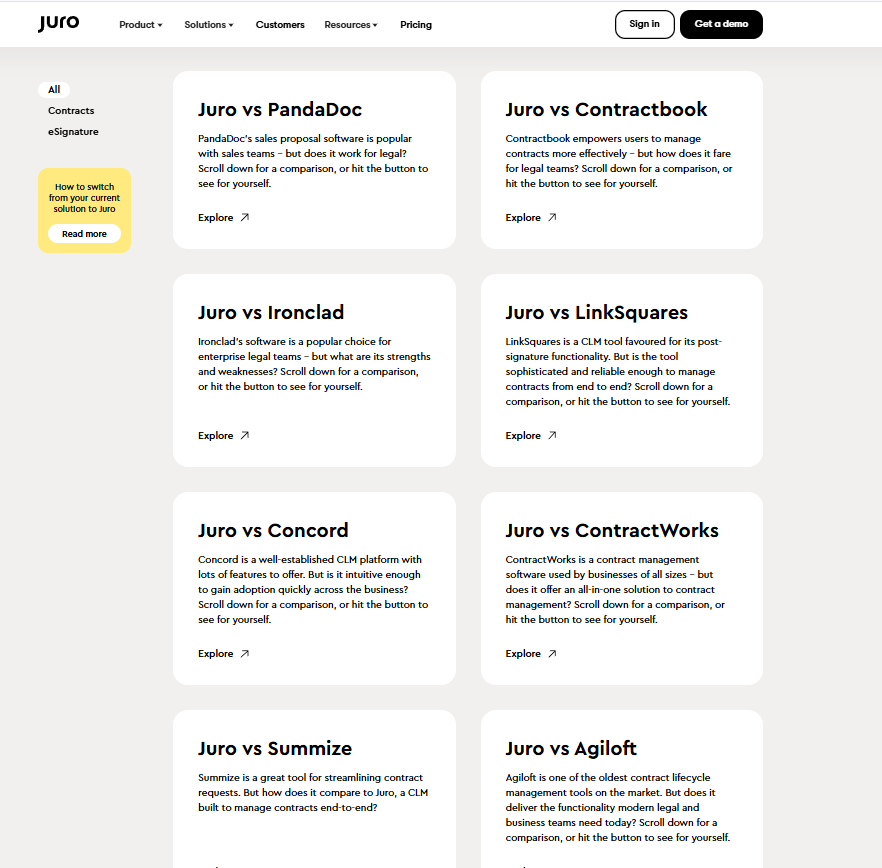
Source – Juro
Each of these comparison pages are structured around real evaluation questions, highlighting differences in usability, workflows, integrations, and pricing models.
This becomes extremely powerful in AI search. When users ask queries like “Juro vs Ironclad” or “alternatives to PandaDoc,” these pages directly match the intent. As a result, AI platforms often reference them while generating recommendations.
For instance, Perplexity shows this when we search for Juro Vs Ironclad. Moreover, Ironclad has a similar page too.
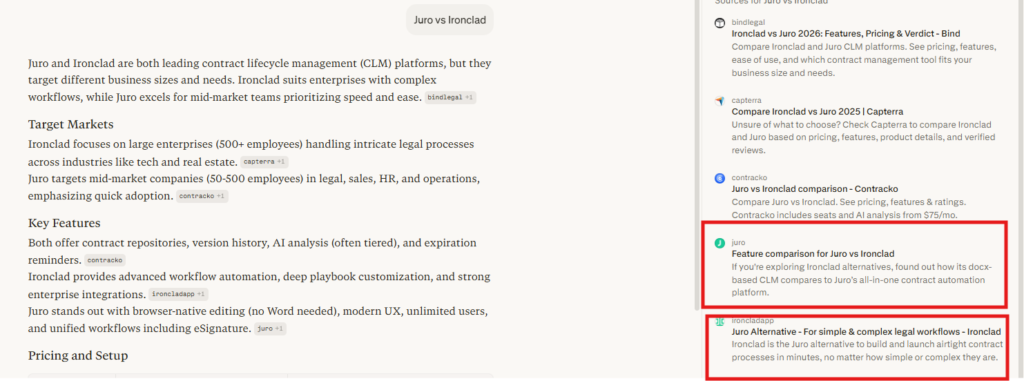
Over time, this strategy creates repeated visibility across comparison-driven queries, which are typically closer to decision-making.
Large Contract Template Libraries Built for Real Contracting Tasks
When we were running queries across each platforms, we were trying to anticipate what else they might search. We figured since the audience of contract management software might also search for different types of contracts and agreements.
So we asked ChatGPT to generate an Airbnb rental agreement template. ChatGPT produced a structured agreement covering common clauses such as property details, rental duration, payment terms, security deposits, house rules, liability, and signatures.
We then asked the system the source for formulating these templates.
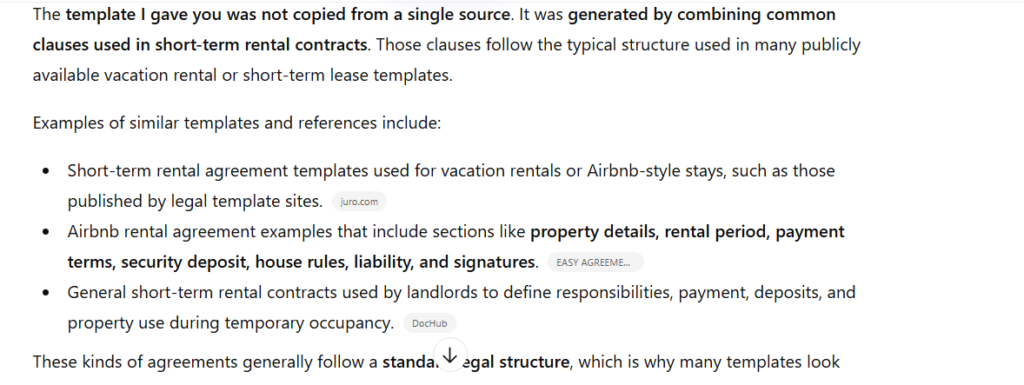
Source – ChatGPT
The response indicated that the structure of these agreements generally follows standard clauses used in publicly available rental contract templates and commonly published legal template resources.
This caught our attention. We zoomed in the source and saw another clear pattern:many of the vendors that showed up across AI recommendations publish extensive template libraries covering dozens of agreement types.
For instance, Juro alone publishes dozens of downloadable templates spanning categories like employment agreements, commercial contracts, intellectual property agreements, real estate contracts, and corporate agreements, to name a few.

Source – Juro
We noticed similar template libraries across Contractbook, which provides contract templates in multiple languages including Norwegian, Danish, Swedish, German, and English.
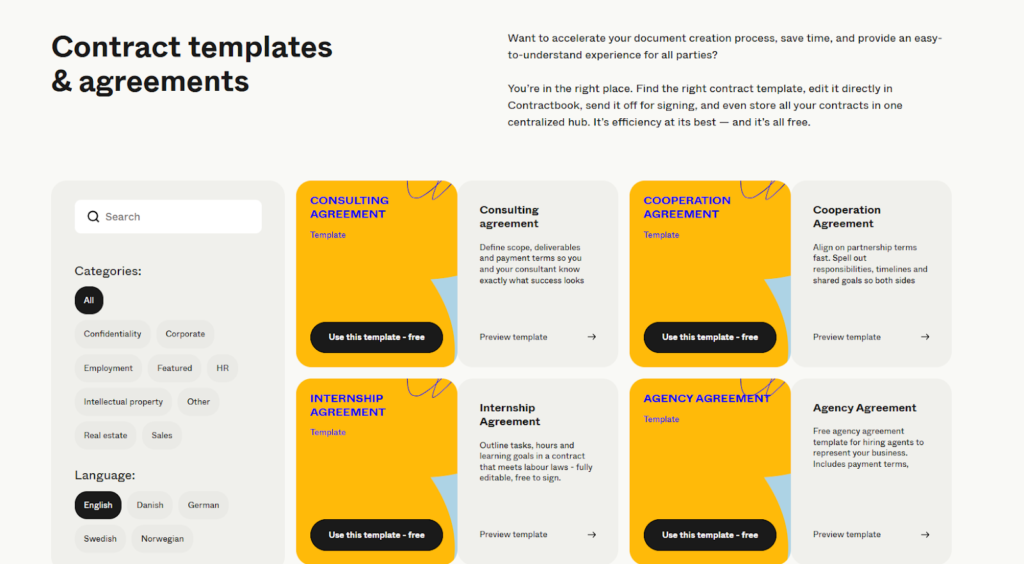
Source – ContractBook
This helps explain why these vendors appear frequently across AI responses. By publishing large collections of commonly used legal templates, they create highly practical resources around real contracting tasks.
When users ask AI platforms for templates, agreement structures, or examples of legal documents, these kinds of pages become natural sources for the systems to reference.
Over time, this strategy increases the likelihood that these vendors continue appearing across AI generated answers.
These are just some of the strategies these contract management software companies appear to be using. These strategies are not just helping them rank across traditional search engines, but also giving them increased visibility across AI surfaces.
Of course, given the scope of this article, we can not dive into every tactic these companies use.
However, it leads to the next question: if you want your product to appear in AI recommendations as well, how do you build that kind of authority?
Let’s explore that in the next section.
We’ve put together 13 Point Checklist to Optimise SaaS Blogs for Dominating AI Searches. Get the full list by filling out the form below.
5 Things Contract Software Companies Can Do To Improve Their Chances Of Appearing in AI Recommendations
After looking at the patterns across these platforms, one thing becomes fairly clear. The companies that consistently appear in AI recommendations are not relying on a single marketing tactic. Instead, they are building strong authority across multiple surfaces where buyers research solutions.
While every company’s strategy will differ, there are a few practical approaches that organizations can adopt if they want to improve their visibility across search engines and AI discovery platforms.
1. Publish Comparison Lists and Vendor Roundups Buyers Already Search For
One interesting observation from our research is that several vendors appeared not only in the AI answers themselves but also in the sources those answers cited.
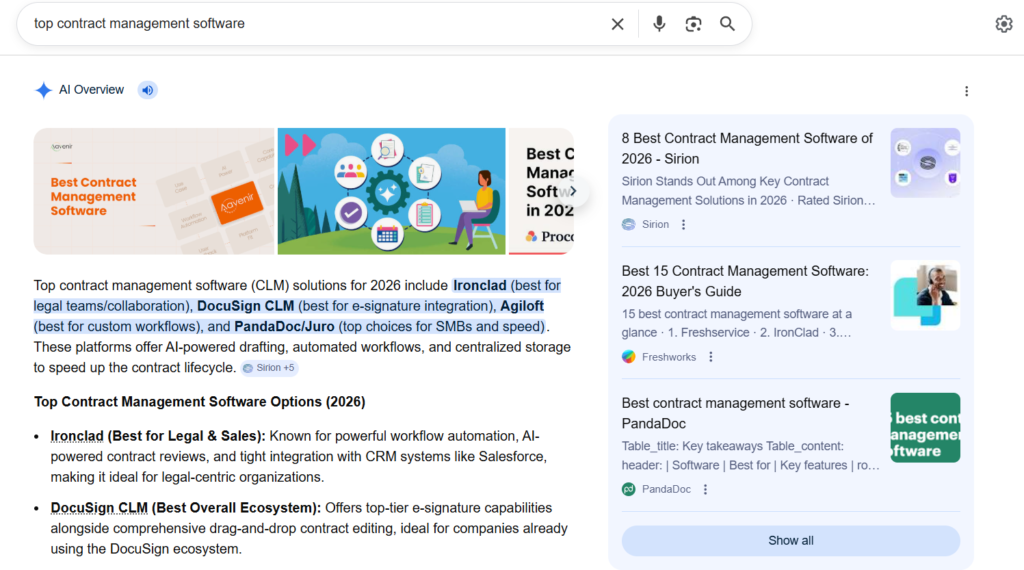
In many cases, these sources were comparison articles or best-of lists evaluating contract management platforms. Even when a vendor did not appear in direct AI responses, it often showed up inside these comparison lists, which were then cited by AI systems as supporting references.
We have seen this pattern repeatedly across AI answers. When platforms evaluate tools side by side, those pages often become sources AI systems rely on while generating recommendations.
If you’re a contract management software company that does not appear across AI recommendations yet, here’s a practical approach you can adopt.
- Create best-of-your-industry lists around queries people in your domain search for. For instance, target queries like:
- Top contract management software in 2026
- Best contract lifecycle management software
- Top enterprise contract management platforms
- Best CLM tools for enterprises
- Top contract lifecycle management software companies
- Best contract management platforms for legal teams
- Create strong alternative and competitors list, listing alternatives of popular platforms, and use the opportunity to position your tool right while citing your features clearly. You can create articles around queries people ask, like:
- alternatives to DocuSign CLM
- Juro alternatives
- PandaDoc alternatives
- Sirion competitors and alternatives
A good example of this strategy in action is how IronClad created a page ranking for Juro alternatives:
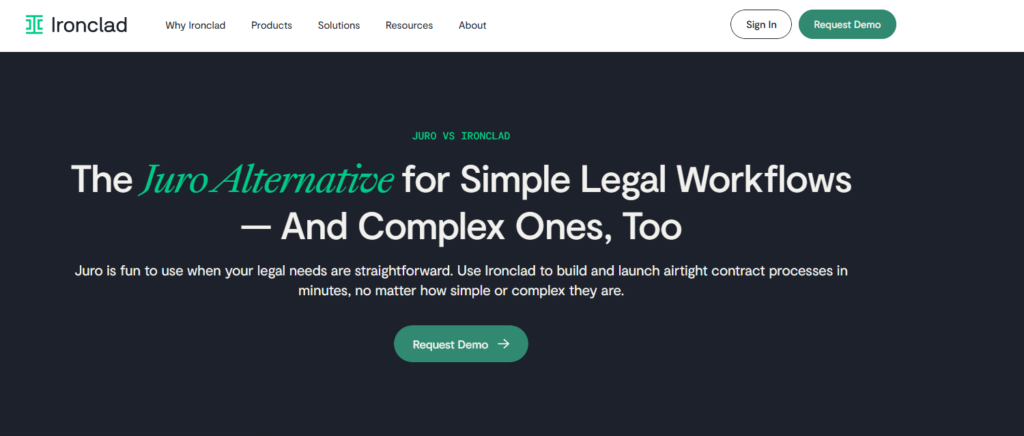
When AI engines look for authoritative references, they often rely on sources that already evaluate vendors side by side. Publishing well-structured comparison content can increase the chances that your platform appears in both search results and AI-generated recommendations.
2. Use Programmatic SEO to Scale Content Across Use Cases
Another opportunity contract management companies can explore is scaling content systematically across different use cases and buyer scenarios.
Many SaaS companies already publish educational guides and blog posts. While this is useful, the reality is that most competitors in a category are doing the same thing.
Previously, we have seen programmatic content strategies at work in several popular SaaS tools like Storylane, ElevenLabs, Canva, and many more.
A more scalable approach is to think beyond individual articles and instead build structured content covering the many use cases, problems, and scenarios your product can solve.
For example, you can do:
Landing pages around industries your product can work for to increase reach. It acn look like:
- contract management for healthcare
- contract management for IT services
- contract management for Pharma
- contract management for BFSI
- contract management for insurance
You can also build pages based on departments like:
- contract management tool for legal teams
- contract management tool for procurement leaders
- contract management tool for finance departments
- contract management tool for sales operations
| A word of caution: Avoid creating thin pages with duplicate content. They can get penalized by search engines and could do more harm than good. |
Your strategy need not be limited to landing pages alone. You can also create how-to type posts on operational problems buyers search.
Like:
- How to reduce contract approval delays
- How to manage contract renewals
- How to track compliance obligations
The key idea here is scale. When companies systematically cover the many contexts in which their product is used, they create a larger content footprint that both search engines and AI systems can easily discover.
Over time, this structured expansion helps companies appear across a much wider range of buyer queries.
3. Build Pain Point Specific Content Around Real Problems Users Face
Another practical approach is to create content that explains the problems within the category, not just the product itself.
Many buyers searching for software solutions are not initially looking for a specific vendor. Instead, they are trying to understand how to solve specific operational challenges they encounter in the contract lifecycle management workflows, procurement contracting processes, or legal operations automation.
Companies that publish clear, structured pages or blogs explaining these topics often become trusted sources for understanding the category.
For example, teams using contract management software often struggle with challenges such as:
- Slow contract approval cycles that delay deals and vendor onboarding
- Poor visibility into contract renewals, obligations, and deadlines
- Contracts scattered across drives, inboxes, and document versions
- Procurement teams renegotiating agreements without historical context
- Compliance risks caused by inconsistent templates and contract processes
- Difficulty tracking obligations across multiple departments and vendors
Creating content that explains how to solve these problems and a quick mention of where your product can help can hit two birds with one stone.
This kind of pain-point-focused content builds authority and increases the chances that AI systems reference those pages and your tool when users search for solutions to these problems.
4. Distribute Insights Across Multiple Content Channels
Good content rarely lives in a single format.
While blogs and written guides remain important, many vendors now share insights through a variety of formats such as short videos, webinars, industry talks, and social content. While these are popular, there are other less-used venues like YouTube Shorts and LinkedIn videos that allow companies to distribute the same insights in different ways and reach audiences who may not discover them through search alone.
This multi-channel presence can increase overall visibility and strengthen the authority signals associated with a brand.
5. Build a Strong Help Center and Product Knowledge Base
Finally, one underrated but powerful strategy is building a comprehensive help center or documentation hub.
Think detailed product guides, walkthrough videos, feature explanations, troubleshooting articles, and onboarding tutorials. All the popular tools have them, and you should have them too. Because they not only help existing users succeed with the product but also create valuable educational resources around the platform itself.
Over time, these knowledge bases become rich sources of structured information about how the product works and the problems it solves. This type of content can help search engines and AI systems better understand the product and its capabilities, hallucinate less and increase the chances of getting recommended.
These five tactics mirror many of the strategies we’ve seen the most visible SaaS companies apply.
And this list is not exhaustive by any means either. There are so many more things you could do. Companies that rank across AI surfaces have built entire content ecosystems over time, combining multiple approaches to strengthen their visibility across both search engines and AI platforms.
If you want AI shortlists to notice your product, these are a few strategies to start with. And if you need help implementing these ideas, we can help.
We’ve also put together 30 proven SaaS growth strategies to help you achieve double the impact. Get the full list by filling out the form below.
Want to Improve Your Visibility in the Contract Management Software Space?
The contract management software market is becoming increasingly competitive. Dozens of platforms are competing for the same buyers, often offering similar feature sets and capabilities.
So how do you make your mark? Doing so requires more than writing a few hundred blogs. It involves building a structured content strategy that positions your company where buyers research solutions today.
At Concurate, we have spent the last several years studying how SaaS companies appear across both search engines and AI systems. Through this work, we have developed multiple playbooks, templates, and execution frameworks that help companies build authority in competitive software categories.
Our experience spans several industries, including IP technology, innovation management platforms, fintech, e-commerce, and other SaaS sectors where credibility, compliance, and domain expertise play an important role in buyer decision-making.
We understand that each industry has its own dynamics. But the underlying challenge remains the same: ensuring that when buyers research solutions – whether on Google or inside AI engines like ChatGPT, Gemini, Perplexity, or Claude – your company is part of the shortlist.
If that’s something your team is looking to improve, Concurate can help you build the content and authority needed to get there. Book a call with us, and we can map out the right approach for your category.
Frequently Asked Questions
1. How can contract management software companies improve visibility in AI search results?
Contract management companies can improve visibility by creating content that aligns with how buyers search. This includes publishing comparison pages, list-based articles, and use-case-driven content. Structuring content with clear sections, bullet points, and direct answers also helps AI systems extract and reference it more easily across platforms like ChatGPT and Perplexity.
2. Why do some contract management tools appear more frequently in AI-generated recommendations?
Some tools appear more often because they consistently publish educational content, comparison pages, and practical resources like templates. Over time, this builds strong topical authority. AI platforms tend to reference sources that repeatedly show up across relevant queries, making these vendors more likely to be included in recommendations.
3. How can CLM software companies build authority in competitive SaaS categories?
CLM companies can build authority by covering their category in depth. This means creating content around core topics, use cases, buyer problems, and industry-specific applications. Consistency matters more than volume. When companies show up across multiple related queries, it signals expertise to both search engines and AI systems.
4. What role do comparison pages play in marketing contract management software?
Comparison pages help buyers evaluate tools side by side, especially when they are close to making a decision. These pages also align well with high-intent queries like “alternatives” or “vs” searches. Because of this, AI platforms often reference them when buyers search for recommendations or are comparing options, making them a powerful asset for visibility.
Want golden insights in your inbox (without the spam, of course!) Each week, we share what we’ve tested, learned, and proven in SaaS marketing. Sign up to get smarter with us.
Disclaimer: The information presented in this article is compiled from publicly available sources, including company websites, industry reports, and social media. All trademarks, brand names, and logos mentioned are the property of their respective owners. We do not claim any ownership of third-party marks, nor do we imply endorsement or affiliation. This article is intended for informational purposes only.