


| TL;DR: This guide explains what influences AI visibility: mentions in trustworthy sources, content trustworthiness, and content relevance. You’ll learn how to track visibility on AI tools manually or with tools like SE Ranking’s AI visibility tracker. We cover how to measure brand mentions, content citations, competitor positioning, and sentiment across LLMs. |
With AI search becoming a major part of the standard Google search experience and LLMs gradually replacing Google as the only way to find information online, AI visibility has become increasingly important for SaaS businesses.
Clicks are declining in organic search, and being visible in AI search can bring some of the lost traffic back. But how do you track this visibility, and how do you improve it?
This article explains this and provides tips and best practices for both processes.
What is AI Visibility?
AI visibility is the measure of how visible your SaaS brand or website is in AI search results. This includes being visible in contextually rich informational queries on LLMs like Claude, Perplexity, or ChatGPT.
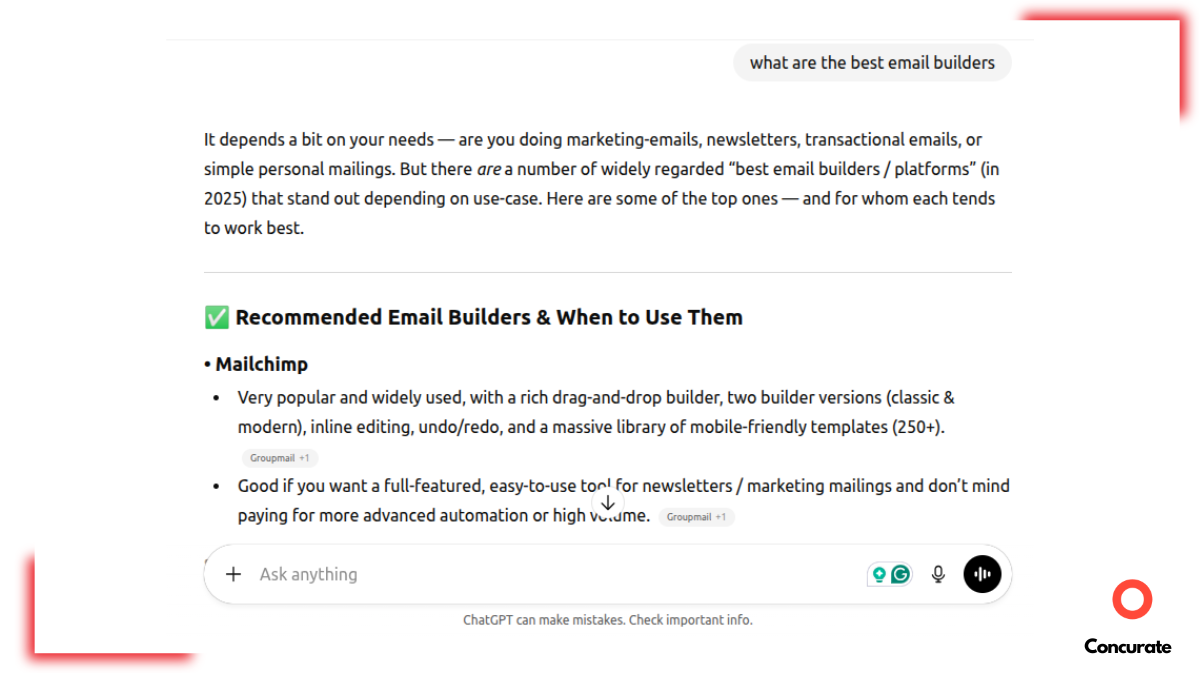
Source: ChatGPT
The metric also includes Google’s AI-powered search features, like AI Overviews.
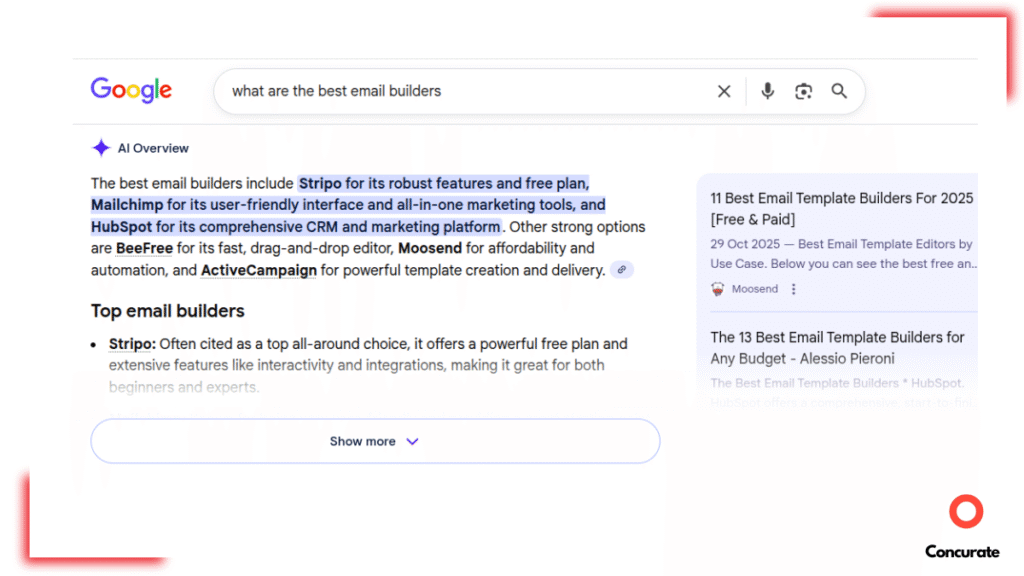
Source: Google
High visibility on AI tools indicates that your business or SaaS is often mentioned as a trustworthy vendor, or content posted on your website is credited as a source in AI replies relevant to your field. Low visibility in AI search means you are rarely mentioned or appear low on the list.
Why Do You Need to Optimize For and Track AI Visibility?
AI search isn’t just a fad that’s not worth looking into. It’s becoming an important way B2B buyers find SaaS information.
Understanding your visibility on these platforms and improving it can bring significant benefits. For instance, you can
- Tap Into the New Mode of Search: 700 million people weekly use ChatGPT alone. Tracking and optimizing for visibility on AI engines can help your SaaS get impressions on the new search engine.
- Improve Performance in Traditional Search: AI visibility includes Google’s search experiences, like AI Overviews. Google displays such pages above organic search results for 12% of keywords. Being mentioned there beats being first in organic search, at least in terms of impressions.
- Improve Brand Awareness: Improving visibility on AI search can help your SaaS appear in more searches and be discovered by high-buying-intent users.
- Increase qualified traffic. Having your brand mentioned in search queries related to your line of work can bring leads to your website, either directly from the AI tool or from later research conducted by a prospect.
You can achieve all this by AI search tracking and slightly altering your approach to content creation and digital PR to increase AI visibility.
What Influences AI Visibility?
Let’s look at how AI decides which brands or pages to show for each user request to understand how we can do AI search optimization.
Mentions in Trustworthy Sources
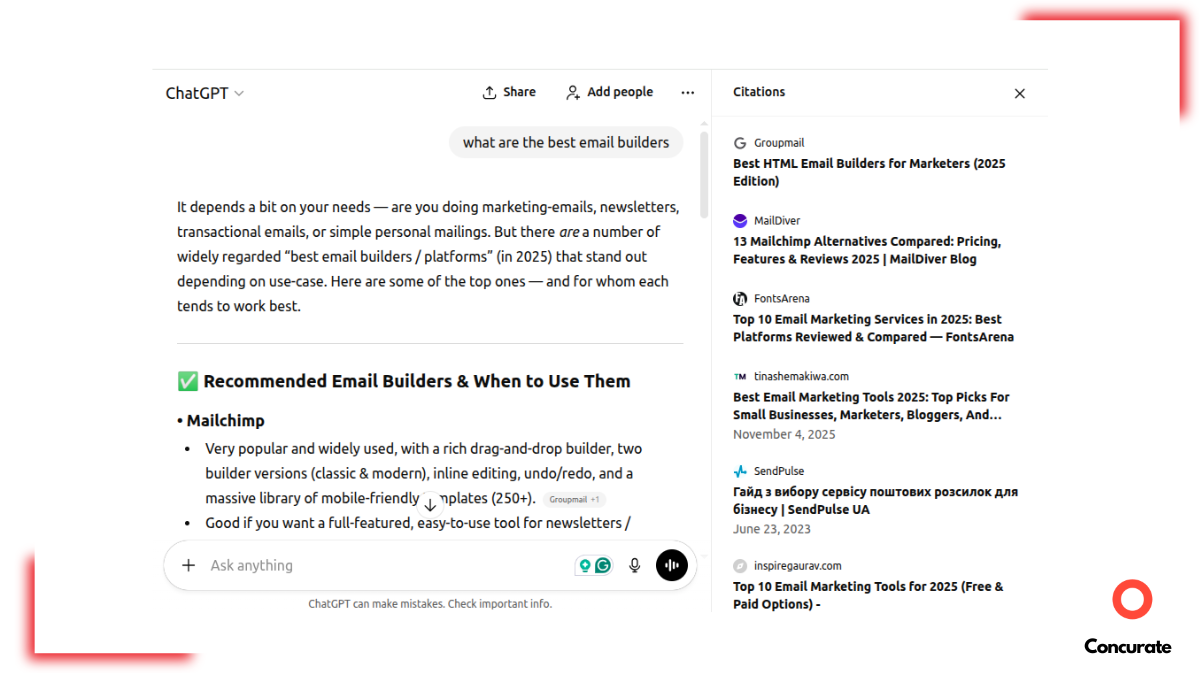
One major aspect of brand visibility on AI platforms is appearing in industry-related queries with a commercial intent.
An example of a query like that is “what is the best email marketing software” or “what are the best payroll softwares for startups.”
AI search results mostly present information like that from reputable external sources, like in this output.
Source: ChatGPT
Content Trustworthiness
When the goal is to get visibility on AI engines for the content posted on your website, your content should be trustworthy (and accurate) enough to serve as a source of information.
The factors that can play a role in determining the trustworthiness are:
- External mentions of the website or the page.
- Topical authority of the website.
- Author’s trustworthiness.
- Content recency.
Content Relevance
Finally, AI tools will consider how relevant your content is to the user’s question.
Most AI platforms will look at:
- Presence of keywords in meta tags and H1.
- Answering the intent behind the question.
- The quality of the content.
How to Track Visibility in Gen-AI Platforms?
AI search and its visibility are rather new concepts, so there isn’t a single set of best practices that everybody agrees on. On top of that, there are no native analytics tools for AI platforms. There’s no tool like Google Analytics for ChatGPT or Perplexity, so you can’t access data on impressions and queries the traffic comes from.
Google’s analytics suite also doesn’t yet work with its own AI tools. Clicks on links presented in AI Overviews and AI Mode do not have a separate category and will appear as either organic or direct traffic. Google officials have said these analytical features will be added to GA and Google Search Console soon, though.
These two factors make tracking AI visibility and referral AI traffic a harder task than most of the established marketing channels, but there are plenty of workarounds.
What to Measure in AI Visibility?
First, you need to know what to measure to understand this visibility. The most important metrics are:
- Brand mentions.
- Content citations.
- Competitor comparison.
- Sentiment.
- Traffic and conversions.
Measuring them is not as easy as with organic search, because in traditional SEO, Google Search Console can show you which keywords your website gets traffic from. Third-party keyword research tools can show thousands of keywords relevant to your website that you can track.
In AI visibility optimization, there is no way to reverse engineer the prompts your brand shows up for. Finding every query that your brand can show up for is also virtually impossible because each user’s question is unique.
What you have to do is understand which barebones questions are relevant to your brand.
For instance, if you run a time management tool, people might find you by prompting AI questions like:
- How to manage my time better?
- How to be more productive at work?
- How to get more things done during a workday?
- What are the best productivity tools for a manager?
- What are the best time management tools?
All of these questions, of course, can be phrased in a hundred different ways. When looking for an answer, AI will often break down the questions into smaller search phrases in a process known as query fanout.
Inevitably, one of the core search terms in all of these questions will be “best time management tools.”
You can also refer to the list of keywords you’re tracking and take prominent long-tail keywords from there. Taking single-word keywords won’t help much, but there’s a good chance user questions will be broken down by the AI into long-tail keywords similar to those popular on Google.
To get more ideas on questions users can ask the AI, look into long-tail keywords related to your main keyword in SEO tools, and check Google’s People Also Ask section.
You can also ask the AI to provide a list of potential questions its users can ask.
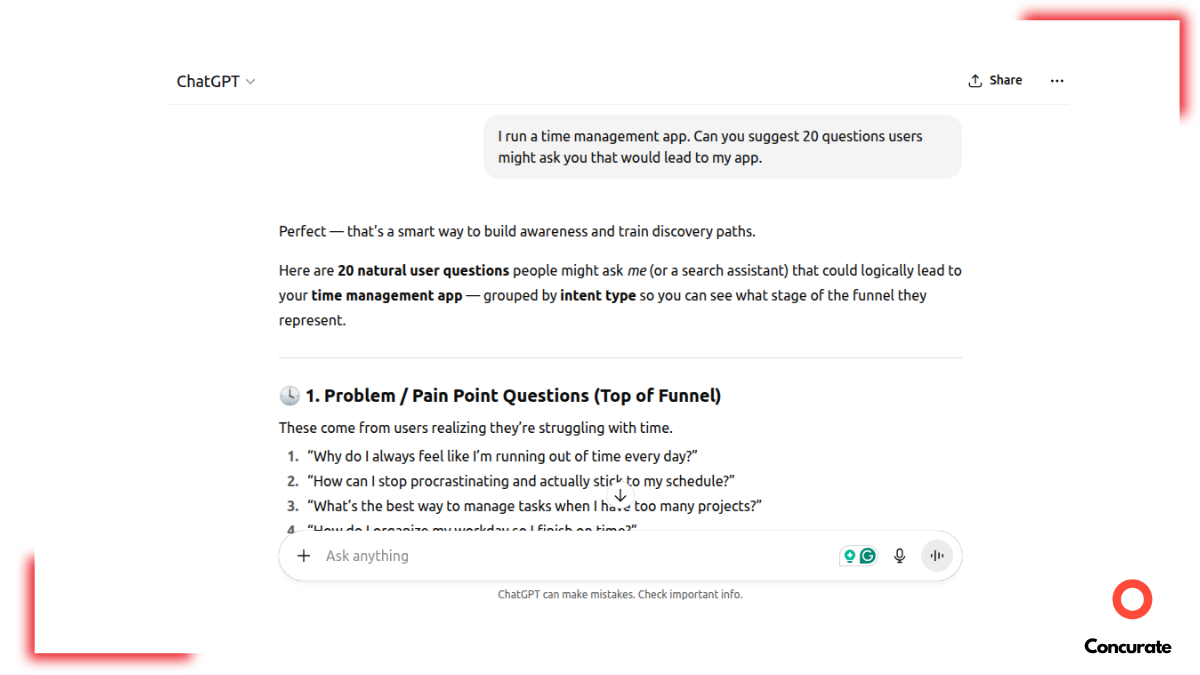
Source: ChatGPT
Compile a list of potential key phrases and questions. You’ll measure your AI visibility for those queries.
How to Manually Analyze AI Visibility?
Once you have a list of search terms and questions that you’re interested in tracking, get a free account on different AI models and run each question through them one by one. It’s best to use a new chat window for each query. Otherwise, the AI might start giving answers in the context of the conversation, not only based on the query itself.
When you’re going through the list of queries, note the following:
- Does the answer contain unlinked brand mentions?
- Does the answer contain a list of sources?
- Does your brand appear on the list of brands?
- What is the context in which your brand mention appears?
- Does your content appear on the list of sources?
- What position does it take?
- What are the competing brands and websites on the list?
Add this information to a spreadsheet and save the AI conversation for future reference.
You can use this spreadsheet to calculate a couple of metrics:
- Citation frequency — total AI brand mentions divided by the number of queries.
- Average position — the average position of all brand mentions and source links.
- Share of voice — total brand mentions and source links divided by the total number.
Even though this method is free, it’s best to save it for select queries that you want to understand better. Tracking AI visibility manually can take a lot of time, even if it’s only done monthly.
How to Analyze AI Visibility with Tracking Tools?
A better way to track AI visibility is with third-party tools that go through a similar process laid out above, but do it automatically and can do it on a daily schedule.
Let’s take the SE Ranking AI visibility tracker as an example.
This tool takes keywords and questions that might be relevant to your business and runs them through Google’s AI Overviews and AI Mode, as well as ChatGPT, Perplexity, and Gemini.
For each platform, you can view:
- Presence of mentions.
- Presence of links in sources.
- Average position.
- AI visibility score.
- Share of voice score.
This makes tracking AI visibility trivial and saves you dozens of hours in manual tracking.
Another important metric you want to track is the traffic you get from AI platforms. While tracking traffic from AI Overviews and AI Mode is difficult at the moment, you can access traffic from AI engines through the referrer filter in GA4.
Set up a separate report for AI traffic by limiting it to the referral traffic from LLM websites. If you connect your GA4 account to SE Ranking, you can view the traffic numbers from its AI visibility tracking tool.
It’s impossible to view which queries the referral traffic comes from, but even raw traffic numbers can serve as an indicator of the success of your AI optimization strategy.
For a detailed guide on how to track traffic from AI tools, check out our video below:
How to Improve AI Visibility?
Once you have a good understanding of your position in AI search, you might find that it needs improvement. Here are the four main options you have to increase AI presence and rank in ChatGPT-like queries.
Get Mentions from Relevant Websites
The most important brand mentions you’ll get from AI engines are those connected to commercial queries. These are the queries where people ask for a list of the best businesses or products in the industry.
The most widespread way AI finds answers to queries like those is by referring to articles that provide lists of the best businesses. Another one is quoting useful answers from platforms like Reddit and Quora.
Your best bet at getting your brand mentioned for those queries is to earn mentions on these websites.
How to Get Mentions for Relevant Domains
Here’s what you need to do to get mentions from listicles with the best businesses.
- Run the query you’re interested in.
- Save the listicle pages quoted in search.
- Find out who is responsible for managing the website. You’re looking for positions like editor, editor in chief, content writer, or head of content.
- Get their contact information on LinkedIn or by using an email marketing tool.
- Create outreach copy to compel them to consider including your brand on the list.
- Start an outreach campaign.
You’ll have to be consistent with outreach to get a mention like that, but even a few can play a major role in changing your brand’s visibility in AI search.
To get mentions on UGC platforms like Quora and Reddit, you’ll need to identify which threads to contribute to. Do that by reviewing AI citations across different platforms. You can also check out Google’s Discussions and Forums section.
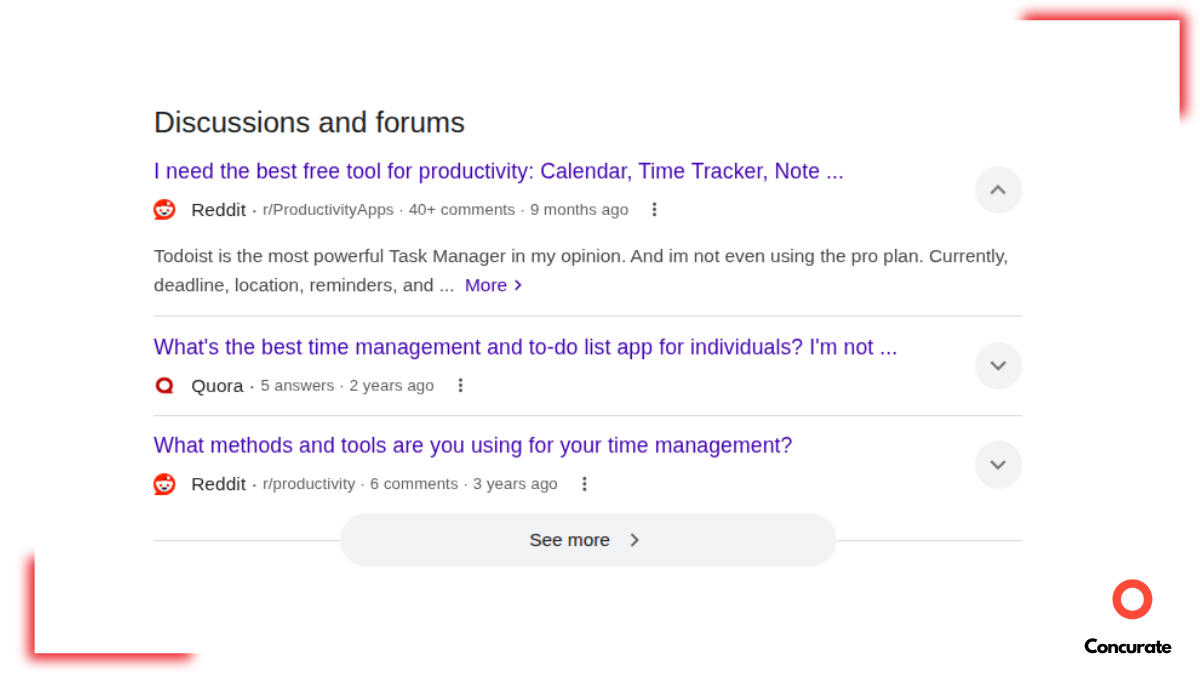
Source: Google
Even if these aren’t quoted by AI yet, they might be in the future.
With a list of relevant threads, log in to the platform and leave a helpful comment that addresses the OP’s (original poster) question or one of the posts in the thread. Mention your brand and disclose the connection, keep the post non-promotional, and don’t leave a link. An unlinked mention can appear in AI search, and leaving links might lead to your post getting deleted.
You might need a profile with a posting history and karma to post in some subreddits.
Once you get mentions on one of these platforms, track the visibility changes for the relevant queries.
Create Original Content
In informational queries, it might be hard to beat long-established sources for the most basic information. You have much better odds of appearing in AI responses if you contribute something new to the conversation.
The two types of content you can create for that end are data-driven and an original point of view.
Content based on your own research can be expensive to produce because it typically involves either testing a hypothesis in your field or doing a survey. Neither of these is cheap. But it can both improve AI visibility and SEO.
Coming up with original points of view in an industry with a lot of established best practices can also be hard to pull off.
You can:
- Look at other people’s data and write about your conclusions.
- Share your hands-on experience.
- Share your opinions, as long as they are backed by data.
This kind of content is also useful outside of AI visibility optimization. Use it in your newsletters for qualified leads or repurpose the main points for LinkedIn posts.
Structure Content for AI
The structure of your content plays a role in how well AI can analyze your content.
Here are the best practices:
- Structure Content with Headings: This will help the AI navigate to the right place in your content piece to answer a specific question.
- Include Lists and Tables: AI often summarises content in lists, and providing a ready-to-use summary can help with getting quoted.
- Keep a Question-Answer Structure: Presenting questions, especially the ones you suspect your customers might be asking, and offering short answers can help get your content on AI search.
- Add FAQ Sections: Adding questions and answers relevant to the content as a separate section can help your content appear in more AI searches.
For more best practices, check out our free 13-point checklist to optimise SaaS content to dominate AI searches. Download now!
Implement Structured Data
The final part of the puzzle is using structured data in your content. Structured data, or Schema markup, is a JSON document that provides multiple details about your content. This includes authorship, the topics covered by the piece, date of creation, and many more data points.
It is primarily used for search engine optimization, but AI also accesses structured data to understand your content. Add Article or FAQ Schema to your articles, and you’re going to improve your content’s AI visibility.
Structured data is a rather complicated JSON document, but you can generate one with AI. Make sure to double-check all the fields and test it with Google’s validation tool before submitting.
Update the Schema when you’re updating the article to signal its freshness.
The Bottom Line: AI Visibility Requires Strategy, Not Just Tracking
Tracking visibility on Gen-AI platforms is more complicated than with visibility in traditional organic search. You’ll need to do a lot of research to understand which core prompts you should track first. Then use an AI visibility tool to monitor referral traffic from LLM platforms and identify correlations between AI visibility and conversions.
When it comes to optimizing for AI, focus on building up the number of mentions in websites that AI does or is likely to include as a source, and structuring content to fit AI search. Learn new techniques by reading up on other people’s experiences and experimenting with them yourself.
Ready to Dominate AI Search? Partner With Experts Who’ve Mastered It
Tracking AI visibility is one thing. Actually improving it is another.
While this guide provides a foundation, visibility optimization requires ongoing effort, experimentation, and expertise across multiple platforms.
You’re not just optimizing for one algorithm. You’re trying to appear in ChatGPT, Perplexity, Claude, Gemini, Google AI Overviews, and Google AI Mode, each with its own quirks and content preferences.
That’s where we come in.
At Concurate, we help B2B SaaS companies increase their AI visibility. Our content gets cited in LLM responses and captures traffic from the 700M+ weekly AI users searching for solutions like yours.
We don’t just track metrics. We build strategies that get your brand mentioned in the right conversations, on the right platforms, at the right time.
Our track record includes:
- Helping Triangle IP increase AI-driven engagement by 5.5X on key content pages through strategic LLMs.txt implementation and content optimization.
- Generating 24 qualified leads with just three blog posts for a FinTech SaaS client.
- Dominating 60+ markets for a network training provider, attracting enterprise-level leads.
- Securing the #1 ranking in the US, UK, and Canada for an AI voice cloning SaaS.
Whether you need help with AI visibility tracking, content optimization for LLMs, or a complete AI search strategy, we’ve got the experience and proven methods to help you show up where your buyers are searching.
Ready to stop being invisible in AI search? Claim your free consultation today, and let’s talk about getting your SaaS in front of millions of AI users.
Frequently Asked Questions About AI Visibility
This FAQ section addresses the most common questions we hear from SaaS companies navigating AI visibility for the first time. Whether you’re wondering about specific tools, best practices, or how it fits into your broader marketing strategy, we’ve got you covered.
What Is a Quick Hack to Boost AI Visibility?
One of the fastest ways to boost your visibility on LLMs is by adding an LLMs.txt file to your website. This simple text file acts as a guidebook for AI tools, telling them exactly which pages on your site matter most and what they’re about.
Think of it as the AI equivalent of a sitemap, except instead of helping search engines crawl your site, it helps AI models like ChatGPT, Claude, Perplexity, and Gemini understand your content better and cite you more accurately.
If you need guidance on how to create and implement an LLMs.txt file, read our detailed guide on How to Optimize a Website for AI Search Engines Using LLMs.txt File.
How Do I Appear on Google AI Overviews?
To appear in Google AI Overviews, focus on creating content that targets long-tail informational queries with clear, actionable answers. This is because Google’s AI prefers content that’s fresh, well-structured, and comes from authoritative sources.
For a complete breakdown of the five strategies that work best to get featured in Google AI Overviews, read our detailed guide on How to Rank in Google AI Overviews.
Where Is ChatGPT Getting Its Information From?
ChatGPT pulls its SaaS recommendations from a mix of trusted sources across the web.
Our research shows that third-party blogs and expert roundups carry the most weight (around 34%), followed by review platforms like G2 and Capterra (18%), Wikipedia entries (15%), and industry news publications (15%). Community threads on Reddit, YouTube reviews, and official vendor pages also play a role, though to a lesser extent.
For a detailed breakdown, read our full analysis: Where Does ChatGPT Get Its Information From For SaaS Recommendations.
What Are Other Brands Doing for AI Visibility?
Leading SaaS brands like CrowdStrike are engineering their presence in AI search by creating content that directly answers high-intent buyer questions. They’re not waiting for AI tools to discover them randomly. They’re building comparison pages, solution explainers, and use-case content that aligns perfectly with the questions buyers are asking ChatGPT, Perplexity, and Gemini.
When buyers ask AI, “What’s the best endpoint protection?” or similar queries, these brands consistently show up in the answer set.
Want to see the exact strategies in action? Check out our CrowdStrike AI Visibility Case Study for a detailed breakdown.
What Are the Popular SaaS Marketing Trends With Respect to AI?
The biggest AI trend for 2026 is that SaaS marketers are playing a dual game. It’s about ranking in Google while becoming recommendable in AI tools.
AI referrals convert 3X higher than traditional search, making AI visibility a priority.
Some of the key trends include engineering credibility through third-party mentions, focusing on context-rich content, and optimizing “unsexy” foundational content like product tours, FAQs, and more.
Check out more SaaS marketing trends here.
What Are the Best Agencies for Answer Engine Optimization?
We don’t like to brag, but Concurate is one of the best Answer Engine Optimization agencies. Our focus is not to optimize for rankings. We make your brand the answer.
Our content strategies include traditional SEO, structured AEO, and generative visibility tactics to ensure you show up in AI tools.
We’ve helped clients generate 100+ leads in six months while dominating featured snippets and AI surfaces.
For more top vendors specializing in answer engine optimization, check out our comprehensive guide: Answer Engine Optimization Agencies.
If you want more of such golden insights delivered every Friday to your inbox, subscribe to our newsletter below!