

| TL;DR: Marketplace startups often struggle to get visibility in AI surfaces because of thin listings, inconsistent data, and weak category structure. The right generative engine optimization agency can help fix this by improving how your listings, categories, and marketplace content are structured for AI visibility. In this guide, we cover 10 of the best generative engine optimization agencies for marketplace startups, including Concurate, Ignite Visibility, Embarque.io, and others. We will also cover what makes Concurate especially strong for the marketplace category and listing visibility. |
Running a marketplace startup is already a balancing act. You’re managing supply, demand, listings, and growth all at once. The last thing you want is AI surfaces quietly sending your leads somewhere else. But it’s probably already happening.
These days, people ask ChatGPT or Gemini for recommendations. If your name doesn’t show up there, they simply move on with what’s in front of them. They don’t do it on purpose; the AI shows personalized recommendations. If your content is not built around to showcase what you do best, gone are the chances of showing up in recommendations.
What’s worse? Most marketplace platforms are built in a way that makes this inevitable: thin listing pages, vendor-written descriptions, and templated content that don’t give AI enough trust signals. So, it turns to sources that are clearer, more consistent, and focused. This means even if your platform has a strong supply, your chances of getting skipped are higher than ever.
However, the upside is that it’s fixable. The right GEO agency can help your marketplace appear in AI-generated answers and turn that visibility into real leads.
Top 10 Generative Engine Optimization Agencies for Marketplace Startups
Marketplace startups often assume their existing SEO or content setup will carry over into AI search. Spoiler alert: it doesn’t.
The process of Generative Engine Optimization (GEO) works differently. It’s not about scaling listings or filling category pages with generic content. For marketplaces, it’s about making your supply, categories, and use cases clear enough for AI to understand and surface at the right moment. That means moving beyond vendor-written descriptions and templated pages, and building content that’s structured, consistent, and clear about what your platform offers.
Because marketplaces deal with scattered supply and uneven content quality, this needs a more deliberate approach than traditional SEO. That’s where these specialized generative engine optimization agencies listed below come in:
- Concurate
- Ignite Visibility
- Embarque.io
- Wallaroo Media
- Bay Leaf Digital
- Wpromote
- NoGood
- Tinuiti
- iPullRank
- Right Side Up
Now, let’s learn about each agency in detail, starting with Concurate:
1. Concurate
Concurate is a boutique content marketing and generative engine optimization agency that can help marketplace startups improve visibility in AI search. For marketplaces with thin listings, uneven seller content, and weak category pages, the visibility gap can directly affect discovery. We work to close the gap and turn that visibility into real leads.
Source: Concurate
We understand that there are thousands of marketplaces that exist today. And buyers do not scroll through dozens of platforms anymore to look for a product.
Rather, they ask AI tools like ChatGPT or Claude, “Where can I find this product?” or “Which marketplace offers fast and reliable service for this category?” If your platform is not appearing in those answers, your best sellers and unique categories never even get considered. Basically, you are invisible at the moment that actually matters.
What Does Our GEO Process For Marketplace Companies Look Like?
We fix that by building and structuring your content so AI systems can easily understand and recommend it. In short, we focus on creating content that influences buyer decisions the most. That includes creating comparison content, highlighting high-value categories, and structuring listings so they are clear, detailed, and easy for AI to surface.
How do we do this? By following a very logical approach.
We start by studying marketplaces that dominate AI visibility. We analyze how their categories are organized, how listings are presented, and exactly what kind of content gets picked up in AI recommendations. Then we apply those insights to your marketplace in a way that fits your products, your sellers, and your audience.
This also includes looking at the technical health of your site, because content alone is not enough. AI systems can only recommend pages they can actually crawl and read. If the technical foundation is broken, visibility suffers no matter how good the content is.
How We Applied GEO For A Premium Gifting Brand?
We saw this firsthand with a premium corporate gifting and co-branded merchandise agency we worked for. It’s a type of business that connects buyers with products across a wide catalog, much like how a marketplace operates.
When they came to us, their site health score was sitting at 73, well below the 90-plus scores their competitors maintained. Moreover, key pages were buried on pages 8, 9, and 10 of Google, not because demand was absent, but because nearly 6,000 technical errors were quietly blocking search engines and AI systems from properly crawling the site.
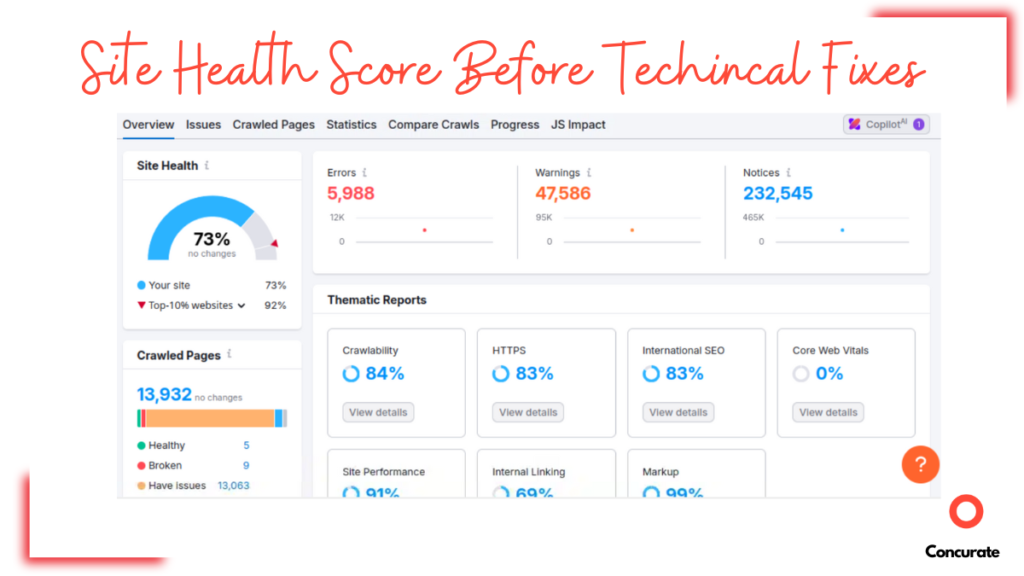
The issues ran deep: pagination errors that left Google with no clean path to follow, broken internal links, redirect chains, duplicate metadata, missing H1 tags, and hreflang conflicts across thousands of pages.
So, we ran a full technical SEO audit and fixed all of it systematically, specifically to improve how AI systems could crawl and read the site. We fixed the pagination, cleaned up redirects, rewrote metadata, and resolved thousands of errors.
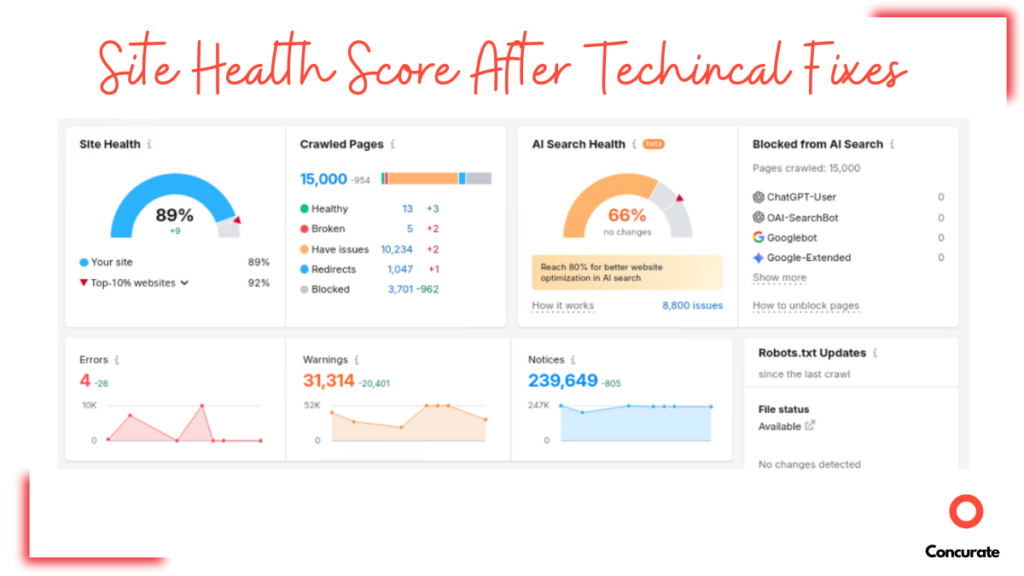
On the content side, we created blog posts targeting high-intent queries like “Corporate Christmas Gifts,” built to reach buyers at exactly the moment they are ready to decide. The result? The site health score went from 73 to 89, total errors dropped from 5,988 to just 4, and far more pages became visible and readable to AI systems. You can read the whole case study here.
That said, getting the technical foundation right is where most agencies stop. But we have noticed that visibility in today’s AI-first era goes much further than that. It is not just about your website. AI systems also look at your broader presence to determine authority and trust.
That is why we think in terms of your entire content ecosystem, including blogs, reviews, and presence on social platforms like LinkedIn and YouTube, to reinforce your marketplace’s credibility and ensure AI systems recognize it as an authoritative source.
The result? AI engines are left with no option but to cite your marketplace whenever a person makes a query relevant to your business. Over time, this visibility turns into engagement, which turns into leads, which end up driving conversions.
If you also want your marketplace to be discovered exactly when buyers are deciding, let’s talk.
Pricing
Our monthly retainers typically range from $5,000 to $7,500, while specialized one-time projects start around $3,500.
Notable clients
Datacipher, Triangle IP, Pinch Patent Drawings
Rating: 5/5
2. Ignite Visibility
Ignite Visibility is a full-service digital marketing agency that specializes in improving how complex platforms like marketplaces appear in AI-driven results.

Source: Ignite Visibility
They typically start by identifying which queries in your space trigger AI answers and analyzing the kind of content those answers rely on. Then, they review your website and existing content and start the real work. This includes refining category pages, cleaning up inconsistent listing data, and making sure key pages clearly describe what your platform offers and who it’s for.
They also support external visibility through PR and SEO, which helps reinforce your platform as a credible source. Over time, this combined approach makes it easier for AI systems to interpret and recommend your marketplace in decision-heavy queries.
Notable marketplace clients: DoorDash, WeddingWire
Rating: 4.8/5 (173 reviews)
3. Embarque.io
Embarque.io is a performance-focused SEO and GEO agency that centers its work on clarity and structure.

Source: Embarque.io
Instead of pushing more content, they focus on making existing marketplace pages easier to process for AI systems by restructuring listings and categories into formats that reduce ambiguity. This also includes using structured data and semantic optimization to help AI systems extract information more reliably.
Alongside this, they refine how content aligns with the way users naturally ask questions in conversational search. The result is a marketplace that shows up in more specific, high-intent queries rather than getting buried under broad results.
Notable marketplace clients: MentorCruise, Collabstr
Rating: 5/5 (13 reviews)
4. Wallaroo Media
Wallaroo Media is a brand growth and performance marketing agency that treats AI discovery as an extension of search, and not a separate channel.

Source: Wallaroo Media
Their work focuses on making marketplace content more complete and easier to understand, especially for queries where users are comparing options or evaluating outcomes. So, instead of just relying on thin category pages, they build out context that explains what users will find, how options differ, and where value lies.
At the same time, they address inconsistencies across similar pages. This improves both depth and accuracy, which helps a marketplace position itself as a more reliable source for AI-generated recommendations.
Notable marketplace clients: REBEL
Rating: 5/5 (4 reviews)
5. Bay Leaf Digital
Bay Leaf Digital is a B2B SaaS marketing agency that focuses on aligning marketplace content with high-intent queries.
Source: Bay Leaf Digital
Their work starts with understanding how buyers phrase detailed questions and what kind of answers AI systems tend to surface. Then, they build content that directly maps to those patterns.
In fact, to make sure there are no loose ends, they also refine categories and supporting content so each section clearly addresses a specific use case, rather than functioning as a generic listing hub.
Apart from this, the agency also supports relevant external mentions to strengthen brand authority over time. The result is a marketplace that is easier for AI systems to connect with specific buyer needs.
Notable marketplace clients: Travelocity, Angi
Rating: 5/5 (3 reviews)
6. Wpromote
Wpromote is a performance marketing agency that combines SEO, content, and analytics to improve visibility across search engines and AI platforms.

Source: Wpromote
Their approach involves finding queries buyers actually use when making decisions. Then they optimize marketplace pages and categories to clearly show what’s offered, why it matters, and how it fits buyer intent.
They also make sure content, listings, and internal links are consistent so AI surfaces can easily interpret the content on the platform and surface the right pages. This means buyers could find the right products or services, either through AI recommendations or traditional search.
Notable marketplace clients: Marriott Homes & Villas
Rating: 4.7/5 (3 reviews)
7. NoGood
NoGood is a growth marketing agency that approaches GEO as an ongoing process rather than a one-time setup.
Source: NoGood
They begin by analyzing how a marketplace currently appears across AI platforms and identifying where it falls short. Then, they use those insights to guide continuous updates. This includes refining category pages, adding missing context, and adjusting how listings are framed. This is done in addition to monitoring how visibility shifts over time.
Their iterative approach ensures the marketplace evolves alongside changing AI behavior, helping it stay relevant as new queries and categories emerge.
Notable marketplace clients: Gelato
Rating: 5/5 (1 review)
8. Tinuiti
Tinuiti is a full-funnel marketing agency that works with large-scale marketplaces to improve content performance across search engines and AI-driven discovery tools.
Source: Tinuiti
Their marketplace GEO strategy focuses on restructuring content so it is detailed, consistent, and easy for AI to understand. They also make technical improvements, like adding schema markup, improving page speed, and setting up canonical URLs, to help pages get indexed and found more easily.
Tinuiti also checks large sets of content for inconsistencies, standardizes messaging, and makes sure categories and listings are organized logically. By combining clear content, proper structure, and technical fixes, Tinuiti makes it more likely that AI and search engines can read the marketplace correctly, show the right pages, and help buyers find the products or services they need efficiently.
Notable marketplace clients: Etsy, DoorDash, Jet.com
Rating: 5/5 (1 review)
Recommended Read: 12 Technical SEO Agencies Setting the Standard in 2026
9. iPullRank
iPullRank is an enterprise SEO and content strategy agency that focuses on the technical setup of marketplaces.
Source: iPullRank
Their GEO work ensures AI can read and understand listings, categories, and pages consistently. So, they examine how different parts of a site are interpreted, identify structural gaps, and fix them by improving internal linking, category organization, and content hierarchy.
They also review content clarity, metadata, and how pages relate to each other to help AI tools figure out what is important and relevant. This approach makes it easier for LLMs and search engines to surface the right products or services when buyers search or use recommendations.
Notable marketplace clients: Quotient Technology Inc.
Rating: NA
10. Right Side Up
Right Side Up is a growth marketing consultancy that connects companies with experienced marketers who understand how marketplaces operate.
Source: Right Side Up
Their GEO approach is all-encompassing. It mainly focuses on making sure your platform is described clearly and consistently across all AI touchpoints. So, they align messaging across listings, categories, and external content to ensure everything reflects the same value and positioning. This consistency helps AI systems better understand the platform and improves their chances of being included in recommendations.
They also offer flexibility in how support is structured, which allows marketplaces to bring in the right expertise as they grow.
Notable marketplace clients: Instacart, DoorDash, Yelp
Rating: NA
And with that, the list of the top generative engine optimization agencies for marketplace startups has come to an end. Now, let’s understand how we curated this list in the first place.
How We Picked the Best GEO Agencies
Putting together this list was not just about picking well-known names. We wanted to find agencies that actually perform well in generative search, especially for marketplace businesses. So, we followed this approach:
- Firstly, we searched AI platforms such as ChatGPT, Perplexity, Claude, and Gemini to find reputable names in generative engine optimization. The idea was simple: if an agency claims GEO expertise, it should show up in AI search too.
- Next, we looked at each agency’s clientele and case studies to find the ones with real experience working with marketplace startups or companies.
- Finally, we reviewed their ratings, overall versatility, and depth of GEO expertise to make sure only the strongest agencies made the list.
Any agency that didn’t meet either of these criteria was excluded from the list. The above list can help you make the decision on choosing the right agency. But there are also a few things you can DIY. Let’s take a look.
5 Things Marketplaces Can Internally Do to Improve GEO
You see, a lot of GEO success comes down to how clean, structured, and usable your data is.
While specialized GEO agencies follow a comprehensive approach to help you scale in the long run, you don’t have to wait to get started. There’s a lot your marketing team can fix internally to start seeing better AI search visibility. Here are a few of them:
- Standardize your listings: Make sure every product listing has clear, complete details like price, category, features, availability, and basic descriptions. When this data is consistent across listings, AI can easily compare options and pull your products into recommendations.
- Build well-structured category pages: Don’t just show a grid of products. Add a short intro explaining the category, include key highlights, and use filters that actually reflect how users search. This gives AI context about what the page represents and improves its chances of being surfaced for broader queries.
- Keep your categories and tags consistent: Avoid overlapping or messy categorization. Stick to a clear, repeatable structure across your marketplace. When your taxonomy is clean, AI can connect listings to the right queries more accurately and with more confidence.
While these are strong starting points, they only take you so far. To consistently show up in AI-generated answers, your marketplace will need a dedicated GEO strategy. And that’s where a specialized partner like Concurate comes in.
What Makes Concurate the Best Generative Engine Optimization Agency for Marketplace Startups
For marketplace startups, GEO is not just about publishing more content or cleaning up a few pages. It is about solving a structural visibility problem. When your platform depends on listings, categories, and seller-generated content, AI systems need much more clarity before they can understand what you offer and when to recommend it.
That is where Concurate stands out. Instead of treating marketplace visibility like a standard SEO problem, we focus on the parts that shape AI discovery most. We move beyond basic keyword rankings to build deep entity authority and structural clarity for your marketplace.
By fixing fragmented content, resolving data instability, and establishing your platform as a category leader, we ensure you are not just another link in a search result but the definitive answer to a buyer’s question.
We also know that visibility is only valuable if it drives action. Our approach is designed to help your marketplace show up at the exact moment of decision, turning AI-driven discovery into qualified traffic, leads, and conversions.
If you are ready to stop being filtered out and start being the platform that AI recommends by name, Concurate is the partner to take you there.
Ready to dominate the next generation of search? Let’s talk.
Frequently Asked Questions:
1. How do GEO strategies differ between marketplaces and SaaS platforms?
Online marketplaces serve both buyers and sellers and handle large volumes of product listings, while SaaS platforms focus on a single product for one audience. So for SaaS, usually just a few strong key pages are enough to get cited by AI. However, marketplaces need structured categories, detailed listing attributes, and broad coverage across use cases, locations, and niches, so AI surfaces can compare options and cite them effectively.
2. What signals do AI search engines look for when recommending marketplace platforms?
AI search engines look for content that directly answers a user’s query with structured data. Think comparison tables, features, pricing, ratings, testimonials and more. Such pages are easier for AI to pick information from, so they get cited more often than pages with scattered or unstructured content.
3. How can marketplaces utilize user-generated content to improve AI search visibility?
Marketplaces should make user-generated content like reviews and Q&A easier to parse. That means organizing it clearly on the page, tying it to the right product or listing, and using valid structured data where appropriate. They can also summarize recurring themes from reviews to make the main takeaways clearer for both users and search systems
4. What content formats perform best for marketplace visibility in AI search?
Content formats that tend to work best for marketplace visibility are the ones that make products, categories, and buyer questions easy to understand. That usually includes well-structured listing pages, clear category pages, comparison content, and FAQ or Q&A pages where relevant.
Additionally, filtered pages based on factors like price or location can be useful, but they should be handled carefully, since faceted URLs can also cause crawl and indexing issues if they generate too many near-duplicate pages.
We’ve also put together 30 proven SaaS growth strategies to help you achieve double the impact. Get the full list by filling out the form below.
Disclaimer: The information presented in this article is compiled from publicly available sources, including company websites, industry reports, and social media. All trademarks, brand names, and logos mentioned are the property of their respective owners. We do not claim any ownership of third-party marks, nor do we imply endorsement or affiliation. This article is intended for informational purposes only.