


| TL;DR: If your product is strong but buyers still feel unconvinced, marketing is usually the gap. This guide explains where medical device marketing breaks down today and reviews 10 agencies built to support real buyer evaluation. |
To be honest, marketing a medical device can be hard in today’s time.
Search results are crowded, and AI-generated answers often compress nuance into clean, confident summaries. Devices that look similar on the surface often get presented side by side, even when their underlying accuracy, validation depth, and clinical reliability are very different. And when accuracy is the difference between trust and risk, that comparison can feel unfair.
The medical device market is on track to hit nearly $680 billion in 2025 as innovation explodes, yet that boom brings scrutiny that would make a tightrope walker sweat.
What makes this space tougher is that adoption never happens in one step. People discover you, question you, validate you, and then question you again. Every phase demands clarity, evidence, and restraint in how you communicate.
When marketing misses that nuance, good products quietly get overlooked. This guide looks at how teams are navigating that reality and who actually understands it.
Top B2B Marketing Agencies for Medical Device Companies
Most medical device teams bring in outside help when progress slows in subtle ways. Messaging becomes too cautious to convince, proof exists, but never reaches the right people, and sales keep hearing the same doubts.
The agencies listed below understand those realities. They work in environments where every claim is scrutinized, every audience sees the product differently, and decisions are made long before a form is filled.
Here’s the lineup of the agencies:
- Concurate
- First Page Sage
- Digital Elevator
- Parker White
- Healthcare Success
- Distill Health
- Icovy
- Epsilon
- Elevation Marketing
- Jairus Marketing
Let’s explore each one by one.
1. Concurate
At Concurate, conversations usually start with honesty. Something like, “We know the product works. That’s not the problem.”
The real problem is this. Your buyers keep asking the same questions on calls. Your sales team keeps repeating the same explanations. Your website technically has content, but it does not help anyone make a decision. And every time you try to simplify the story, compliance pushes back, and the message gets watered down again.
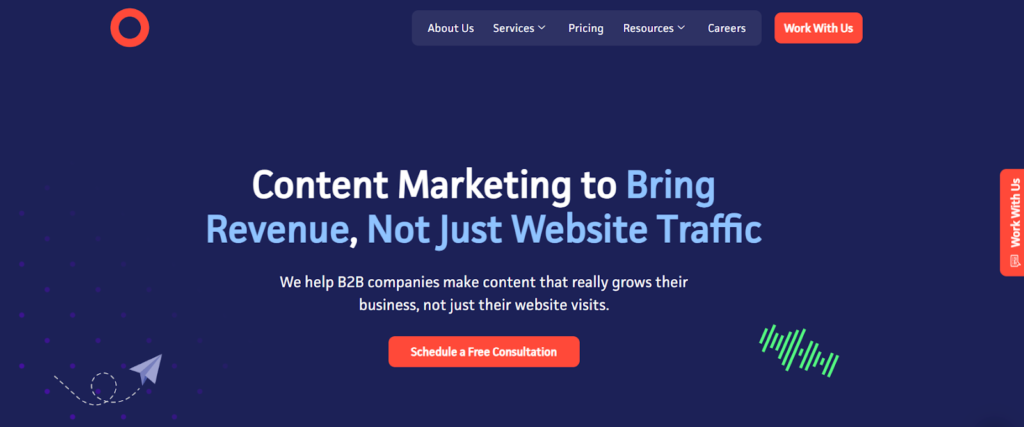
Source – Concurate
We work with teams where marketing has quietly become a dumping ground. Blogs here, decks there, and a few videos someone wanted six months ago. There is nothing connected, nothing reusable, and nothing that sales actually trusts.
So we fix that first.
For one medical device client, we sit in the middle of everything. We write blogs that explain the problem the way clinicians actually think about it. We turn those ideas into YouTube videos because sales teams keep asking for something they can share without a disclaimer-filled email.
We create comparison pages because buyers are already comparing you in private anyway. We map what shows up on Google and what now shows up inside tools like ChatGPT and Perplexity, because that is where early opinions form.
We have done the same kind of work in adjacent categories like wellness tech, where explaining value without overselling is just as critical. Different product, same pressure. Same buying psychology.
We do not think in channels. We think in questions, like:
- What question is the buyer stuck on right now?
- What answer helps them move forward safely?
- And where will they look for it when no one from sales is around.
That is what you get with Concurate. Not more content, but content that finally pulls its weight.
Notable clients: Enghouse Interactive, Inspire IP, Triangle IP, Datacipher, Athena Security, and others
Pricing: Our partnerships typically range from USD 5,000 to USD 7,500 per month, with project-based work starting at USD 3,500.
2. First Page Sage
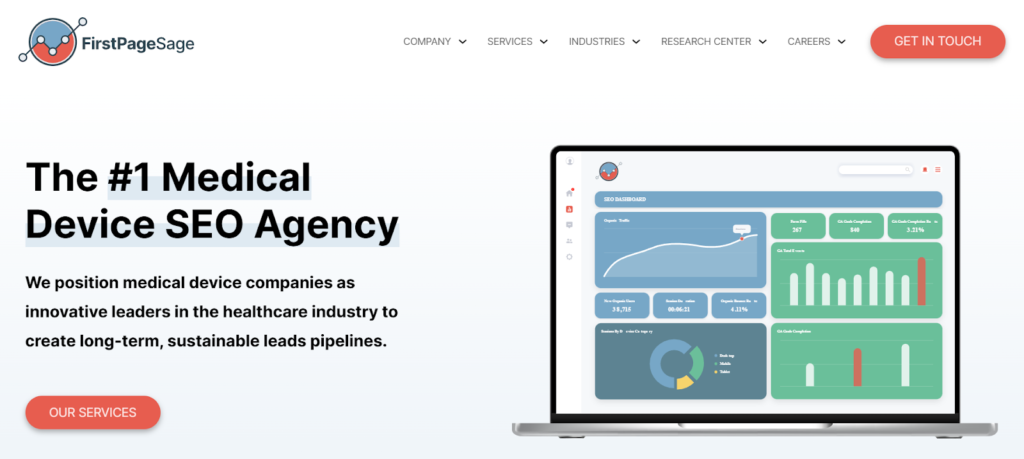
First Page Sage works with medical device companies on SEO and content programs that focus on long-term organic visibility. Their approach centers on helping device manufacturers show up during early research stages, particularly for informational and problem-led searches related to medical and clinical topics.
Source – First Page Sage
Their services include SEO strategy, medically focused content creation, and thought leadership programs supported by subject matter experts. The work typically involves keyword mapping, educational resource pages, white papers, and pillar content designed to align with longer evaluation cycles common in medical devices.
Notable clients: Biovia, Altoida, Kiverdi
Pricing: They offer custom pricing, generally structured as long-term SEO and content retainers
3. Digital Elevator
Digital Elevator works with medical device and healthcare technology companies that sell through complex, evaluation-heavy buying journeys. Their focus is on supporting how buyers research products across search engines, AI tools, and owned websites, particularly when decisions involve clinicians, administrators, and procurement teams.

Source – Digital Elevator
Their services center on SEO, content strategy, and site experience, with emphasis on product-led pages and bottom-funnel content. This includes technical comparisons, pricing and validation content, UX improvements, and conversion optimization designed to support sales conversations rather than replace them.
They also work on AI and LLM visibility, public relations, and analytics to help brands maintain presence across modern search environments.
Notable clients: McKesson, DuvaSawko, Halo Labs
Pricing: Pricing is custom and typically offered through monthly retainers based on the scope of services and level of ongoing involvement.
4. Parker White
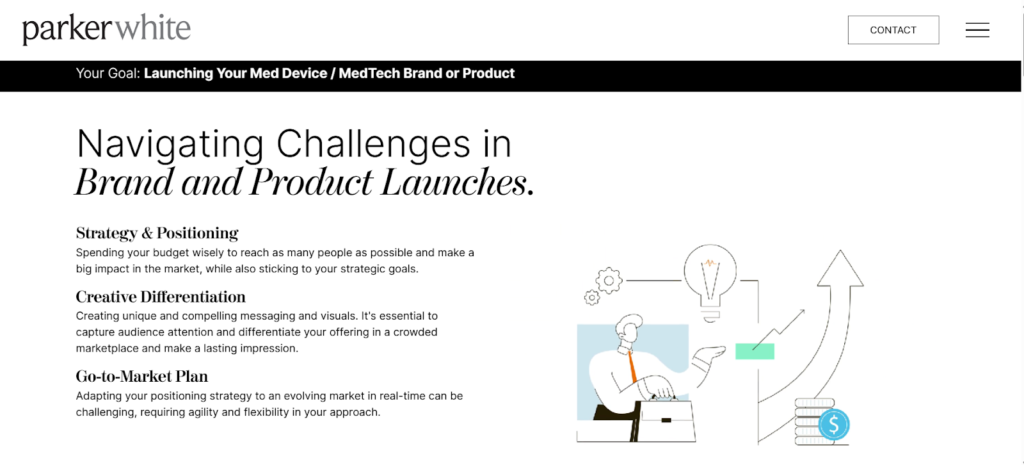
Parker White works with medical device and MedTech companies primarily around brand strategy and product launches. Their focus is on helping teams clarify positioning and differentiation when entering new markets or introducing new products. This is particularly relevant for device companies that need to balance clinical credibility with clear market messaging during launch or rebrand phases.
Source – Parker white
Their services center on strategy, positioning, creative development, and go to market execution. Using their structured 5D branding process, they support discovery, messaging, creative asset development, and launch planning across owned and earned channels. The work is oriented toward helping medical device brands stand out in competitive categories while maintaining alignment with regulatory and market expectations.
Notable clients: Orthofix, FUJIFILM Sonosite, Ivenix, Semler Scientific
Pricing: Pricing is customized based on the scope of brand strategy, creative development, and launch support required for each engagement.
5. Healthcare Success
Healthcare Success operates in the medical device space with a focus on supporting both marketing communications and sales-facing needs. Their work often involves coordinating messaging and materials that need to function across physicians, sales teams, and broader healthcare stakeholders.

Source – Healthcare Success
Their services include strategy, content development, digital marketing, and traditional media, alongside sales enablement and provider-focused educational materials. They also offer practice development programs intended to support device adoption through ethically aligned and regulation-aware content, particularly in physician-led environments.
Notable clients: Astera, SynergenX, Illinois Dermatology Insttitute
Pricing: Pricing is customized and depends on the mix of marketing services, sales support materials, and ongoing engagement required.
6. Distill Health
Distill Health is typically involved at earlier stages of medical device and healthtech companies, particularly when teams are preparing to introduce a product, clarify positioning, or communicate value to investors and early customers.
Their work is often centered around shaping how a product is understood before scale, which is relevant for device companies navigating funding milestones or early market entry.
Source – Distill Health
Their services focus on brand strategy, visual identity, content, and launch readiness. This includes positioning frameworks, messaging platforms, design systems, websites, and investor-facing materials such as pitch decks and product profiles. They also support omnichannel communications and campaign development, helping teams present a consistent story across digital, sales, and investor touchpoints.
Notable clients: Theragen, Nuvara, Alcon, podimetrics
Pricing: Pricing is customized and depends on the scope of strategic, design, and launch-related work required for each engagement.
7. Icovy
Icovy is often involved when medical device companies are preparing for launch or trying to bring structure to commercialization across regulated markets. Their work tends to sit at the intersection of regulatory alignment, product education, and brand execution. This is relevant for teams managing FDA milestones, distributor readiness, or multi-market rollouts.
Source – Icovy
Their services cover go-to-market strategy, brand and creative development, launch campaigns, video production, and distributor enablement materials. This includes messaging frameworks tied to regulatory context, product demos, sales toolkits, and content systems designed to support both clinical and commercial audiences.
They also work on performance tracking and funnel visibility to help teams understand how launch and growth efforts translate into adoption.
Notable clients: Centese, Genesee, Poba Medical, Kaneka
Pricing: Pricing is customized and typically depends on the scope of launch planning, creative production, and commercialization support involved.
8. Epsilon
Epsilon is a large marketing services and data platform that works with enterprise organizations across multiple industries, including healthcare and medical devices. In the context of medical devices, they are typically involved where marketing programs require scale, structured data management, and coordination across multiple digital channels.

Source – Epsilon
Their services include paid media, customer data platforms, audience segmentation, messaging, and analytics. For medical device companies, this often supports large-budget digital campaigns, lifecycle communication, and performance measurement across regions and business units, particularly in organizations with established marketing infrastructure.
Notable clients: Visionworks, Walgreens, Marriot, Coach
Pricing: Pricing is contract-based and varies depending on platform usage, media spend, and the scope of services involved.
9. Elevation Marketing
Elevation Marketing positions itself as a full-service B2B agency that works with medical device companies alongside a wide range of other industrial and technology-driven sectors.
In the medical device context, they are typically involved when companies are looking to build broader market presence or support product launches. Their work often includes running integrated campaigns that span research, brand, and demand generation.

Source – Elevation Marketing
Their services cover strategy, content, digital marketing, media, branding, and lead generation, with additional support across SEO, paid campaigns, PR, events, and sales enablement. For medical device companies, this often translates into end-to-end marketing execution that combines audience research, positioning, and multi-channel campaign delivery rather than narrowly focused device-specific commercialization work.
Notable clients: Vocera, JDRF, Blue Cross Blue Shield, Pfizer, Zoetis
Pricing: Pricing is customized and varies based on the breadth of services, campaign scale, and level of ongoing support required.
10. Jairus Marketing
Jairus Marketing focuses specifically on medical device and MedTech companies that sell to providers and healthcare decision-makers. Their work is typically oriented around helping teams reach clinicians, administrators, and health system stakeholders through digital channels, particularly when traditional sales access becomes limited or inconsistent.

Source – Jairus
Their services include content development, digital marketing, SEO, public relations, events and webinar support, and sales enablement. In the medical device context, this often shows up as go-to-market support, physician-focused messaging, and pipeline visibility across marketing and CRM systems, with an emphasis on tracking how campaigns influence engagement and opportunities.
Notable clients: Medical device and MedTech companies across provider, hospital, laboratory, and outpatient care settings
Pricing: Pricing is customized and depends on the scope of digital marketing, content, and sales enablement services required.
| How we decided which agencies belonged on this listThis list came together the same way most real shortlists do. By eliminating what clearly would not work for a medical device company.We looked at who has actually sat in regulated conversations: Agencies that only talk about healthcare at a high level dropped off quickly. We kept the ones who seem comfortable operating where claims, approvals, and caution are part of daily work.We paid attention to what they help teams unblock: Some focus on launches, some on sales enablement, some on visibility or distribution. We favored agencies that solve real bottlenecks, not abstract marketing goals.We checked whether their work aligns with how buyers research today: Quiet evaluation, internal comparisons, and long gaps before sales calls matter more than flashy campaigns here.We filtered out broad generalists: If an agency tries to be everything to everyone, it usually struggles in medical devices.The result is a practical list you could realistically defend inside your team. |
How Medical Device Buyers Actually Research Today
Most medical device founders picture research as something neat and linear. A buyer reads your website, downloads a brochure, then calls sales. That’s not how it plays out anymore.
What usually happens is quieter.
Someone from the hospital team asks ChatGPT or scans a forum thread just to see what comes up. No one announces they are evaluating you. No one fills out a form. They are just trying to reduce risk before pulling others into the conversation.
By the time sales gets involved, opinions already exist. Comparisons have been made and concerns have been formed. Sometimes you are shortlisted without knowing why and sometimes you are ruled out without ever being considered seriously.
This is why surface-level content does not work anymore. Buyers are not looking for marketing. They are looking for reassurance, clarity, and answers they can defend internally. The brands that show up clearly and consistently during this quiet phase are the ones that move forward.
Things you can fix internally before hiring anyone
Not everything needs an agency immediately. There are a few shifts medical device teams can make on their own that often unlock clarity fast.
- Sales questions can be turned into usable content: If your sales team keeps explaining the same thing on calls, those explanations can be shaped into short pages, FAQs, or even simple blog posts that buyers can read before or after conversations. This helps reduce repetition and keeps messaging consistent.
- Your website can act as a decision aid, not just a brochure. Reviewing key pages through the lens of a procurement or clinical committee can reveal gaps. Adding context around outcomes, trade-offs, or common concerns often makes the content more useful in internal discussions.
- Consistency across formats usually matters more than volume. A single idea explained through a blog, a short video, and a sales deck can be more effective than creating separate pieces that all say something slightly different. Buyers notice when the story changes.
- Early research happens in more places than most teams expect. In addition to search engines, many buyers now check comparison content or even AI tools to form early opinions. Making sure your core messaging shows up clearly in these spaces can quietly improve shortlist chances.
These steps can take you a long way. But keeping them aligned, compliant, and working together over time often benefits from a partner who is already embedded in these challenges. That is typically where teams start exploring a collaboration with Concurate.
Why Concurate is usually the right fit for medical device teams
If you’ve read this far, chances are you already know what is not working. It’s not effort, it’s not intent, and it’s not even budget most of the time.
It’s the gap between what your product actually does and how buyers experience it when no one from your team is around.
At Concurate, we step in exactly there.
We’ve seen this with teams where buyers read the blog but still ask basic questions. Or where SEO is working, but not for the searches that signal real intent. Or where someone says, “We should probably do YouTube,” but no one owns it end to end.
That’s the work we quietly take on. We handle SEO and programmatic SEO so the right people find you. We write blogs and comparison pages sales can actually send. We produce YouTube videos that explain, not promote. We think about how your product shows up in AI tools because that’s where early opinions now form.
It’s not louder marketing. It’s calmer conversations.
And if this sounds familiar, it’s worth a conversation. Book time with us and let’s talk through what’s actually getting in the way.
hbspt.forms.create({ portalId: “6897012”, formId: “0790ec74-5497-4425-9d2f-6ba9ec36a4df”, region: “na1” });Frequently Asked Questions
1. When should a medical device company invest in content marketing?
Content becomes important once sales conversations start repeating the same explanations. If buyers arrive informed but still confused, or if evaluation stalls without clear objections, content can help. Well-timed content supports internal buyer discussions and reduces friction before and after sales calls, especially during early research and comparison phases.
2. How do clinicians and procurement teams research medical devices today?
Research often begins quietly through search engines, peer recommendations, industry content, and increasingly AI tools. Buyers compare options privately before involving sales. Marketing that supports both perspectives tends to influence shortlisting decisions earlier.
3. What role does SEO play in medical device decision-making?
SEO helps medical device companies show up during early and mid-stage research, not just at the point of contact. Buyers search for categories, comparisons, and use cases long before filling out forms. Ranking for these queries builds familiarity and trust, which can influence how a product is perceived once direct conversations begin.
4. Why do many medical device marketing efforts fail to support sales?
Marketing often focuses on awareness while buyers are already evaluating options. Content may be accurate but not usable in real decision-making contexts. When messaging does not align with sales conversations or internal buyer concerns, marketing activity increases without improving deal momentum or reducing objections.
Disclaimer: The information presented in this article is compiled from publicly available sources, including company websites, industry reports, and social media. All trademarks, brand names, and logos mentioned are the property of their respective owners. This article is intended for informational purposes only.