

| TL;DR: The best generative engine optimization agencies for cybersecurity companies include Concurate, Directive Consulting, Obility, Amplifyed, and others that consistently show up across AI search platforms. What matters here is not who does SEO, but who actually understands how AI surfaces pick and recommend companies. Concurate stands out for decoding these patterns and building content that shows up when buyers are actively shortlisting tools. The right agency for you, however, depends on how your buyers search, what they compare, and where you need to show up. This article should help make that decision easy. |
Marketing your cybersecurity company can often feel like shouting in a crowded control room during an active breach.
There’s just too much happening. It’s a vast category, with dozens of tools offered by countless vendors. Add to it the fact that decisions are increasingly being shaped on AI surfaces like ChatGPT, Perplexity, Claude, and more.
And here’s the real problem. When buyers evaluate top tools across, say, DDoS protection software, the same set of names show up everywhere.
If your name does not appear on any of these lists, how do you even become a part of the evaluation? Spending thousands of dollars to create generic content will not help.
That’s where the right generative engine optimization agency can help. The agencies listed below have the expertise to help you rank for high-intent queries in your domain and show up where it actually matters.
Top 11 Generative Engine Optimization Agencies for Cybersecurity Companies
Most people assume that any content marketing or SEO agency can help them rank on generative engines.
But that is not how it works. Generative engine optimization is not just about publishing hundreds of blogs, hoping something ranks. It is about structuring your content, positioning your expertise, and building signals in a way that AI platforms can understand, trust, and recommend your platform, tool or company.
In cybersecurity, where categories are complex and trust signals matter, this requires a far more deliberate approach than traditional SEO. That is where the specialized generative engine optimization agencies listed below stand out:
- Concurate
- Maximus Labs
- Content Visit
- Victorious
- Blend
- Yes&
- LenGreo
- Sure Oak
- Obility
- Amplifyed
- Directive Consulting
Let’s look at them, starting with Concurate.
1. Concurate – Best Generative and Answer Engine Optimization Agency for Cybersecurity Companies
At Concurate, we are a boutique content marketing and generative engine optimization agency that primarily works with B2B and SaaS companies to help them show up where buyers are actually making decisions.
We understand that visibility today is no longer just about Google rankings. Buyers are not just searching Google or depending on referrals alone. They are asking AI platforms like ChatGPT, Perplexity, Grok, and more about the tools they need, asking very specific questions about tools, features, and use cases. They’re not browsing anymore, they’re shortlisting.
So if your product has the capability but is still not showing up, there is a gap. At Concurate, we work on closing that gap.
Source – Concurate
You see, we don’t treat GEO or AEO as separate services. For us, this is a natural evolution of how search works. We believe SEO is the foundation, and we build on top of it with buyer-intent content, strong internal linking, content depth, and clear positioning.
This is why a big part of our approach is creating bottom-of-funnel and consideration-stage content. This includes list-based content like best tool lists, comparison pages against competitors, use-case driven pages, and targeting multiple variations of the same core query based on audience, industry, and features.
How does that look like?
For instance, say a company sells endpoint protection software, we don’t create a single landing page and stop there. We break it down into multiple entry points across various content formats, with listicles, feature lists, and evaluation content such as:
- Top endpoint protection software for enterprises
- Best endpoint security platform for remote teams
- Leading endpoint protection tool with AI capabilities
- Features to look for in endpoint protection tools for SMBs
Our goal is simple: show up across every variation of how a buyer searches for the same solution.
Another key part of how we work is decoding what already ranks and gets picked up across AI search.
We actively study which companies keep appearing for high-intent queries, what kind of content they have built, how those pages are structured, and why AI systems are choosing them. For example, in one of our recent analyses, we broke down how top cybersecurity vendors consistently appear across AI search and what strategies they follow.
Once we understand those patterns, we don’t copy them blindly. We apply those learnings in a way that fits the client’s actual product, positioning, and market.
This is also why we don’t just create content for the website and stop there. We think in terms of content ecosystems. That means supporting core content with distribution across platforms like LinkedIn and YouTube, building external mentions, and ensuring the brand shows up across multiple surfaces that AI systems rely on.
In fact, we’ve applied this approach across industries like enterprise IT, cybersecurity, training, and patent tech.
For one enterprise services and cybersecurity client, this translated into 100+ inbound leads within six months, driven entirely through content. We achieved this by focusing on the right type of content that appears when buyers are actually evaluating solutions. You can read about our approach here.
At the core of all our work is a simple belief: content should not just bring traffic. It should bring leads. And when your brand shows up at the moment of decision, leads follow naturally.
Pricing
Our monthly retainers typically range between $5,000 and $7,500, with one-time projects starting around $3,500.
Notable Clients: Datacipher, Triangle IP, Pinch Patent Drawings
Rating: 5/5
2. Maximus Labs
Maximus Labs positions itself as an AI search-first agency that helps B2B SaaS and AI companies improve their visibility across AI platforms like ChatGPT, Perplexity, and Google AI Overviews.
Source – Maximus Labs
They emphasize a full-stack AI visibility approach that goes beyond content. This includes structuring their content for AI extraction, implementing schema and EEAT signals, and building presence across third-party platforms like G2, Reddit, and LinkedIn to improve citation likelihood.
Like any good GEO company, Maximus focuses heavily on bottom-of-funnel and high-intent queries, structuring its content such that it easily gets cited across AI platforms.
Pricing: They offer three plans, with pricing starting at around $1,299/month and going up to $3,499/month, depending on content volume, platform coverage, and reporting depth.
Notable Cybersecurity Clients: UnderDefense
Rating – Not available
3. Content Visit
Content Visit is a cybersecurity-focused content marketing agency that works with security vendors on go-to-market campaigns, demand generation, and organic growth. Unlike most agencies on this list, they are deeply verticalized in cybersecurity.

Source – Content Visit
Their approach is built around combining content strategy, SEO, and AI visibility into one system. The agency focuses on creating high-quality, technically accurate content from subject matter experts, and structuring it in a way that aligns with both search intent and how AI tools retrieve and cite information.
A key part of their model is around building authority outside the website. For every campaign, they support content with contextual backlinks, external mentions, and distribution across relevant channels, ensuring that their clients are visible not just on their own site, but across the broader ecosystem that AI models rely on.
They also work closely with product marketing teams, creating assets like whitepapers, landing pages, and sales enablement content that directly support pipeline and GTM efforts.
Pricing: Their pricing information is not publicly available.
Notable Cybersecurity Clients: IBM (Randori), Morphisec, Element Security, DeleteMe
Rating: Not available
4. Victorious
Victorious is a full-service SEO agency that has added dedicated Answer Engine Optimization services to its offerings to help brands stay visible as AI search changes how people discover companies.
Source – Victorious
Their approach to AEO is fairly structured. They start with an audit to see where content is losing visibility, then move into query research, content optimization, and technical work to make pages easier for AI systems to retrieve and cite.
A big part of their model is making existing content more answer-ready by surfacing direct responses, adding Q&A sections, and improving semantic clarity.
Pricing: Not publicly available
Notable Clients: GE Digital, Parasoft
Rating: 4.8/5
5. Blend
Blend is a B2B-focused agency that has built a dedicated AEO offering around getting companies cited inside AI-generated answers. They clearly position this as a demand generation channel, not just an extension of SEO.
Source – Blend
Their approach is quite execution-heavy. They start with prompt mapping and persona research, then move into technical setup (schema, structure), followed by AI-focused content creation.
Blend also places a lot of emphasis on measurement. They use tools like Scrunch and HubSpot to track which prompts surface your brand, how often you get cited, and how that translates into traffic and pipeline. Alongside this, they continue refining content and expanding coverage based on what’s getting picked up.
Pricing: Their pricing starts at $7,500/month and goes up to $14,000+, depending on scope.
Notable Clients: Acre Security, Cybexer
Rating: Not available
6. Yes&
Yes& Agency is a full-service creative and digital agency that offers services across branding, content, media, communications, and digital. Answer Engine Optimization is also a part of its offerings, where they position AI as a scene partner in their overall marketing and creative process.
Source – Yes&Agency
Their approach to AEO is built around a structured creative loop. This includes stages like listening to data, exploring ideas using AI tools, validating concepts through predictive scoring, scaling content with automation, and then optimizing it for AI systems.
As part of this loop, they focus on structuring copy, data, and metadata so AI agents can understand, retrieve, and cite their clients’ content.
They also layer this with internal tools like their VIBE Score for tracking brand visibility and engagement and monitoring trend systems to adapt content based on real-time signals.
Pricing: Not publicly available
Notable Cybersecurity Clients: CrowdStrike, Qualys, Rubrik
Rating: 4.8/5
7. LenGreo
LenGreo is a digital marketing agency that offers SEO and answer engine optimization services across multiple industries, including B2B, SaaS, healthcare, cybersecurity, fintech, and even niche verticals like gambling and Web3.
Source – LenGreo
Their approach is built around helping cybersecurity brands become more visible across AI-driven search environments, and not just Google search results. This includes starting with an AI visibility audit, building AI-tuned content strategies around real buyer questions, improving technical infrastructure with structured data and schema, and developing thought leadership assets that AI systems can pick up and cite.
They also place a strong emphasis on conversational content, AI-focused keyword and intent mapping, and trust-driven SEO.
A big part of their positioning is around helping cybersecurity companies get discovered by multiple stakeholders, from engineers and risk teams to procurement buyers, across tools like ChatGPT, Gemini, and Perplexity.
Pricing: Not publicly available
Notable Cybersecurity Clients: They have catered to cybersecurity companies, however their mentions remain anonymous in their case studies.
Rating: 5/5
8. Sure Oak
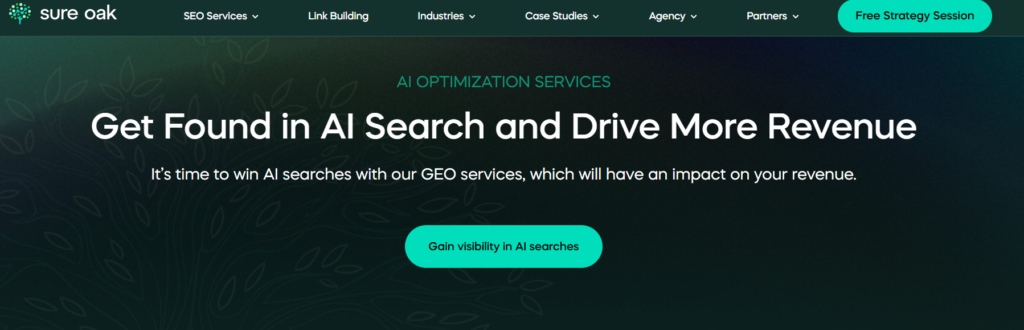
Sure Oak is a full-service SEO and digital marketing agency that works across industries like B2B services, SaaS, fintech, insurance, and eCommerce. Alongside traditional SEO and link building, they also offer AI search optimization services.
Source – Sure Oak
Their approach combines SEO with AI search readiness. They start with fixing the basics — content, technical SEO, and site structure — and then extend into making that content usable for AI systems.
A huge part of their work is about building authority. They invest heavily in link building and external mentions, getting brands featured across sources that AI tools pull from. Alongside this, they track where AI traffic is coming from and optimize for it.
Pricing: Not publicly available
Notable Clients: GuidePoint Security
Rating: 4.9/5
9. Obility
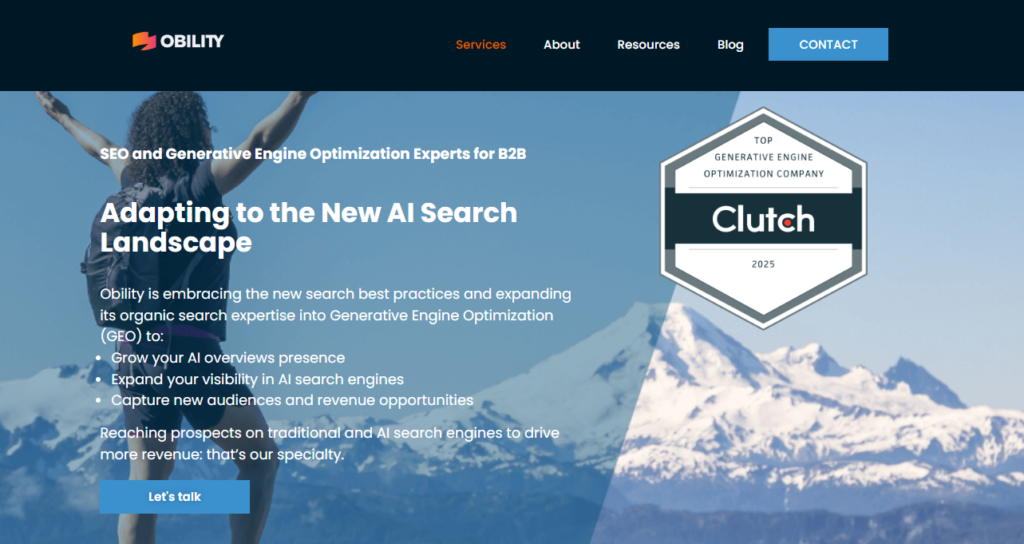
Obility is a B2B digital marketing agency focused on tech and SaaS companies, with services across SEO, paid media, revenue operations, and generative engine optimization.
Source – Obility
Their GEO approach is tightly connected to SEO rather than treated as a separate layer. They use SEO to build technical health, internal linking, and overall search visibility, and then extend that into GEO to improve how brands show up across AI search engines and AI overviews. On the GEO side, the focus is on bottom-of-funnel queries, structured content, and making pages easier for AI systems to pick up and surface.
They also put strong emphasis on measurement. Instead of just tracking rankings or traffic, they look at AI overview presence, user interactions, and how that ties back to pipeline and revenue.
GEO for them is less about publishing new content and more about making existing visibility convert across both search and AI surfaces.
Pricing: Not publicly available
Notable Clients: Boomi, Snowflake, Juniper Networks, At-bay
Rating: 4.8/5
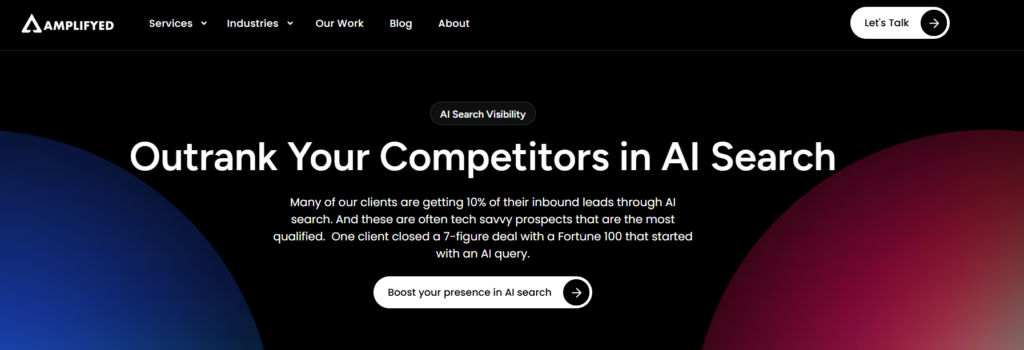
10. Amplifyed
Amplifyed is another cybersecurity-focused SEO agency that works with security companies to improve their visibility across search results and AI surfaces.
Source – Amplifyed
Their approach to AI search visibility is built on top of strong SEO fundamentals. They focus on creating structured, well-organized content that AI systems can easily parse, using clear hierarchies, Q&A formats, and semantic depth. Alongside this, they invest in building topical authority by covering adjacent concepts and creating interconnected content that reinforces expertise.
Their approach is pretty straightforward. They focus on making content easy for AI systems to pick up, i.e., clear structure, clean formatting, and depth across topics.
They also place a lot of emphasis on authority signals. This includes backlinks from relevant sources and building depth across cybersecurity topics so AI systems see the brand as a reliable source.
Pricing: Not publicly available
Notable Cybersecurity Clients: Portnox, VMRay, Semperis, OffSec
Rating: Not available
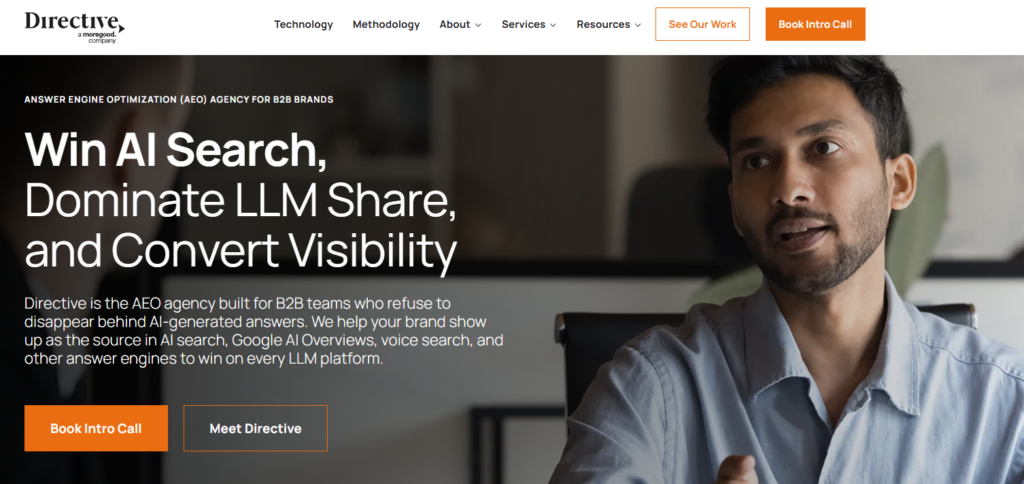
11. Directive Consulting
Directive Consulting is a B2B marketing agency focused on tech and SaaS companies, with services across SEO, content, paid media, revenue operations, and generative and answer engine optimization.
Source – Directive
Their approach to AEO and GEO is built around the pipeline. Their focus is on structuring content so it can be extracted, summarized, and cited inside AI-generated answers, especially for high-intent queries that influence buying decisions.
They also combine this practice with technical SEO, schema, and content optimization to make pages answer-ready. Alongside this, they also work on conversion optimization and performance design, and support distribution through paid and programmatic campaigns to ensure that visibility actually translates into pipeline.
What sets Directive apart is how they tie everything back to revenue. Instead of tracking just rankings or traffic, they focus on visibility in AI answers, influence on buyer decisions, and contribution to the pipeline.
Notable Cybersecurity Clients: TokenEx, OneSpan
Pricing: Not publicly available
Rating: 4.8/5
How We Identified the Right GEO Agencies
We didn’t just pull a random list of agencies here. The idea was simple: if AI is where buyers are discovering and shortlisting companies, then it should also tell us which agencies are actually visible in that ecosystem.
So we started from there and then manually filtered things down.
- We first asked AI platforms like ChatGPT, Perplexity, and Gemini to surface agencies working in GEO, AEO, and AI search visibility with clients or case studies in the cybersecurity domain. This gave us a broad list of ~30 companies.
- From there, we manually reviewed each one to check if they actually offer GEO/AEO/AI search as a dedicated service, not just a passing mention under SEO.
- Finally, we filtered for relevance to cybersecurity. This included agencies that either had dedicated cybersecurity experience, industry-specific services, or at least one strong case study in the space.
Companies without clear proof of work in this domain were excluded. That’s how this list was formed.
Why Concurate Is the Best Generative Engine Optimization Agency for Cybersecurity Companies
Most agencies are still trying to understand how AI search works. We’ve been busy figuring out how to win it.
At Concurate, we’ve spent months decoding what actually gets picked across AI surfaces like AI Overviews, ChatGPT, Perplexity, and Gemini. We don’t just track what ranks, we break down which companies keep showing up, what they’ve built, and why AI keeps choosing them.
This article is proof of that. We didn’t just list agencies. We asked AI, analyzed patterns, and verified everything manually. That’s exactly how we approach client work.
And we don’t force a single strategy.
- If programmatic SEO is what will get you scale, we do that.
- If technical SEO needs fixing, we fix it.
- If content + distribution is what gets you into decision flows, we build that.
Because our goal is not traffic. It’s getting your platform or company visibility when buyers are choosing.
So that marketing does not feel like shouting in a crowded room anymore. Book a call with us today, and we will map the right strategy for you.
Frequently Answered Questions
1. How can cybersecurity companies improve their chances of getting cited in AI-generated answers?
Cybersecurity companies that consistently show up in AI answers are doing a few things consistently well. Here’s what they are doing and you can too:
- They create content that matches how buyers search when they are evaluating tools. This includes “best tools” lists, 1:1 comparison pages, and use-case driven content. AI platforms rely heavily on these formats when generating answers
- They cover multiple variations of the same query. For example, instead of just targeting the primary keyword like “endpoint security software,” they also create content around enterprise use cases, SMB use cases, AI-based solutions, and more. This increases the chances of being picked across queries.
- They structure content clearly. Well-defined sections, comparison tables, bullet points, and direct answers make it easier for AI systems to extract and cite information.
Finally, they build authority beyond their own site. Mentions across third-party blogs, reviews, and communities reinforce credibility, which AI systems factor in when deciding what to include.
2. Can smaller cybersecurity companies compete with large vendors in generative engine optimization?
Yes, they can. AI search is not only about brand size. It’s about how well your content matches the query. Smaller companies can compete by focusing on specific use cases, long-tail queries, and clear positioning. Instead of broad keywords, targeting niche, high-intent searches gives them a better chance to appear alongside larger vendors.
3. Should cybersecurity brands create separate content for different use cases to improve AI visibility?
Yes. Cybersecurity brands should not rely on a single page. Instead, they should create content across formats like blogs, comparison pages, use-case driven pages, and feature-specific content. AI systems pick from multiple sources, so covering different angles helps improve visibility across queries without limiting yourself to just landing pages.
4. Does updating old cybersecurity content improve visibility across AI search platforms?
Yes, it does. AI platforms tend to favor content that is current and relevant. Updating existing pages with new data, improved structure, and clearer answers can increase the chances of being picked. Even older pages can resurface in AI results if they are refreshed regularly and aligned with what users are currently searching for.
5. What role does topical authority play in generative engine optimization for cybersecurity companies?
Topical authority is critical. AI systems prefer sources that consistently cover a subject in depth. If your content spans multiple related queries within cybersecurity, it signals expertise. This increases your chances of being cited.