

| TL;DR: Expensify is one of the most recommended expense management platforms in AI tools like ChatGPT and Perplexity, alongside Ramp and Brex. The brand pulls in an estimated 21,900 monthly commercial searches, a strong signal of active buyer intent. This article breaks down the content and marketing strategies behind that visibility across Google and AI tools. |
Expensify keeps showing up as a recommended expense management software alongside Ramp and Brex, in ChatGPT, Perplexity, and AI Overviews.
The numbers back this up too: Expensify draws roughly 22,000 probable buyers every month, based on commercial search volume alone- people actively comparing tools before a purchase, not just browsing.
So we decided to do a teardown of what’s actually helping Expensify earn this kind of visibility.
Performance Overview – Google, ChatGPT, Perplexity And More
During this teardown, one small detail stood out: nearly every marketing, product, and blog URL runs on use.expensify.com, not the root domain. Companies often keep the core domain locked down for the actual software for security reasons, and push public-facing marketing onto a separate subdomain instead.
The word choice is worth pausing on, though. “Use” doubles as a quiet call to action baked into the URL itself; every citation or shared link reads as a small instruction: use Expensify :).
More on that later. First, the numbers, pulled from Ahrefs in July 2026. Figures will drift over time; what matters here is the direction they point, not the exact count.
| Metric | Value | What it means |
| Organic Traffic (Monthly) | 108K | Total monthly visits from unpaid search results |
| Domain Rating (DR) | 79 | Very Strong; Google trusts Expensify. |
| Backlinks | 88.6K | Total links pointing to Expensify from other websites. |
| Branded searches | 81.5K | Users who already know Expensify and search for it by name. This is brand recall at work. And this brand authority is something AI engines also trust. |
| Non-branded searches | 26.6K | Users who find Expensify without searching for it by its name. |
| Informational searches | 2.4K | Users seeking answers to “what is,” “how to,” or “why” questions. High volume, low purchase intent. Increasingly answered by AI Overviews before the user ever clicks |
| Navigational searches | 10.5K | Users typing a URL or brand name to reach a specific page directly |
| Commercial searches | 21.9K | Users researching before a purchase: “best expense management software,” “Expensify alternatives.” High intent, closer to a decision searches. |
| Transactional searches | 205 | Users ready to act: sign up, buy, book a demo. Lowest volume, highest conversion potential |
| Platform | Citations | Pages cited |
| AI Overviews (Google) | 130 | 47 |
| AI Mode | 148 | 51 |
| Perplexity | 112 | 34 |
| Grok | 57 | 29 |
| Gemini | 19 | 13 |
| ChatGPT | 27 | 35 |
| Copilot | 24 | 16 |
| AIO search queries | 1100 | 225 |
Buyer Focused Content – Where Expensify Wins and Why
A question we hear often from prospects: how do we show up when someone is forming a shortlist in our category, using an AI tool instead of Google?
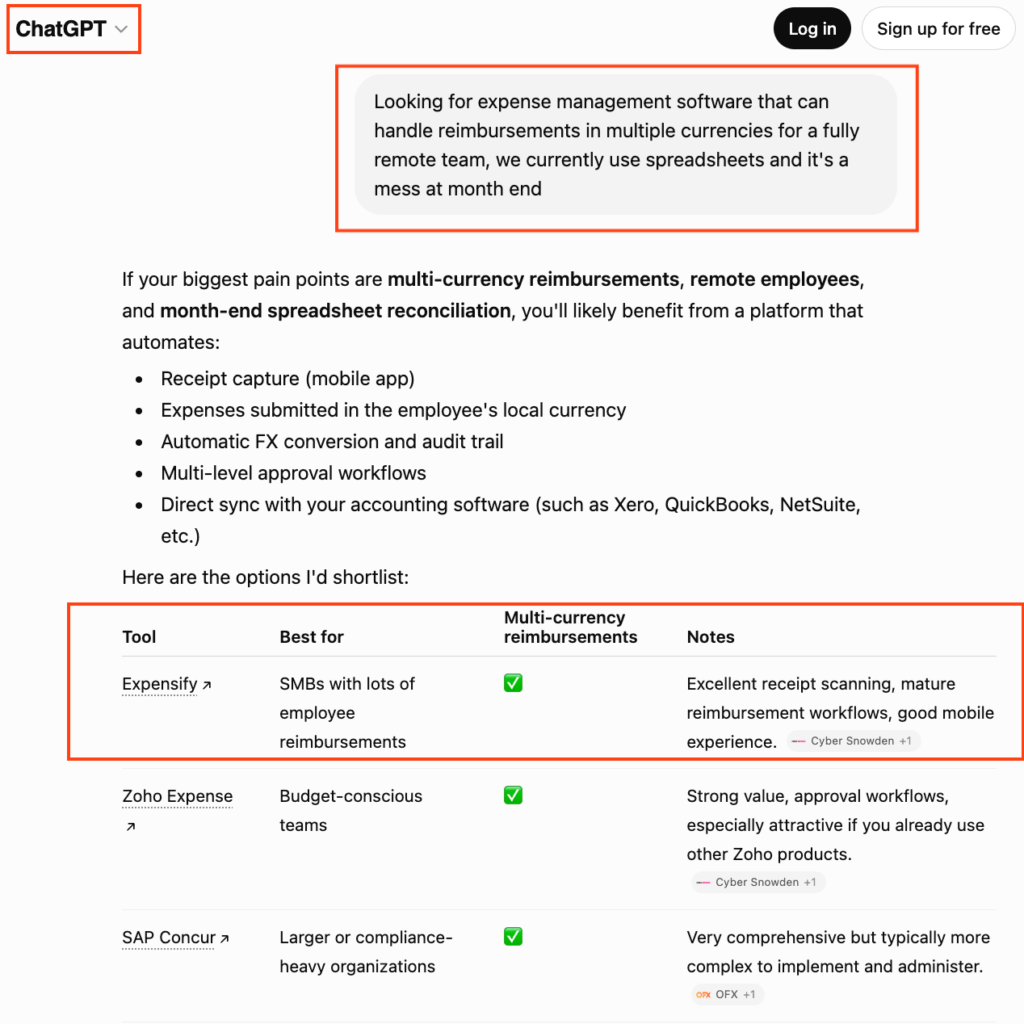
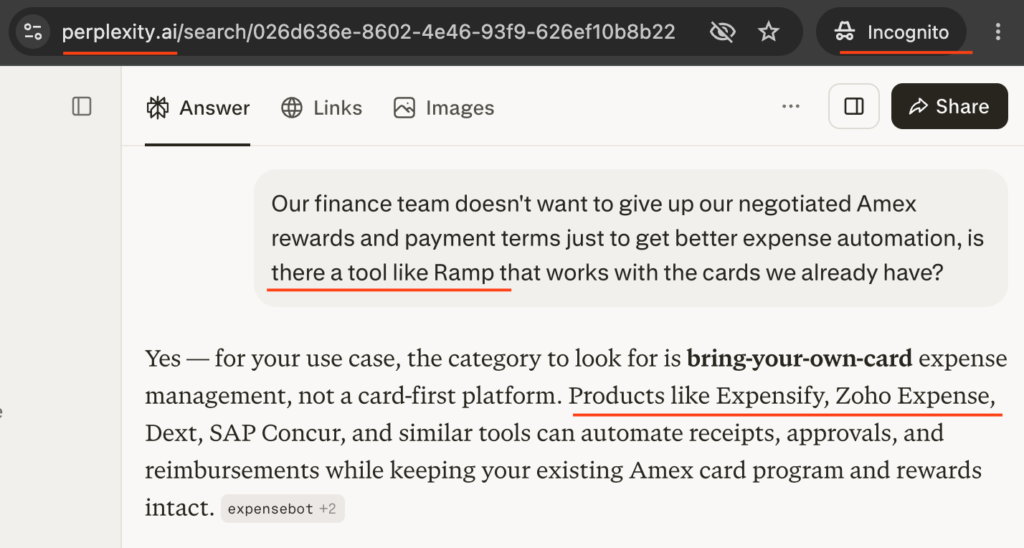
Expensify offers a clear working example. Based on the ideal customer profile we built from their published case studies, we wrote nuanced queries and ran them in ChatGPT, Perplexity, and Claude.
ChatGPT
Perplexity
Claude
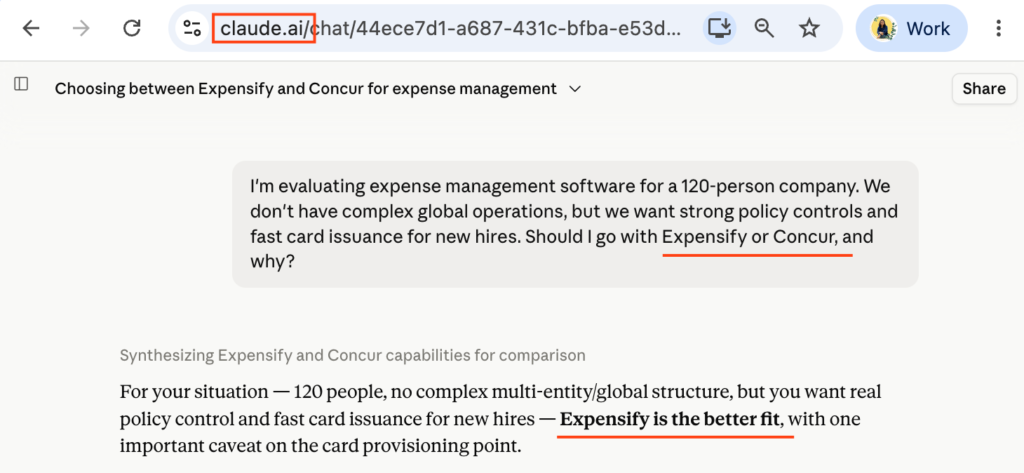
Expensify was recommended in all these AI answers.
This raises the real question: how does a brand earn those placements?
Even when the underlying source is a third-party listicle, the brand still holds real control over the narrative written about it. So, when a brand publishes buyer-focused content, built for the shortlisting stage or the comparison stage, it owns that content entirely. The brand’s own positioning becomes the raw material other people’s content is built from.
Below are the keywords where Expensify has already built this kind of buyer-stage content, split into listicles, alternatives, and comparisons.
| Keyword | Volume | KD | Organic Traffic | Position Type | Current URL |
| best apps for tracking expenses | 1,900 | 62 | 113 | AI Overview | /blog/personal-expense-tracker-apps |
| 0 apr business credit cards | 1,800 | 30 | 42 | AI Overview | /blog/0-apr-business-credit-cards |
| best spend management software | 500 | 19 | 16 | AI Overview | /resource-center/guides/best-business-expense-tracking-app |
| telecom expense management software | 300 | 6 | 21 | AI Overview | /resource-center/guides/telecom-expense-management-solutions |
| best app for business expenses | 200 | 40 | 19 | AI Overview | /resource-center/guides/free-personal-finance-software |
| best credit card for self employed | 150 | 6 | 47 | AI Overview | /resource-center/guides/credit-cards-for-self-employed |
Alternatives Keywords
| Keyword | Volume | KD | Organic Traffic | Position Type | Current URL |
| ramp alternatives | 250 | 0 | 0 | AI Overview | /resource-center/guides/ramp-competitors |
Comparison Keywords (ranking #1 organic)
| Keyword | Volume | KD | Organic Traffic | Position | Current URL |
| bill.com vs. expensify | 200 | 0 | 13 | 1 | /resource-center/guides/expensify-vs-bill-com |
| expensify vs concur | 200 | 1 | 8 | 1 | /resource-center/guides/expensify-vs-concur-comparison |
| certify vs expensify | 90 | 0 | 2 | 1 | /resource-center/guides/expensify-vs-emburse-professional |
However, AI tools additionally confirm if the internet mirrors the same information or not; hence, it’s important that the B2B SaaS is featured in third-party listicles.
Third Party Listicles Featuring Expensify
89 unique listicles mention Expensify, spanning DR 30 to 90. Most listicles cluster around three query types: “best expense management software,” “best receipt scanner apps,” and “best bookkeeping software for small business.” That maps closely to the three product surfaces Expensify pushes hardest (SmartScan, expense management, accounting integrations).
Business credit card listicles are a visible gap, with less than 10 mentions and none above DR 74.
The table below just shows a few from the top ones:
| Domain | DR | Referring Page (Keyword Context) | Ranking Keywords | Anchor Text | Target URL |
| paylocity.com | 90 | 9 Best Expense Management Software Tools [2026] | 47 | Expensify – Mobile App | https://use.expensify.com/expensify-mobile-app |
| ionos.com | 89 | Best bookkeeping software for small businesses | 18 | Expensify | https://www.expensify.com/ |
| apartmenttherapy.com | 87 | Best Free Tax Organizing Apps – Expenses, Mileage, Receipts | 0 | integrating | https://use.expensify.com/all-integrations/ |
| ionos.co.uk | 82 | Best bookkeeping software for small businesses (UK) | 17 | Expensify | https://www.expensify.com/ |
| bill.com | 81 | Best Travel and Expense Management Software for 2026 | 49 | Best Travel and Expense Management Software | https://use.expensify.com/travel |
| ramp.com | 81 | Best Business Expense Tracking Apps and Tools of 2026 | 137 | $36 per user per month | https://www.expensify.com/pricing |
| rho.co | 71 | 16 Best Business Credit Card EIN Only Options in 2026 | 273 | Expensify | expensify.com/ |
| A Quick Tip: Outrank Instead of Outreach There are two ways to earn a mention in third-party listicles.Path 1: Pitch for placement. Find the top-ranking listicles in your category and request a mention, in exchange for a fee, a reciprocal link, or a product trial. This works fast, but it scales with budget and needs repeat outreach every time a listicle refreshes.Path 2: Build your own listicle and become the destination. Publish a well-researched, well-optimized roundup on your own domain covering vendors, tools, or distributors in your space. Once it ranks in the top ten for competitive queries, the dynamic reverses. Companies you’d otherwise pitch start reaching out to get included, and you can offer them a mention in exchange for one back. |
Beyond listicles, our citation analysis found that case studies play a significant role in moving AI answers in a SaaS tool’s favor. So we explored Expensify’s case studies section next.
Case Studies
We found six case studies on Expensify’s site, with a strong pattern: SMB and mid-market companies, reimbursement and card management as the core need, and QuickBooks, Xero, or NetSuite integration as the technical hook.
| Case Study | Customer Profile | Core Use Case | Key Result |
| Pivot Bio | Agtech, North America (soon Brazil), customer since 2023 | Expensify Card + automated approval workflows for T&E | Cash back covers full T&E program cost; admin time slashed 90%; audit coverage dropped from 100% to 5–10% of reports |
| Seasonal Magic | 27 Halloween retail stores, 3 states, 750 seasonal employees, customer since 2024 | Automated receipt capture (SmartScan) + QuickBooks Online sync for complex multi-state card setup | $23K in savings identified through better reporting; real-time visibility across all 27 locations |
| Accordcare | Home healthcare, 300+ employees, customer since 2025 | NetSuite integration + automated approval workflows + reimbursements | Faster month-end close; no manual data entry; solid audit trails |
| Buffer | Fully remote social media platform, distributed team since 2015, customer since 2015 | Global multi-currency reimbursements + Xero integration (note: page’s summary box mislabels this as QuickBooks, but body text confirms Xero) | Faster, clearer reimbursements; smooth new-hire onboarding; scalable workspace setup |
| Lightstorm Asia | Telecom company, likely Singapore-based or Malaysia-based on “Pte. Ltd.” suffix (not stated explicitly), customer since 2023 | Ditched Excel; SmartScan receipt capture + Xero integration | Faster reimbursements; zero lost receipts; planned expansion to a merging related company |
| Aviv Clinics | Healthcare startup, customer since 2017; COO explicitly switched from Concur | Expensify Card + Expensify Travel + NetSuite integration | Same-day reimbursement; easy onboarding for new hires; replaced third-party travel vendor |
Case studies do the heavy lifting when prospects turn to AI tools to find their perfect match. It works like a match-the-columns exercise: when parts of a buyer’s query line up with details in a case study, AI tools pick up on that overlap and recommend the tool with confidence.
Original Data Studies
We could not find a data lab or an original data study on Expensify, a gap since AI tools tend to favor primary sources over compiled ones.
Ramp shows what this looks like done well. Ramp Economics Lab, run by an in-house economist, publishes two monthly reports built on Ramp’s own transaction data: the AI Index (adoption and spend across 70,000+ businesses) and Top SaaS Vendors (category share and growth).
With these monthly reports, Ramp offers story-ready angles for journalists and has earned coverage from renowned outlets including the New York Times, Wall Street Journal, and Bloomberg. SaaS businesses take pride in sharing that they were on the leaderboards, earning Ramp brand mentions and authority.
For the full breakdown of how Ramp built and distributes this, see our Ramp GEO Playbook.
Expensify’s adjacent move is statistics aggregation, not original data. Pages like credit card statistics and business travel statistics compile external numbers rather than generate new ones. They work because writers on deadline link to whoever pre-pulled the stat, rather than chasing the primary source.
| Referring Domain | DR | Target Page | Anchor Text |
| ainvest.com | 77 | credit-card-statistics | general-purpose credit cards return an average of 1.6 cents per dollar spent |
| staxpayments.com | 74 | credit-card-statistics | 83% of small businesses |
| paymentcloudinc.com | 69 | credit-card-statistics | The State of Credit Cards in 2025: 50 Stats You Need to Know |
| ppai.org | 79 | business-travel-statistics | 60% of business travelers |
This is a reasonable starting point without a data lab, cheap and steady for backlinks. Its ceiling, visible here at DR 79, is set by the fact that any competitor can build the same page. Real GEO advantage comes from data nobody else has.
Brand Web Mentions
Branded web mentions correlate with AI visibility at 0.664 on ChatGPT, 0.709 on AI Mode, and 0.656 on AI Overviews, each notably stronger than Domain Rating (0.266 to 0.326) across every platform studied.
Being talked about now matters more than being linked to.
B2B SaaS brands earn these mentions through a handful of proven channels: PR and earned press coverage, partner and referral programs, cultural or sponsorship campaigns, industry events and conferences, review site presence, and community engagement on forums.
One notable example is the ExpensifyApproved partner program here.
Partner Program – Expensify Approved
ExpensifyApproved isn’t a referral program. It’s a badge of trust that accountants wear on their own websites, and Expensify built an entire growth engine around getting them to want it.
ExpensifyApproved does two jobs at once. It drives new business through partner referrals, and it generates brand mentions across accounting firm websites, trade press, and community forums. Every partner who displays the badge or writes about the program creates a citable mention on a domain Expensify does not own, which is exactly the third-party signal GEO systems weight.
Why partner programs like this work
- Money: revenue share on client card spend, recurring and scalable, not a flat one-time fee.
- Status: a badge and a tier system that signal credibility to the partner’s own clients.
- Less work: dedicated support that removes friction from onboarding and servicing clients.
Two structures reinforce this. Expensify Approved University trains and certifies partners before they get access to perks, so status feels earned. The Champion tier rewards firms that adopt Expensify internally with a bigger discount, turning partners into users, then advocates, then a public source of mentions.
Reviews
Case studies tell an AI model who a product is for. Reviews confirm whether real users agree.
| Channel | Rating & Review Count |
| G2 | 4.5 stars, 5,651 reviews |
| Trustpilot | 4.0 stars, 1,101 reviews |
| Software Advice | 4.3 stars, 1,333 reviews |
| Xero App Store | 4.5 stars, 505 reviews (integration specific) |
Reddit Consensus
Expensify is a popular expense management tool, but its suitability varies depending on the business’s size, needs, and integration requirements. Here’s a succinct guide to help you understand who Expensify is most suitable for and its pros and cons, based on Redditor experiences:
Who is Expensify Most Suitable For?
- Small Teams and Startups: Expensify is often recommended for small teams and startups due to its simplicity and mobile-first approach. “Expensify’s core workflow centers on expense tracking and reimbursement rather than proactive spend controls.”
- Businesses Prioritizing Easy Receipt Tracking: Its mobile app allows employees to easily snap photos of receipts, which can be a godsend for those who struggle with keeping track of physical receipts. “I LOVE expensify; they link with AmEx. Never used Concur, but I have demoed with every accounting platform.”
- Companies Using QuickBooks: Expensify integrates well with QuickBooks, making it a good option for businesses that need to streamline their accounting processes. “Expensify is probably your best bet for the QBD + Chase combo.”
Pros of Expensify
- Easy Receipt Tracking: Employees can easily upload receipts using the mobile app or email. “Employees can snap photos of receipts, log mileage, and get reimbursed quickly.”
- Quick Reimbursements: The platform simplifies the reimbursement process, which can be a big plus for employee satisfaction. “It has really streamlined the process of getting my employees’ receipts, reviewing them, and getting them into QuickBooks.”
- SmartScan Feature: Expensify’s SmartScan can automatically read and categorize receipts, reducing manual data entry. “SmartScan is actually pretty good at reading receipts automatically.”
- Integration with Accounting Software: It integrates with popular accounting platforms like QuickBooks, which can save time and reduce errors. “Expensify integrates with QuickBooks, making it a good option for businesses that need to streamline their accounting processes.”
Cons of Expensify
- Aggressive Marketing: Some users find Expensify’s marketing aggressive and intrusive. “I feel like most products where our business pays the bill and prescribes the solution as a matter of policy, we have the ability to manage how much contact our employees receive from the company.”
- Customer Support Issues: Several users have reported poor customer support experiences. “The concierge is impossible to communicate with.”
- Scalability Issues: As businesses grow, Expensify may not meet their needs. “Where Expensify falls short is in scalability.”
- Billing Problems: Some users have reported being billed even after trying to cancel their subscriptions. “They will keep billing you after you try cancelling.”
- User Experience: The app and website can be clunky and hard to use for some. “Almost unusable web app experience and loading errors.”
Alternatives
- Ramp: Recommended for businesses that need comprehensive spend management and corporate cards. “I would suggest Ramp or Brex, depending on geographic availability.”
- Brex: Another option for corporate cards and expense management. “From personal experience, I would stick to either Brex or Ramp.”
- Bill.com: Formerly Divvy, offers a good balance of features and credit limits. “Bill.com, formerly Divvy. Is probably my favorite dude to the high credit limit and functionality that is similar to the other ones on this list.”
- Zoho Expense: Suitable for businesses already using the Zoho ecosystem. “Zoho Expense is actually pretty good, and they are in the process of completely overhauling it.”
In summary, Expensify is a solid choice for small businesses and startups that need a simple, mobile-friendly tool for expense tracking and reimbursements, especially if they use QuickBooks. However, it may not be the best fit for larger organizations or those needing more robust features and better customer support.
YouTube
We reviewed the top 100 YouTube search results for “Expensify.” Content splits into how-to tutorials, influencer reviews, comparisons, and alternatives roundups. A small share comes from Expensify’s own channel, mostly product updates and feature launches, with no customer testimonial or case study videos. The majority is independent tutorial content: submitting a report, syncing QuickBooks, merging expenses, largely low-view and templated.
The more interesting slice is comparisons and alternatives. Several channels run a repeatable “Expensify vs X” format (Zoho, QuickBooks, Wave, Concur, Ramp), mirroring exactly how a buyer would query an AI tool while shortlisting software.
Technical Site Health
Core Web Vitals:
| Parameter | Desktop | Mobile |
| Largest Contentful Paint (LCP) | 1.5 seconds | 2.3 seconds |
| Cumulative Layout Shift (CLS) | 0.01 | 0 |
| Interaction to Next Paint (INP) | 54 milliseconds | N/A |
Source: PageSpeed Insights
Auditing site health for the entire domain is tedious and tool-heavy, so we have kept it beyond the scope of this study. But strong site health is non-negotiable for AI visibility.
LLMs.txt
We could not find an llms.txt file for Expensify. Brex, a close competitor, has one and has taken it a step further. Brex has created markdown, plain-text versions of its business-priority pages, listicles, case studies, and landing pages, and added them to its llms.txt, so AI tools can read the content directly instead of parsing it out of JavaScript, images, and other elements that make pages harder for AI systems to interpret.
Schemas
Schemas make the information on a website easy for AI tools to read.
We looked at four pages: the homepage, a blog post, the expense management product page, and the pricing page. We spotted WebSite, LocalBusiness, Article/BlogPosting, FAQPage, SoftwareApplication, Product, and Service schemas across the four pages.
Expert Authors on Blogs
Expensify’s blog posts carry named authors, not a generic “Expensify Team” byline. Each post ends with a photo, a name, a job title, and a short bio. This is a real trust signal. It maps directly to E-E-A-T, since it gives AI engines a person to attribute the claims to, not an anonymous brand voice.

One gap is worth fixing. The author bio has no LinkedIn or credential link built into its structure. A strong author bio should link out to LinkedIn and other external profiles alongside the name, role, and credentials. These links function as verification points. AI systems don’t just read what a bio claims; they try to confirm the person exists and holds the stated role.
Wikipedia
Expensify’s Wikipedia page rests on independent press coverage, with Reuters, TechCrunch, Bloomberg, and WSJ covering its funding rounds and 2021 IPO, exactly the sourcing bar Wikipedia checks for, not company size.
ChatGPT and other OpenAI models are trained significantly on Wikipedia, and this content does inform how they form answers, so a well-sourced page offers a real, indirect trust signal.
However, in our experience, having a Wikipedia page helps visibility. But not having one is not a disqualifier.
Concurate – Your AI Visibility Partner
At Concurate, we believe SEO is GEO with muscles: the content on your B2B SaaS website needs to be mirrored across the internet, so that when a buyer asks an AI tool for a recommendation, the answer already sounds like you.
The goal isn’t just visibility. It’s attracting the ideal customer so clearly that conversion feels like a formality for your sales team.
With that belief, we built the Perfect Match Framework, a six-step methodology (Define, Benchmark, Audit, Strategise, Create, Monitor) to align your content with who should be buying from you.
Curious to learn more? Book a meeting with us.
Disclaimer:
This article is an independent analysis based on publicly available data regarding Expensify’s SEO and GEO strategy. It is not endorsed by, affiliated with, or sponsored by Expensify, Inc. All trademarks mentioned are the property of their respective owners.