

| TL;DR: The MarTech space moves fast, and not every agency is built to keep up. This guide highlights the 7 digital marketing agencies that have a real track record of helping teams improve acquisition, adoption, and revenue impact. |
We all know MarTech is crowded. Not in a scary way, but in a confusing way. You can build something genuinely powerful, but the moment you try explaining it, you’re suddenly next to ten other tools that sound just like you.
That’s why so many MarTech leaders look for outside support. To carve out a space where your positioning finally feels distinct. When your content helps people who are genuinely ready to evaluate, your sales take off.
If clarity is what you’re aiming for, you’re in the right place. This guide lists the digital marketing agencies that know how to give MarTech brands the edge they deserve.
Top 7 Digital Marketing Agencies for MarTech Companies
Marketing to marketers is its own kind of challenge. Your buyers have seen every framework, every funnel, every promise of automation and efficiency. They can spot generic messaging instantly, and they won’t engage unless something feels genuinely sharp and relevant.
That’s why MarTech companies need partners who can create content that stands up to a marketer’s eye, because it is strategic, credible, and impossible to ignore.
These agencies excel at doing exactly that.
- Concurate
- 42DM
- Verticurl
- The Rubicon Agency
- Cremarc
- Velocity Partners
- MO Agency
- DemandLab
- Clevertouch Consulting
- Cooperate Marketing
Let’s explore each one by one.
1. Concurate
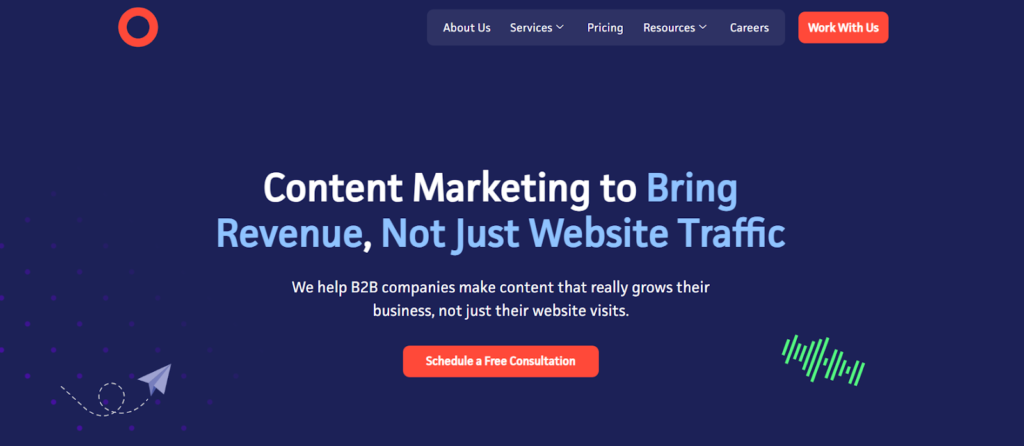
At Concurate, we’ve noticed one pattern consistently across MarTech companies. Some are redefining a category, some are trying to stand out in an overcrowded one, and others are quietly building something powerful but struggling to get the right people to notice.
That is why no two Concurate playbooks look the same. We understand some teams need stronger positioning, whereas others need sharper comparison assets or customer proof.
Source – Concurate
Before talking about strategy, we focus on understanding what makes your platform genuinely useful, who needs to hear that story first, and what stops them from getting it today. Once that clarity lands, everything else, i.e., your messaging, your demand engine, your content roadmap becomes far easier to scale.
Most of our work blends content, messaging, demand-gen assets, and SEO into one cohesive system that helps buyers understand your platform faster and choose you with more confidence. Sometimes that means simplifying a category narrative. Other times, it means building scalable content models for complex feature sets. Additionally, we also create assets to support your sales teams with content that can answer objections before they are raised.
If you look at one of our recent pieces, you’ll notice something interesting. We didn’t change the product, the pricing, or the funnels. We simply reframed how the brand spoke to buyers. We focused on the exact questions people ask before shortlisting a tool, stitched those into a clean content structure, and suddenly the brand started appearing in the conversations it was previously missing.
It’s a small example, but it shows how clarity and intent-driven content often move the needle faster than big, complex changes.
This is the type of system we build for MarTech brands. It helps prospects understand your product faster, trust your expertise sooner, and move through the buying journey with less hesitation.
If you want a partner who thinks about growth the way you do, Concurate tends to fit naturally into that conversation. Reach out to us, and we can share a strategy that works best for your MarTech brand.
Notable Clients
Datacipher, Triangle IP, Inspire IP, RatioTech, Athena Security, and many more.
Pricing
Our engagements typically start at a project baseline of USD 3,500, with ongoing partnerships ranging from USD 5,000 to USD 7,500 per month.
2. 42DM
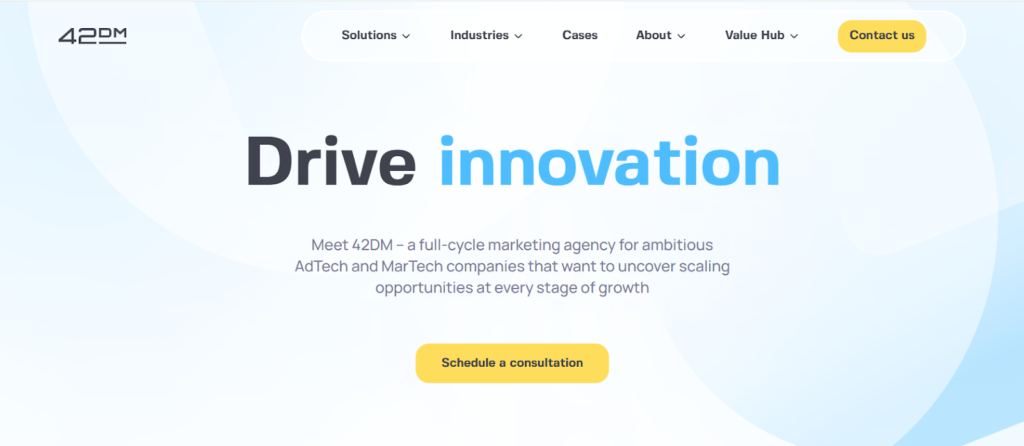
42DM works as a full-cycle marketing agency with a focus on companies operating in tech-led categories. Their team covers areas like demand generation, content, ABM, automation, and analytics, and they tend to structure their work around building consistent marketing engines rather than isolated campaigns. Most of their approach comes from combining strategy with hands-on execution across channels and tools.
Source – 42DM
They also support teams through launch plans, customer journey mapping, and ongoing program management, depending on the growth stage a company is in. Since they work across AdTech, SaaS, and data-heavy products, they’re used to handling products that need clear positioning and steady, structured marketing activity to scale.
Notable Clients
Payoneer, Zeeto, Lumin, Notiv, Nortia Logistics
Pricing
Their pricing is typically determined by the size of the marketing team required and the scope of services included in the engagement.
3. The Rubicon Agency
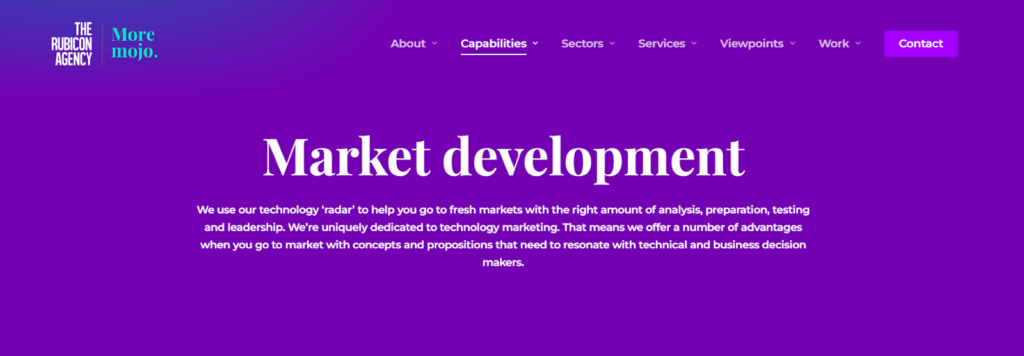
The Rubicon Agency works with companies in technology driven markets, where messaging often needs to balance technical depth with broader commercial clarity. Their work spans areas like proposition development, product marketing, content strategy, market positioning, and campaign planning.
Source – The Rubicon Agency
Because they stay close to trends in cloud, SaaS, engineering, and AI, most of their projects start with understanding how a product fits into a shifting market and how to communicate that clearly to different decision makers.
They also support teams that are entering new markets or refreshing existing narratives, often by using research, testing, and structured creative development. Much of their work is focused on building material that helps sales, product, and marketing stay aligned, whether that is through thought leadership, strategic content, or demand programs.
Notable Clients
VMware, AT&T, First Resonance, Five9
Pricing
Their pricing is typically set after scoping the strategic, creative or content requirements and depends on the scale and duration of the engagement.
4. Cremarc
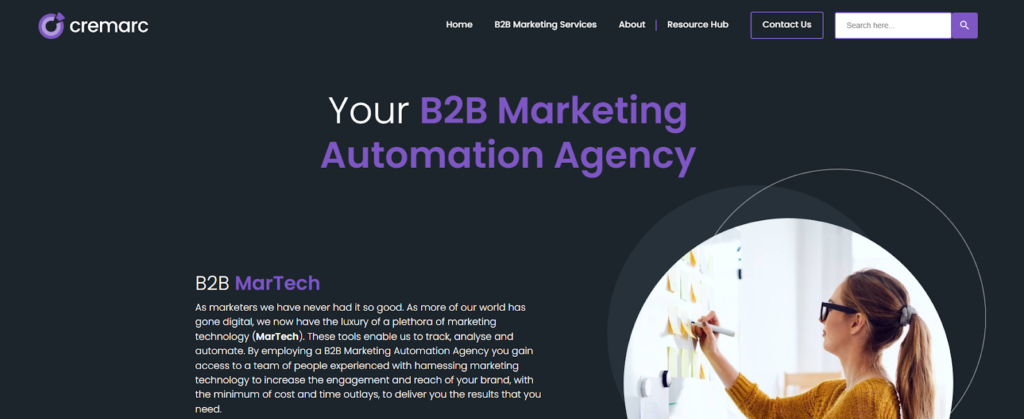
Cremarc positions itself as an agency that works closely with companies using marketing automation and related tools. Much of their work involves helping teams set up platforms, refine existing workflows, and make better use of the data that sits across different channels.
Source – Cremarc
They often support clients in selecting automation software, improving how those systems are used day to day, and managing ongoing activity for teams that need additional operational support.
They also spend time on areas like attribution, telemetry, and reporting, which means a lot of their focus is on connecting data points and giving teams a clearer view of what is working. Their experience with tools such as HubSpot, Pardo,t and Act On allows them to streamline processes for companies that rely on structured funnels and consistent activity across the customer journey.
Notable Clients
Quantum, SilverCloud, and Advanced Dynamics.
Pricing
Their pricing is usually shaped around the specific automation platforms involved and the level of ongoing management or optimisation a team requires.
5. Velocity Partners
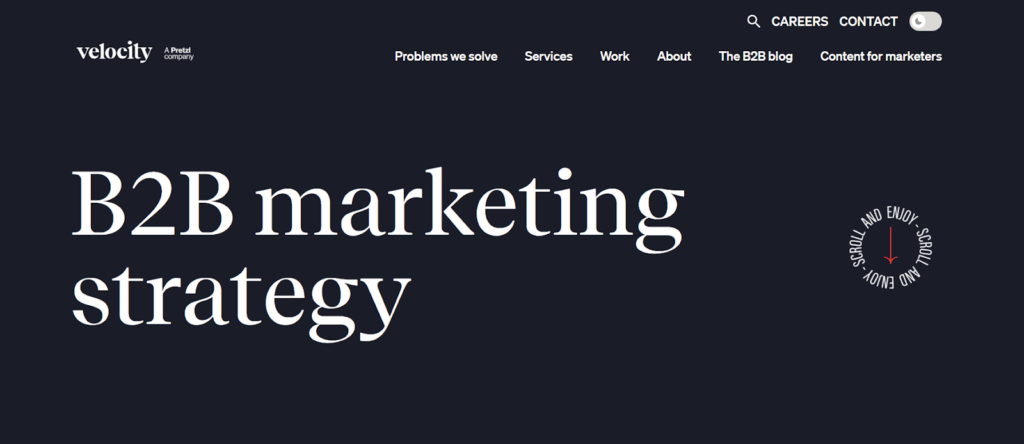
Velocity works with companies that need support across areas like positioning, messaging, and content development. Their projects often involve helping teams organise their ideas, structure their market narrative, and create the materials needed for ongoing marketing activity. They work across strategy, creative, and production, depending on what a team requires at a given stage.
Source – Velocity
They also handle programs that include content creation, visual identity work and performance campaigns. Much of their involvement focuses on bringing consistency to how a company communicates, whether that is through written material, design or multi-channel marketing efforts.
Notable Clients
OnProcess, Geotab, CID, Learnship
Pricing
Their pricing is typically finalised once the scope of strategy, creative, or production work is defined and can vary based on project size and duration.
6. MO Agency
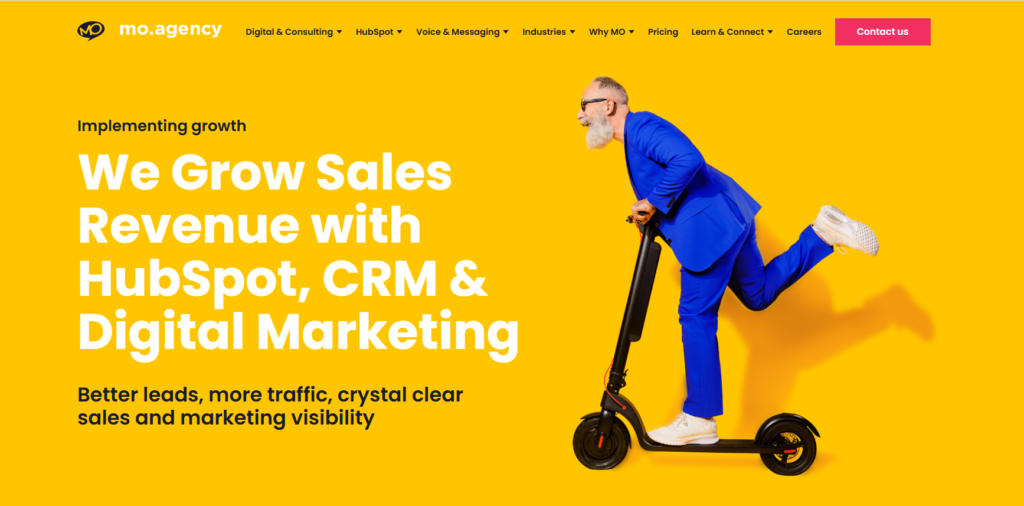
MO Agency works across digital marketing, CRM enablement, and HubSpot-related projects for companies that need more structure in how their sales and marketing systems operate. Their work usually spans areas such as automation, lead management, website development, and performance activity, along with the implementation or optimisation of CRM and connected tools.
Source – MO Agency
They also help companies set up user journeys, run ongoing campaigns, and build the technical foundation needed for day-to-day activity. This often includes platform migrations, integrations, and web projects that aim to centralise information and improve visibility across teams. Their involvement tends to vary by scope, ranging from retained digital programs to specific CRM or HubSpot projects.
Notable Clients
Robus, Vodeno, People Solved, and Messer
Pricing
Their pricing starts at 3,075 dollars per month for marketing or CRM retainers, with onboarding services beginning at 590 dollars per month and support options available from 800 dollars as a once off fee.
7. DemandLab
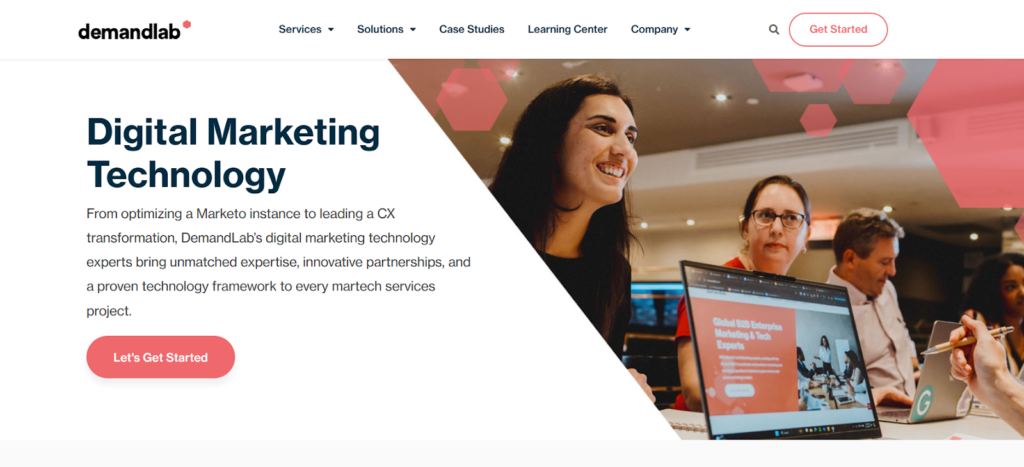
DemandLab focuses on helping marketing teams organise and manage the systems, data and processes that sit behind their digital programs. Their work usually covers areas such as auditing existing setups, planning technology roadmaps, supporting migrations and running initiatives that bring more structure to reporting and attribution.
Source – DemandLab
They also offer short term sprints for leadership alignment, platform transitions or scaling specific parts of the marketing ecosystem.
Another part of their offering includes work with digital marketing technologies, where they support teams in using tools more effectively across strategy, execution and performance measurement. Their own product, Insentric, is designed to consolidate data and give companies a clearer view of how different marketing activities contribute to revenue.
Notable Clients
DemandLab has client base across various domains like InsurTech, Fintech, education, and many others.
Pricing
Their pricing is scoped individually for each engagement, with projects varying based on the type of sprint, technology work or attribution support required.
Methodology: How We Selected These Agencies
To shortlist the right partners for this list, we focused on what actually matters to B2B and MarTech teams today. Instead of surface-level reputation, we evaluated each agency on signals that show real capability, consistency, and commercial impact.
1. Proven execution in complex B2B industries: We looked for agencies with a track record across SaaS, enterprise tech, and MarTech ecosystems.
2. Depth of strategy, not just services: Agencies had to demonstrate thinking across content, SEO, demand generation, and channel execution.
3. Evidence of measurable outcomes: We prioritized teams showing clear ROI, pipeline influence, or visibility gains.
4. Credible client proof and long-term relationships: Sustained partnerships carried more weight than one-off wins.
This approach helped us filter out noise and highlight agencies that can genuinely move the needle for a growing MarTech brand.
How to Evaluate a Digital Marketing Agency for Your Market
If you’re here, you’re probably weighing a few agencies already. And honestly, choosing the right one feels less like reviewing portfolios and more like figuring out who actually understands the world you operate in.
So here’s a simple way to evaluate any agency without getting lost in jargon or shiny decks.
- Start with your market, not their services: Ask yourself whether they’ve worked in ecosystems that look like yours. MarTech, channel marketing, and complex B2B aren’t easy spaces. If an agency can’t explain your buyer landscape back to you, that’s already a red flag.
- Look for thinking, not templates: Most agencies can show a process. Few can show how they adapt that process to the realities of your product, sales cycle, or partner ecosystem. Pay attention to how they ask questions. Good agencies get curious fast.
- Ask for proof of momentum, not vanity numbers: Anyone can share impressions or generic traffic spikes. What you want is evidence that their work created qualified demand, improved discoverability, or unlocked new segments. The good ones always have stories to back this up.
- Notice how they communicate: Your agency will become an extension of your team. If their communication feels slow, unclear, or overly polished during the sales stage, it rarely gets better later. Look for someone who speaks in a way that makes you feel understood, not overwhelmed.
Once you evaluate agencies through this lens, the right partner becomes easier to spot. It’s not about who looks the biggest. It’s about who makes your marketing feel lighter, sharper, and more effective.
Key Takeaways You Can Use Right Away
If you’re not ready to work with an agency yet, there’s still a lot you can start doing on your own. Think of these as gentle starting points rather than a checklist.
1. Clarity always beats volume: Before creating more content or campaigns, it helps to zoom out and ask what your buyers genuinely want to understand. Even a small refinement in messaging can unlock far better engagement.
2. Your website can carry more weight than you think: Most MarTech companies underestimate how much their buyers rely on the homepage, pricing page, or integration pages. A few thoughtful updates often make the whole journey feel smoother.
3. High-intent topics deserve attention: You don’t need a big SEO program to begin showing up where motivated buyers are searching. Identifying a handful of decision-stage questions and addressing them well is already a strong foundation.
4. Distribution doesn’t have to be complicated: Sharing your content across LinkedIn, email, or partner channels in a consistent, human way can create surprising traction..
5. Keep a close eye on what resonates: Whether it’s a LinkedIn post that unexpectedly performed well or a feature explanation that converts better than others, these signals tell you where your story feels strongest. You can see that leaning into them slowly builds momentum.
If you focus on these small but meaningful shifts, your marketing engine naturally becomes clear, but for clearer marketing, you must choose an agency like Concurate.
Why Concurate Is The Right Fit For Your MarTech Company
As you’ve gone through this list, you’ve probably noticed a pattern. Every agency brings something useful, but not every agency brings something usable for the world you operate in.
At Concurate, that’s where we lean in the hardest. We don’t start with templates or generic roadmaps. We start with your market realities, your buyers’ decision triggers, and the friction points that slow down adoption in MarTech and enterprise ecosystems.
You can see this in one of our recent projects, where we built a full programmatic SEO engine for a B2B platform that needed predictable, scalable visibility. Instead of adding more blogs into the void, we created structured page frameworks around real buyer questions. Within weeks, they began ranking for terms they had been chasing for years.
And separately, if you want to study how a MarTech giant shapes demand through content, our teardown of HubSpot Content Strategy is a great example of what strong editorial architecture can do at scale.
This is the mix we bring to our clients: clarity, structure, and execution that actually moves numbers.
If you want the same for your marketing engine, book our calendar today.
Frequently Asked Questions
1. What makes a digital marketing agency a good fit for MarTech companies?
A strong digital marketing agency understands complex buyer journeys in MarTech space, can simplify technical products through content, and knows how to align SEO, demand generation, and sales enablement so that marketing isn’t working in isolation.
2. How is a MarTech-focused agency different from a general digital marketing agency?
General agencies manage broad brand and awareness campaigns. MarTech-focused agencies work at a deeper layer: explaining integrations, workflows, data flows, and ROI models that matter to technical buyers and revenue teams.
3. How long does it take to see results from a digital marketing agency?
For MarTech, results vary by complexity. Content and SEO improvements typically show traction within three to four months, while full-funnel gains and repeatable pipeline movement take six months or more.
4. Can a digital marketing agency support both product marketing and demand generation?
Yes, many agencies operate across the entire lifecycle. The key is to ensure they’re comfortable translating product capabilities into messaging that helps both marketing and sales teams accelerate conversions.
Disclaimer: The information presented in this article is compiled from publicly available sources, including company websites, industry reports, and social media. All trademarks, brand names, and logos mentioned are the property of their respective owners. This article is intended for informational purposes only.