


| TL;DR: This article breaks down the best SaaS marketing campaigns of 2025, highlighting how Gong, Palo Alto Networks, Zoom, OpenAI, and ClickUp used innovative, high-impact marketing strategies to drive awareness, engagement, and conversions. These top SaaS campaigns reveal what modern B2B SaaS marketing looks like, and the key lessons founders, CMOs, and marketers can apply to their own growth strategies. |
I’ve been neck-deep in the SaaS content marketing world for almost a year now, and I’ve noticed something wild: SaaS marketing has gotten weirdly creative. And I mean that in the best way possible.
CMOs and marketers are throwing the rulebook out the window. Stunts that would’ve gotten frowns from senior leadership? Now they’re case studies. LinkedIn—once just a place where people humble-brag about promotions–is now the primary growth engine for many leading SaaS companies.
The campaigns that I will talk about made me go, “Bro, that’s so clever. I can’t believe they got approval for this. If I could pull something like this off for my clients, that would totally be chef’s kiss.”
So let’s break down what makes these SaaS marketing campaigns actually worth stealing.
5 Best SaaS Marketing Campaigns of 2025
Here’s the problem with most SaaS marketing: it’s safe. Painfully safe.
Everyone’s running the same playbook. Explainer videos with stock footage. Whitepapers no one reads. LinkedIn ads that look identical except for the logo. The campaigns are so vanilla that you could swap the brand names, and no one would notice.
But every once in a while, a company breaks the mold. They do something so unexpected that you actually stop and pay attention. These five campaigns did exactly that, and the results speak for themselves.
Here’s what you’re about to steal:
- Gong’s LinkedIn Marketing: Building a Content Army.
- Palo Alto Networks’ “Be A Genius. Deploy Bravely”: Practicing What You Preach.
- Zoom’s “Zoom Ahead” Campaign: Making Your Brand a Verb.
- OpenAI’s ChatGPT: Making AI Feel Like Your Best Friend.
- ClickUp’s “Cut the Slack” Dreamforce Stunt: Crashing the Party
Let’s break them down one by one.
1. Gong’s LinkedIn Marketing: Building a Content Army
Turning employees into brand ambassadors, one purple gradient at a time.
Look, I love LinkedIn. I’ve been trying to crack LinkedIn marketing for a while now, testing different tactics, experimenting with formats. So when I come across a company from my target that is absolutely nailing it on LinkedIn, it gets me unreasonably excited.
Gong was one such company.
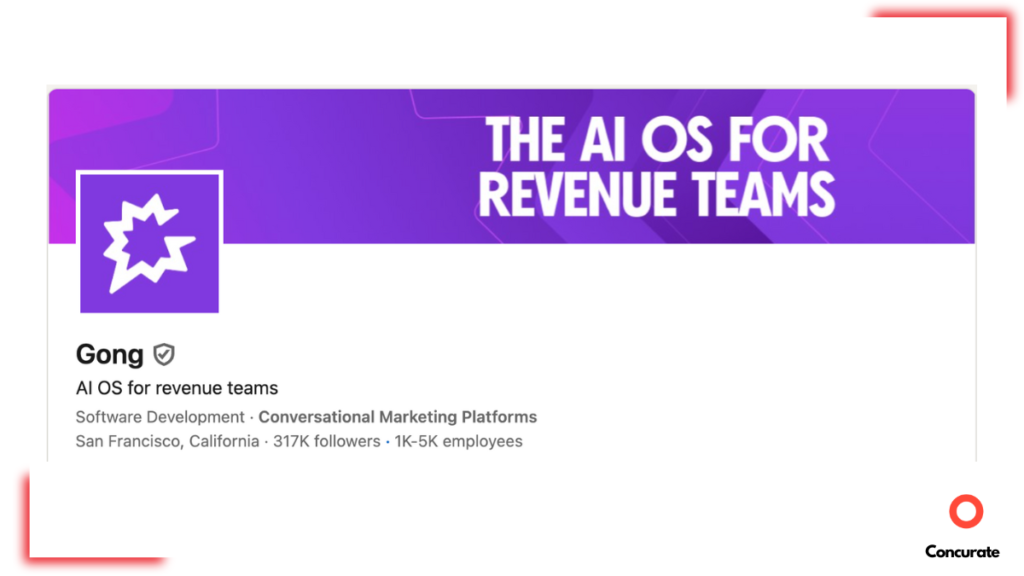
Source: Gong’s LinkedIn
The strategy itself is not that glamorous on paper. It was how they got every single executive, every team member, every “Gongster” (yes, that’s what they call themselves) to buy into the same playbook.
The purple gradients in LinkedIn profile pictures. The coordinated content. The consistent posting cadence. Most companies can’t even get their sales team to update their LinkedIn profiles. Gong turned their entire workforce into brand ambassadors.
The Three Pillars of Gong’s LinkedIn Strategy
1. Brand Consistency at Scale: Gong’s CEO Amit Bendov gets marketing. He spent 15+ years in software marketing, and it shows. Those white glasses in his profile picture? Not an accident. That’s personal branding 101.
Here’s what the team’s LinkedIn profiles look like:
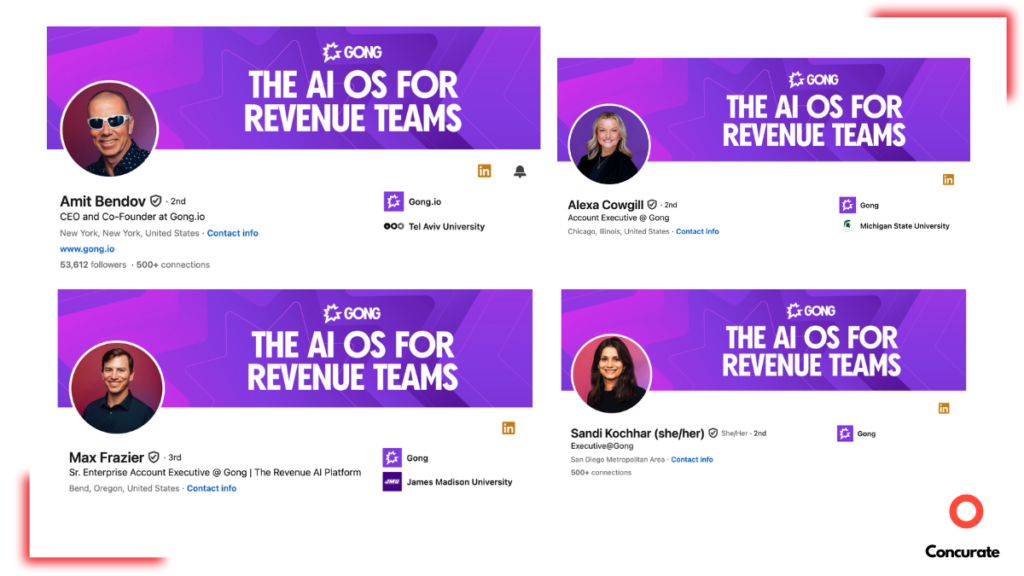
Source: Gong’s LinkedIn
That purple gradient is everywhere. When you see that color on LinkedIn, you know it’s Gong.
2. Funneling Traffic Where It Matters: Gong generates 287K visits per year. Instead of ending blog posts with newsletter CTAs, they add “Follow us on LinkedIn.”
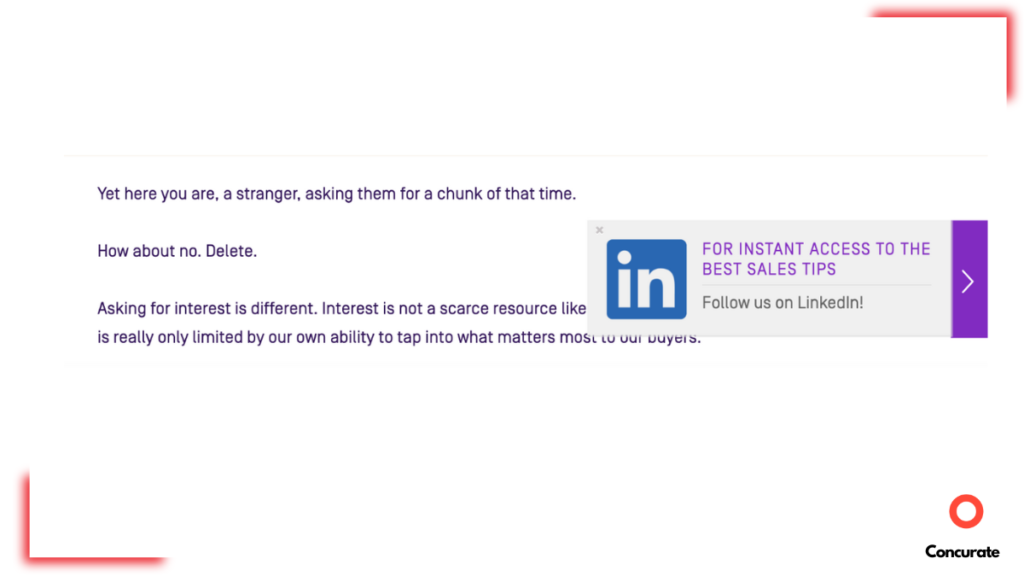
The result? Gong has 316K LinkedIn followers compared to competitor Chorus’s 29K. That’s 11x more. Once they have that follow, they post 10-15 times per week, more than most B2B companies post all year.
3. Content That Actually Works: Gong understands the LinkedIn algorithm. They create content that shows their product in action. Not as a sales pitch, but as genuine user enthusiasm.
Look at this post from Max Frazier, one of their Enterprise Account Executives:
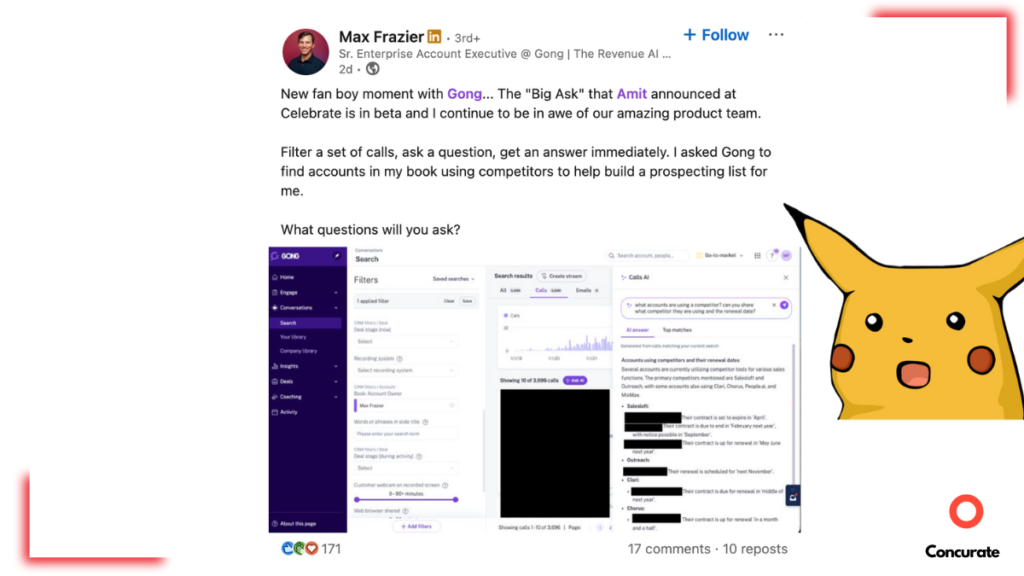
Source: LinkedIn
“New fan boy moment” → Makes enterprise software relatable.
Shows real use case → Finding competitor accounts to build prospecting lists.
Demonstrates value immediately → Sales pros see exactly how they’d use this.
This is product marketing disguised as authentic excitement. And it works because Max isn’t selling. He’s sharing a genuine “wow” moment.
| Key Takeaway for SaaS CMOs, Founders, and Marketers Gong’s LinkedIn strategy works because of culture, consistency, and content-market fit. You need buy-in from leadership, a recognizable brand identity your team embraces, and content your audience actually wants. Start small. Pick one executive. Build their LinkedIn presence. Test what resonates. Then scale. |
For more marketing strategies from Gong, check out this Gong content strategy analysis.
2. Palo Alto Networks’ “Be A Genius. Deploy Bravely”: Practicing What You Preach
When your product secures AI, you’d better use AI to sell it.
Here’s what I love about this campaign. Palo Alto Networks didn’t just talk about AI security. They put their money where their mouth is. Their product, Prisma AIRS, helps companies use AI tools securely.
And how did they advertise it? By creating the entire campaign using AI tools. The in-house creative team used Google Veo, Gemini, and Artlist to
- Generate concepts and write copy.
- Create visuals and video content.
- Localize messaging for multiple languages.
- Predict creative effectiveness before finalizing scenes.
Most cybersecurity companies would play it safe. They’d hire a big agency, spend months in production, and launch a traditional campaign. Palo Alto did the opposite. They showed their customers exactly what’s possible when you deploy AI bravely, because that’s literally what they did.
For me, as a marketer, this resonated because so few companies actually practice what they preach. It’s easy to say “our product enables innovation.” It’s harder to demonstrate it by completely reimagining how you market.
The “Be A Genius. Deploy Bravely” campaign is a ten-part series featuring historical innovators like Thomas Edison, Marie Curie, and Leonardo da Vinci. People whose discoveries created entirely new industries.
Here’s what one of the ads looks like:
And here’s Marie Curie.
Traditional campaigns take about 9 months to produce, cost tens of millions of dollars, and require massive employee hours across multiple agency partners. Palo Alto’s AI-powered approach? One week per ad video, less than $1,000 per ad, and 20x fewer employee hours.
The campaign ran across PR Newswire, CNBC, The Wall Street Journal, Forbes, Fortune, YouTube, and LinkedIn.
Why This Works?
Kelly Waldher, Palo Alto’s CMO, nailed it when he said: “We’re showing our customers that we’re just as excited as they are about leveraging AI’s capabilities, and doing it securely.”
That’s the entire strategy in one sentence.
| Key Takeaway for SaaS CMOs, Founders, and Marketers If your product enables something, use it to market itself. Don’t just tell people what’s possible. Show them by doing it. |
If you want to read content strategies from other cybersecurity companies, check out our CrowdStrike content strategy and SEO analysis.
3. Zoom’s “Zoom Ahead” Campaign: Making Your Brand a Verb
When “Google it” works, why not “Zoom it”?
What impressed me most about this campaign wasn’t just that Zoom hired SNL’s Bowen Yang or made a funny advertisement. It was the audacity of what they were trying to do: turn “Zoom” into a verb.
“Google it.” “Xerox this.” “FedEx it overnight.” These brands became so embedded in our vocabulary that they transcended their products. They became actions.
Zoom wanted that too. And honestly? That’s clever as hell.
“Zoom Ahead” works on multiple levels. It’s a play on the brand name (Zoom), and it means to move forward, to get ahead. Like when Judy Geller said in F.R.I.E.N.D.S, “You pulled a Monica.” It’s instantly understood.
Zoom wanted to own that same mental real estate. They didn’t just slap the tagline on a billboard and call it a day. They made it funny and relatable. And they made sure millions of people saw it during major sports broadcasts.
That’s how you turn a brand into a verb.
The Campaign: Humor Meets Frustration
The “Zoom Ahead” campaign launched in late 2025 with a 30-second ad starring Bowen Yang. The spot, titled “I Use Zoom!”, took direct aim at “clunky, overengineered tools” and positioned Zoom as the simple, easy-to-use alternative.
Here’s the video:
The ad lampooned the universal frustration everyone has with bad tech. Software that requires a PhD to operate, tools that crash during important meetings, and platforms that make simple tasks complicated.
Zoom’s message? We’re not that. We make work easier.
CMO Kimberly Storin explained it perfectly, “I Use Zoom! resonates with audiences because it humorously delivers a truth familiar to everyone: don’t give us bad tools when Zoom makes work easier.”
The campaign was produced by Colin Jost’s team (yes, the SNL Weekend Update guy) and will debut on December 31, 2025, during the U.S. College Football Playoff. The campaign has already generated buzz.
Zoom surveyed over 22,000 customers post-campaign and received an industry-leading Net Promoter Score (NPS) of 58. For context, that’s exceptional in the SaaS world.
But here’s what really mattered:
70% of respondents praised Zoom’s simplicity.
40% highlighted its reliability.
| Key Takeaway for SaaS CMOs, Founders, and Marketers If you want to own a category, own the language around it. Make your brand name synonymous with the action. Make it memorable. |
4. OpenAI’s ChatGPT: Making AI Feel Like Your Best Friend
When people are skeptical, make your product feel personal.
What impressed me most about ChatGPT’s first brand campaign was how it made AI feel personal.
OpenAI could have showcased all the impressive stuff. Data analytics, enterprise automation, complex coding. Instead, they showed ChatGPT helping someone prep for a job interview. Helping someone create a routine. Helping someone plan their sister’s holiday trip.
These aren’t flashy use cases. They’re deeply personal ones. And that’s exactly why it’s clever.
The Campaign: Real People, Real Problems
OpenAI launched ChatGPT’s first major brand campaign in 2025, and they deliberately avoided the “sci-fi future” angle that every other AI company was leaning into.
Here’s what the ads looked like:
Here’s how ChatGPT is helping a schoolgirl prepare for an interview:
The campaign featured warm, emotional contexts where ChatGPT acts as a helpful companion. No robots. No futuristic interfaces. Just everyday people getting help with everyday tasks.
The messaging is spot on! AI isn’t here to replace you. It’s here to help you with the stuff you’d normally struggle with alone.
The Results: Making AI Approachable
The campaign achieved exactly what it set out to do: it made ChatGPT feel less like a tool and more like a companion. With this SaaS marketing campaign, OpenAI signaled that they want everyday users, not just developers and early adopters, to feel comfortable using their product.
| Key Takeaway for SaaS CMOs, Founders, and Marketers Don’t just showcase what your product can do. Show people why they should use it. If your product feels intimidating or complex, strip away the jargon and lead with empathy. Find the human moment. |
If you are wondering how ChatGPT fetches SaaS information for different prompts, check out our research piece, Where Does ChatGPT Get Its Information From For SaaS Recommendations.
5. ClickUp’s “Cut the Slack” Dreamforce Stunt: Crashing the Party
When everyone’s playing it safe, show up uninvited.
This campaign impressed me for one simple reason: it was risky as hell. ClickUp showed up at Dreamforce—Salesforce’s massive conference—and staged a fake protest against Slack, which Salesforce owns.
Instead of buying a booth or sponsoring anything, they just crashed the party with actors holding “Cut The Slack!” signs and chanting outside the event.
That’s the kind of move that gets you in trouble. Or gets you talked about everywhere. With ClickUp, the latter happened.
They put the whole stunt on TikTok, and it went viral. 500K views within hours. Over 100 million impressions total.
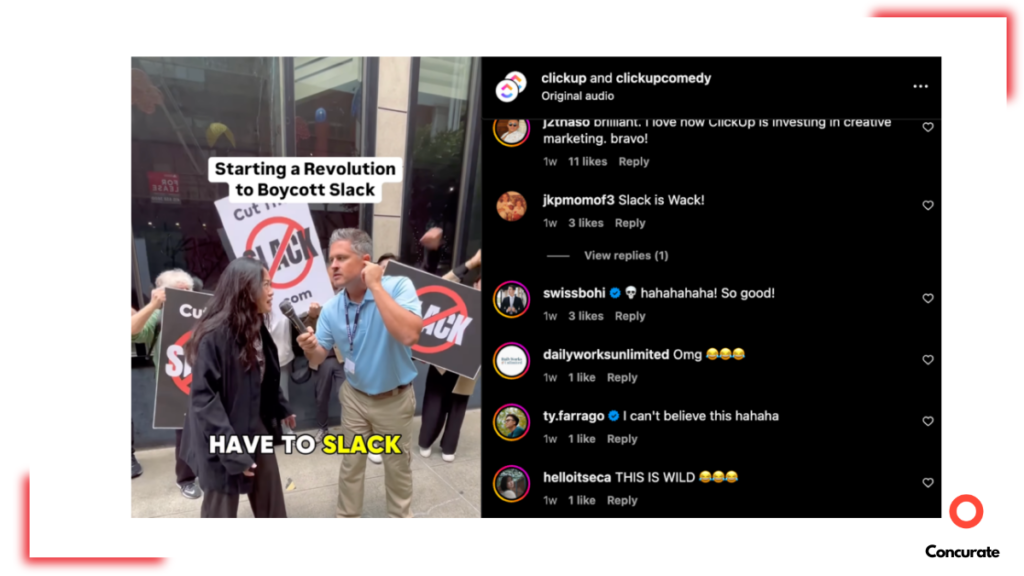
Source: Instagram
Why Did This Strategy Work?
ClickUp isn’t just for enterprises or B2B companies. It’s for everyone. Students are planning their exam schedules. Freelancers managing client work. Teams coordinating projects. I use ClickUp extensively for my day-to-day task management.
By creating a spectacle that felt rebellious and fun, ClickUp reached way beyond the Dreamforce crowd. They reached the general public. And that’s exactly what resonated with me as a marketer.
Chris Cunningham, ClickUp’s social marketing lead and Founding Member, explained the strategy: “People keep asking me how we get 100M+ impressions a month. This is how.”
That’s more reach than most traditional ad campaigns achieve with millions in budget. And ClickUp did it with actors, signs, and a camera. Industry observers praised the creativity. Competitors probably fumed. But everyone was talking about ClickUp.
You can watch the video in Cunningham’s LinkedIn post.
| Key Takeaway for SaaS CMOs, Founders, and Marketers Bold wins. Safe gets ignored. If you want to break through the noise, you can’t play by the same rules as everyone else. Find the spectacle. Create the moment people can’t help but share. Just make sure you’re ready for the attention when it comes. |
Frustrated with SaaS Marketing Campaigns That Look Good but Don’t Convert? Let Concurate Fix That.
You just went through some of the boldest, smartest SaaS marketing campaigns of 2025. If one takeaway stands out, it’s this: creativity wins, but only when it’s tied to revenue.
At Concurate, that’s exactly what we do.
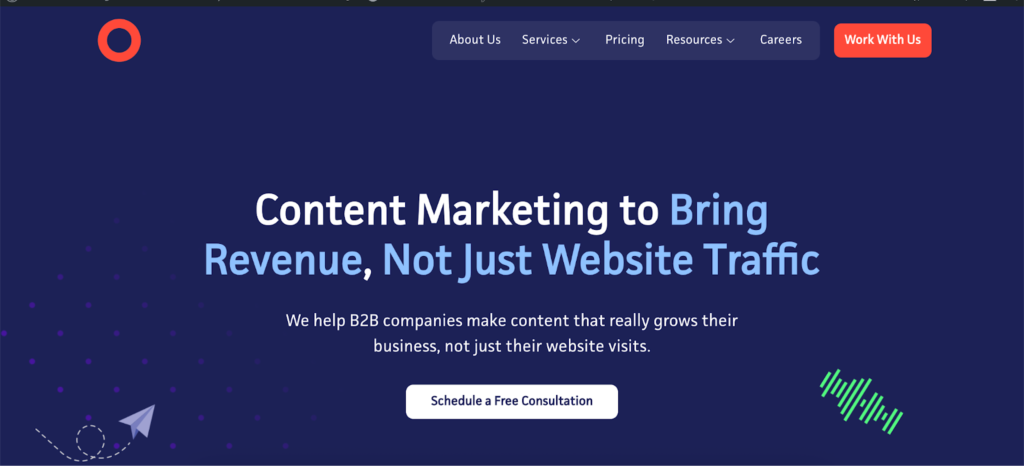
We don’t believe in a one-size-fits-all approach. Every SaaS company has its own positioning challenges, audience nuances, and competitive landscape. That’s why we begin by deeply understanding your goals, and then build a content strategy designed to convert your target users into qualified leads.
We are trusted by B2B SaaS companies to turn content into real sign-ups, free trials, and demo requests.
Read how we
- Generated 24 leads with just three blog posts for a FinTech SaaS.
- Helped a network training provider dominate 60+ markets and attract enterprise leads.
- Helped an AI voice cloning SaaS surpass Google Ads and high-authority domains to claim the #1 spot in the US, UK, and Canada.
- Helped an E-commerce client boost their site health score from 73 to 89.
If you’re tired of campaigns that burn budget, chase vanity metrics, and make no real impact, it’s time for a different approach.
Your Questions About the Best SaaS Marketing Campaigns, Answered
You’ve seen what the big players are doing. Now you’re probably wondering, “Okay, but how do I apply this to my SaaS?” or “What other legendary campaigns should I know about?” Below, we’ve tackled the questions that come up most often when marketers read about campaigns like these.
What is SaaS Marketing?
SaaS marketing is how software-as-a-service companies attract, convert, and retain customers.
Unlike traditional software that you buy once and install, SaaS products are subscription-based. You’re not just selling a product. Here, you’re selling ongoing value. That changes everything about how you market.
You need to prove value before someone pays. That’s why free trials, freemium models, and product-led growth are huge in SaaS.
At Concurate, we approach SaaS marketing differently. We know that traffic and impressions alone won’t bring you business. That’s why we focus on creating content that drives free sign-ups, trial requests, and demo requests.
How do we do it? If you’d like to learn more, click here to talk with us.
What is Campaign Marketing?
Campaign marketing is the coordinated set of marketing activities around a specific goal, message, or theme. This is typically done for a limited period.
Think of it like this: Instead of random social posts and advertisements, you build everything around one big idea. You create a narrative, choose your channels (email, social, paid ads, PR), and launch it all together to maximize impact.
Good campaign marketing has:
- A clear objective (launch a product, enter a new market, increase brand awareness).
- A central message or theme.
- Multiple touchpoints (ads, content, events, social).
- A defined timeline.
- Measurable outcomes.
Most importantly, campaign marketing creates a moment. It gives people something to talk about, share, and remember.
What is a SaaS marketing plan?
A SaaS marketing plan is your roadmap for attracting and converting prospects. It’s a strategic plan where you outline who you’re targeting, how you’ll reach them, and what success looks like.
Here’s what a solid SaaS marketing plan typically includes:
- Target audience and buyer personas: Who are you selling to? What problems do they have? Where do they hang out online?
- Positioning and messaging: What makes you different? Why should someone choose you over competitors?
- Goals and KPIs: What are you trying to achieve? Sign-ups? MRR growth? Demo requests? How will you measure it?
- Marketing channels and tactics: SEO, content marketing, paid ads, social media, email, partnerships—what mix makes sense for your audience and budget?
- Budget and resources: How much can you spend? Who’s executing this?
- Timeline and milestones: When are you launching things? What are the key deadlines?
The best SaaS marketing plans aren’t static documents you write once and forget. They evolve as you learn what works. Start with a hypothesis, test it, measure results, and adjust.
What are the Best SaaS Marketing Campaigns of All Time?
While this article focuses on 2025, there are legendary SaaS campaigns that set the standard for bold, creative marketing:
- Slack’s “Make Work Better” (2014-2016): Slack didn’t just sell software. They sold a better way to work. Their campaign focused on reducing email overload and making collaboration enjoyable. The messaging was simple, the product delivered, and Slack became one of the fastest-growing SaaS companies ever.
- Dropbox’s Referral Program (2008): Dropbox grew from 100K to 4M users in 15 months by incentivizing referrals. Give extra storage, get extra storage. Simple, effective, and it turned users into marketers.
- Mailchimp’s “Did You Mean Mailchimp?” (2017): Mailchimp intentionally created misspellings of its name (MailShrimp, KaleLimp, JailBlimp) and turned them into a multi-channel campaign. It was weird, memorable, and got people talking.
What these campaigns have in common: They didn’t just push flashy features. They created movements, changed behaviors, and moved people.
What Other Marketing Campaigns Should I Know About?
We’ve documented innovative campaigns across different industries and categories:
- Best Social Media Marketing Campaigns
- Innovative Marketing Campaigns
- Best Christmas Marketing Campaigns
- Best Ad Campaigns
- Best B2B Marketing Campaigns
PS. We’ve put together 30 proven SaaS growth strategies to help you achieve double the impact. Get the full list by filling out the form below.
Disclaimer: The information provided in this article is based solely on publicly available sources and is intended for general informational and guidance purposes only. It should not be relied upon as a final decision-making resource or as a substitute for professional advice. While we strive for accuracy and completeness, we make no representations or warranties regarding the correctness of the content. If you believe any information should be updated, corrected, or removed, please contact our team for review.