

| TL;DR- Semrush is one of those SEO tools that looks powerful but raises an immediate question: Will I actually use it? In this Semrush review, I evaluate the platform from a content writer’s point of view. The analysis is based on hands-on testing of core Semrush Pro features, including keyword research, competitive analysis, and AI visibility. The goal is to show what feels genuinely useful in day-to-day work—and what may be more than you need. |
The real question isn’t “Is Semrush good?”
Semrush has been around long enough that its credibility isn’t really up for debate. It’s one of the most widely used SEO tools in the world. SEO teams build workflows around it.
The more interesting question—the one most people are actually asking—is this:
Will I actually use it?
Because Semrush doesn’t suffer from a lack of features. If anything, it has the opposite problem. There’s a lot going on. Multiple toolkits. Dozens of reports. Usage limits. Add-ons. AI features. Pricing tiers.
So in this Semrush review, I’m not trying to cover everything SEMrush can do. Instead, I’m looking at it from a content writer’s perspective, based on hands-on testing of the SEMrush Pro plan, and focusing on the features I actually used:
- Keyword research
- Competitive analysis
- AI visibility
The goal is simple: show what fits naturally into real content workflows—and what feels like overkill.
First Impressions: Strong Direction, Heavy Surface Area
The experience with Semrush starts at signup, and it immediately signals that this is a paid, professional SEO platform built for regular use—not casual experimentation.
You’re asked to choose a plan and enter payment details upfront. There is a 7-day free trial. Pricing, plan tiers, and limits are clearly laid out during signup, so you know what you’re committing to before you ever see the dashboard.
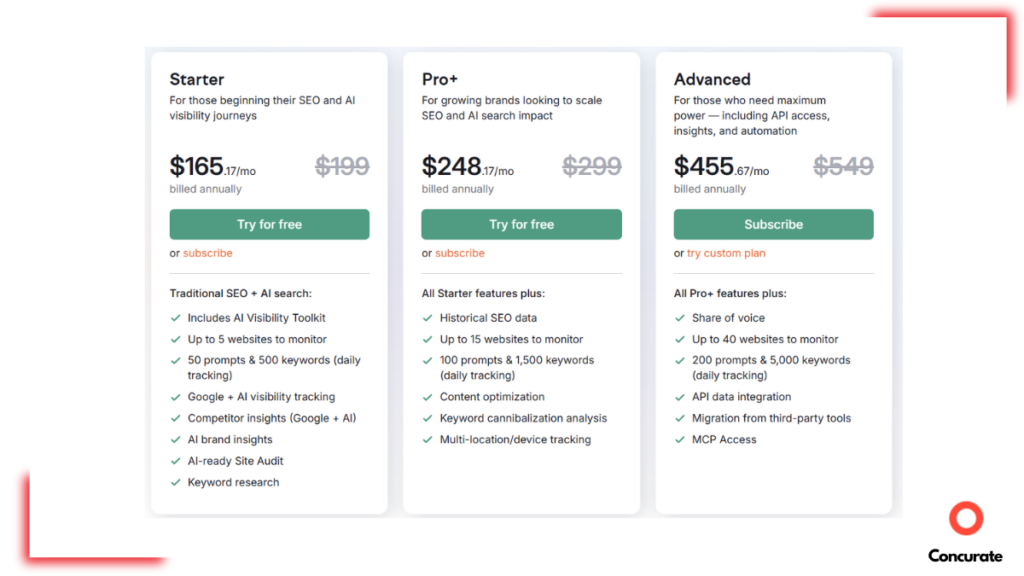
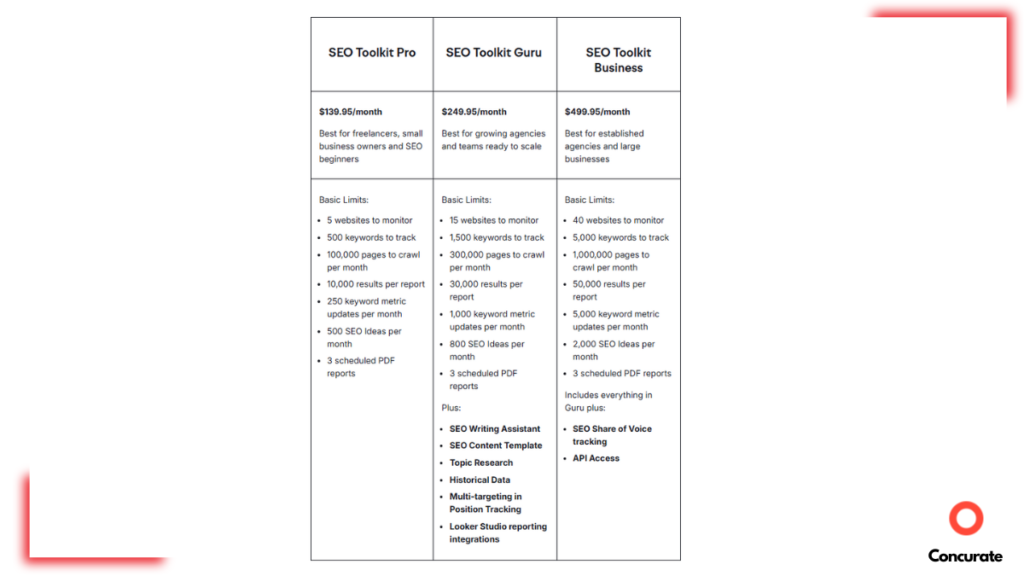
Semrush also offers an SEO Toolkit option, which makes sense if your focus is on content and organic search rather than paid or social.
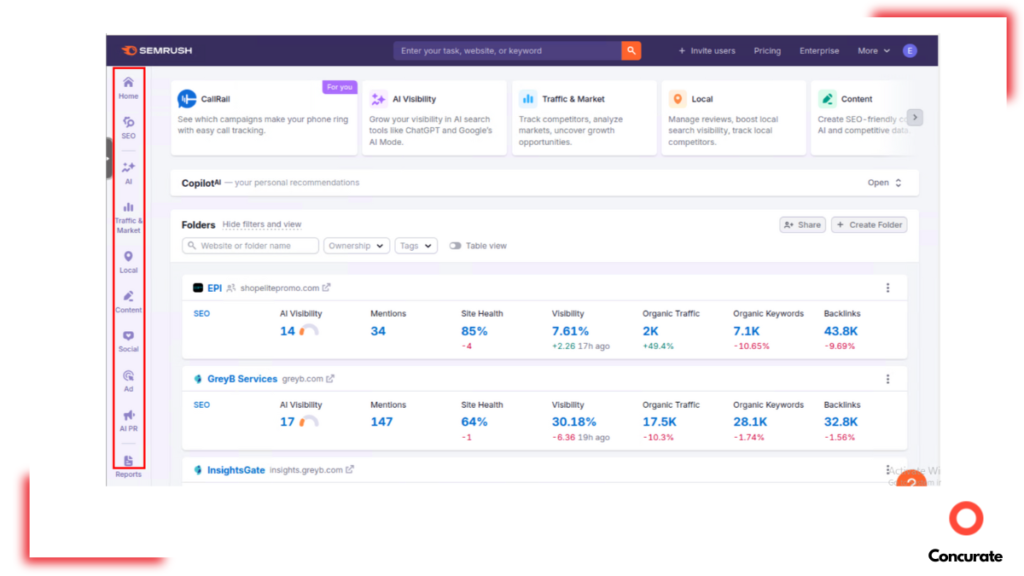
Once you sign in, the first thing you notice is the dashboard. It’s clean, professional, and data-heavy.
That said, the first few minutes came with a definite “where do I start?” moment.
The left navigation lists SEO, AI, Traffic & Market, and more. I hovered for a bit, clicked into a couple of sections, then quickly realized I was overthinking it. As a content writer, I wasn’t going to touch half of this.
Once I mentally filtered out everything I didn’t need and focused on keyword research and competitive analysis, the tool felt far more approachable.
So yes—there’s a learning curve. But it’s manageable if you’re intentional.
Now, let’s look at the features I actually explored in Semrush.
Inside Semrush: The Features that Made It Into My Workflow
I approached SEMrush with a simple rule: if a feature didn’t help me plan content faster or more clearly, I moved on. These are the ones that stuck.
1. Keyword Research: Where Semrush Really Shines
Most of my time in Semrush ended up here. Keyword research is where the tool stopped feeling overwhelming and started feeling genuinely helpful.
Keyword Overview: A Quick Reality Check
This was my starting point.
Keyword Overview gives you a fast snapshot: search volume, difficulty, intent, and a look at what’s already ranking. As a content writer, that intent label matters more than almost anything else. It helps answer a basic but critical question early:
Does this keyword call for an informational article, or are searchers expecting a product page, comparison, or tool?
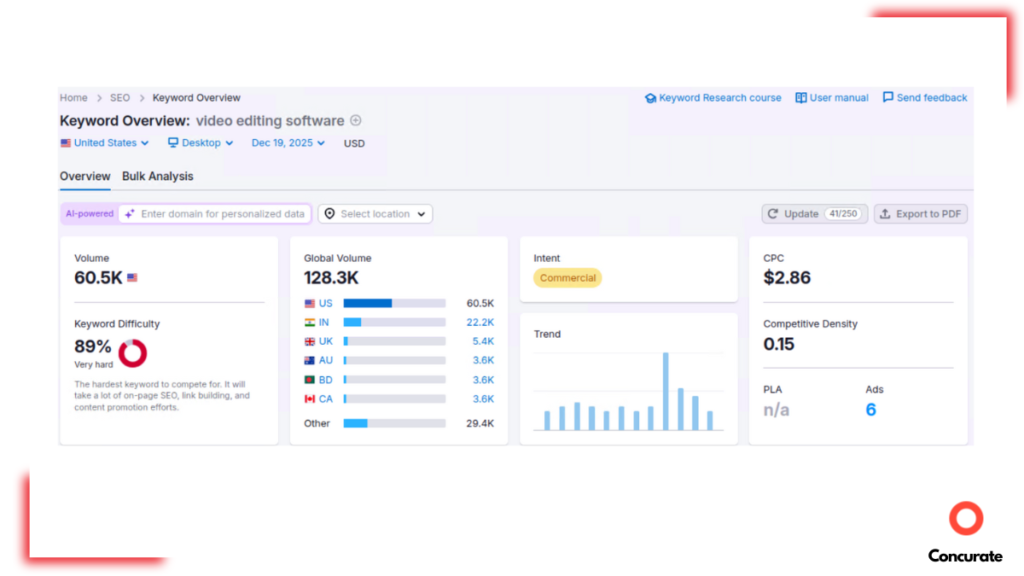
You do need a bit of SEO context to interpret all the metrics confidently, but overall, this tool works well as a “write or don’t write” filter.
Keyword Magic Tool: Turning Ideas Into Structure
This is where Semrush becomes genuinely useful for writers.
Instead of guessing subtopics, the Keyword Magic Tool lets you expand a main keyword into related terms and questions people are actually searching for. The Questions tab, in particular, is great for shaping outlines and section headers.
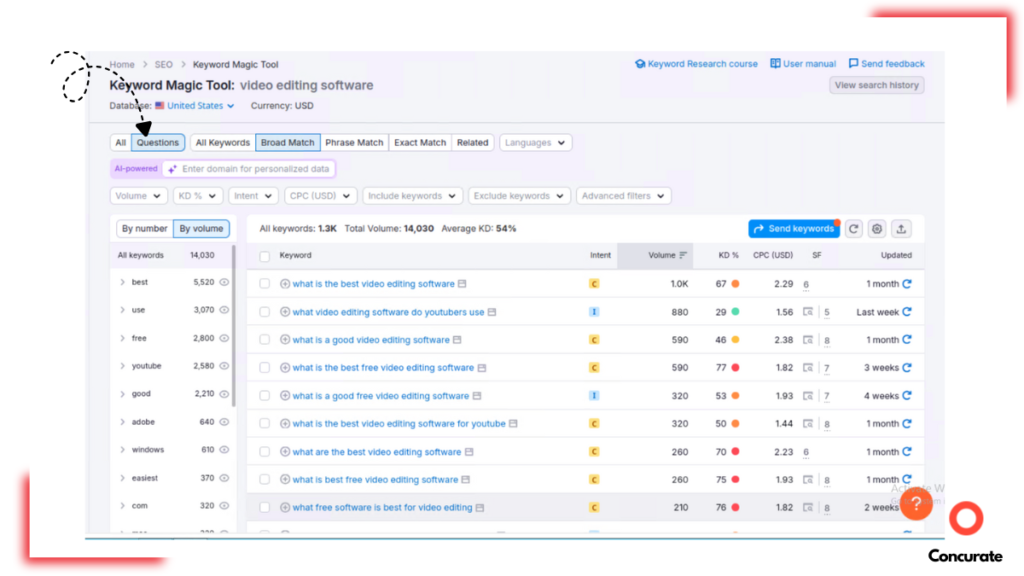
There’s a lot of data here—sometimes too much. If you don’t filter, it’s easy to get overwhelmed. But once you get the hang of narrowing things down, this tool saves a ton of time and guesswork.
The same goes for turning that research into visuals. Napkin AI converts keyword clusters and outlines into diagrams without manual design work. This Napkin AI review covers whether it actually saves time or just adds friction.
Keyword Strategy Builder: Helpful, But Not Always Necessary
Keyword Strategy Builder takes things a step further by grouping keywords into topic clusters. This is useful if you’re planning content at a strategy level—pillar pages, supporting articles, long-term coverage of a topic.
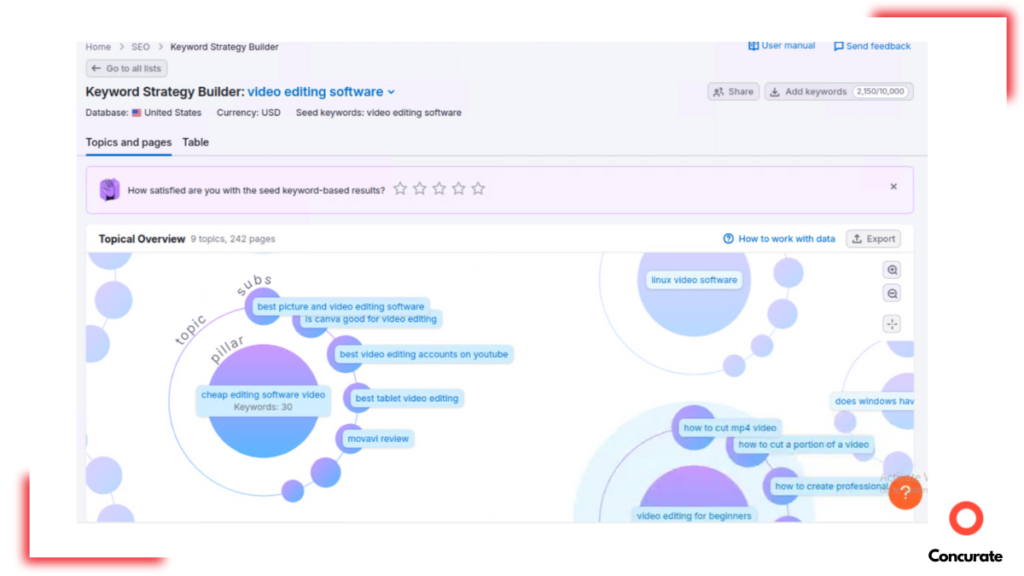
For one-off blog posts, it can feel like more than you need. But for content teams planning at scale, it reduces a lot of manual organization.
Keyword Gap: Very Effective, If You’re Selective
I tested the Keyword Gap by comparing ahrefs.com and semrush.com, focusing on organic keywords. The overlap visual makes the insight immediate. Semrush shows a much broader keyword footprint, while Ahrefs ranks for a smaller but still significant set of keywords.
The “Missing” and “Weak” tabs quickly surface keywords one site ranks for, and the other doesn’t. On paper, this looks like a long list of opportunities. In practice, it needs filtering.
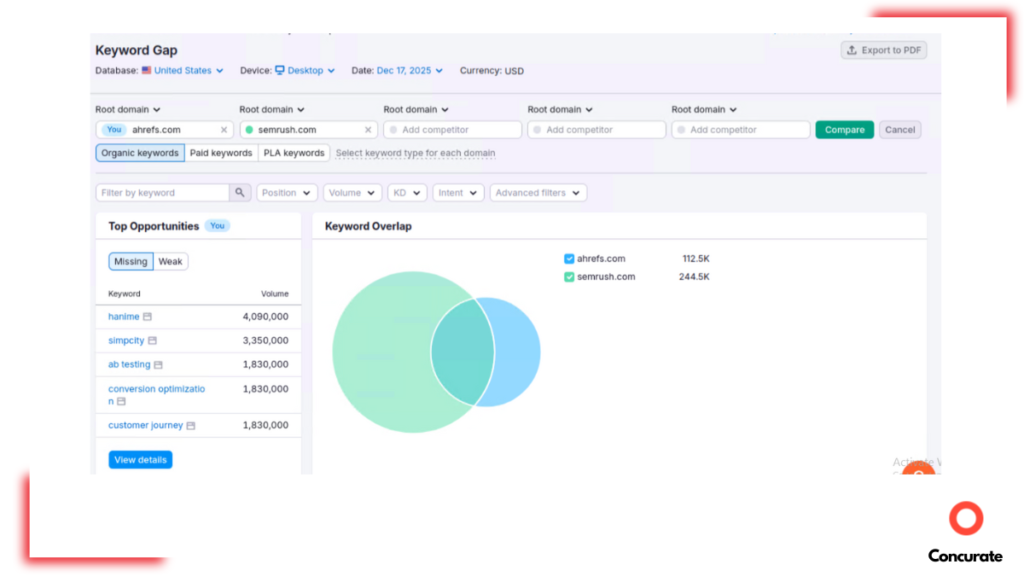
Keyword Gap works best as a directional tool. It shows where competitors have strength and where your coverage is thinner, but it doesn’t decide priorities for you. I found it most useful when comparing against one or two direct competitors and filtering aggressively. Used casually, it’s easy to chase noise.
2. Competitive Analysis: Deciding What’s Worth Competing On
Keyword research tells you what people are searching for. Competitive analysis tells you what’s already working—and what realistically has a chance to compete.
Domain Overview
Domain Overview is where I went when I needed fast context before digging into details. In one screen, Semrush shows authority score, organic traffic, keyword footprint, backlinks, and traffic trends over time.
What’s useful here isn’t the exact numbers, but the relative scale. You quickly see how established a domain is, how broad its keyword coverage looks, and whether traffic is trending up or flat. For content planning, this helps set expectations early. Competing with a domain showing millions of keywords and steady traffic growth is a very different challenge from going after a smaller site.
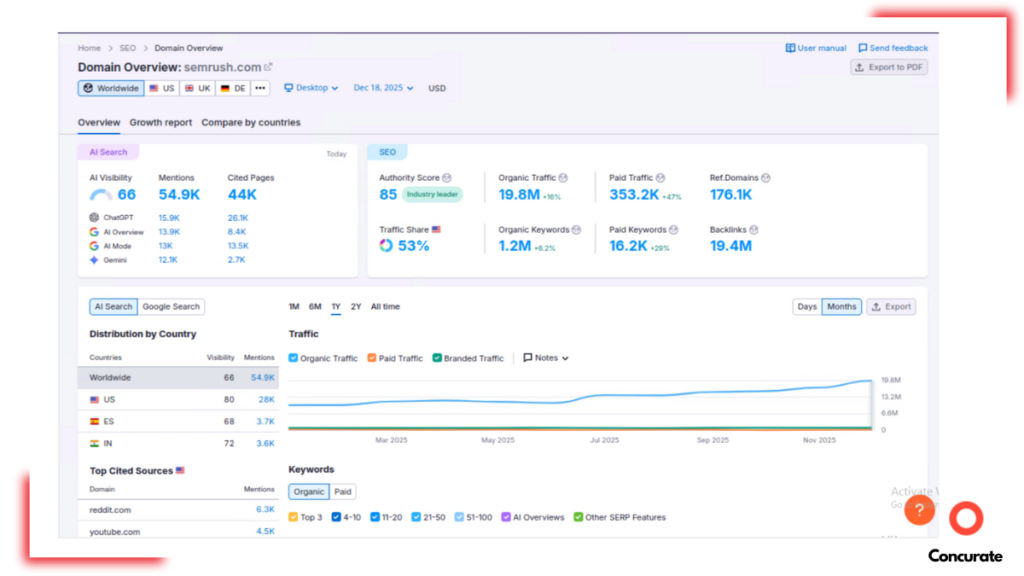
I treated this less as an analysis tool and more as a sanity check. It helped me understand who I was really up against before spending time on keyword gaps or content ideas.
Top Pages
The Top Pages report is where Semrush stops being abstract and starts feeling very real. Instead of looking at keywords in isolation, this view shows which specific pages are pulling in traffic and how much.
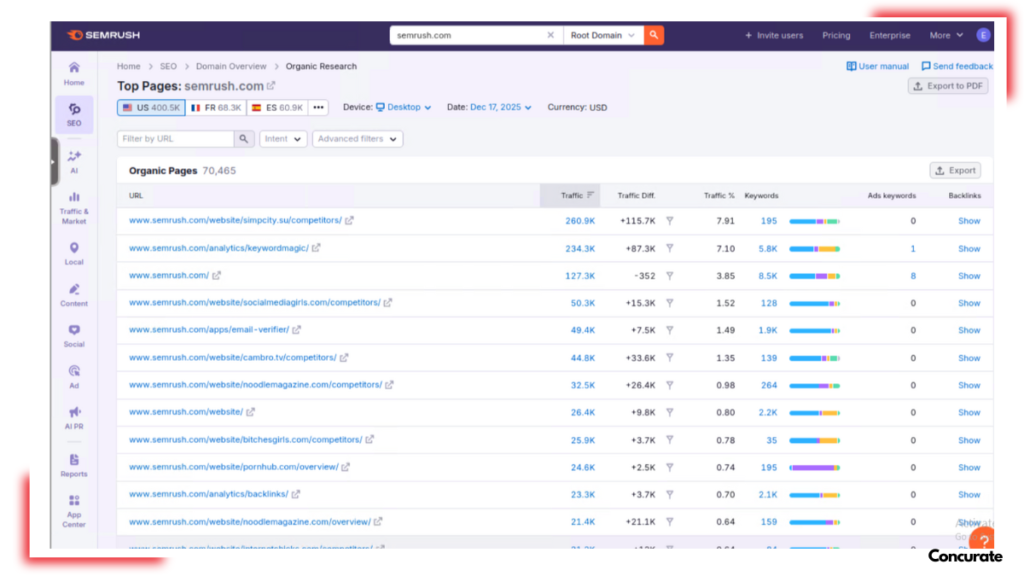
I used this mainly as a reality check. Seeing which pages account for the largest share of traffic helps you understand what formats and topics actually work for a site. In this case, comparison pages, tools, and feature-specific pages clearly dominate, which says a lot about user intent and content expectations.
For content planning, this is useful in two ways. It shows which types of pages are worth replicating, and just as importantly, which ideas are unlikely to compete as blog posts. It’s a quick way to avoid chasing topics that look good on paper but don’t align with how search traffic is actually distributed.
Organic Keywords
The Organic Keywords report gives a quick sense of how broad and resilient a domain’s search presence actually is. At a glance, you can see total ranking keywords, estimated traffic, traffic value, and how much of that traffic is branded versus non-branded.
What stood out to me here was the balance. A strong non-branded traffic share signals that the site isn’t relying solely on brand searches to drive visibility. That matters when you’re assessing competitors, because it tells you whether their content ecosystem is pulling in discovery traffic or just capturing existing demand.
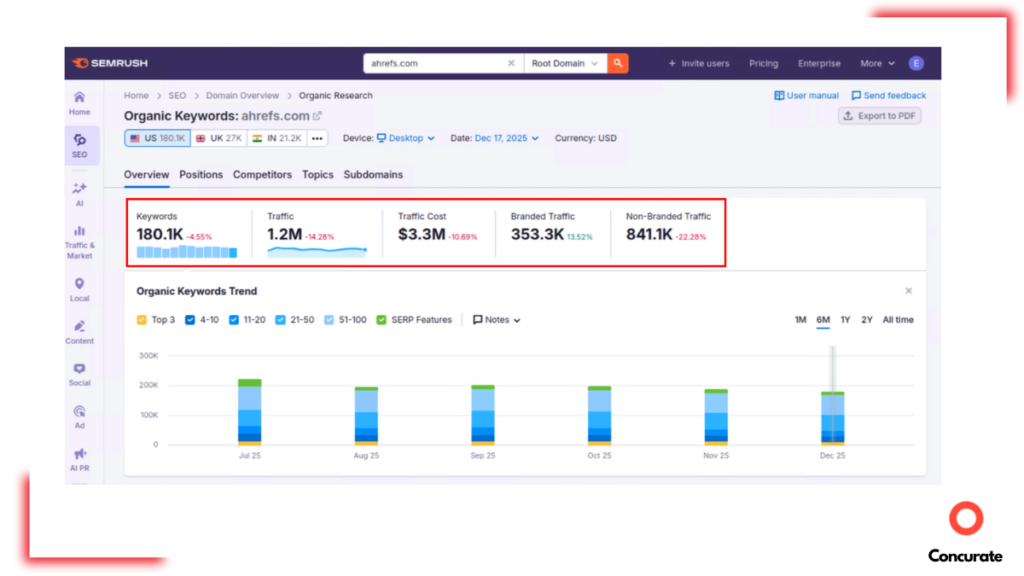
I didn’t use this view to hunt for individual keywords. Instead, I treated it as a health check. It helped me understand whether a domain’s rankings were expanding, stagnating, or contracting over time before digging deeper into gaps or specific pages.
Ranking Changes
The Rankings Changes view is where Semrush shows how a domain’s positions are shifting over time. I used this less for daily monitoring and more to understand momentum.
The trend chart gives a quick sense of whether rankings are generally improving, declining, or staying flat. The real value, though, is in the Top Page Changes table. Seeing which specific pages gained or lost traffic helps connect ranking movement to real content, not just abstract metrics.
This is especially useful for identifying patterns. Pages tied to tools, comparisons, or evergreen explainers tend to show clearer swings, while blog-style content often moves more gradually. I treated this as a diagnostic view, not something to react to daily, but it helps undersatnd what types of content are actually driving changes in visibility.
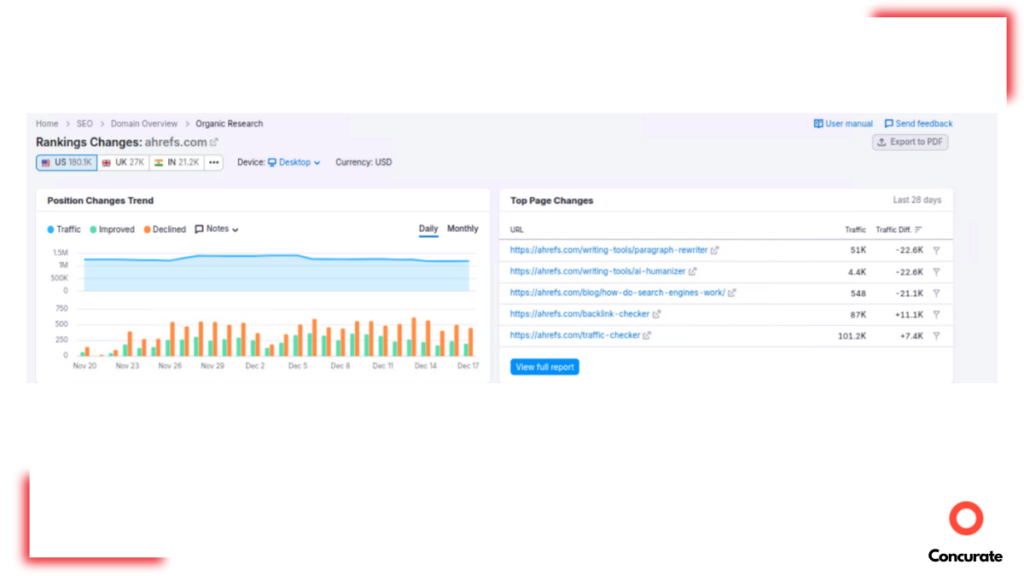
One limitation is that historical data is not available in the Pro plan. Historical insight (like past traffic trends or keyword ranking trends over time) is only unlocked starting with the Guru plan or higher.
3. AI Visibility
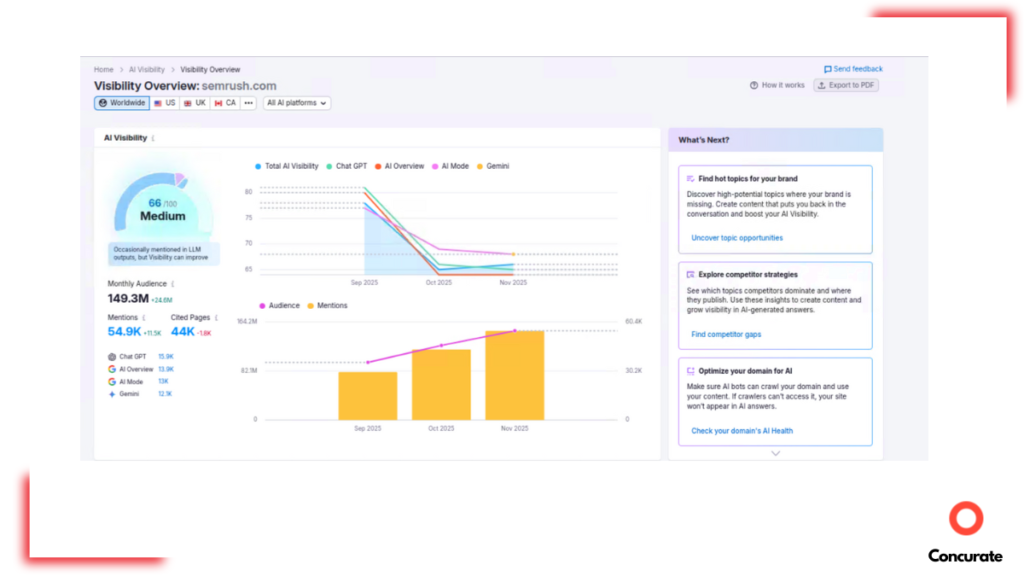
The AI Visibility dashboard tracks how brands appear in AI-generated answers across platforms like ChatGPT, AI Overviews, and Gemini.
I didn’t use this to plan content directly. Instead, it helped answer a broader question: Is this brand even part of the AI conversation yet?
At this stage, it feels early but directionally important for teams to think ahead rather than reacting later.
4. A Quick Word on Semrush’s Content Tools
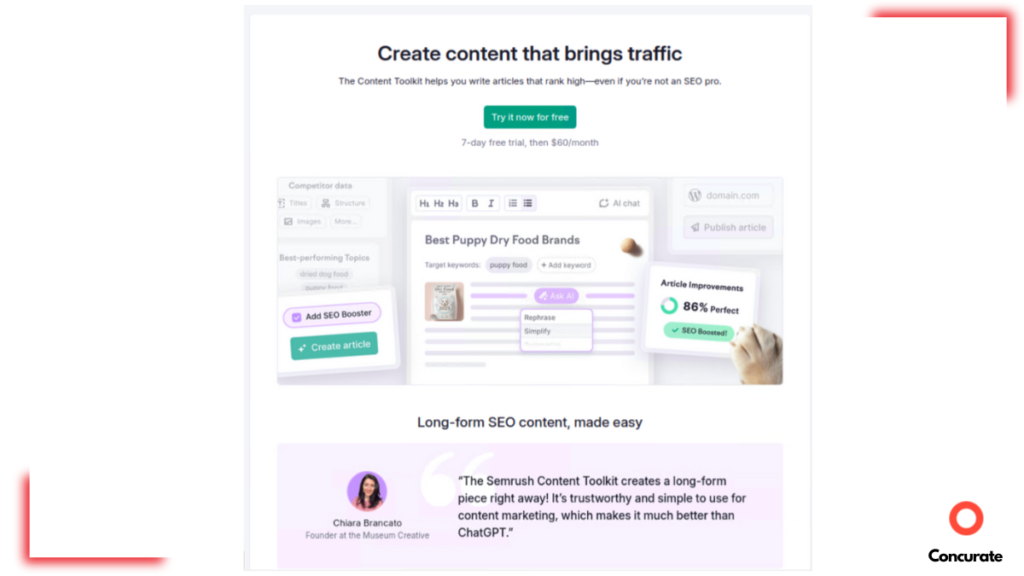
Semrush also offers a Content toolkit, including SEO Content Template and SEO Writing Assistant. These aim to bridge research and execution by generating briefs and live optimization guidance.
I haven’t used these tools in full production yet—and I’m cautious. Content tools often promise to “make content rank,” but real performance still depends on judgment, context, and intent.
That said, Semrush treats these tools as optional add-ons (around $60/month after a trial), not mandatory bundles. I appreciate that. You can test whether they fit your workflow before committing.
For now, I see the Content toolkit as an adjacent value, not core. It may help newer writers or teams standardize briefs, but I wouldn’t rely on it for ranking decisions without human oversight.
After spending time inside the platform and seeing how these features fit into my workflow, a few clear strengths and trade-offs stood out.
Pros
- It feels solid once you find your footing.
After the initial learning curve, Semrush feels dependable. Dashboards load quickly, reports are stable, and switching between tools is smooth. It’s clearly designed for ongoing work, not one-off checks. - Designed for repeat workflows
This is a platform meant to support repeat workflows. When you use it consistently, patterns start to emerge, and decisions become easier to justify with data. - Strong support for real content decisions
Keyword intent, gap analysis, and competitor insights make it easier to decide what’s worth writing—and what isn’t. It helps replace guesswork with structure.
Cons
- Feature overload at the start: The sheer number of tools can feel overwhelming, especially for content writers. You have to actively ignore what you don’t need before the platform feels manageable.
- Units and limits are learned the hard way: Semrush uses usage-based limits across many reports, and you often don’t feel them until you run multiple searches or deeper analyses. Nothing is hidden, but the impact of limits becomes clear only once you start using the tool regularly, which can interrupt workflows if you’re not planning around them.
- Historical data is locked behind higher plans: On the Pro plan, you don’t get historical keyword or traffic data. That’s fine for forward-looking content planning, but it limits deeper analysis. Comparing position changes over custom time periods becomes difficult unless you upgrade.
Taken together, these strengths and limitations make one thing clear: Semrush is built for ongoing SEO work, where content decisions are planned, tracked, and revisited over time. It rewards consistency and structure, but it’s not optimized for fast, lightweight research.
The difference between structured, ongoing SEO and quick, ad-hoc research matters, because other tools approach the same problems very differently. To understand whether Semrush’s trade-offs align with your workflow, it helps to see how it compares to its closest alternative: Ahrefs.
You might be interested in The Most Honest HeyGen Review
Semrush vs Ahrefs: Same Power, Very Different Experience
While both tools cover similar SEO ground, they feel very different in practice. The comparison below isn’t about picking a winner. It’s meant to clarify how SEMrush’s approach differs, and which type of workflow each tool supports best.
| Area | Semrush | Ahrefs |
| Overall feel | Broad, structured, planning-oriented | Focused, analytical, SEO-deep |
| Best for | Content teams, agencies, SEO-aware marketers | SEO specialists, link-focused teams |
| Keyword research | Broader keyword coverage with strong intent labels, questions, clustering | Tighter set of core keywords, strong SERP analysis |
| Content planning support | Built-in tools for outlines and topic clusters | Minimal—requires manual structuring |
| Competitive analysis | Excellent for keyword and content gaps | Excellent for understanding SEO strength |
| Ease for non-SEOs | More guidance, but more noise | Cleaner UI, less guidance |
| Learning curve | Initial overwhelm, improves with focus | Steeper for beginners, clearer for experts |
| Pricing experience | Units, limits, add-ons (can feel complex) | Tighter limits, simpler structure |
| Daily usability for writers | High, once narrowed to relevant tools | Moderate—more analysis than direction |
| AI / future-facing features | Actively expanding | Actively expanding |
So… Is Semrush Worth It?
Here’s my honest answer:
Semrush is worth it if SEO is part of how you decide what content gets written, not just how it gets optimized after the fact.
If you routinely ask questions like Is this keyword worth a post?, What format is actually winning here?, or Are we late to this topic or early?, Semrush earns its keep. It helped me rule out ideas faster, spot where competitors were already entrenched, and build outlines that reflected real search demand instead of assumptions.
Where it falls short is for lighter use. If your workflow stops at checking a few keywords or tracking rankings occasionally, the platform can feel disproportionate. You’ll spend more time navigating reports than extracting insight, and much of their depth will go unused.
Semrush isn’t about doing SEO better at the margins. It’s about avoiding bad content bets before you’ve invested hours writing them. If that’s a real problem in your workflow, the tool makes sense. If it isn’t, you’ll feel the weight more than the value.
The Real Test of SEO for SaaS Content
Whichever SEO tool you use, the real test is the same. Does it help you decide what content is actually worth creating? Traffic is only the entry point. What matters is whether the content helps the right buyers understand their options and move closer to a decision. That is how we approach SaaS content at Concurate.
We use SEO and competitive insight to guide what gets written and what does not. The result is SaaS content that earns trust, aligns with real intent, and consistently drives leads, not just pageviews.
Book a free SaaS content consultation with Concurate.