

| TL;DR: Cybersecurity vendors that win AI search visibility do four things well: list-based content, comparison pages, structured formatting, and coverage across query variations.If you are not doing this, you are not showing up when buyers shortlist solutions. |
RSA Conference is soon approaching, held from March 22 to 25 this year. As conferences go, there will be packed booths, product demos, and thousands of cybersecurity professionals attending.
But if you are thinking that having a booth will get your product exposure, you may want to rethink that. Gone are the days when buyers waited for conferences to discover solutions.
Today, discovery is already happening across search engines and AI tools like ChatGPT, Gemini, and Claude. Serious buyers are typing queries to shortlist the solutions they need, with exact features, such as “best endpoint security tools with AI capabilities”.
And that’s where a few companies keep showing up. Take CrowdStrike, for instance. It consistently appears across these searches because it has built detailed, helpful content around what buyers are actively looking for.
This is the real game now. Visibility is earned before the conversation even begins.
In this article, we’ll break down why this happens and share five practical steps you can take to improve your brand visibility in AI search results.
Who Actually Shows Up When Buyers Search
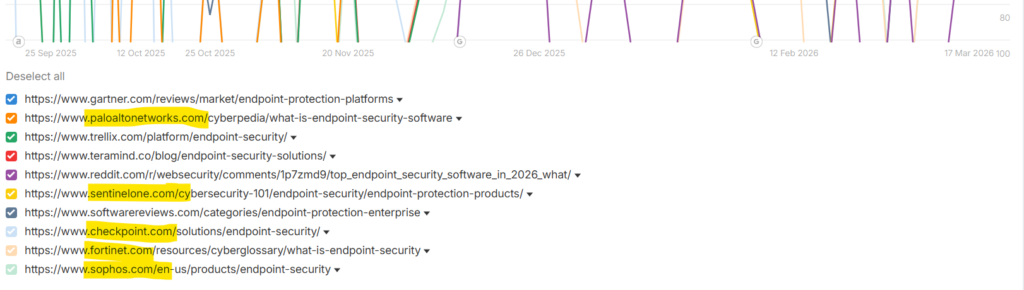
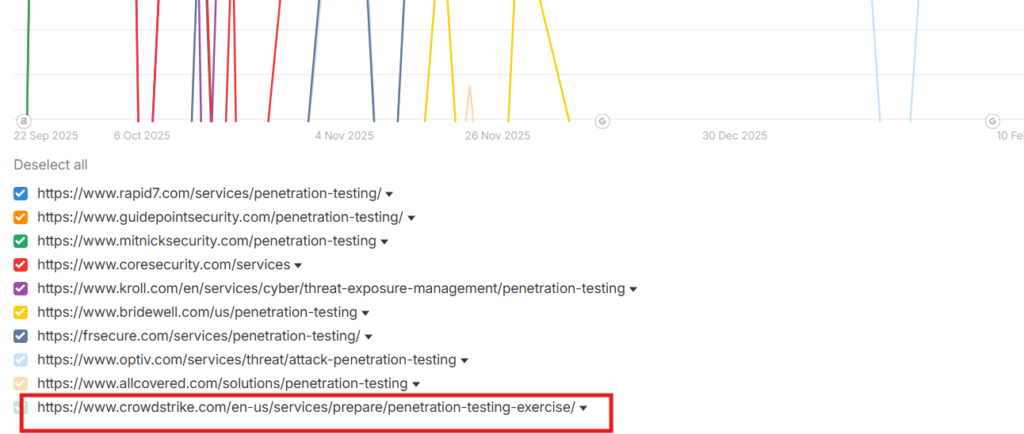
If you run a simple check on Ahrefs, a search analytics tool that helps identify which companies are ranking for which queries, among other things, for queries like “data loss prevention tools,” “penetration testing services,” or “endpoint security software,” you will start noticing a pattern.
A few names keep showing up again and again.
Companies like CrowdStrike, Palo Alto Networks, Fortinet, and others consistently dominate these search results.
For instance, here are the top pages that appear when people search for endpoint security solutions:
These companies appear for penetration testing services:
And these are the top pages which appear when people search for data loss prevention tools in the US.
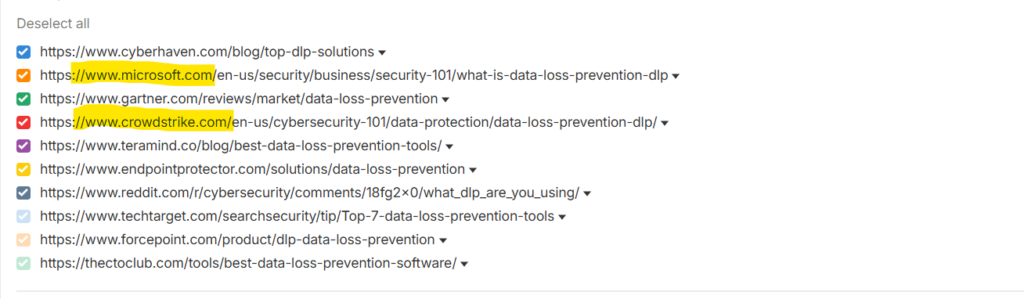
You can see the pattern here, no? Even across different categories and queries, these companies continue to appear in the top results, continually improving their brand recall value as they appear.
To most people, it might seem obvious why these companies keep appearing. These are large cybersecurity vendors with strong brand presence, along with a huge content engine that helps them appear across searches for various queries.
But that’s not the complete story. Because if it were only about brand size or budget, many other large vendors would show up just as consistently.
So if you are a cybersecurity brand that also offers one of these solutions and are wondering if the opportunity is closed for you, that’s not true. Even if you don’t have the same level of resources, you can still build visibility across search engines and AI surfaces. It all comes down to how you approach content and search visibility.
In the next section, we will break down five practical steps you can take to improve your brand visibility in AI search results.
5 Things Top Cybersecurity Vendors Do to Show Up in AI Search Results
Though it may seem like companies like CrowdStrike, Palo Alto Networks, and Fortinet dominate search simply because of their size or brand presence, there’s more at play.
Beyond having a large repository of educational content, investing in webinars, and other content channels, these companies are consistently executing a few specific strategies that help them appear across top queries that drive conversions, both on Google and AI platforms like ChatGPT, Gemini, and Claude.
These are not random wins, but the result of deliberate efforts to align content with what buyers are actively searching for at different stages of evaluation. Here’s what these companies are doing differently and you can do too.
1. They Create “Top Tools” and List-Based Pages Around Buyer Queries
One thing you’ll consistently notice across top cybersecurity vendors is that they don’t just publish product pages or generic blogs. They actively create list-based pages around what buyers are already searching for.
For example, when you search for “top endpoint security software,” you’ll see results like SentinelOne’s list of endpoint security tools.
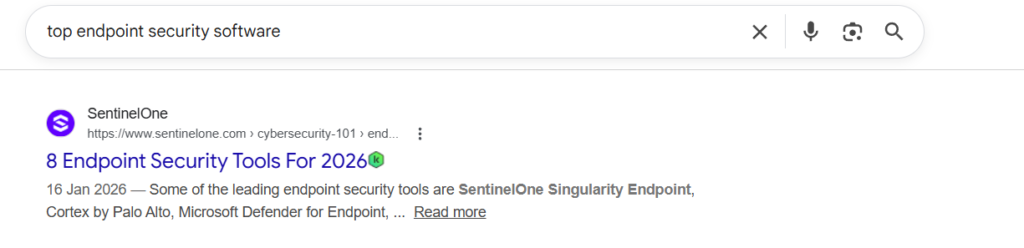
Source – Google
Interestingly, SentinelOne doesn’t show up here because of its product page alone. It shows up because it has invested in creating a page that directly matches the query: a curated list of tools that helps buyers evaluate options.
In fact, when you search on Perplexity for the same query. SentinelOne shows up there too, and among the list of sources referenced, one of them is the top endpoint security solutions list created by them.
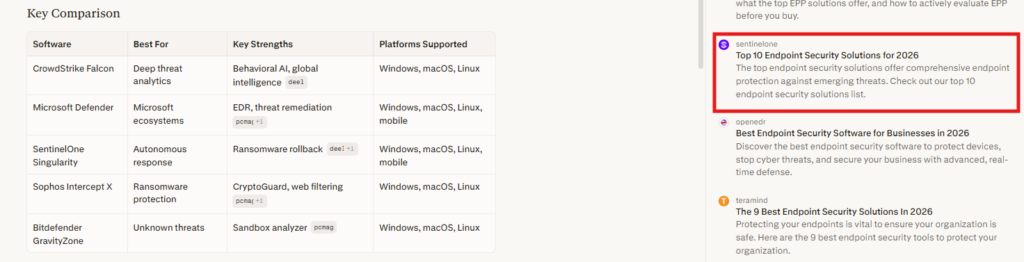
Source – Perplexity
One thing is clear. Whether it’s Google or AI tools, the same types of list-based content take precedence over landing pages. These posts or pages are referenced when AI surfaces for the shortlist for your query.
In fact, this is also one of the easier strategies to replicate. You can create similar posts based on your product category and use cases.
For instance, if you sell endpoint security solutions, you can create lists around
- top endpoint security tools for enterprises
- endpoint security tools with AI capabilities
- best endpoint solutions for mid-sized businesses
To strengthen this further, pair these lists with supporting content like “features to look for in endpoint security software” or “how to evaluate endpoint protection tools.”
Together, this builds topical authority and increases your chances of appearing across both search engines and AI-driven platforms.
2. They Create Detailed Comparison Pages Against Competitors
If you operate in cybersecurity, chances are there are already multiple tools solving a similar problem. Which means your buyers are constantly comparing options before making a decision.
The real question is: are you helping them make that decision, or leaving it to third-party sites?
Top vendors don’t leave it to chance. They create detailed comparison pages where they position themselves directly against competitors.
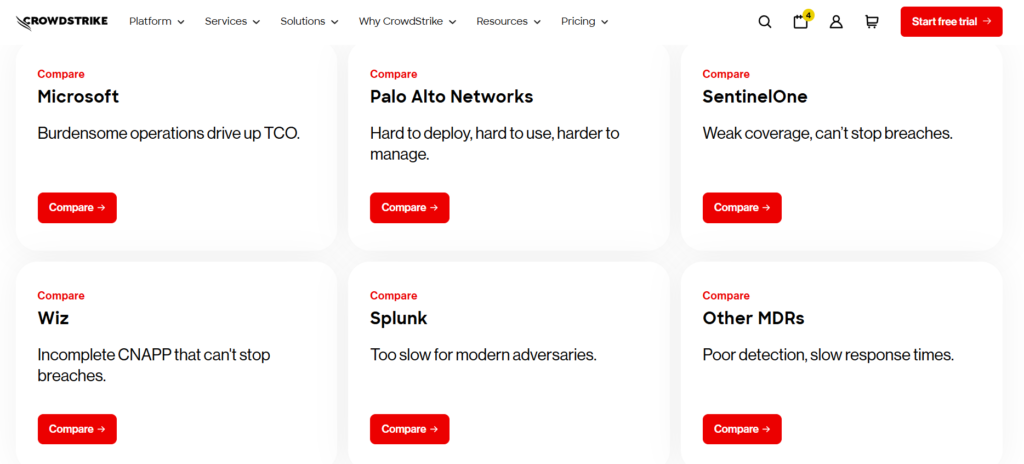
For example, CrowdStrike has dedicated pages comparing its platform with solutions like Palo Alto Networks, Splunk, SentinelOne, and others.
Source – Crowdstrike
These pages are not just feature lists. They are structured to help buyers understand differences, evaluate trade-offs, and move closer to a decision. The decision to go with Crowdstrike.
This becomes especially powerful in AI search. When someone searches for queries like “CrowdStrike Falcon vs SentinelOne,” these comparison pages often surface because they directly match the intent behind the query.
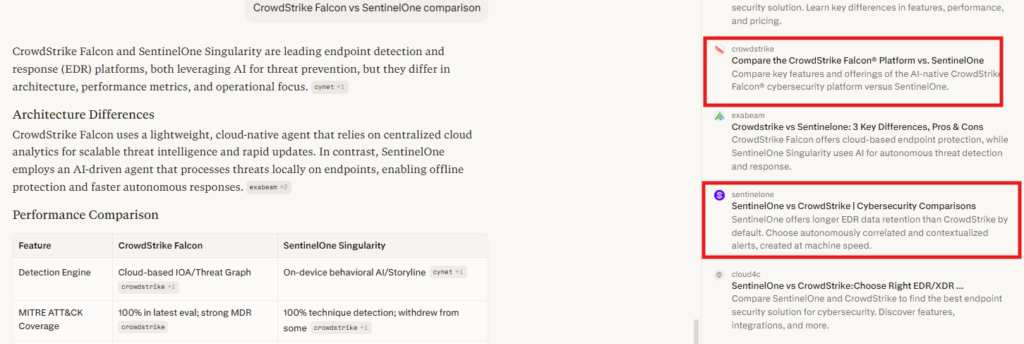
Source – Perplexity
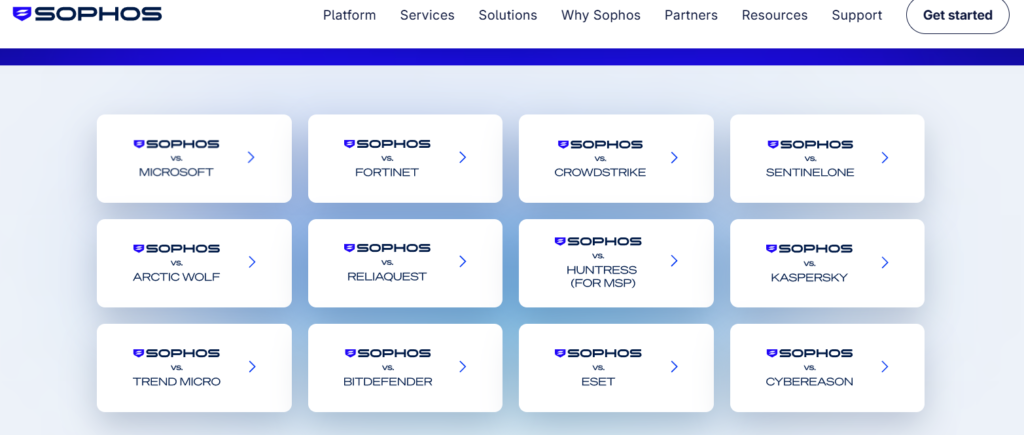
And it’s not just Crowdstrike doing this. SentinelOne has a similar page, and so does Sophos, Palo Alto, just like many other players.
Source – Sophos
If you want to apply this, start by identifying your closest competitors and creating honest, structured comparison pages.
The idea here is to focus on clarity: what’s different, where you fit better, and who your solution is best suited for.
Done right, this helps you show up exactly when buyers are deciding between you and someone else.
Recommended Read: Best DDoS Protection Software for 2026: Recommended by ChatGPT, Perplexity & Claude (and Why They Rank)
3. They Structure Content in a Way AI Can Easily Extract
When it comes to content, it’s not just about how many pages/articles you publish or how many comparisons you create. How the content is structured matters just as much.
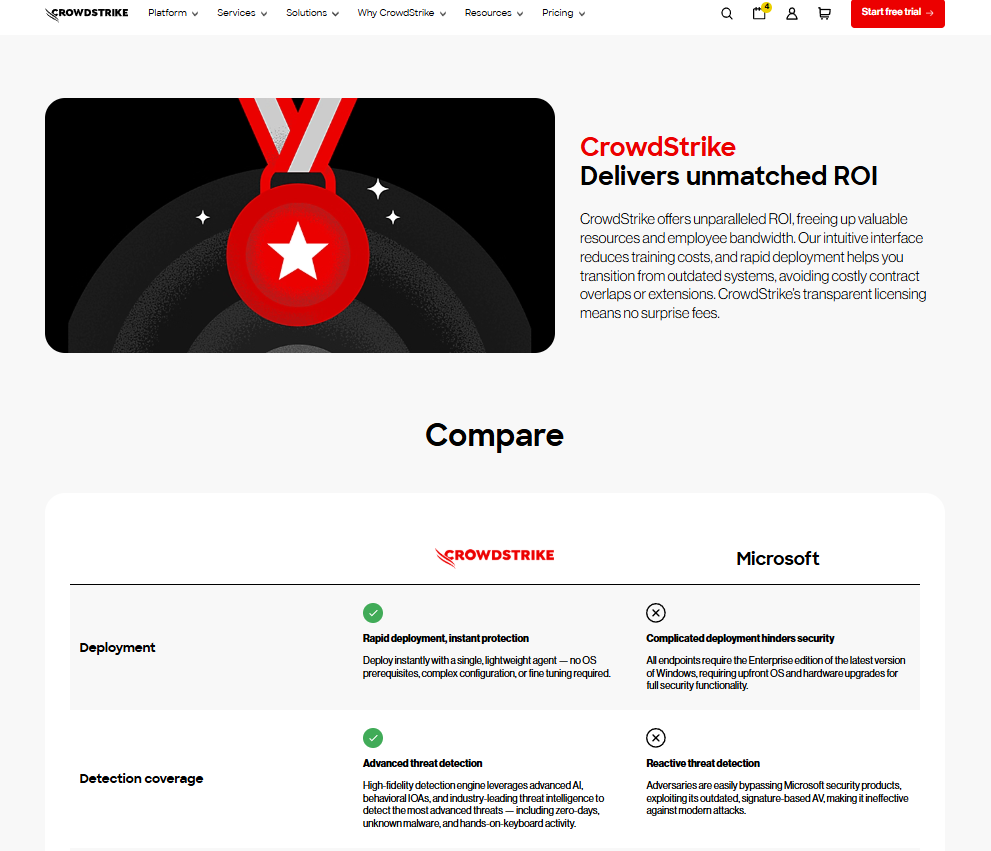
If you look closely at how top cybersecurity vendors approach this, they don’t just write comparison blogs. They build dedicated landing pages designed specifically for comparison and evaluation.
These pages are structured with clear sections like features, differences, use cases, and positioning, making it easier for buyers to make a decision.
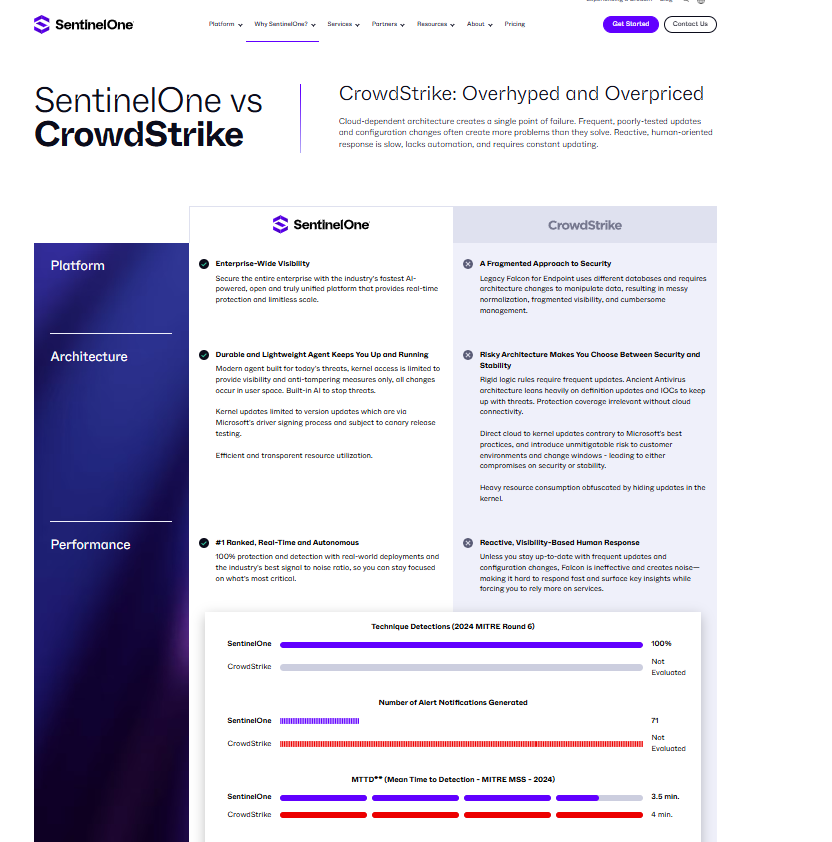
For example, take SentinelOne’s comparison page against CrowdStrike. Instead of long-form text, the page is broken down into structured sections such as architecture, performance, and platform capabilities, along with side-by-side comparisons and clear differentiation points.
Source – SentinelOne
This kind of structure does two things. First, it helps buyers quickly understand which solution fits their needs. Second, it makes the content extremely easy for AI platforms to extract and reference.
AI tools like ChatGPT, Gemini, and Claude don’t just rank pages. They pull specific answers. And structured formats like bullet points, comparison tables, and clearly defined sections make that extraction much easier.
That’s why when you search for alternatives or comparisons, these pages repeatedly show up across AI responses.
Source – Crowdstrike
SentinelOne and Crowdstrike are not the only ones doing this. This approach is followed by many top vendors, and maybe you should do it too.
4. They Cover Multiple Variations of the Same Buyer Query
Most people would think that you create a page or an article and you are done. But that’s not the case. At least, that’s not what top companies do. They go much deeper. They create content around multiple variations of the same query.
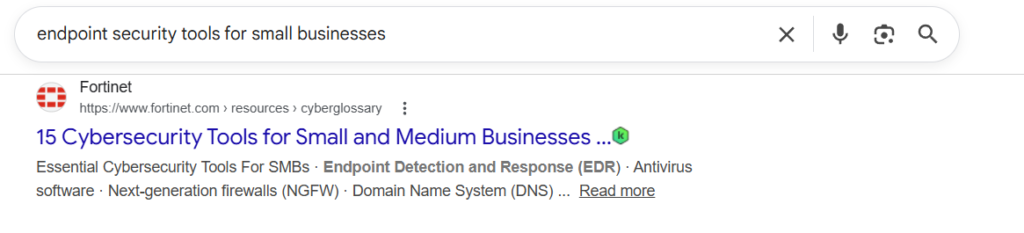
For example, if you Google for “endpoint security tools for small businesses,” Fortinet shows up.
Source – Google
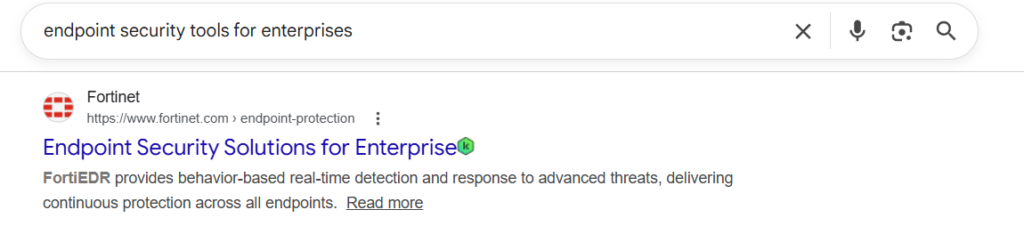
It also shows up for “endpoint security solutions for enterprises.”
Source – Google
In one case, it is a blog post, whereas in another, it’s a landing page.
The core topic is the same, but the entry points are different.
Instead of relying on a single page to rank, they build multiple pages targeting different use cases, audiences, and contexts, all tied to the same solution category.
This approach allows them to show up across a wider range of searches, especially long-tail queries that buyers use when they are closer to making a decision. This is where it becomes even more powerful in AI search.
When AI platforms like ChatGPT or Gemini scan for answers, they often pick up signals from those exact variations. If your brand keeps appearing across these variations, it strengthens recall and increases the chances of being referenced.
BTW, if you want to apply this for your company, start by breaking down your core offering into different use cases. Think in terms of segments like enterprise vs SMB, features like AI capabilities, or specific industries. Then create focused content around each variation.
Here are a few ways you can apply this:
- Endpoint security tools for enterprises
- Endpoint security solutions for small businesses
- Endpoint protection for hybrid teams
- Best endpoint security tools for remote teams
- Endpoint security solutions for healthcare
In AI search, visibility doesn’t come from ranking for one keyword. It comes from building topical authority by showing up consistently across multiple variations of what your buyers are searching for. It goes unsaid that your product should definitely meet the use case for it to work for you.
Recommended Read: Best Cybersecurity Software: Decoding The Success Behind The Top 3 Search Results Ranking For This Keyword
5. They Don’t Rely on Just One Channel
There’s a simple idea most cybersecurity leaders already understand: don’t rely on a single point of failure. The same applies to content and visibility.
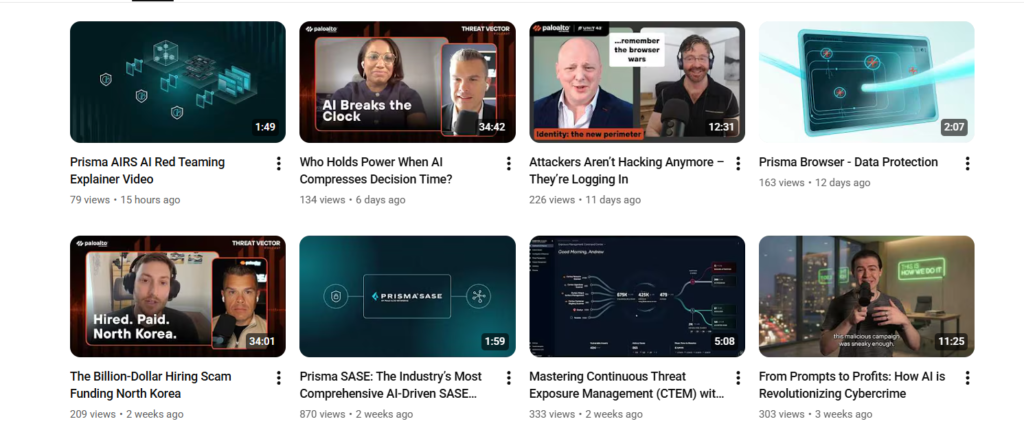
While websites and search content play a major role, top cybersecurity vendors don’t stop there. They stay consistently active across platforms where their buyers already spend time, such as LinkedIn, YouTube, and even communities like Reddit.
If you look at companies like Palo Alto Networks, they are regularly publishing videos that break down complex topics, explain new threats, or simplify their solutions.
Source – YouTube/Palo Alto
On LinkedIn, they share insights, quick takes, and thought leadership content that keeps them visible in daily conversations.
It is not just them. Other vendors are doing it too, in addition with engaging on Reddit where most of these companies have their own official Subreddits, take for instance, Crowdstrike. On the platform, these companies engage in real discussions happening around tools or problems associated with them.
The goal is simple: be present wherever your buyer is actively learning or evaluating solutions.
This also strengthens your visibility in AI search. Content from platforms like Reddit, LinkedIn and YouTube is increasingly referenced across AI surfaces, especially when it aligns with what users are searching for.
If you want to apply this, start small. Stay consistent on LinkedIn. Repurpose your core ideas into short YouTube videos. And participate in relevant communities where your audience is already asking questions.
Because in today’s landscape, visibility is not built on one platform. It compounds when your brand shows up across multiple trusted channels.
While these are some of the most common patterns you’ll see across top cybersecurity vendors, they are just the starting point. There’s a lot more that goes into building consistent visibility, but even implementing a few of these well can start making a real difference in how your brand shows up.
That said, executing this consistently isn’t always easy. Between building the product, managing customers, and driving growth, content often takes a back seat. If you’re looking to move faster and see results sooner, having the right team can make that process much simpler. That’s where Cybersecurity marketing agencies like Concurate can help.
How Concurate Can Help You Build AI Search Visibility
The strategies we discussed are a strong starting point, but execution is where most teams struggle.
At Concurate, we’ve applied some of the above-discussed strategies for an enterprise cybersecurity client, helping them build visibility across both Google and AI platforms. In just six months, this translated into 100+ inbound leads, driven entirely through organic content.
The difference was not more content, but the right content. You see, we understand how cybersecurity buyers evaluate solutions, so we know how to position your brand in those exact moments.
If you want to improve brand visibility where your buyers are already searching, without relying on events like RSAC, we can help. Book a quick strategy call, and let’s map the right strategy for your company.
Frequently Asked Questions
1. What are AI search results and how do they work?
AI search results are answers generated by tools like ChatGPT, Gemini, Claude, Perplexity and more by analyzing multiple sources across the web. Instead of showing just links, these platforms extract and summarize the most relevant information. To do that, they rely on structured, authoritative content and repeated mentions across sources to decide which brands or answers to include.
2. How do companies rank in AI search results like ChatGPT or Gemini?
Companies don’t rank traditionally in AI search. Instead, they get referenced when their content is clear, structured, and aligns closely with user queries. AI systems extract answers from sources that show authority, relevance, and consistency across topics, especially when the brand appears repeatedly across high-intent queries.
3. Why is my brand not showing up in AI search results?
This usually happens when your content does not align with how buyers search. If you lack comparison pages, list-based content, or coverage across key queries, AI systems have fewer reasons to reference you. Limited topical authority and weak presence across search variations also reduce your chances of appearing.
4. What type of content performs best in AI search results?
Content that directly answers buyer intent performs best. This includes list-based articles, comparison pages, feature breakdowns, and evaluation guides. Structured formats like bullet points and tables make it easier for AI systems to extract information, increasing the chances of your content being referenced.
5. How can I track my cybersecurity brand visibility in AI search results?
Test relevant cybersecurity queries across tools like ChatGPT, Gemini, and Perplexity, such as “best MSSP providers” or “endpoint security tools.” Track whether your brand appears. Combine this with SEO tools to monitor rankings, since strong search visibility often correlates with AI mentions.
6. How do AI tools choose which brands to recommend?
AI tools prioritize content that is relevant, structured, and frequently referenced across the web. They look for clear answers, strong topical coverage, and repeated mentions across trusted sources. Brands that consistently appear across different queries are more likely to be included in AI-generated responses.
Recommended Read: What Are the Best Practices to Rank in ChatGPT Search
7. How can smaller cybersecurity companies compete in AI search results?
Smaller companies can compete by focusing on high-intent queries and building targeted content around specific use cases. Creating comparison pages, list-based articles, and detailed guides helps them appear alongside larger players. Consistency and relevance matter more than scale in building visibility.