

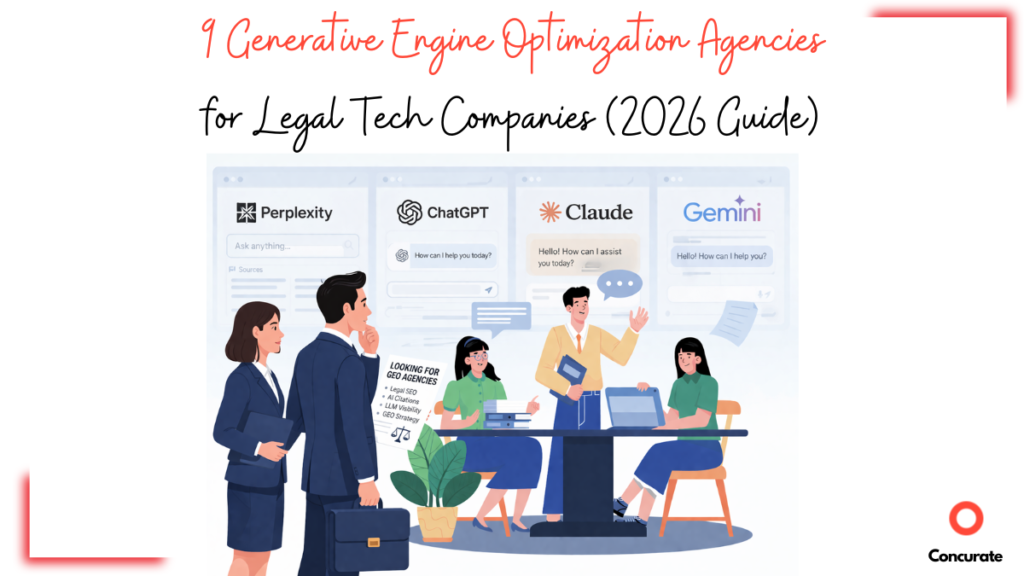
| TL;DR – The best Generative Engine Optimization (GEO) agencies for legal tech companies include Concurate, Directive Consulting, SimpleTiger, Quoleady, Forthea, Intrepid Digital, Nowspeed, Insivia, and Bay Leaf Digital. Concurate stands out for helping legal tech companies turn decision-stage content into visibility in ChatGPT, Perplexity, and other AI search tools. Use its GEO playbook and category expertise as your benchmark. |
Getting your legal tech company the AI visibility is no longer a nice extra. Your buyers are using ChatGPT, Perplexity, Gemini, and other AI tools to discover products, compare options, and form opinions before they ever visit your site.
In legal tech, that is especially hard because the market is complex, the messaging is nuanced, and trust matters more than ever.
So we looked closely at agencies with public legal-sector proof, dedicated Generative Engine Optimization (GEO) service pages, and real experience marketing complex legal brands.
Some stood out for all content-led growth, like Concurate. Others, like SimpleTiger, stood out for combining SEO with AI search visibility. Firms like Bay Leaf Digital stood out for sharpening legal SaaS messaging.
We are covering the top eight of these generative engine optimization agencies for legal tech companies worth considering in 2026.
Top Eight Generative Engine Optimization Agencies for Legal Tech Companies in 2026
Before we go further, let’s get one thing straight. Showing up on the first page of Google is one challenge. Showing up in AI tools is another. The good news is, AI visibility is not a mystery. It builds on Google search fundamentals only if you are doing it right. It takes stronger positioning, better content, cleaner structure, more authority, more trust, and smarter distribution.
If you want to go deeper, read our guide on where AI tools like ChatGPT get their information for making product recommendations. That’ll give you an idea about what it takes to show up there.
That is where the right agency can make a real difference. The lineup below features agencies that know how to do exactly that.
- Concurate
- Directive Consulting
- SimpleTiger
- Quoleady
- Forthea
- Intrepid Digital
- Insivia
- Bay Leaf Digital
Now let’s look at each one by one more closely.
1. Concurate
Concurate is a generative engine optimization agency operating with a clear belief: legal tech companies don’t need more content. They need content that helps them get discovered where buyers search, understood, and chosen.
That distinction matters more in legal tech than in most categories.
Legal tech products often look similar on the surface. Whether it’s an IP management platform, contract lifecycle tool, or legal research solution. But underneath, they solve very different problems.
When that difference is not clearly articulated, two things happen: buyers struggle to evaluate options, and AI tools struggle to position the product correctly.
That’s where Concurate’s approach to generative engine optimization stands out.
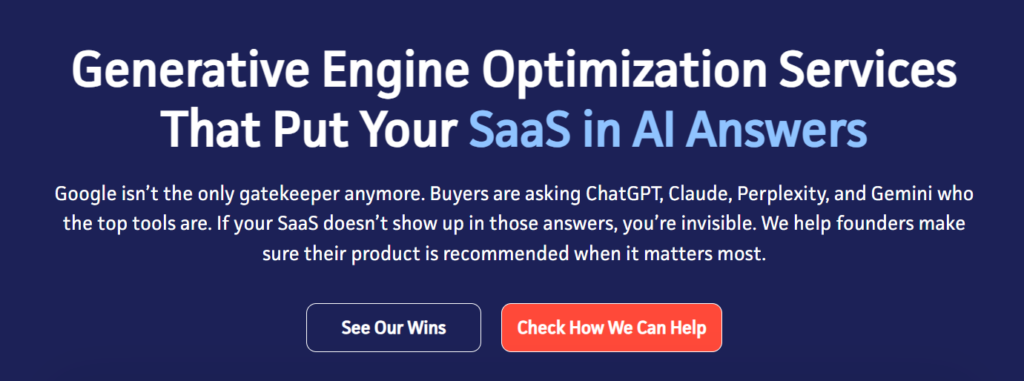
Instead of treating GEO as a separate layer, Concurate treats it as the outcome of getting content, structure, and intent right from the ground up. The focus is not on publishing more, but on building content that aligns with how buyers search — whether on Google or inside AI tools.
What Concurate Does for Generative Engine Optimization
Concurate’s GEO capability is built through a set of repeatable content strategies that are already tested in legal tech environments:
1. Creating Content Around Real Customer Queries
Concurate starts by identifying what potential customers are actually searching for when they are trying to solve a problem or compare options.
In legal tech, people rarely begin with broad category terms. They search in a much more practical way: “how to protect my IP if my co-founder leaves”, “how to optimize patent prosecution,” “how to capture innovation within an enterprise”, “how to manage invention disclosures”, or which tools are best for a specific workflow. That is the right starting point for generative engine optimization, too, because AI platforms are more likely to cite content that directly answers real user questions.
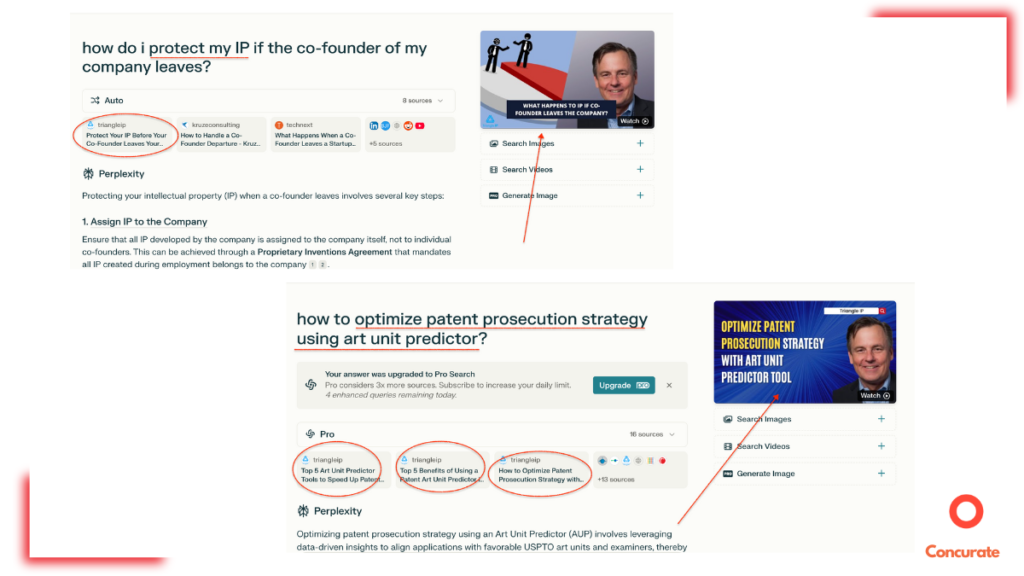
Concurate also pays attention to high-intent searches that show a person is already evaluating software, such as “best tools,” “top alternatives,” and competitor comparison queries. These topics matter because they reach readers who are much closer to making a decision.
| 📌What are High-Intent Searches? 💡High-intent searches are queries that show a person is close to making a decision, not just learning. For example, “what is patent management” is a learning query, while “best patent management software” or “IPfolio alternatives” shows the person is ready to evaluate and choose a solution. |
By focusing on the searches that real users were already making, the content became more useful not only for search engines but also for AI platforms trying to find the best answer to a user’s question. In other words, the strategy was not to publish more content, but to publish the kind of content that is more likely to be surfaced when someone is actively researching a legal tech problem or solution.
2. Structuring Content so AI Tools Can Read and Surface It
Concurate also improves how content is organized so AI tools can understand it more easily. Even strong content can be overlooked if it is too dense, too scattered, or unclear about what question it is answering.
To avoid that, the content is structured in a way that makes the page easier to scan, easier to interpret, and easier for AI systems to pull from. That usually means using:
- Adding TL;DR sections that summarize the core answer upfront
- Using clear headings and subheadings aligned with user questions
- Creating FAQ sections + schema markup for machine readability
- Writing in sections in Q&A formats where answers sit directly under each section
These changes are not cosmetic. They directly improve how generative engines extract, summarize, and reference content for one of our legal tech clients, TriangleIP. Here’s a search we conducted on Claude and what we found:
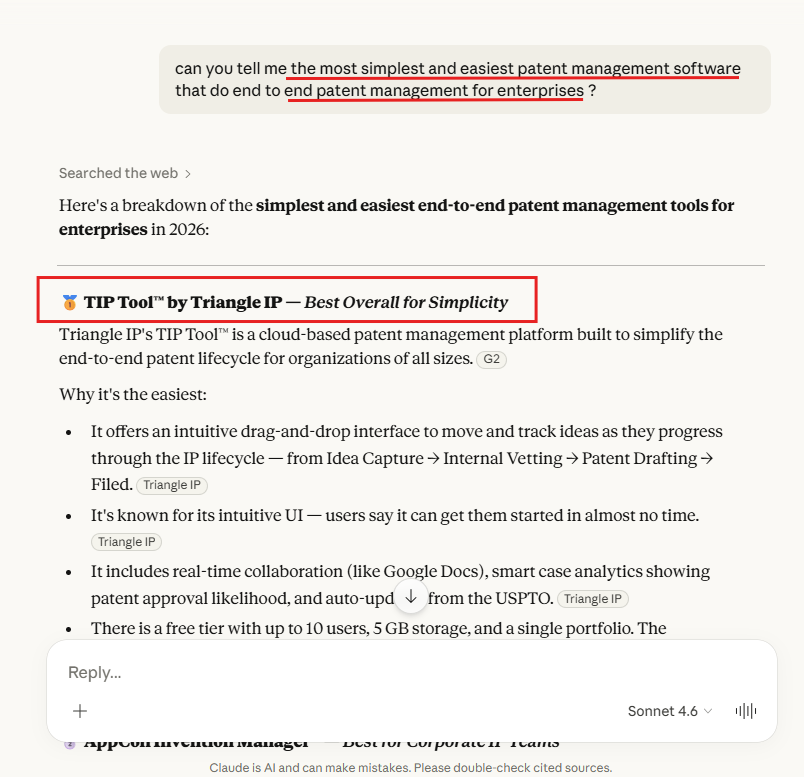
Triangle IP’s TIP Tool™ appeared in recommendations because we made the necessary efforts in the blog content to drive this visibility. You can check out the Best Patent Management Software blog, for instance, which was recommended in Claude for the given query in the snapshot above.
3. Strengthening Credibility so AI Tools Trust the Content
Concurate’s third strength is credibility. AI tools do not just look for relevant content. They also look for signs that the content comes from a real expert, reflects genuine knowledge, and is supported across more than one platform. In legal tech, that matters even more because the subject matter is complex and readers expect accuracy.
One of the ways Concurate builds that trust is through founder-led thought leadership. Instead of writing generic opinion pieces, the team works closely with founders to capture their expertise. This usually starts with interviews or recorded video conversations, where the founder shares insights, views, and practical experience on a specific topic.
That input is then turned into articles that reflect the founder’s own thinking and expertise. Each piece is fact-checked and refined so it is both clear and reliable.
In Triangle IP’s case, we use the founder’s expert-led Youtube videos. Those videos are not published and forgotten. They become the basis for thought leadership articles, which are then repurposed across other channels. That includes:
- blogs and guides on the website
- LinkedIn posts and carousels
This creates a stronger trust signal because the same expertise shows up consistently across formats.
And trust does not stop at owned channels. AI systems also look for broader signs that a company is credible, such as mentions on trusted platforms, third-party references, and a visible presence across the web, including places like Wikipedia and Reddit, where relevant.
Taken together, these efforts show that Concurate’s GEO capability is not built on isolated tactics, but on creating content that is easier for AI tools to understand, trust, and cite.
What Other Services Does Concurate Offer Beyond GEO
In simple terms, everything you need to turn content into a consistent, revenue-driving engine.
Which Legal Tech Companies Has Concurate Worked With
- Triangle IP
- PQAI
- Global Patent Search
- Inspire IP
How Much Does Concurate Charge?
Concurate uses custom pricing. Monthly retainers typically range from $5,000 to $7,500, while project-based work usually starts at $3,500.
2. Directive Consulting
Directive Consulting is an Answer Engine Optimization (AEO) agency focused on helping B2B SaaS companies gain visibility across AI-driven search environments like Google AI Overviews, voice search, and LLM platforms. While not exclusive to legal tech, their approach is highly relevant for legal tech companies that rely on high-intent, research-driven buying cycles.
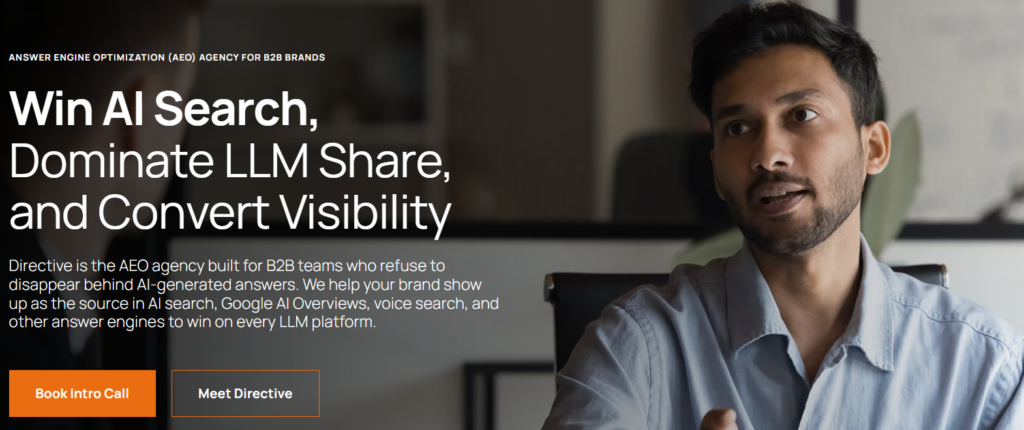
Source: directiveconsulting-aeo-homepage
Directive combines technical SEO, structured content optimization, and answer mapping to ensure content is extracted and cited in AI-generated responses. This makes them a strong fit for legal tech brands looking to influence decision-making earlier in AI-powered discovery journeys.
What Other Services Does Directive Consulting Offer Beyond GEO
- SEO and technical SEO implementation
- Content marketing and conversion-focused strategy
- Paid media and go-to-market strategy
- Marketing automation and revenue operations
Which Legal Tech Companies Has Directive Consulting Worked With
Zapproved
How Much Does Directive Consulting Charge
Clutch listed Directive charges $100–$149 per hour, with a minimum project size of $5,000+
3. SimpleTiger
SimpleTiger is a SaaS-focused GEO and SEO agency that helps software companies improve visibility across traditional search and AI-powered discovery platforms like ChatGPT, Perplexity, and Google AI Overviews. For legal tech companies, its relevance comes from combining technical SEO, content production, authority building, and AI search optimization in one program.
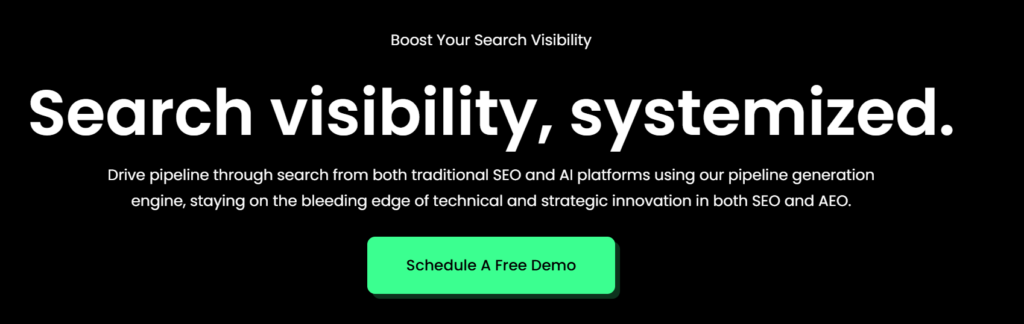
Source: simpletiger-search-visibility
The agency is not exclusive to legal tech, but its public work with legal software brands shows it can support companies selling into research-heavy, high-intent markets. Its positioning is strongest for SaaS brands that want both classic organic growth and better presence in generative search results.
What Other Services Does SimpleTiger Offer Beyond GEO
- SEO, keyword research, and technical optimization
- Content marketing and link building
- Paid search and paid social
- Web design, web development, and digital PR
Which Legal Tech Companies Has SimpleTiger Worked With
- Centerbase
- Onit
- ContractWorks
How Much Does SimpleTiger Charge
Clutch lists SimpleTiger at $200–$300 per hour, with a minimum project size of $5,000+.
4. Quoleady
Quoleady is a SaaS content and LLM optimization agency that helps brands improve visibility in ChatGPT, Gemini, Claude, Perplexity, and Google AI Overviews. For legal tech companies, its relevance comes from combining expert-led content, technical on-site updates, digital PR, and AI visibility tracking to improve both search rankings and citation potential in answer engines.

Source: quoleady.com/saas-llm-optimization
Quoleady is not a legal-tech-only agency, but it has direct experience in legal and compliance-heavy markets. Its work with Legal Nodes shows it can handle complex, regulation-driven topics while tying LLM visibility efforts to tangible business outcomes like booked meetings and qualified inbound growth.
What Other Services Does Quoleady Offer Beyond GEO
- Link building and digital PR
- Content strategy and content writing
- Content audits and consulting
- Web analytics
Which Legal Tech Companies Has Quoleady Worked With
- Legal Nodes is the clearest public legal-tech/legal-services proof shared in its LLMO case studies
How Much Does Quoleady Charge?
Clutch lists Quoleady at $50–$99 per hour, with a minimum project size of $1,000+; package pricing starts at $1,500/month for SEO, $1,500/month for copywriting, and $1,990/month for content creation.
5. Forthea
Forthea is a digital marketing agency that offers Generative Engine Optimization services to help brands improve visibility across AI-driven platforms such as ChatGPT, Claude, Perplexity, and Google AI. For legal tech companies, Forthea is relevant because it connects GEO work to measurable business outcomes like demo requests, conversions, and revenue, not just rankings.

Source: forthea/services/seo/geo/
Its approach combines AI-first content strategy, structured data, knowledge graph engineering, competitive intelligence, and performance tracking. Forthea is not exclusive to legal tech, but its public work with Mitratech shows direct experience supporting a legal software company navigating AI-influenced search behavior and complex enterprise buying journeys.
What Other Services Does Forthea Offer Beyond GEO
- SEO and AI-first content strategy
- Marketing analytics and data science
- Paid media management
- Website design, development, and conversion rate optimization
Which Legal Tech Companies Has Forthea Worked With
• Mitratech
How Much Does Forthea Charge?
Clutch lists Forthea at $100–$149 per hour, with a minimum project size of $5,000+.
6. Intrepid Digital
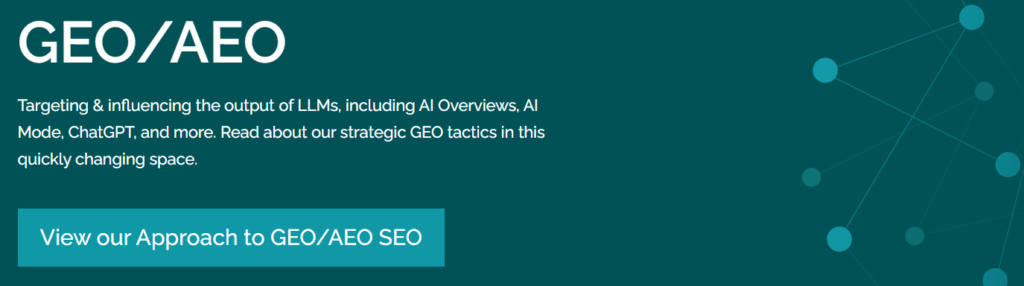
Intrepid Digital is an enterprise digital marketing agency that offers GEO/AEO services focused on influencing how brands appear in LLM outputs, AI Overviews, and other AI-driven search experiences. For legal tech companies, its relevance comes from combining SEO, technical recommendations, content strategy, RAG-oriented optimization, and GEO measurement into one program.
Source: intrepidonline/services/ai/geo-aeo/
Intrepid work with Clio gives it clear credibility in the legal software space. Its approach is especially relevant for legal tech brands that want to improve discoverability across both traditional search and AI-powered buying journeys.
What Other Services Does Intrepid Digital Offer Beyond GEO
- SEO, CRO, and content strategy
- Data science and performance marketing
- Digital strategy and conversion optimization
- UX/UI recommendations and internal GEO reporting guidance
Which Legal Tech Companies Has Intrepid Digital Worked With
- Clio
How Much Does Intrepid Digital Charge?
Clutch lists Intrepid Digital at $200–$300 per hour, with a minimum project size of $10,000+.
7. Insivia
Insivia is a consultancy and agency built specifically for LegalTech companies. Its positioning is centered on helping LegalTech brands win trust in complex, risk-averse markets by improving buyer understanding, sharpening positioning, and building proof-driven marketing systems. For companies selling to law firms and corporate legal teams, that matters because adoption often depends on credibility, validation, and internal buy-in rather than product claims alone.

Source: insivia/growth/marketing/ai-optimization/
Insivia also directly addresses Answer Engine Optimization for LegalTech and has published thought leadership around future-proofing LegalTech websites for AI search. This makes it one of the more category-relevant options in a legal-tech-focused agency list.
What Other Services Does Insivia Offer Beyond GEO
- Buyer research, intelligence, and positioning
- SEO, website design, and digital experiences
- Account-based marketing and sales enablement
- AI sales strategy, UX/UI, and interactive content
Which Legal Tech Companies Has Insivia Worked With
- EsquireTek
- ContractPodAi
How Much Does Insivia Charge?
Clutch lists Insivia at $100–$149 per hour, with a minimum project size of $5,000+.
8. Bay Leaf Digital
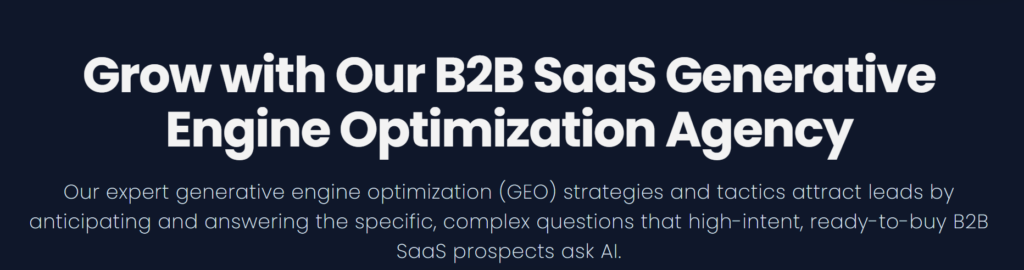
Bay Leaf Digital is a B2B SaaS marketing agency that also serves in the LegalTech industry. It offers a GEO service tailored to how modern SaaS buyers search through AI tools like ChatGPT, Gemini, Perplexity, and Google SGE.
Source: bayleafdigital/services/geo
For LegalTech companies, its relevance comes from helping complex products translate technical capabilities into clear buyer-facing messaging for attorneys, legal ops teams, and in-house counsel. The agency combines SEO, AEO/GEO, paid media, content, and conversion strategy to drive the pipeline. It appears best suited for LegalTech SaaS companies that want industry-aware messaging and full-funnel demand generation support, not just AI visibility work in isolation.
What Other Services Does Bay Leaf Digital Offer Beyond GEO
- SEO and AEO
- PPC and retargeting
- Content marketing and social media marketing
- Marketing automation, HubSpot management, and website optimization
Which Legal Tech Companies Has Bay Leaf Digital Worked With
No specific LegalTech client names are publicly listed on the website.
How Much Does Bay Leaf Digital Charge?
Clutch lists Bay Leaf Digital at $150–$199 per hour, with a minimum project size of $10,000+.
And that’s a wrap. But be sure to think through what you need, and we insist you check this before making your final decision:
Concurate: The GEO Agency That Gets Your Legal Tech Product Recommended in AI Answers
GEO is getting a lot of attention right now. Every agency wants to say it does AI search. But this is not something Concurate started because of the hype.
What makes this more urgent is the business impact. Visitors from AI tools convert nearly 3x better than traditional search, which makes AI visibility hard to ignore. If your legal tech brand is not showing up there, you are missing a high-intent channel that is already influencing buying decisions.
Yes, you can try building this in-house using the same playbook we have discussed in this blog. But doing that well takes time, people, training, and money. You are not just creating content. You are building a new capability from scratch.
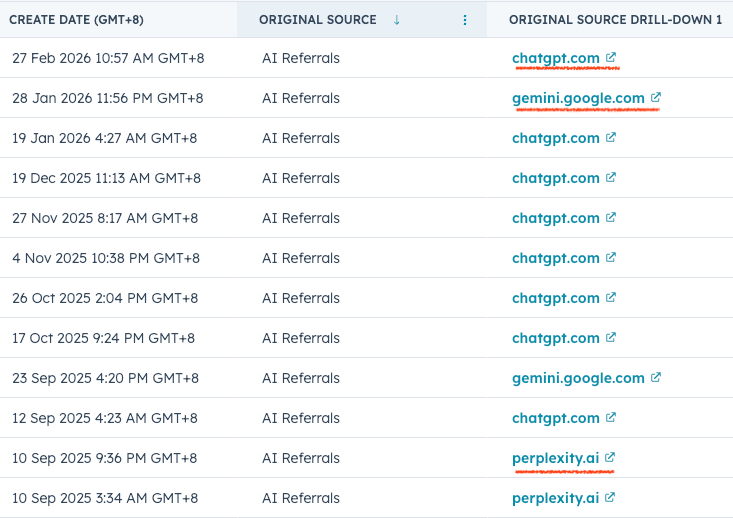
That is why partnering with a team that already understands the space is the smarter move. Concurate does this not only for clients, but for itself too. In fact, some of our most recent leads found us through ChatGPT, Perplexity, and Gemini, as the screenshots below show.
If you want to explore what this could look like for your legal tech company, book a discovery call with Nitesh at Concurate. No pressure. Just a practical conversation about what your path to AI visibility could look like.
Disclaimer: This article is based on publicly available information from agency websites, case studies, and third-party platforms. The evaluation reflects our independent analysis, and we recommend checking each agency’s website or speaking with their team for the latest details on services, pricing, and results.
FAQs
1. What are the Pricing Ranges for Top GEO Agencies Serving Legal Tech?
Based on the public pricing information available on the web, hourly rates range from $50 to $300 per hour, and minimum project sizes usually start between $1,000 and $10,000+.
But for legal tech, the more important question is not who charges less. It is how much time and budget will be wasted before the agency understands your category well enough to produce useful work.
In a complex market like legal tech, category understanding affects ramp-up time, messaging quality, and how quickly an agency can turn GEO into a qualified pipeline. That is why fit usually matters more than headline price.
2. What Should be the Evaluation Questions to ask GEO Agencies for Legal Tech?
Focus on questions that reveal how the agency thinks, not just what it offers.
Start with: How would you identify the AI-search queries our buyers actually use?
Then ask: What content would you prioritize first for a legal tech product like ours, and why?
Go deeper with:
- How do you ensure our product gets included in comparisons and “best tools” queries?
- What proof can you share of AI visibility or leads from similar B2B or legal tech work?
- How do you balance traditional SEO with GEO without losing existing rankings?
- What signals (content, authority, structure) matter most for getting cited in AI answers?
- What would your first 90 days look like for our category?
If the answers are generic or tool-focused, the agency is likely still experimenting rather than executing with clarity.
3. How Can You Check If Your Legal Tech Product Is Visible in AI Search?
One of the simplest ways is to simulate how buyers actually search.
In our study, we ran ~50 real-world buyer queries across ChatGPT, Perplexity, Gemini, Copilot, and Grok, and analyzed 1,000+ recommendations across 61 tools to see which products actually surface.
You can follow the same approach:
- Ask tools questions your buyers would ask (pricing, alternatives, best tools)
- Check if your product appears in recommendations
- Observe which competitors show up repeatedly
If your product is missing, it usually comes down to gaps in comparison content, structured data, authority signals, or AI-readable assets.
For a full breakdown of the methodology, leaderboard, and step-by-step playbook, refer to our detailed study on Legal Case Management Software 2025 : Top 10 in AI Searches.